

Here's something you might be interested in.
Ask a Hipster — Advice you didn't know you needed
Big Screen — Movie commentary
Blurt — Music's inside track
Booze News — San Diego spirits
Classical Music — Immortal beauty
Classifieds — Free and easy
Close to Home — What it’s like on the street where you live
Cover Stories — Front-page features
Drinks All Around — Bartenders' drink recipes
Excerpts — Literary and spiritual excerpts
Feast! — Food & drink reviews
Feature Stories — Local news & stories
Fishing Report — What’s getting hooked from ship and shore
From the Archives — Spotlight on the past
Golden Dreams — Talk of the town
The Gonzo Report — Making the musical scene, or at least reporting from it
Letters — Our inbox
Movies@Home — Local movie buffs share favorites
Movie Reviews — Our critics' picks and pans
Musician Interviews — Up close with local artists
Neighborhood News from Stringers — Hyperlocal news
News Ticker — News & politics
Obermeyer — San Diego politics illustrated
Outdoors — Weekly changes in flora and fauna
Overheard in San Diego — Eavesdropping illustrated
Poetry — The old and the new
Reader Travel — Travel section built by travelers
Reading — The hunt for intellectuals
Roam-O-Rama — SoCal's best hiking/biking trails
San Diego Beer — Inside San Diego suds
SD on the QT — Almost factual news
Sheep and Goats — Places of worship
Special Issues — The best of
Street Style — San Diego streets have style
Surf Diego — Real stories from those braving the waves
Theater — On stage in San Diego this week
Tin Fork — Silver spoon alternative
Under the Radar — Matt Potter's undercover work
Unforgettable — Long-ago San Diego
Unreal Estate — San Diego's priciest pads
Your Week — Daily event picks
Fish Report: Priscilla and Raymond deke the forecasters for Pac-side Baja
Excellent Calico bass fishing southward before the kelps peter out

Solid calico bass fishing for the Tribute along the Baja coast while waiting for better offshore conditions as Priscilla spun out near the Vizcaino Peninsula
Dock Totals 10/5 – 10/11: 2263 anglers aboard 108 half-day to 3-day trips out of San Diego landings over the past week caught 6 barracuda, 1747 bluefin tuna (to 150 pounds), 30 bonito, 29 calico bass, 12 dorado, 3 halibut, 8 lingcod, 1 mako shark, 104 rock crab, 4480 rockfish, 54 sand bass, 39 sanddab, 813 sculpin, 57 sheephead, 14 skipjack tuna, 1 Spanish jack, 60 spiny lobster (192 released), 462 whitefish, 1 white seabass, 475 yellowfin tuna, and 1179 yellowtail.
Saltwater: This past week featured blustery conditions offshore down south as two hurricanes, Priscilla and Raymond, came out of the tropics, then right hooked, stalled, and sent rain across the southern and mid-Baja Peninsula and up through Sonora and into Arizona. As hurricanes go, neither was too damaging in Baja. Although there was some severe flooding in places, wind speeds remained mostly under 30 mph or so. Still, with the approaching weather, most boats stayed coastal — out of the worst of it — and focused more on yellowtail than tuna. (The hurricanes did much more damage on the mainland as they broke apart, sending lots of moisture and flash flooding.)
We also had a southbound cold front up north that frothed up seas in U.S. waters a bit, with San Diego being about halfway between the storms to the south and to the north. Local boats did well on rockfish in the deeper zone, though fewer lingcod were caught than in the last week of the shallow water rockfish season. Bluefin continued to bite well — they often seem more moon- than weather-influenced — while dorado, skipjack tuna, and yellowfin tuna catches fell off substantially from the week previous. Hopes were that the systems would push more warm water (and the species that prefer it) further north. But so far, signs are the strong southward push of the California Current is prevailing.
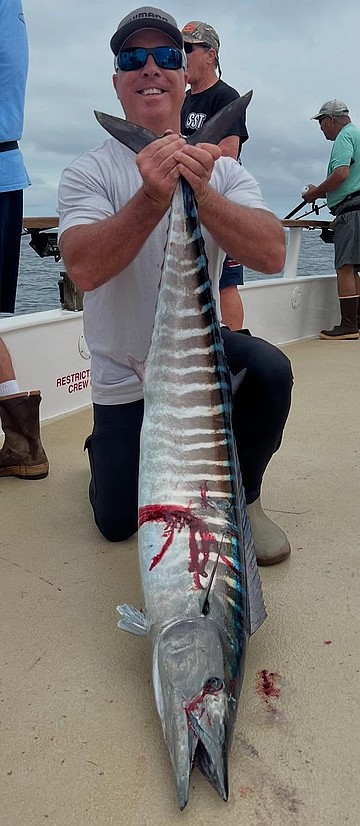
The Royal Polaris made a run south as the weather cleared and loaded up on wahoo by the end of the week
That is the way of hurricanes here in the Eastern Pacific – they are difficult to predict. Living mostly in Baja for the past couple of decades has taught me that. I keep an eye on Windy.com and check every model any time storms develop in the tropics, and though the models are usually somewhat accurate, they can miss entirely from a week or so out. Sometimes, even just a few days out, predictions can be "meh"-inducing to the locals, only to give way to a blustering gully-washer. Other times, you might spend a week boarding up and sandbagging for a predicted monster only to have it miss entirely. I’ve been through a few, and to be honest, I prefer tornadoes.
Tornadoes do not deke and move for a week before they arrive. By the time one forms and heads toward you, you have only minutes to find suitable shelter. There is no wasted week of readying for tornadoes. Just build a shelter if you live in tornado country, then run to it when the time comes, if. Alas, in the places where I like to do my fishing, tornadoes are rare and hurricanes are common. (I’m being facetious, of course; neither is to be laughed at.)
While we had some light sprinkles from Priscilla’s outer bands here in San Quintin in northern Baja, Tucson and Phoenix got much more of her rain. Either way, we’re still trying to figure out if the more tropical species will turn back on again. This year has been strange here along the northern Baja coast. Yellowtail fishing — along with rockfish and some impressive lingcod catches — has been very good, but development of bait balls through the spring were practically non-existent in some of the areas where it usually shows up. There has been more anchovy than sardine, and smaller bait has been common this year, which is why many boats are suggesting #2 to #4 live bait hooks instead of the #1/0 to #3/0 hooks we are normally using by the end of summer.
Asi es, "it is what it is." Fishing has still been very good overall, even if we've had to work a little harder for results. Out west toward the Outer Banks and San Clemente Island, bluefin have still been biting well, as have the fish down south off Ensenada, where more yellowfin and skipjack are mixed in. Yellowtail have been biting like crazy along the mid Baja coast, and further south outside of Bahia Magdelena along the Ridge, large yellowfin, Wahoo, and Dorado have been the top catches, punctuated by that great yellowtail (and some grouper) fishing along the coast. And a few of the long-range boats took advantage of tucking in for some really excellent calico bass fishing in the southern stretch of kelp forest biospheres that peter out as you pass Bahia Asuncion.
The calico fishing around Islas Asuncion and San Roque is the best I have ever experienced. The immediate area around those islands is biosphere and off limits for sportboats out of the U.S., but can be fished if you're with a local pangero or in a personal boat (as long as it's legal and licensed). Within the reach of a kayak or tin boat, the reefs and kelps through that region hold some solid fish to 10 pounds, and I often have had days of double-digit numbers of calico bass that averaged five pounds or so. Of course, most is catch and release fishing, but fresh calico ceviche is an excellent end to a day on the water, and those middling 4- to 5-pounders are perfect. (The larger ones are usually breeder females and those we always release.) San Pablo Canyon and other coastal spots are okay for the fleet, and they will sometimes tuck in and target coastal species along that stretch.
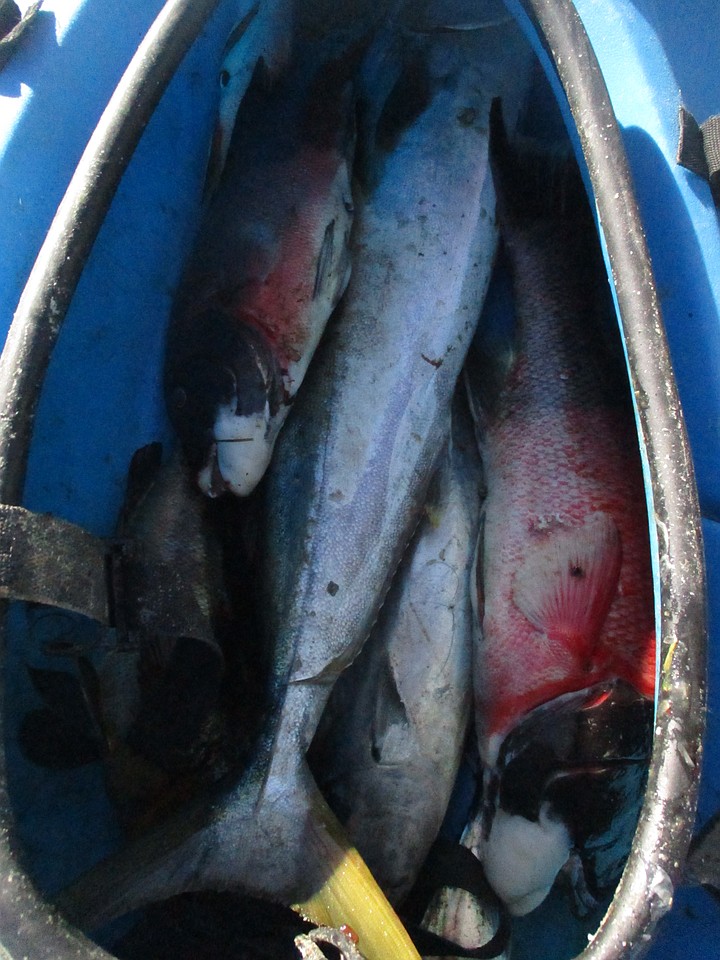
Average catch from the kayak when I lived in Bahia Asuncion: big calico bass, sheephead, and yellowtail, all just a short paddle from the beach
Anyhow, it looks like the next bit of weather will be another northern front sliding down the coast, and that it will have its greatest effect on the conditions out west from the Channel Islands to the grounds around San Clemente Island. Conditions south along Baja will be improving through the week with lighter winds and no developing hurricanes predicted…yet. So, whether the beach, bay, lake, or offshore, they’re out there so go out and get ‘em!
Here's something you might be interested in.
Fish Report: Priscilla and Raymond deke the forecasters for Pac-side Baja
Excellent Calico bass fishing southward before the kelps peter out

Fish Report: Priscilla and Raymond deke the forecasters for Pac-side Baja
Excellent Calico bass fishing southward before the kelps peter out
Solid calico bass fishing for the Tribute along the Baja coast while waiting for better offshore conditions as Priscilla spun out near the Vizcaino Peninsula
Dock Totals 10/5 – 10/11: 2263 anglers aboard 108 half-day to 3-day trips out of San Diego landings over the past week caught 6 barracuda, 1747 bluefin tuna (to 150 pounds), 30 bonito, 29 calico bass, 12 dorado, 3 halibut, 8 lingcod, 1 mako shark, 104 rock crab, 4480 rockfish, 54 sand bass, 39 sanddab, 813 sculpin, 57 sheephead, 14 skipjack tuna, 1 Spanish jack, 60 spiny lobster (192 released), 462 whitefish, 1 white seabass, 475 yellowfin tuna, and 1179 yellowtail.
Saltwater: This past week featured blustery conditions offshore down south as two hurricanes, Priscilla and Raymond, came out of the tropics, then right hooked, stalled, and sent rain across the southern and mid-Baja Peninsula and up through Sonora and into Arizona. As hurricanes go, neither was too damaging in Baja. Although there was some severe flooding in places, wind speeds remained mostly under 30 mph or so. Still, with the approaching weather, most boats stayed coastal — out of the worst of it — and focused more on yellowtail than tuna. (The hurricanes did much more damage on the mainland as they broke apart, sending lots of moisture and flash flooding.)
We also had a southbound cold front up north that frothed up seas in U.S. waters a bit, with San Diego being about halfway between the storms to the south and to the north. Local boats did well on rockfish in the deeper zone, though fewer lingcod were caught than in the last week of the shallow water rockfish season. Bluefin continued to bite well — they often seem more moon- than weather-influenced — while dorado, skipjack tuna, and yellowfin tuna catches fell off substantially from the week previous. Hopes were that the systems would push more warm water (and the species that prefer it) further north. But so far, signs are the strong southward push of the California Current is prevailing.
The Royal Polaris made a run south as the weather cleared and loaded up on wahoo by the end of the week
That is the way of hurricanes here in the Eastern Pacific – they are difficult to predict. Living mostly in Baja for the past couple of decades has taught me that. I keep an eye on Windy.com and check every model any time storms develop in the tropics, and though the models are usually somewhat accurate, they can miss entirely from a week or so out. Sometimes, even just a few days out, predictions can be "meh"-inducing to the locals, only to give way to a blustering gully-washer. Other times, you might spend a week boarding up and sandbagging for a predicted monster only to have it miss entirely. I’ve been through a few, and to be honest, I prefer tornadoes.
Tornadoes do not deke and move for a week before they arrive. By the time one forms and heads toward you, you have only minutes to find suitable shelter. There is no wasted week of readying for tornadoes. Just build a shelter if you live in tornado country, then run to it when the time comes, if. Alas, in the places where I like to do my fishing, tornadoes are rare and hurricanes are common. (I’m being facetious, of course; neither is to be laughed at.)
While we had some light sprinkles from Priscilla’s outer bands here in San Quintin in northern Baja, Tucson and Phoenix got much more of her rain. Either way, we’re still trying to figure out if the more tropical species will turn back on again. This year has been strange here along the northern Baja coast. Yellowtail fishing — along with rockfish and some impressive lingcod catches — has been very good, but development of bait balls through the spring were practically non-existent in some of the areas where it usually shows up. There has been more anchovy than sardine, and smaller bait has been common this year, which is why many boats are suggesting #2 to #4 live bait hooks instead of the #1/0 to #3/0 hooks we are normally using by the end of summer.
Asi es, "it is what it is." Fishing has still been very good overall, even if we've had to work a little harder for results. Out west toward the Outer Banks and San Clemente Island, bluefin have still been biting well, as have the fish down south off Ensenada, where more yellowfin and skipjack are mixed in. Yellowtail have been biting like crazy along the mid Baja coast, and further south outside of Bahia Magdelena along the Ridge, large yellowfin, Wahoo, and Dorado have been the top catches, punctuated by that great yellowtail (and some grouper) fishing along the coast. And a few of the long-range boats took advantage of tucking in for some really excellent calico bass fishing in the southern stretch of kelp forest biospheres that peter out as you pass Bahia Asuncion.
The calico fishing around Islas Asuncion and San Roque is the best I have ever experienced. The immediate area around those islands is biosphere and off limits for sportboats out of the U.S., but can be fished if you're with a local pangero or in a personal boat (as long as it's legal and licensed). Within the reach of a kayak or tin boat, the reefs and kelps through that region hold some solid fish to 10 pounds, and I often have had days of double-digit numbers of calico bass that averaged five pounds or so. Of course, most is catch and release fishing, but fresh calico ceviche is an excellent end to a day on the water, and those middling 4- to 5-pounders are perfect. (The larger ones are usually breeder females and those we always release.) San Pablo Canyon and other coastal spots are okay for the fleet, and they will sometimes tuck in and target coastal species along that stretch.
Average catch from the kayak when I lived in Bahia Asuncion: big calico bass, sheephead, and yellowtail, all just a short paddle from the beach
Anyhow, it looks like the next bit of weather will be another northern front sliding down the coast, and that it will have its greatest effect on the conditions out west from the Channel Islands to the grounds around San Clemente Island. Conditions south along Baja will be improving through the week with lighter winds and no developing hurricanes predicted…yet. So, whether the beach, bay, lake, or offshore, they’re out there so go out and get ‘em!
Comments