

Here's something you might be interested in.
Ask a Hipster — Advice you didn't know you needed
Big Screen — Movie commentary
Blurt — Music's inside track
Booze News — San Diego spirits
Classical Music — Immortal beauty
Classifieds — Free and easy
Close to Home — What it’s like on the street where you live
Cover Stories — Front-page features
Drinks All Around — Bartenders' drink recipes
Excerpts — Literary and spiritual excerpts
Feast! — Food & drink reviews
Feature Stories — Local news & stories
Fishing Report — What’s getting hooked from ship and shore
From the Archives — Spotlight on the past
Golden Dreams — Talk of the town
The Gonzo Report — Making the musical scene, or at least reporting from it
Letters — Our inbox
Movies@Home — Local movie buffs share favorites
Movie Reviews — Our critics' picks and pans
Musician Interviews — Up close with local artists
Neighborhood News from Stringers — Hyperlocal news
News Ticker — News & politics
Obermeyer — San Diego politics illustrated
Outdoors — Weekly changes in flora and fauna
Overheard in San Diego — Eavesdropping illustrated
Poetry — The old and the new
Reader Travel — Travel section built by travelers
Reading — The hunt for intellectuals
Roam-O-Rama — SoCal's best hiking/biking trails
San Diego Beer — Inside San Diego suds
SD on the QT — Almost factual news
Sheep and Goats — Places of worship
Special Issues — The best of
Street Style — San Diego streets have style
Surf Diego — Real stories from those braving the waves
Theater — On stage in San Diego this week
Tin Fork — Silver spoon alternative
Under the Radar — Matt Potter's undercover work
Unforgettable — Long-ago San Diego
Unreal Estate — San Diego's priciest pads
Your Week — Daily event picks
Theater Review: All's Well That Ends Well at The Old Globe
A mingled yarn of a play
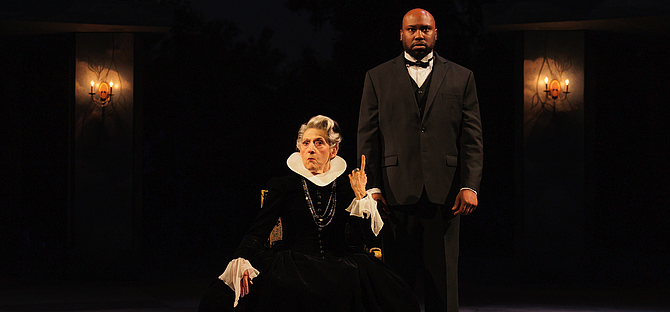
My chief impression after the seeing the Globe’s current production of Shakespeare’s All’s Well That Ends Well was how much the play reminded me of other plays. There’s a king who sets the drama in motion with a reckless decision, a la King Lear. (There’s a fool here as well, but he’s very much his own thing.) There’s a wronged woman who makes a dramatic return from the dead, a la Much Ado About Nothing. There’s a boastful coward whose knavery is exposed, a la Falstaff in the Henry plays — though his pathetic wretchedness following his undoing reminded me of Twelfth Night’s Malvolio.
The set may have had something to do with it: there were columns, stairs, and balconies, but like the stage itself, they were painted sky blue and adorned with pale, puffy clouds. The result was a feeling that was literally the opposite of grounded — more floating, dreamlike. Also dreamlike: the wiggy depiction of war between France and Italy, itself heralded by a weird tantrum from the Duke of Florence, and the bizarre introduction of Diana and her killer good looks — slayin’ ‘em with a peek from behind the curtain like a kind of reverse Medusa. There’s an argument for all these choices. The war here is utterly inconsequential except as an excuse for the ill-married Bertram to run away without consummating, so it would be folly to portray its horrors. Diana, too, is inconsequential except as bait to lure Bertram into his poor wife’s plot, so why not go all in to highlight her intoxicating beauty? But dreams do have a way of fragmenting as they move through associations and memories.
Also fragmented: the tone and pitch of the performances. Mary Lou Rosato’s widowed Countess managed the neat trick of melding the play’s goofy levity and serious sorrow, wringing laughs from the audience even in the midst of genuine distress. (Her steward Rinaldo was much the same: so stonefaced and somber, how could I resist smiling?) Most others fell to one side or the other: Bertram played it straight as a cad who somehow inspires love in sweet Helena — also straight, despite the occasional snorting laugh. The Falstaffian Parolles was meanwhile ridiculous whether happy or sad. And Matthew Harris’ Fool, while impressive in both his crackling delivery and precise movement, seemed to be dropping in from another story.
All this was intentional. A tell during the show: why else would it outfit only one member of the French court with a French accent and give another an aviator helmet and goggles? A tell after the show: the program’s interview with director Peter Francis James has him saying that he wants the audience to have “a kaleidoscopic experience.” Fractured facets producing an overall effect. Artistic director Barry Edelstein’s letter quotes the play: “The web of our life is a mingled yarn, good and ill together.” So here is a mingled yarn of a production to untangle — or not. I left it puzzling for the first time over the play’s title, which I had always shrugged at as a cheerful dismissal of past troubles in the light of present joys. But now it felt darker, a declaration that the ends justify the means. A mingled yarn, indeed. Mission accomplished, Old Globe.
Here's something you might be interested in.
Theater Review: All's Well That Ends Well at The Old Globe
A mingled yarn of a play

Theater Review: All's Well That Ends Well at The Old Globe
A mingled yarn of a play
My chief impression after the seeing the Globe’s current production of Shakespeare’s All’s Well That Ends Well was how much the play reminded me of other plays. There’s a king who sets the drama in motion with a reckless decision, a la King Lear. (There’s a fool here as well, but he’s very much his own thing.) There’s a wronged woman who makes a dramatic return from the dead, a la Much Ado About Nothing. There’s a boastful coward whose knavery is exposed, a la Falstaff in the Henry plays — though his pathetic wretchedness following his undoing reminded me of Twelfth Night’s Malvolio.
The set may have had something to do with it: there were columns, stairs, and balconies, but like the stage itself, they were painted sky blue and adorned with pale, puffy clouds. The result was a feeling that was literally the opposite of grounded — more floating, dreamlike. Also dreamlike: the wiggy depiction of war between France and Italy, itself heralded by a weird tantrum from the Duke of Florence, and the bizarre introduction of Diana and her killer good looks — slayin’ ‘em with a peek from behind the curtain like a kind of reverse Medusa. There’s an argument for all these choices. The war here is utterly inconsequential except as an excuse for the ill-married Bertram to run away without consummating, so it would be folly to portray its horrors. Diana, too, is inconsequential except as bait to lure Bertram into his poor wife’s plot, so why not go all in to highlight her intoxicating beauty? But dreams do have a way of fragmenting as they move through associations and memories.
Also fragmented: the tone and pitch of the performances. Mary Lou Rosato’s widowed Countess managed the neat trick of melding the play’s goofy levity and serious sorrow, wringing laughs from the audience even in the midst of genuine distress. (Her steward Rinaldo was much the same: so stonefaced and somber, how could I resist smiling?) Most others fell to one side or the other: Bertram played it straight as a cad who somehow inspires love in sweet Helena — also straight, despite the occasional snorting laugh. The Falstaffian Parolles was meanwhile ridiculous whether happy or sad. And Matthew Harris’ Fool, while impressive in both his crackling delivery and precise movement, seemed to be dropping in from another story.
All this was intentional. A tell during the show: why else would it outfit only one member of the French court with a French accent and give another an aviator helmet and goggles? A tell after the show: the program’s interview with director Peter Francis James has him saying that he wants the audience to have “a kaleidoscopic experience.” Fractured facets producing an overall effect. Artistic director Barry Edelstein’s letter quotes the play: “The web of our life is a mingled yarn, good and ill together.” So here is a mingled yarn of a production to untangle — or not. I left it puzzling for the first time over the play’s title, which I had always shrugged at as a cheerful dismissal of past troubles in the light of present joys. But now it felt darker, a declaration that the ends justify the means. A mingled yarn, indeed. Mission accomplished, Old Globe.
Comments