

Here's something you might be interested in.
Ask a Hipster — Advice you didn't know you needed
Big Screen — Movie commentary
Blurt — Music's inside track
Booze News — San Diego spirits
Classical Music — Immortal beauty
Classifieds — Free and easy
Close to Home — What it’s like on the street where you live
Cover Stories — Front-page features
Drinks All Around — Bartenders' drink recipes
Excerpts — Literary and spiritual excerpts
Feast! — Food & drink reviews
Feature Stories — Local news & stories
Fishing Report — What’s getting hooked from ship and shore
From the Archives — Spotlight on the past
Golden Dreams — Talk of the town
The Gonzo Report — Making the musical scene, or at least reporting from it
Letters — Our inbox
Movies@Home — Local movie buffs share favorites
Movie Reviews — Our critics' picks and pans
Musician Interviews — Up close with local artists
Neighborhood News from Stringers — Hyperlocal news
News Ticker — News & politics
Obermeyer — San Diego politics illustrated
Outdoors — Weekly changes in flora and fauna
Overheard in San Diego — Eavesdropping illustrated
Poetry — The old and the new
Reader Travel — Travel section built by travelers
Reading — The hunt for intellectuals
Roam-O-Rama — SoCal's best hiking/biking trails
San Diego Beer — Inside San Diego suds
SD on the QT — Almost factual news
Sheep and Goats — Places of worship
Special Issues — The best of
Street Style — San Diego streets have style
Surf Diego — Real stories from those braving the waves
Theater — On stage in San Diego this week
Tin Fork — Silver spoon alternative
Under the Radar — Matt Potter's undercover work
Unforgettable — Long-ago San Diego
Unreal Estate — San Diego's priciest pads
Your Week — Daily event picks
Local boxer Jonny Mansour does have a prayer
And a plan
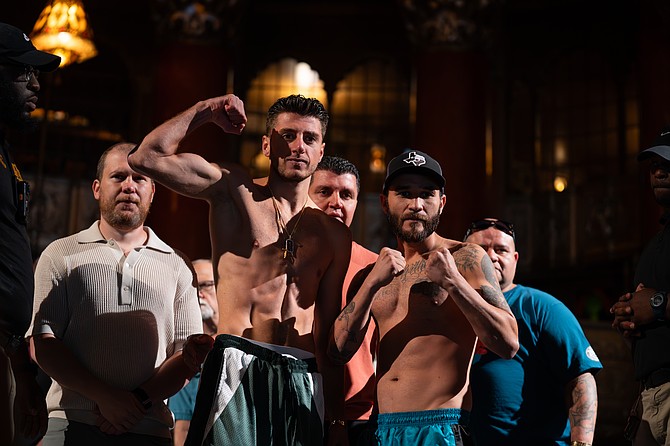
Jonny Mansour (left) at yesterday's weigh-in
In a few hours, La Mesa lightweight Jonny Mansour will step into the ring at the 5100-seat Fox Theatre in Detroit to face Texas fighter Ernest Bustos. He was scheduled to fight undefeated Richard Segura, but “he pulled out, so we got a replacement opponent last minute. It’s boxing, man. That’s how it is.”
Not that the change matters much to him. “Honestly, I’m just going to step into the ring and be myself, no matter what style steps in front of me,” he says. “Just be Jonny, have fun in there, and let my hands go — with speed, power, and footwork. These guys have some chins, and sometimes, when a fighter has a chin, no matter how hard you hit him, he’s not going to go down. But I just stick to the game plan. If the knockout comes, it comes. If it doesn’t, it doesn’t. But I believe I’m going to stop this guy.”
That’s not to say that opponents are interchangeable. For one thing, Bustos is shorter than Segura — and both are shorter than the 5’10” Mansour. “I’ve always been a boxer who’s tall and skinny,” he notes. “Fighting shorter fighters, it’s important to be able to sit down and fight on the inside more. And I’ve got a lot of speed, but just slowing it down a little bit — being more precise and accurate. That’s what I plan to do in this fight.”
Detroit is a long way from San Diego, but Mansour chose it for a reason: it’s home to the largest Chaldean community in the country. Mansour, the son of Iraqi immigrants, is counting on that community. “The boxing world is in a strange position right now,” he explains. “There are some shifts going on” — with big-time promoter Bob Arum getting older, “the Saudis stepping in, and ESPN stepping out.”
In the old model, “there’s a promoter and there’s a fighter. But I studied business at San Diego State, and I’ve learned how to market myself and build a community. I have over 600,000 followers across all my social media platforms. So I told myself, ‘If I can sell tickets myself, what do I need a promoter for?’ My cousin and I started our own promotion company, G2G, to keep us busy as fighters and bring boxing back to San Diego. We’re basically betting on ourselves. There’s a big, big Latino community here that loves boxing, and a strong Middle Eastern community that is discovering it. In one year, we went from selling 1000 tickets at Sycuan to selling 4800 tickets at Frontwave Arena.” (His cousin, super featherweight JuJu Ballo, is also on the card, taking on Julian Gomez-Clemons.)
Today’s event is a partnership between G2G and Salita Promotions, which promotes Olympic gold medalist Claressa Shields a big draw in the boxing world. Mansour knows the day may come when “it’s the right time with the right promoter to put me on the right TV network.” But in the meantime, he’s happy to keep building his own platform and relying on his own people. “The San Diego community sparked my career,” showing up in numbers when he made his professional debut at Pechanga in 2024. “And I’ve been able to build fans by using that big stage to tell my story.”
That story begins with the day he “stepped into a gym at eight years old. I knew what I wanted to do for the rest of my life. After that day, my uncle asked me if I wanted to start boxing, and I’ve never missed a day since. I failed over and over, and my parents didn’t want me to box, because it’s a dangerous sport. But it was something that I loved to do, and I proved to my parents that I could become the best.” After he rose to number one in USA Boxing’s national amateur rankings, “my dad said, ‘We see how hard you’re working. Let’s see how far you can go.’” For Mansour, that means becoming a world champ and an Olympic gold medalist — possibly fighting for Iraq, where he recently obtained citizenship with an eye toward the 2028 games. “I represented Team USA for four years. Why not represent my family’s country?”
The mention of family is not casual. After he won at Frontwave, he said, “For the rest of my life, I’m dedicating every victory to my mother,” who died in 2025. And even that tragedy brings him back to the idea of building community. “Everybody goes through things,” he says. “My mother suffered cancer, and it was one of the hardest parts of my life. It was the first funeral I attended. I never understood the hardships of life until I went through it myself.
“And the way I bounced back and continued fighting — for my family, for my purpose, and for my faith — is inspiring people. There isn’t a day where I can’t pray for somebody, because people are coming to me and saying, ‘Hey man, I lost a parent. I lost a loved one to cancer.’ They look me in the eyes and tell me, ‘The way you stood back up and kept fighting inspires me. I’m pursuing my dreams too, because of you.’ They understand that if I can do it, they can, too.”
Here's something you might be interested in.
Local boxer Jonny Mansour does have a prayer
And a plan

Local boxer Jonny Mansour does have a prayer
And a plan
Jonny Mansour (left) at yesterday's weigh-in
In a few hours, La Mesa lightweight Jonny Mansour will step into the ring at the 5100-seat Fox Theatre in Detroit to face Texas fighter Ernest Bustos. He was scheduled to fight undefeated Richard Segura, but “he pulled out, so we got a replacement opponent last minute. It’s boxing, man. That’s how it is.”
Not that the change matters much to him. “Honestly, I’m just going to step into the ring and be myself, no matter what style steps in front of me,” he says. “Just be Jonny, have fun in there, and let my hands go — with speed, power, and footwork. These guys have some chins, and sometimes, when a fighter has a chin, no matter how hard you hit him, he’s not going to go down. But I just stick to the game plan. If the knockout comes, it comes. If it doesn’t, it doesn’t. But I believe I’m going to stop this guy.”
That’s not to say that opponents are interchangeable. For one thing, Bustos is shorter than Segura — and both are shorter than the 5’10” Mansour. “I’ve always been a boxer who’s tall and skinny,” he notes. “Fighting shorter fighters, it’s important to be able to sit down and fight on the inside more. And I’ve got a lot of speed, but just slowing it down a little bit — being more precise and accurate. That’s what I plan to do in this fight.”
Detroit is a long way from San Diego, but Mansour chose it for a reason: it’s home to the largest Chaldean community in the country. Mansour, the son of Iraqi immigrants, is counting on that community. “The boxing world is in a strange position right now,” he explains. “There are some shifts going on” — with big-time promoter Bob Arum getting older, “the Saudis stepping in, and ESPN stepping out.”
In the old model, “there’s a promoter and there’s a fighter. But I studied business at San Diego State, and I’ve learned how to market myself and build a community. I have over 600,000 followers across all my social media platforms. So I told myself, ‘If I can sell tickets myself, what do I need a promoter for?’ My cousin and I started our own promotion company, G2G, to keep us busy as fighters and bring boxing back to San Diego. We’re basically betting on ourselves. There’s a big, big Latino community here that loves boxing, and a strong Middle Eastern community that is discovering it. In one year, we went from selling 1000 tickets at Sycuan to selling 4800 tickets at Frontwave Arena.” (His cousin, super featherweight JuJu Ballo, is also on the card, taking on Julian Gomez-Clemons.)
Today’s event is a partnership between G2G and Salita Promotions, which promotes Olympic gold medalist Claressa Shields a big draw in the boxing world. Mansour knows the day may come when “it’s the right time with the right promoter to put me on the right TV network.” But in the meantime, he’s happy to keep building his own platform and relying on his own people. “The San Diego community sparked my career,” showing up in numbers when he made his professional debut at Pechanga in 2024. “And I’ve been able to build fans by using that big stage to tell my story.”
That story begins with the day he “stepped into a gym at eight years old. I knew what I wanted to do for the rest of my life. After that day, my uncle asked me if I wanted to start boxing, and I’ve never missed a day since. I failed over and over, and my parents didn’t want me to box, because it’s a dangerous sport. But it was something that I loved to do, and I proved to my parents that I could become the best.” After he rose to number one in USA Boxing’s national amateur rankings, “my dad said, ‘We see how hard you’re working. Let’s see how far you can go.’” For Mansour, that means becoming a world champ and an Olympic gold medalist — possibly fighting for Iraq, where he recently obtained citizenship with an eye toward the 2028 games. “I represented Team USA for four years. Why not represent my family’s country?”
The mention of family is not casual. After he won at Frontwave, he said, “For the rest of my life, I’m dedicating every victory to my mother,” who died in 2025. And even that tragedy brings him back to the idea of building community. “Everybody goes through things,” he says. “My mother suffered cancer, and it was one of the hardest parts of my life. It was the first funeral I attended. I never understood the hardships of life until I went through it myself.
“And the way I bounced back and continued fighting — for my family, for my purpose, and for my faith — is inspiring people. There isn’t a day where I can’t pray for somebody, because people are coming to me and saying, ‘Hey man, I lost a parent. I lost a loved one to cancer.’ They look me in the eyes and tell me, ‘The way you stood back up and kept fighting inspires me. I’m pursuing my dreams too, because of you.’ They understand that if I can do it, they can, too.”
Comments