

Here's something you might be interested in.
Ask a Hipster — Advice you didn't know you needed
Big Screen — Movie commentary
Blurt — Music's inside track
Booze News — San Diego spirits
Classical Music — Immortal beauty
Classifieds — Free and easy
Close to Home — What it’s like on the street where you live
Cover Stories — Front-page features
Drinks All Around — Bartenders' drink recipes
Excerpts — Literary and spiritual excerpts
Feast! — Food & drink reviews
Feature Stories — Local news & stories
Fishing Report — What’s getting hooked from ship and shore
From the Archives — Spotlight on the past
Golden Dreams — Talk of the town
The Gonzo Report — Making the musical scene, or at least reporting from it
Letters — Our inbox
Movies@Home — Local movie buffs share favorites
Movie Reviews — Our critics' picks and pans
Musician Interviews — Up close with local artists
Neighborhood News from Stringers — Hyperlocal news
News Ticker — News & politics
Obermeyer — San Diego politics illustrated
Outdoors — Weekly changes in flora and fauna
Overheard in San Diego — Eavesdropping illustrated
Poetry — The old and the new
Reader Travel — Travel section built by travelers
Reading — The hunt for intellectuals
Roam-O-Rama — SoCal's best hiking/biking trails
San Diego Beer — Inside San Diego suds
SD on the QT — Almost factual news
Sheep and Goats — Places of worship
Special Issues — The best of
Street Style — San Diego streets have style
Surf Diego — Real stories from those braving the waves
Theater — On stage in San Diego this week
Tin Fork — Silver spoon alternative
Under the Radar — Matt Potter's undercover work
Unforgettable — Long-ago San Diego
Unreal Estate — San Diego's priciest pads
Your Week — Daily event picks
Cop Week, Part 1: Jim Harrell's fist
The original One Punch Man
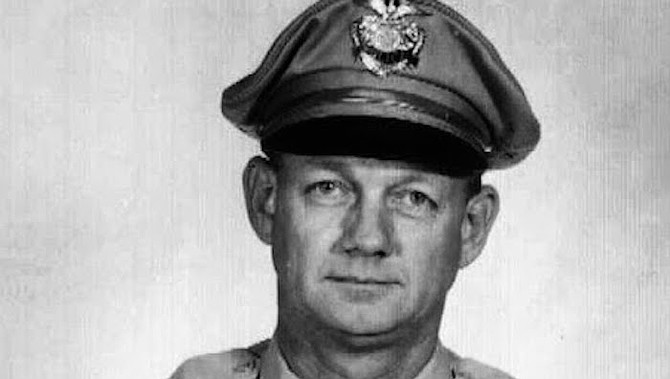
This week, the Reader is dipping back into its archives for a few cop stories — that is, stories told by cops. First up is a slightly abridged version of Judith Moore's interview about old-style police work with officer Jim Harrell, who retired in 1972. The original story ran in 1989.
Jim Harrell makes a fist. Shows a brown hump of knuckle. How the fist feels is hard. Up close, you see that his index, second, and ring fingers’ knuckles have been driven back into the hand. He grins, says his knuckles got that way from doing to bad people what bad people needed done to them. He jabs at air, says — tone flat, no juice, no boast in it — “It was like hittin’ ’em with a rock.” He undoes the fist, puts out his hands on the dining room table, palms down. “You can see where teeth used to go in.”
Harrell, 73, is called by those who know him "one of the toughest cops to ever hit San Diego’s streets.” He retired in 1972, after 31 years with the SDPD. Over and after lunch in the North Park home in which Harrell and his wife Eleanor raised their two children, Harrell talks about those years.
Just under six feet, weighing only a few pounds more than he did at 25, Harrell has wide shoulders, his torso is long, legs short and stocky. He looks strong, fit. You wouldn’t guess he’d had two quadruple-bypass heart surgeries, the last performed three years ago.
Born in Texas in 1916, Harrell hoped to enter college, take a pre-med course, become a doctor. Depression hard times scotched that; Harrell followed his master-carpenter father into construction. They moved in 1937 to San Diego. By 1939, the younger Harrell held a contractor’s license. By 1941, Harrell was a builder, doing, he says, “all right.” But with the war effort, materials were harder to get, it was taking longer to get loans through. One day a plasterer told Harrell, "They’re having a police exam downtown.”
Harrell took the test. “A simple IQ test, that’s all patrolman exams were in those days.” His score put him among the top 20. In the fitness exam, he did even better. “When we took the agility test — at the University Heights playground — I ran, and jumped, and scaled the course in 60 seconds.”
On December 15th, a week and a day after Japan attacked Pearl Harbor, the SDPD issued Harrell a set of the “old blues” in wool and cotton, a badge, a five-inch .38 Colt, and 20 rounds of ammunition. "You had to buy your handcuffs, your Sam Browne belt. That belt,” Harrell says with satisfaction, “lasted me the full time."
What they did not give him was a book of regulations, or any formal training — the academy had shut down because of the war. His first day, Harrell went into the captain’s office. “I said, ‘Hey, they just handed me a badge and a gun. What do I do?'
“He looked at me and asked, ‘Do you know right from wrong?’
"‘Yeah.'
“‘Well, if you think somebody’s doin’ somethin’ wrong out there, you bring ’em down here and I’ll tell you what to put ’em in jail for.’"
Harrell pins me with his eyes. “That is police work, basically. A lot of people don’t realize, when a policeman goes out there, that people want action. You wouldn’t call a policeman if you didn’t want action.”
He fast-forwards to a time when he, as a sergeant and then a lieutenant, was in charge of other men: "I used to demand that a policeman give the people satisfaction. In other words, if you had a problem, we’d correct it. If a policeman said to me, ‘But the Supreme Court said ... ’ I'd say, 'To hell with the Supreme Court. We’re gonna give them peace tonight. Let the Supreme Court sort it out tomorrow morning.’ Because if somebody’s doin’ wrong, you stop it.”
From December 1941 to 1946, Harrell served as a patrolman. Then, for 18 months, he was assigned to plainclothes work in vice, returning after that to patrol — where as patrolman, sergeant, and finally, lieutenant, he remained for all his career. He was assigned for many years to Southeast San Diego and East San Diego — including, for 18 months, the old East San Diego substation, which closed in the early '50s. From the late '60s until retirement, he served in La Jolla, in the Northern Division, and for the last two years commanded a shift in the communications division. “I had a good time wherever I was, because if I didn’t, I’da quit and gone back into building.”
In his first years on the force, without training, Harrell and his fellow recruits “just kinda picked up ways of doing things.” He adds, it was "the old-timers who taught me to survive. Nobody ever shot me, cut me. I went through all those riots [at UCSD during the ’60s], never got hit with a bottle, never got hit with a brick. I don’t want ever to sound like I'm bragging. What I had was a God-given gift. They used to call me ‘Fast Eyes.’ If somebody shot a .38, I could actually follow the bullet all the way to the target. I never knew how good my eyes were until they began to go bad."
They also called him One Punch, "because I’d take the one punch and that was usually it. Those last two years, they put me inside. That’s what almost killed me. It was because I wouldn’t conform.” He was an old-style, foot-beat street cop — “gorilla” — and by 1970, the force wanted a new-style, college-trained, “good public relations” cop.
As Harrell talks, the “war stories” pile up — World War II bar brawls, “perv” busts, a baby delivered in a police car, a daring rescue from a hotel top floor, '60s riots. There’s no swagger. He doesn’t bathe himself in a hero’s spotlight. Harrell talks to himself as well as to me, using the opportunity of my inquiries to ask himself about himself. He looks back over his life, asks, “Did I do right? Did I do wrong?” He questions himself the way a cop questions a suspect: the old “good cop-bad cop” routine, for one moment hard on himself, cold, and the next moment easing up, warm.
He goes back to his hands, runs an index finger over horny scar tissue along the enlarged knuckles. ‘‘The first thing we used to do when we come in from some tangle, we’d get out nitric acid and alcohol and then take a two-ended swab. Stick one end of the swab in the nitric acid and the other end in alcohol. You’d burn the wound out with the nitric acid and neutralize the acid with the alcohol.” He flexes his hands. "This is what I ended up with.”
He makes a fist. Grinds his jaw. “I hit a man once with my left hand, gloves on, and when it was all over and I took off my glove, I saw I’d split my ring into three pieces.” You should have seen the other guy: “Yeah, I’ve broken jaws. I’ve broken lots of bones. Sure, you can hear ’em break. You can feel ’em go.”
Busting up bar fights, he says, “I used to rather fight ’em in bunches. More fun that way. Because when you hit one, the rest of ’em’d turn their head a little bit to see what happened to him. Then, just as fast as you could go into ’em, you could knock off five or six, like that.” Harrell snaps his fingers. “I hated to fight one-on-one. I would much rather fight a group any time of the day. Because of the fact, then I can turn loose. Because I don’t like to hold back. If I have to go, I wanna go first class. An' I usually did."
That part he was prepared for, but not by the police. "As a youngster, I’d been trained to take care of myself. I had boxing and wrestling all through high school. I learned pain. I learned to accept pain.” When Harrell became a policeman, he quit boxing as sport. "Completely. I would never even spar. You knocked your timing off because you would hesitate. If you ever hesitated out there, you were hurt.”
When Harrell joined the SDPD, the department patrolled the entire city with three squad cars — one downtown, one in East San Diego, and one for all the beach areas. "Downtown we had beat 21, beat 15, beat 19. That’s it. The first arrest I made was for drunk driving." But, he says, "I can also recall the exact day I became a policeman. Up to then, I thought I was a policeman." After all, "I was wearing the uniform, I was walking a beat."
But then: "It was in the evening. We would regularly walk into the Exchange Club. The war hadn’t gotten going yet, so there wasn't that much goin’ on. I went back to the men’s room, I walked in, there was a man sitting on the stool. There was a man standing up in front of him getting a blow job. It embarrassed me. I said, ‘Oh, pardon me,’ turned around, backed out fast. Once I got out, I said to myself, ‘You dumb son of a bitch, you’re supposed to do something about this.’" Back then, "They used to go to prison on that, any oral sex, between man and woman or men and men." It was, as they say, another time.
"In my own mind, that night, I was a civilian still. I didn’t want to get involved. Was none of my business. But if you're a policeman, that’s what you’re paid to do: become involved.”
When the war came, bringing with it hordes of servicemen, there was a lot of involvement. "Club Romance, Paris Inn — Jimmy Kennedy owned Paris Inn and a place out on University that had Western music. There was Sherman’s Dine and Dance, a big place — like a big old warehouse — on State and B. Blackout was in force. Nobody had lights on outside. No neon signs. None of that. We’d drive around with no lights. Everybody was rationed on gas. So there wasn’t any traffic. I worked graveyard or swing shift most of the time, and I got to the point I could see better at night than I could in daytime.
"Every night was fight night. Every night. They’d be out at the Last Roundup fighting all the time. We hit every place that there was trouble. I think every other Marine that left the Marine base had to have a fight with a policeman. I got to the point where I hated to see ’em coming. I could pretty well take care of myself. You had to in those days; we had only a thin line of officers to do the job.”
I stop him and ask what it was like to fight. "I would get a shot of adrenaline you wouldn’t believe. It hit me all at once. It would hit and explode in me like a bomb. Once I start, I can’t stop. It’s like golf or anything else — you gotta follow through, you gotta finish it off.” In a fight, everything seemed to happen in slow motion. "Say you’re driving 80, and you slow down to 50 — you feel then like you can get out and walk. Because your reflexes are going 80 miles an hour.”
He closes his eyes, re-creating the scene in his mind. “Down at Club Romance, ah, I can still see this guy. He’s shifting his feet like he was trying to get on balance. Well, I just move a little bit, throw him off balance. But he keeps shiftin’ back. I can see his hand. I can see him silly bastard is going to hit me. He’s gonna hit me!’ I see the punch cornin’ at me. I was incensed. Just the last minute, my head moves a little bit, and right as the punch is getting there, I see his mouth coming open just as I go through his head, take his whole jaw and lay it on his shoulder. I hammered him down in the ground like he was a stake."
Harrell opens his eyes, lets loose his jaw. “I think I saved a hell of a lot of those young Marines’ lives. At the base, they’d get ’em all pumped up. They’d give a kid a three weeks’ course. Then they’d tell him, ‘You’re the best.' Hell, cannon fodder was all it amounted to, was all they were. When these kids’d start in to try some of their stuff, I’d short cut it. They’d find out they weren’t invincible."
Was there one incident from those days that stood out, still, in his mind? There was a bar, its name lost now to Harrell, “up there right across from the Spreckels." A call came that a fight was in progress. “Always," says Harrell, “in a bar-fight situation, I’d be the first one to get out of the car, and my partner’d lock the doors." In he went. A melee. Packed in there solid. Someone yelled: “Hey, there’s only one cop here! Let’s take the son of a bitch and beat the shit out of him."
Outraged still, almost 50 years later, Harrell’s eyes narrow, voice turns menacing, cold. “I never even missed a stride. I just walked up to this S.O.B. and hit him. Then I picked him up, bodily, over my head, an’ started walkin’ through the crowd. Kennedy, my partner, opened the car door, and I threw the S.O.B. in the back seat. Kennedy started up the car, and we took off. Situations like that, you don’t waste any time. You don’t stop for niceties. We swung over to Newton Park ’n stopped the car.
"I said to this guy, 'Over there with that crowd, you wanted to get that gang to beat the shit out of me. I want you to think about tryin’ to get me hurt back there.’
“This guy is lookin’ in my eyes, sayin’, ‘Don’t kill me. Don’t kill me.’
“Kennedy turns around, says, real slow, ‘Don’t — quite — kill him, Harrell.’
“So I said to the guy I wouldn’t hit him hard, I’d just break his ribs. Said he was gonna hurt for about a week. I knew the ribs to hit. When I got through, he was pantin’, he couldn’t breathe. I said, ‘Now, next time, I might kill you if you try to get me hurt.'”
Harrell heaves a big sigh, asks, “So, where were we? Yeah. East San Diego, that was beat 22. I started there in 1942, was there for a year. Once you established yourself down there, it was the easiest beat to work of all. You were boss. ‘Mr. Boss.’ That was the way you kept it. You had above all to be fair. You could do anything after that."
It wasn't all violence, of course. The whole idea is to keep the peace. “1945, we’d been havin’ gang fights, I’d broken up one alone, up there, between Linda Vista and the Tunavillers. That’s what we used to call the fishing families who were here at Point Loma. Linda Vista at the time was mostly navy housing. Anyway, I got word that the group from Point Loma were headin’ for Linda Vista. Had a shore patrolman with me. I spotted them on the Sixth Street extension. I drove up ahead and stopped them all — 35, 40 cars.
“I told the shore patrol, ‘Go back near the end of the line, start grabbin’ drivers’ licenses and car keys.’ I started at the other end, picking up drivers’ licenses and car keys. Pretty soon everybody was out of the cars, gathered around. At my feet, I got car keys and drivers’ licenses stacked up like this." Harrell indicates a pile several feet high. “I say, very calm, ‘I understand you boys are going up here to Linda Vista to get into a fight. Now, we’d appreciate it if you’d all go home. ’Cause we got enough to do without having to go up and referee your fights. If you can think you can do that, here’s your keys and your licenses.’ Then the shore patrol and I got in our car. We sat there and waited while they rustled through that heap of keys and papers. Pretty soon, they’d all gone off. And that was that."
After the war, he worked vice. "Lotta gambling in the AOs, always has been, always will be. I don’t get excited. I worked the prostitutes. Never could get excited about that, either. Prostitution will be around as long as anybody has a little red blood in ’em. Prostitutes serve a purpose. The big argument has always been that it brings organized crime. I’ve never seen any instances of that."
In 1966, the United States Supreme Court's decision in Miranda vs. Arizona changed things. “Before Miranda, it didn’t make any difference how you got your information. You could even burglarize to a degree. If we’d get a tip someone was a burglar, we might check, see if he had the loot, and if he did, we’d be waitin’ for him when he came in. We didn’t go through all this BS, this lollygagging.
“I can remember being confused by the Miranda decision. Like they’d say, ‘You went into this man’s house and you arrested him. Did you have a warrant?’ I’d say, ‘No, I didn’t have a warrant. I knew where he was, and I wanted him, and I went in, and I got him.’ They’d throw it out of court; and it dawned on me, ‘That’s not the way to do it anymore.’"
As a sergeant, Harrell broke in rookies. “You’d get a new man, they’re all hot to trot. They would think I was the meanest son of a bitch that ever was, because I would try to take all the shock out of them as soon as I could. I’d tell ’em, ‘Look, don’t ever be surprised by anything you see. Everything has happened before. There isn’t anything new. If ever you’re afraid, you let me know. And then I’ll look out for you. There’s nothin’ wrong with being afraid. I’m crazy, I’m not afraid. So I’ll take care of us both. But if you ever run out on me, I’ll break your back.'" I can hear Harrell’s jaw grind.
From several policemen, now retired, I’d heard that Harrell became a hero to the rookies he broke in. “With these young guys, when one of them would start complaining about the old-timers, say, ‘He was doin’ this, and that, and doin’ the other,’ I would say, ‘You better listen to him, he’s a survivor. Keep the part you like about him, and take the part you don’t like about him and throw it away. Maybe you will even understand the part you don’t like. But he will teach you to survive.’ ”
We’re quiet. I ask, finally, how he feels about today’s police department. "Right now,” he says, "everybody’s afraid to make a decision." What would he do if he were running San Diego’s police department? "I would do what the book says. I’m not a book man, but I’d do what the book says, and they don’t. And that is, every decision will be made at the lowest possible level and only kicked up to the next level when it’s an impossibility for that party, from lack of knowledge of something else, to make the decision. Now, they go all the way up to commander to make a decision.”
"What’s the very worst thing you dealt with?” I ask.
He says, voice low, "I’d been around a lot of rough people before I became a policeman. But after 1941, I saw things I’d never seen. I went through a lot of shock before I learned the world was not all wonderful. Got a call out to that navy housing used to be on Point Loma. A sailor. Here he is up in the middle of these two little girls and stompin’ them to death; and he’s taken the baby by the heels, and here’s blood all over the walls and parts of the baby all over the place. He’s banged it up against the wall. I knocked him loose from the little girls. They had ruptured spleens and a few other things, but they lived. Of course, the baby was dead.
"They let him off, never even charged him. Temporary insanity. You know what his defense was? He had married a prostitute in Long Beach, and they married and had three kids. He was low on the totem pole as far as pay, and they were getting in debt. He came home, there was a note from his wife: 'Take care of the kids. I’ve gone back to the trade again, to get us out of debt.’ He blew up at the thought of her becoming a prostitute again, so he started killing the kids.
"Incidents like that are the ones you think of. Like the woman out there by Encanto that killed and dismembered five kids; and then they pronounced her sane, and she had four more kids, and she killed and dismembered all of them.
"A homosexual murder, I remember that real clear. I was the first person there. They gave him an enema with Clorox, really fouled him up pretty good. Split his body open, his gut open. He was cut all over. His guts had pulled up and stacked up on his chest. There was blood all over the walls. Quite a mess. Couple of sailors did it. Queer bashin’ is about what it amounted to. Sailors went up there, took the guy’s money, all of that. I go back to those."
Looking back on this methods, he says, “I used to have a sixth sense for what I was looking for, I built it by observing and not condemning. Condemning gets in your way. You take a man, no matter how obnoxious he is, no matter what he does, you learn something from him.’’
He never felt frightened when he went to work. “Only about two or three things in my life I’m afraid of. Heights is one. And yet I’ve gone on top of buildings and gotten people off. But if I contemplate heights, I feel like I’m going over. If I have a job to do, it’s okay.” Case in point: “It was at the U.S. Grant. This WAVE was gettin’ ready to jump; her husband walked out on her.” Harrell stops, footnotes. “This was after the war. They used to run whorehouses in the U.S. Grant and the El Cortez, you couldn’t get up there. They had it sealed off. It was mainly like Spanish Marie’s girls. When she was younger, Spanish Marie was a beautiful gal, smooth, soft skin. And she was a real lady, a madam, and she had the prettiest whores in town. Anyway, these gals — all call girls — they would meet their clients up in the Grant or the El Cortez, away from everything, and you couldn't get up there.
“This WAVE was up there, teetering on the edge of the U.S. Grant. I said to the elevator operator, 'Take me to the roof.’ And he said, 'I can’t do that.’ I said, ‘You sure can get knocked on your ass then, you son of a bitch. I’ll knock you on your ass, and I’ll take us up there.’ He got the idea. So, I’m out there on that ledge, and I reach out and grab her; and she weighs 130 pounds, and when I grab her she lets go; and here I am with her pulling me this way, and my partner got my arm, and we pulled her back in.”
Among the copies of the San Diego Union Harrell has brought out, I notice a headline from 1944: Police Officer Flatly Denies Brutality Story. Paragraph One: “As official investigation continued into two charges of brutality leveled at members of the police department, James H. Harrell, one of the accused officers, yesterday flatly denied that he had used undue force in arresting....”
Harrell nods, says, “Yep, I went before the grand jury a couple of times. For brutality. They always cleared me. The times I went before the grand jury, they kept demanding to know, 'You hit these people. Well, why?’ I said, ‘Because they were hitting me. Because they were getting ready to hit me.’ I never considered myself a physical person. But when I hit a certain point, then I become dangerous. Very few people have seen me that way. However, it is true that a lot of people who have actually seen me that way, they don’t like me as well.
“These people can be violent upon you. Most of the fights I’ve had were in defense of someone else. Like, the last memorable one I had at the 3500 block of National Avenue in 1962. Took on a whole family. Six of ’em, by myself. Put ’em in the hospital.
“The only people I ever hurt were those who wanted to hurt me. The chief called me ‘Muscles.’ I didn’t care. It held me back in a lot of ways. A lot of people didn’t want me around because they figured everywhere I went there was heat. There was. It was true. If you’re a policeman, and you go out there and see something, you take care of it. Sometimes it’s a pretty rough situation. Then you’re trouble. And I guess I was trouble. I’m not too nice a person sometimes.”
Did they have stress counseling back then? Harrell looks at me, laughs, laughs more, as if I’d gotten off the world’s best punch line. Then he stops laughing. “You took your stress counseling out on the field. We used to say, ‘You go along, and you take and you take, and you build up and you build up; and some poor son of a bitch would come along and whack and take a swing at you, and you’d unload on him, and all of that stress was gone, ever’ bit of it. You’d feel a little sorry for him, but,” Harrell laughs, softly, the laugh sounds like a growl, low in the throat, “you’d feel so much better. If you’d have even mentioned anything like stress, they woulda fired you. You weren’t allowed the luxury of crying. I’ve cried since."
Here's something you might be interested in.
Cop Week, Part 1: Jim Harrell's fist
The original One Punch Man

Cop Week, Part 1: Jim Harrell's fist
The original One Punch Man
This week, the Reader is dipping back into its archives for a few cop stories — that is, stories told by cops. First up is a slightly abridged version of Judith Moore's interview about old-style police work with officer Jim Harrell, who retired in 1972. The original story ran in 1989.
Jim Harrell makes a fist. Shows a brown hump of knuckle. How the fist feels is hard. Up close, you see that his index, second, and ring fingers’ knuckles have been driven back into the hand. He grins, says his knuckles got that way from doing to bad people what bad people needed done to them. He jabs at air, says — tone flat, no juice, no boast in it — “It was like hittin’ ’em with a rock.” He undoes the fist, puts out his hands on the dining room table, palms down. “You can see where teeth used to go in.”
Harrell, 73, is called by those who know him "one of the toughest cops to ever hit San Diego’s streets.” He retired in 1972, after 31 years with the SDPD. Over and after lunch in the North Park home in which Harrell and his wife Eleanor raised their two children, Harrell talks about those years.
Just under six feet, weighing only a few pounds more than he did at 25, Harrell has wide shoulders, his torso is long, legs short and stocky. He looks strong, fit. You wouldn’t guess he’d had two quadruple-bypass heart surgeries, the last performed three years ago.
Born in Texas in 1916, Harrell hoped to enter college, take a pre-med course, become a doctor. Depression hard times scotched that; Harrell followed his master-carpenter father into construction. They moved in 1937 to San Diego. By 1939, the younger Harrell held a contractor’s license. By 1941, Harrell was a builder, doing, he says, “all right.” But with the war effort, materials were harder to get, it was taking longer to get loans through. One day a plasterer told Harrell, "They’re having a police exam downtown.”
Harrell took the test. “A simple IQ test, that’s all patrolman exams were in those days.” His score put him among the top 20. In the fitness exam, he did even better. “When we took the agility test — at the University Heights playground — I ran, and jumped, and scaled the course in 60 seconds.”
On December 15th, a week and a day after Japan attacked Pearl Harbor, the SDPD issued Harrell a set of the “old blues” in wool and cotton, a badge, a five-inch .38 Colt, and 20 rounds of ammunition. "You had to buy your handcuffs, your Sam Browne belt. That belt,” Harrell says with satisfaction, “lasted me the full time."
What they did not give him was a book of regulations, or any formal training — the academy had shut down because of the war. His first day, Harrell went into the captain’s office. “I said, ‘Hey, they just handed me a badge and a gun. What do I do?'
“He looked at me and asked, ‘Do you know right from wrong?’
"‘Yeah.'
“‘Well, if you think somebody’s doin’ somethin’ wrong out there, you bring ’em down here and I’ll tell you what to put ’em in jail for.’"
Harrell pins me with his eyes. “That is police work, basically. A lot of people don’t realize, when a policeman goes out there, that people want action. You wouldn’t call a policeman if you didn’t want action.”
He fast-forwards to a time when he, as a sergeant and then a lieutenant, was in charge of other men: "I used to demand that a policeman give the people satisfaction. In other words, if you had a problem, we’d correct it. If a policeman said to me, ‘But the Supreme Court said ... ’ I'd say, 'To hell with the Supreme Court. We’re gonna give them peace tonight. Let the Supreme Court sort it out tomorrow morning.’ Because if somebody’s doin’ wrong, you stop it.”
From December 1941 to 1946, Harrell served as a patrolman. Then, for 18 months, he was assigned to plainclothes work in vice, returning after that to patrol — where as patrolman, sergeant, and finally, lieutenant, he remained for all his career. He was assigned for many years to Southeast San Diego and East San Diego — including, for 18 months, the old East San Diego substation, which closed in the early '50s. From the late '60s until retirement, he served in La Jolla, in the Northern Division, and for the last two years commanded a shift in the communications division. “I had a good time wherever I was, because if I didn’t, I’da quit and gone back into building.”
In his first years on the force, without training, Harrell and his fellow recruits “just kinda picked up ways of doing things.” He adds, it was "the old-timers who taught me to survive. Nobody ever shot me, cut me. I went through all those riots [at UCSD during the ’60s], never got hit with a bottle, never got hit with a brick. I don’t want ever to sound like I'm bragging. What I had was a God-given gift. They used to call me ‘Fast Eyes.’ If somebody shot a .38, I could actually follow the bullet all the way to the target. I never knew how good my eyes were until they began to go bad."
They also called him One Punch, "because I’d take the one punch and that was usually it. Those last two years, they put me inside. That’s what almost killed me. It was because I wouldn’t conform.” He was an old-style, foot-beat street cop — “gorilla” — and by 1970, the force wanted a new-style, college-trained, “good public relations” cop.
As Harrell talks, the “war stories” pile up — World War II bar brawls, “perv” busts, a baby delivered in a police car, a daring rescue from a hotel top floor, '60s riots. There’s no swagger. He doesn’t bathe himself in a hero’s spotlight. Harrell talks to himself as well as to me, using the opportunity of my inquiries to ask himself about himself. He looks back over his life, asks, “Did I do right? Did I do wrong?” He questions himself the way a cop questions a suspect: the old “good cop-bad cop” routine, for one moment hard on himself, cold, and the next moment easing up, warm.
He goes back to his hands, runs an index finger over horny scar tissue along the enlarged knuckles. ‘‘The first thing we used to do when we come in from some tangle, we’d get out nitric acid and alcohol and then take a two-ended swab. Stick one end of the swab in the nitric acid and the other end in alcohol. You’d burn the wound out with the nitric acid and neutralize the acid with the alcohol.” He flexes his hands. "This is what I ended up with.”
He makes a fist. Grinds his jaw. “I hit a man once with my left hand, gloves on, and when it was all over and I took off my glove, I saw I’d split my ring into three pieces.” You should have seen the other guy: “Yeah, I’ve broken jaws. I’ve broken lots of bones. Sure, you can hear ’em break. You can feel ’em go.”
Busting up bar fights, he says, “I used to rather fight ’em in bunches. More fun that way. Because when you hit one, the rest of ’em’d turn their head a little bit to see what happened to him. Then, just as fast as you could go into ’em, you could knock off five or six, like that.” Harrell snaps his fingers. “I hated to fight one-on-one. I would much rather fight a group any time of the day. Because of the fact, then I can turn loose. Because I don’t like to hold back. If I have to go, I wanna go first class. An' I usually did."
That part he was prepared for, but not by the police. "As a youngster, I’d been trained to take care of myself. I had boxing and wrestling all through high school. I learned pain. I learned to accept pain.” When Harrell became a policeman, he quit boxing as sport. "Completely. I would never even spar. You knocked your timing off because you would hesitate. If you ever hesitated out there, you were hurt.”
When Harrell joined the SDPD, the department patrolled the entire city with three squad cars — one downtown, one in East San Diego, and one for all the beach areas. "Downtown we had beat 21, beat 15, beat 19. That’s it. The first arrest I made was for drunk driving." But, he says, "I can also recall the exact day I became a policeman. Up to then, I thought I was a policeman." After all, "I was wearing the uniform, I was walking a beat."
But then: "It was in the evening. We would regularly walk into the Exchange Club. The war hadn’t gotten going yet, so there wasn't that much goin’ on. I went back to the men’s room, I walked in, there was a man sitting on the stool. There was a man standing up in front of him getting a blow job. It embarrassed me. I said, ‘Oh, pardon me,’ turned around, backed out fast. Once I got out, I said to myself, ‘You dumb son of a bitch, you’re supposed to do something about this.’" Back then, "They used to go to prison on that, any oral sex, between man and woman or men and men." It was, as they say, another time.
"In my own mind, that night, I was a civilian still. I didn’t want to get involved. Was none of my business. But if you're a policeman, that’s what you’re paid to do: become involved.”
When the war came, bringing with it hordes of servicemen, there was a lot of involvement. "Club Romance, Paris Inn — Jimmy Kennedy owned Paris Inn and a place out on University that had Western music. There was Sherman’s Dine and Dance, a big place — like a big old warehouse — on State and B. Blackout was in force. Nobody had lights on outside. No neon signs. None of that. We’d drive around with no lights. Everybody was rationed on gas. So there wasn’t any traffic. I worked graveyard or swing shift most of the time, and I got to the point I could see better at night than I could in daytime.
"Every night was fight night. Every night. They’d be out at the Last Roundup fighting all the time. We hit every place that there was trouble. I think every other Marine that left the Marine base had to have a fight with a policeman. I got to the point where I hated to see ’em coming. I could pretty well take care of myself. You had to in those days; we had only a thin line of officers to do the job.”
I stop him and ask what it was like to fight. "I would get a shot of adrenaline you wouldn’t believe. It hit me all at once. It would hit and explode in me like a bomb. Once I start, I can’t stop. It’s like golf or anything else — you gotta follow through, you gotta finish it off.” In a fight, everything seemed to happen in slow motion. "Say you’re driving 80, and you slow down to 50 — you feel then like you can get out and walk. Because your reflexes are going 80 miles an hour.”
He closes his eyes, re-creating the scene in his mind. “Down at Club Romance, ah, I can still see this guy. He’s shifting his feet like he was trying to get on balance. Well, I just move a little bit, throw him off balance. But he keeps shiftin’ back. I can see his hand. I can see him silly bastard is going to hit me. He’s gonna hit me!’ I see the punch cornin’ at me. I was incensed. Just the last minute, my head moves a little bit, and right as the punch is getting there, I see his mouth coming open just as I go through his head, take his whole jaw and lay it on his shoulder. I hammered him down in the ground like he was a stake."
Harrell opens his eyes, lets loose his jaw. “I think I saved a hell of a lot of those young Marines’ lives. At the base, they’d get ’em all pumped up. They’d give a kid a three weeks’ course. Then they’d tell him, ‘You’re the best.' Hell, cannon fodder was all it amounted to, was all they were. When these kids’d start in to try some of their stuff, I’d short cut it. They’d find out they weren’t invincible."
Was there one incident from those days that stood out, still, in his mind? There was a bar, its name lost now to Harrell, “up there right across from the Spreckels." A call came that a fight was in progress. “Always," says Harrell, “in a bar-fight situation, I’d be the first one to get out of the car, and my partner’d lock the doors." In he went. A melee. Packed in there solid. Someone yelled: “Hey, there’s only one cop here! Let’s take the son of a bitch and beat the shit out of him."
Outraged still, almost 50 years later, Harrell’s eyes narrow, voice turns menacing, cold. “I never even missed a stride. I just walked up to this S.O.B. and hit him. Then I picked him up, bodily, over my head, an’ started walkin’ through the crowd. Kennedy, my partner, opened the car door, and I threw the S.O.B. in the back seat. Kennedy started up the car, and we took off. Situations like that, you don’t waste any time. You don’t stop for niceties. We swung over to Newton Park ’n stopped the car.
"I said to this guy, 'Over there with that crowd, you wanted to get that gang to beat the shit out of me. I want you to think about tryin’ to get me hurt back there.’
“This guy is lookin’ in my eyes, sayin’, ‘Don’t kill me. Don’t kill me.’
“Kennedy turns around, says, real slow, ‘Don’t — quite — kill him, Harrell.’
“So I said to the guy I wouldn’t hit him hard, I’d just break his ribs. Said he was gonna hurt for about a week. I knew the ribs to hit. When I got through, he was pantin’, he couldn’t breathe. I said, ‘Now, next time, I might kill you if you try to get me hurt.'”
Harrell heaves a big sigh, asks, “So, where were we? Yeah. East San Diego, that was beat 22. I started there in 1942, was there for a year. Once you established yourself down there, it was the easiest beat to work of all. You were boss. ‘Mr. Boss.’ That was the way you kept it. You had above all to be fair. You could do anything after that."
It wasn't all violence, of course. The whole idea is to keep the peace. “1945, we’d been havin’ gang fights, I’d broken up one alone, up there, between Linda Vista and the Tunavillers. That’s what we used to call the fishing families who were here at Point Loma. Linda Vista at the time was mostly navy housing. Anyway, I got word that the group from Point Loma were headin’ for Linda Vista. Had a shore patrolman with me. I spotted them on the Sixth Street extension. I drove up ahead and stopped them all — 35, 40 cars.
“I told the shore patrol, ‘Go back near the end of the line, start grabbin’ drivers’ licenses and car keys.’ I started at the other end, picking up drivers’ licenses and car keys. Pretty soon everybody was out of the cars, gathered around. At my feet, I got car keys and drivers’ licenses stacked up like this." Harrell indicates a pile several feet high. “I say, very calm, ‘I understand you boys are going up here to Linda Vista to get into a fight. Now, we’d appreciate it if you’d all go home. ’Cause we got enough to do without having to go up and referee your fights. If you can think you can do that, here’s your keys and your licenses.’ Then the shore patrol and I got in our car. We sat there and waited while they rustled through that heap of keys and papers. Pretty soon, they’d all gone off. And that was that."
After the war, he worked vice. "Lotta gambling in the AOs, always has been, always will be. I don’t get excited. I worked the prostitutes. Never could get excited about that, either. Prostitution will be around as long as anybody has a little red blood in ’em. Prostitutes serve a purpose. The big argument has always been that it brings organized crime. I’ve never seen any instances of that."
In 1966, the United States Supreme Court's decision in Miranda vs. Arizona changed things. “Before Miranda, it didn’t make any difference how you got your information. You could even burglarize to a degree. If we’d get a tip someone was a burglar, we might check, see if he had the loot, and if he did, we’d be waitin’ for him when he came in. We didn’t go through all this BS, this lollygagging.
“I can remember being confused by the Miranda decision. Like they’d say, ‘You went into this man’s house and you arrested him. Did you have a warrant?’ I’d say, ‘No, I didn’t have a warrant. I knew where he was, and I wanted him, and I went in, and I got him.’ They’d throw it out of court; and it dawned on me, ‘That’s not the way to do it anymore.’"
As a sergeant, Harrell broke in rookies. “You’d get a new man, they’re all hot to trot. They would think I was the meanest son of a bitch that ever was, because I would try to take all the shock out of them as soon as I could. I’d tell ’em, ‘Look, don’t ever be surprised by anything you see. Everything has happened before. There isn’t anything new. If ever you’re afraid, you let me know. And then I’ll look out for you. There’s nothin’ wrong with being afraid. I’m crazy, I’m not afraid. So I’ll take care of us both. But if you ever run out on me, I’ll break your back.'" I can hear Harrell’s jaw grind.
From several policemen, now retired, I’d heard that Harrell became a hero to the rookies he broke in. “With these young guys, when one of them would start complaining about the old-timers, say, ‘He was doin’ this, and that, and doin’ the other,’ I would say, ‘You better listen to him, he’s a survivor. Keep the part you like about him, and take the part you don’t like about him and throw it away. Maybe you will even understand the part you don’t like. But he will teach you to survive.’ ”
We’re quiet. I ask, finally, how he feels about today’s police department. "Right now,” he says, "everybody’s afraid to make a decision." What would he do if he were running San Diego’s police department? "I would do what the book says. I’m not a book man, but I’d do what the book says, and they don’t. And that is, every decision will be made at the lowest possible level and only kicked up to the next level when it’s an impossibility for that party, from lack of knowledge of something else, to make the decision. Now, they go all the way up to commander to make a decision.”
"What’s the very worst thing you dealt with?” I ask.
He says, voice low, "I’d been around a lot of rough people before I became a policeman. But after 1941, I saw things I’d never seen. I went through a lot of shock before I learned the world was not all wonderful. Got a call out to that navy housing used to be on Point Loma. A sailor. Here he is up in the middle of these two little girls and stompin’ them to death; and he’s taken the baby by the heels, and here’s blood all over the walls and parts of the baby all over the place. He’s banged it up against the wall. I knocked him loose from the little girls. They had ruptured spleens and a few other things, but they lived. Of course, the baby was dead.
"They let him off, never even charged him. Temporary insanity. You know what his defense was? He had married a prostitute in Long Beach, and they married and had three kids. He was low on the totem pole as far as pay, and they were getting in debt. He came home, there was a note from his wife: 'Take care of the kids. I’ve gone back to the trade again, to get us out of debt.’ He blew up at the thought of her becoming a prostitute again, so he started killing the kids.
"Incidents like that are the ones you think of. Like the woman out there by Encanto that killed and dismembered five kids; and then they pronounced her sane, and she had four more kids, and she killed and dismembered all of them.
"A homosexual murder, I remember that real clear. I was the first person there. They gave him an enema with Clorox, really fouled him up pretty good. Split his body open, his gut open. He was cut all over. His guts had pulled up and stacked up on his chest. There was blood all over the walls. Quite a mess. Couple of sailors did it. Queer bashin’ is about what it amounted to. Sailors went up there, took the guy’s money, all of that. I go back to those."
Looking back on this methods, he says, “I used to have a sixth sense for what I was looking for, I built it by observing and not condemning. Condemning gets in your way. You take a man, no matter how obnoxious he is, no matter what he does, you learn something from him.’’
He never felt frightened when he went to work. “Only about two or three things in my life I’m afraid of. Heights is one. And yet I’ve gone on top of buildings and gotten people off. But if I contemplate heights, I feel like I’m going over. If I have a job to do, it’s okay.” Case in point: “It was at the U.S. Grant. This WAVE was gettin’ ready to jump; her husband walked out on her.” Harrell stops, footnotes. “This was after the war. They used to run whorehouses in the U.S. Grant and the El Cortez, you couldn’t get up there. They had it sealed off. It was mainly like Spanish Marie’s girls. When she was younger, Spanish Marie was a beautiful gal, smooth, soft skin. And she was a real lady, a madam, and she had the prettiest whores in town. Anyway, these gals — all call girls — they would meet their clients up in the Grant or the El Cortez, away from everything, and you couldn't get up there.
“This WAVE was up there, teetering on the edge of the U.S. Grant. I said to the elevator operator, 'Take me to the roof.’ And he said, 'I can’t do that.’ I said, ‘You sure can get knocked on your ass then, you son of a bitch. I’ll knock you on your ass, and I’ll take us up there.’ He got the idea. So, I’m out there on that ledge, and I reach out and grab her; and she weighs 130 pounds, and when I grab her she lets go; and here I am with her pulling me this way, and my partner got my arm, and we pulled her back in.”
Among the copies of the San Diego Union Harrell has brought out, I notice a headline from 1944: Police Officer Flatly Denies Brutality Story. Paragraph One: “As official investigation continued into two charges of brutality leveled at members of the police department, James H. Harrell, one of the accused officers, yesterday flatly denied that he had used undue force in arresting....”
Harrell nods, says, “Yep, I went before the grand jury a couple of times. For brutality. They always cleared me. The times I went before the grand jury, they kept demanding to know, 'You hit these people. Well, why?’ I said, ‘Because they were hitting me. Because they were getting ready to hit me.’ I never considered myself a physical person. But when I hit a certain point, then I become dangerous. Very few people have seen me that way. However, it is true that a lot of people who have actually seen me that way, they don’t like me as well.
“These people can be violent upon you. Most of the fights I’ve had were in defense of someone else. Like, the last memorable one I had at the 3500 block of National Avenue in 1962. Took on a whole family. Six of ’em, by myself. Put ’em in the hospital.
“The only people I ever hurt were those who wanted to hurt me. The chief called me ‘Muscles.’ I didn’t care. It held me back in a lot of ways. A lot of people didn’t want me around because they figured everywhere I went there was heat. There was. It was true. If you’re a policeman, and you go out there and see something, you take care of it. Sometimes it’s a pretty rough situation. Then you’re trouble. And I guess I was trouble. I’m not too nice a person sometimes.”
Did they have stress counseling back then? Harrell looks at me, laughs, laughs more, as if I’d gotten off the world’s best punch line. Then he stops laughing. “You took your stress counseling out on the field. We used to say, ‘You go along, and you take and you take, and you build up and you build up; and some poor son of a bitch would come along and whack and take a swing at you, and you’d unload on him, and all of that stress was gone, ever’ bit of it. You’d feel a little sorry for him, but,” Harrell laughs, softly, the laugh sounds like a growl, low in the throat, “you’d feel so much better. If you’d have even mentioned anything like stress, they woulda fired you. You weren’t allowed the luxury of crying. I’ve cried since."
Comments