

Here's something you might be interested in.
Ask a Hipster — Advice you didn't know you needed
Big Screen — Movie commentary
Blurt — Music's inside track
Booze News — San Diego spirits
Classical Music — Immortal beauty
Classifieds — Free and easy
Close to Home — What it’s like on the street where you live
Cover Stories — Front-page features
Drinks All Around — Bartenders' drink recipes
Excerpts — Literary and spiritual excerpts
Feast! — Food & drink reviews
Feature Stories — Local news & stories
Fishing Report — What’s getting hooked from ship and shore
From the Archives — Spotlight on the past
Golden Dreams — Talk of the town
The Gonzo Report — Making the musical scene, or at least reporting from it
Letters — Our inbox
Movies@Home — Local movie buffs share favorites
Movie Reviews — Our critics' picks and pans
Musician Interviews — Up close with local artists
Neighborhood News from Stringers — Hyperlocal news
News Ticker — News & politics
Obermeyer — San Diego politics illustrated
Outdoors — Weekly changes in flora and fauna
Overheard in San Diego — Eavesdropping illustrated
Poetry — The old and the new
Reader Travel — Travel section built by travelers
Reading — The hunt for intellectuals
Roam-O-Rama — SoCal's best hiking/biking trails
San Diego Beer — Inside San Diego suds
SD on the QT — Almost factual news
Sheep and Goats — Places of worship
Special Issues — The best of
Street Style — San Diego streets have style
Surf Diego — Real stories from those braving the waves
Theater — On stage in San Diego this week
Tin Fork — Silver spoon alternative
Under the Radar — Matt Potter's undercover work
Unforgettable — Long-ago San Diego
Unreal Estate — San Diego's priciest pads
Your Week — Daily event picks
Theater Review: Arms and the Man at Lamb's Players Theatre
All's fair in love and war
Which of the six of me is the real man? That’s the question that torments me. One of them is a hero, another a buffoon, another a humbug, another perhaps a bit of a blackguard. And one, at least, is a coward — jealous, like all cowards.
Another title for George Bernard Shaw’s delightfully clever play might be “All’s Fair in Love and War”— in which he mercilessly skewers romantic ideas of both.
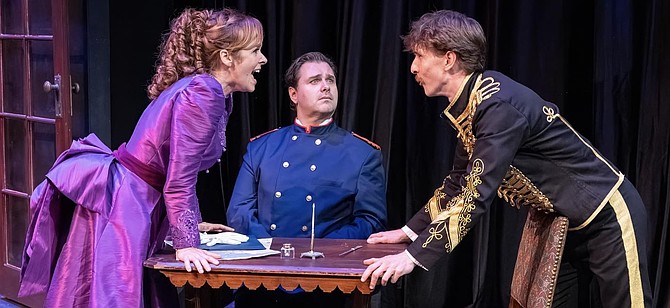
The setting is the comically short, two-week, 1885 Serbo-Bulgarian war, seen from the point of view of the Petkoffs, a Bulgarian family. The father, Major Petkoff (Manny Fernandez), is an officer in the army. His wife Catherine (Melissa Fernandez) wishes for her daughter Raina (Megan Carmitchel) to marry Sergius (Spencer Gerber). The play begins as the mother and daughter receive word that the Bulgarians have won the war and Sergius is the hero.
An evening of celebration ensues. After everyone retires, a bedraggled and weary enemy soldier (MJ Sieber) climbs up a drainpipe, onto a balcony, and into Raina’s bedroom, threatening her with a gun. Tension abates somewhat when she discovers he is less fierce and more fascinating than she first thought. It turns out he is not actually Serbian, but a Swiss mercenary who’s seen enough war to have lost any romantic notions of glory. He thinks escaping certain death is worth being thought a coward for running away —a completely foreign and ignoble idea to Raina. Nevertheless, she begins to pity him, hides him for the night, during which he shares his stories, including his perspective on her “hero” fiance’s actions in the battle. She angrily defends her man's honor, but the seed of doubt has been planted.
When the soldier revisits the Petkoffs to return a borrowed coat—newly scrubbed and dashing in his uniform — he encounters the fiancé and quickly begins to unravel his romanticism as well, much to the improvement of everyone’s future happiness.
Director Deborah Gilmour Smyth chose to have her cast play this very broadly. Think twirling mustache and fainting ladies. It was a bold choice, and I think it worked. (Smyth, by the way, played Raisa in LPT’s premier of Arms and the Man in the 1980s.)
After the play, I exited onto Orange with three well-(under)dressed boomer couples. Their post-play conversation revealed that the outing was clearly the wives’ idea. The remark that stays with me came from one of the gentlemen, who begrudgingly admitted the play was funny, adding, “It was kinda like Shakespeare — but you could understand more words.”
I’m pretty sure neither the Bard nor Bernard would be pleased by that comparison, but it made me guffaw into my fist — and it validated Smyth’s broad approach.
Through November 16
Here's something you might be interested in.
Theater Review: Arms and the Man at Lamb's Players Theatre
All's fair in love and war

Theater Review: Arms and the Man at Lamb's Players Theatre
All's fair in love and war
Which of the six of me is the real man? That’s the question that torments me. One of them is a hero, another a buffoon, another a humbug, another perhaps a bit of a blackguard. And one, at least, is a coward — jealous, like all cowards.
Another title for George Bernard Shaw’s delightfully clever play might be “All’s Fair in Love and War”— in which he mercilessly skewers romantic ideas of both.
The setting is the comically short, two-week, 1885 Serbo-Bulgarian war, seen from the point of view of the Petkoffs, a Bulgarian family. The father, Major Petkoff (Manny Fernandez), is an officer in the army. His wife Catherine (Melissa Fernandez) wishes for her daughter Raina (Megan Carmitchel) to marry Sergius (Spencer Gerber). The play begins as the mother and daughter receive word that the Bulgarians have won the war and Sergius is the hero.
An evening of celebration ensues. After everyone retires, a bedraggled and weary enemy soldier (MJ Sieber) climbs up a drainpipe, onto a balcony, and into Raina’s bedroom, threatening her with a gun. Tension abates somewhat when she discovers he is less fierce and more fascinating than she first thought. It turns out he is not actually Serbian, but a Swiss mercenary who’s seen enough war to have lost any romantic notions of glory. He thinks escaping certain death is worth being thought a coward for running away —a completely foreign and ignoble idea to Raina. Nevertheless, she begins to pity him, hides him for the night, during which he shares his stories, including his perspective on her “hero” fiance’s actions in the battle. She angrily defends her man's honor, but the seed of doubt has been planted.
When the soldier revisits the Petkoffs to return a borrowed coat—newly scrubbed and dashing in his uniform — he encounters the fiancé and quickly begins to unravel his romanticism as well, much to the improvement of everyone’s future happiness.
Director Deborah Gilmour Smyth chose to have her cast play this very broadly. Think twirling mustache and fainting ladies. It was a bold choice, and I think it worked. (Smyth, by the way, played Raisa in LPT’s premier of Arms and the Man in the 1980s.)
After the play, I exited onto Orange with three well-(under)dressed boomer couples. Their post-play conversation revealed that the outing was clearly the wives’ idea. The remark that stays with me came from one of the gentlemen, who begrudgingly admitted the play was funny, adding, “It was kinda like Shakespeare — but you could understand more words.”
I’m pretty sure neither the Bard nor Bernard would be pleased by that comparison, but it made me guffaw into my fist — and it validated Smyth’s broad approach.
Through November 16
Comments