

Here's something you might be interested in.
Ask a Hipster — Advice you didn't know you needed
Big Screen — Movie commentary
Blurt — Music's inside track
Booze News — San Diego spirits
Classical Music — Immortal beauty
Classifieds — Free and easy
Close to Home — What it’s like on the street where you live
Cover Stories — Front-page features
Drinks All Around — Bartenders' drink recipes
Excerpts — Literary and spiritual excerpts
Feast! — Food & drink reviews
Feature Stories — Local news & stories
Fishing Report — What’s getting hooked from ship and shore
From the Archives — Spotlight on the past
Golden Dreams — Talk of the town
The Gonzo Report — Making the musical scene, or at least reporting from it
Letters — Our inbox
Movies@Home — Local movie buffs share favorites
Movie Reviews — Our critics' picks and pans
Musician Interviews — Up close with local artists
Neighborhood News from Stringers — Hyperlocal news
News Ticker — News & politics
Obermeyer — San Diego politics illustrated
Outdoors — Weekly changes in flora and fauna
Overheard in San Diego — Eavesdropping illustrated
Poetry — The old and the new
Reader Travel — Travel section built by travelers
Reading — The hunt for intellectuals
Roam-O-Rama — SoCal's best hiking/biking trails
San Diego Beer — Inside San Diego suds
SD on the QT — Almost factual news
Sheep and Goats — Places of worship
Special Issues — The best of
Street Style — San Diego streets have style
Surf Diego — Real stories from those braving the waves
Theater — On stage in San Diego this week
Tin Fork — Silver spoon alternative
Under the Radar — Matt Potter's undercover work
Unforgettable — Long-ago San Diego
Unreal Estate — San Diego's priciest pads
Your Week — Daily event picks
Theater review: The Counter at Moxie Theatre
Chatting about life (and its end) over that first cup of coffee
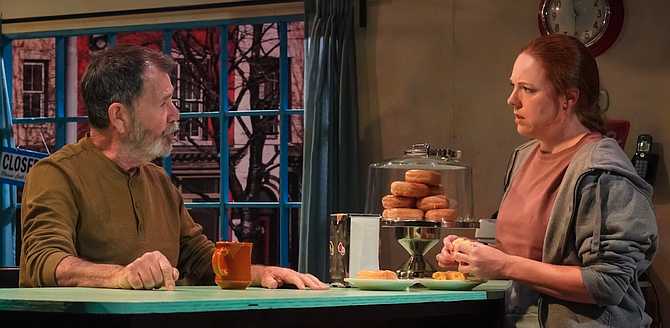
The tone is set before the stage is — or rather, as the stage is: a waitress in a Main Street diner, getting the place ready to open for the morning crowd. Making coffee, drying mugs, filling the napkin dispenser — a dozen tasks, most of them done as the audience is still finding its seats. This will be a quotidian affair, nearly all of it conversations between Katie (Kate Rose Reynolds) and Paul (Mark Stevens), her first customer “every morning for the last two years.”
Well, not entirely quotidian. I don’t see nearly every show that plays in San Diego, though I do try to go where I’m invited. So I’m not any kind of authority on how many local productions feature an old man contemplating suicide. But after 2022’s The Outgoing Tide at North Coast Rep and 2024’s Chapatti at Scripps Ranch, and now this here play at Moxie, it does seem to be worth noting. (It also may be worth noting the outcomes, and the reasons given for them. That’s probably outside the critic’s purview, but then again, plays generally require life and struggle, the two things suicide obviates.)
But wait, you say. Paul makes a point of not committing suicide! He just gives a bottle of poison to his favorite waitress and asks her to dose his coffee some morning — the first and last surprise of his life. Totally different. He specifically says, “I’m not suicidal. I just want to go out on my own terms. And it’s not murder if it’s what I want.” Well, perhaps. I guess the important thing is that he believes it — though the courts and God (lapsed Catholic Paul rates His existence a solid “maybe”) might believe otherwise.
I’m getting ahead of myself. It’s not as if Paul opens the show with his request. First, the retired fireman reels off a list of things he’s noticed about Katie, including the way she deflects compliments, before making a proposal: “Nothing’s happening here. What if we decide to become friends? Tough talk.” He starts by sharing the secret that he’s 11 years sober. She replies that she has 27 saved voicemails from a guy in the City who she ghosted after he failed to reciprocate a kiss. Paul brings the tough talk: “Your secret is that you gave up on life” — doubly tough from a guy who’s decided he’s just done.
There’s more to it than that, of course. Paul has his reasons for wanting to die, and Katie has her reasons for wanting to keep things simple. Katie has her reasons why she thinks Paul might want to stick around, and Paul has his reasons for thinking Katie should leave. Being older, he’s more certain in his judgments, though the play allows that certain may not be the same as correct. But what makes their running conversation engaging is that it rarely plays as an argument. People get upset. They even stop talking for a bit. But they don’t ever stop listening. A friendship that begins with the proposal of friendship may be artificial to the point of absurdity. But by play’s end, while Katie and Paul may not be fellow travelers, they are no longer strangers on the path — and they are no longer alone.
Here's something you might be interested in.
Theater review: The Counter at Moxie Theatre
Chatting about life (and its end) over that first cup of coffee

Theater review: The Counter at Moxie Theatre
Chatting about life (and its end) over that first cup of coffee
The tone is set before the stage is — or rather, as the stage is: a waitress in a Main Street diner, getting the place ready to open for the morning crowd. Making coffee, drying mugs, filling the napkin dispenser — a dozen tasks, most of them done as the audience is still finding its seats. This will be a quotidian affair, nearly all of it conversations between Katie (Kate Rose Reynolds) and Paul (Mark Stevens), her first customer “every morning for the last two years.”
Well, not entirely quotidian. I don’t see nearly every show that plays in San Diego, though I do try to go where I’m invited. So I’m not any kind of authority on how many local productions feature an old man contemplating suicide. But after 2022’s The Outgoing Tide at North Coast Rep and 2024’s Chapatti at Scripps Ranch, and now this here play at Moxie, it does seem to be worth noting. (It also may be worth noting the outcomes, and the reasons given for them. That’s probably outside the critic’s purview, but then again, plays generally require life and struggle, the two things suicide obviates.)
But wait, you say. Paul makes a point of not committing suicide! He just gives a bottle of poison to his favorite waitress and asks her to dose his coffee some morning — the first and last surprise of his life. Totally different. He specifically says, “I’m not suicidal. I just want to go out on my own terms. And it’s not murder if it’s what I want.” Well, perhaps. I guess the important thing is that he believes it — though the courts and God (lapsed Catholic Paul rates His existence a solid “maybe”) might believe otherwise.
I’m getting ahead of myself. It’s not as if Paul opens the show with his request. First, the retired fireman reels off a list of things he’s noticed about Katie, including the way she deflects compliments, before making a proposal: “Nothing’s happening here. What if we decide to become friends? Tough talk.” He starts by sharing the secret that he’s 11 years sober. She replies that she has 27 saved voicemails from a guy in the City who she ghosted after he failed to reciprocate a kiss. Paul brings the tough talk: “Your secret is that you gave up on life” — doubly tough from a guy who’s decided he’s just done.
There’s more to it than that, of course. Paul has his reasons for wanting to die, and Katie has her reasons for wanting to keep things simple. Katie has her reasons why she thinks Paul might want to stick around, and Paul has his reasons for thinking Katie should leave. Being older, he’s more certain in his judgments, though the play allows that certain may not be the same as correct. But what makes their running conversation engaging is that it rarely plays as an argument. People get upset. They even stop talking for a bit. But they don’t ever stop listening. A friendship that begins with the proposal of friendship may be artificial to the point of absurdity. But by play’s end, while Katie and Paul may not be fellow travelers, they are no longer strangers on the path — and they are no longer alone.
Comments