

Here's something you might be interested in.
Ask a Hipster — Advice you didn't know you needed
Big Screen — Movie commentary
Blurt — Music's inside track
Booze News — San Diego spirits
Classical Music — Immortal beauty
Classifieds — Free and easy
Close to Home — What it’s like on the street where you live
Cover Stories — Front-page features
Drinks All Around — Bartenders' drink recipes
Excerpts — Literary and spiritual excerpts
Feast! — Food & drink reviews
Feature Stories — Local news & stories
Fishing Report — What’s getting hooked from ship and shore
From the Archives — Spotlight on the past
Golden Dreams — Talk of the town
The Gonzo Report — Making the musical scene, or at least reporting from it
Letters — Our inbox
Movies@Home — Local movie buffs share favorites
Movie Reviews — Our critics' picks and pans
Musician Interviews — Up close with local artists
Neighborhood News from Stringers — Hyperlocal news
News Ticker — News & politics
Obermeyer — San Diego politics illustrated
Outdoors — Weekly changes in flora and fauna
Overheard in San Diego — Eavesdropping illustrated
Poetry — The old and the new
Reader Travel — Travel section built by travelers
Reading — The hunt for intellectuals
Roam-O-Rama — SoCal's best hiking/biking trails
San Diego Beer — Inside San Diego suds
SD on the QT — Almost factual news
Sheep and Goats — Places of worship
Special Issues — The best of
Street Style — San Diego streets have style
Surf Diego — Real stories from those braving the waves
Theater — On stage in San Diego this week
Tin Fork — Silver spoon alternative
Under the Radar — Matt Potter's undercover work
Unforgettable — Long-ago San Diego
Unreal Estate — San Diego's priciest pads
Your Week — Daily event picks
Theater review: House of India at The Old Globe
A changing world vs. a traditional menu
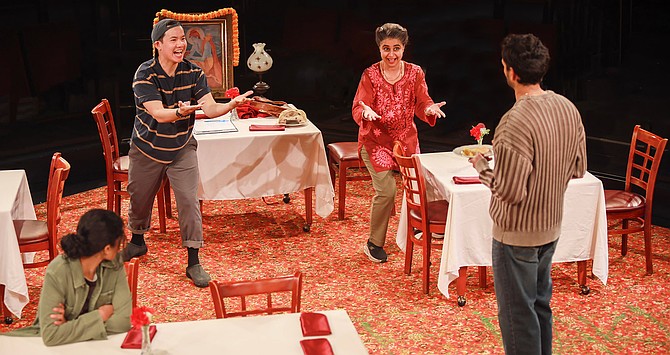
Deepak Kumar’s story of a Midwestern strip-mall restaurant in crisis is…wait, wait, is it the strip-mall restaurant that’s in crisis, or is it the family that owns the strip-mall restaurant? What’s that you say? Why can’t it be both? Now you sound like Jacob, the ambitious young chef who opens the play by trying to convince owner Ananya to try his “kootaco” — koottu in a tortilla instead of Indian chapati. Ananya is having none of it: “I would rather die a hundred times!” she cries — even if such an innovation might help save the business.
Why exactly would she rather die a hundred times? That’s tricky. The old clientele liked the traditional menu — it reminded them of home — but the old clientele has assimilated and moved out of Akron. No matter: “I’m not going to ruin my culture for a quick dollar!” she declares. (Nobody tell her that tomatoes didn’t become a staple in Italy until the 1800s; better, surely, to just let House of India die.) But then, it’s not just her culture she wants to honor; it’s also the legacy of her dear departed husband, who started the place. But then, as Jacob notes, he added avocado to the roti. And it’s not like she wants her kids to take over the family business — she laments daughter Vaidhei’s failure to launch, and praises son Vikram for moving to New York to make it as a writer. (Three years he’s been gone, but now he’s back to write about the House, observing, “I spent so much time here, but I never really saw it.”) Or that she even wants to hang on to the immigrant’s dream of keeping her identity while making it in America.
The point is, she doesn’t want things to change, even though the world has changed around her. And then the world forces the issue: someone breaks in and spraypaints “Go Home Paki” on the beautiful carpet. (It’s a fascinating theatrical moment: on television, the actual act of vandalism would be depicted with a few quick shots leading up to the big reveal. Here, we have to watch and wait as our guy shakes and sprays, sprays and shakes. Hating takes work! Elsewhere, however, the play does feel a bit like television. It’s there in the situations: Ananya says, “Let’s pray that Rama will send some sign that things will be all right,” and right on cue, Jacob runs on stage and announces himself. And it’s there in the big reaction lines, as when Jacob asks rhetorically, “What’s more relatable to Americans than a hate crime?”) It doesn’t matter that they’re Indian and not Pakistani; the message is clear and the damage is done. They can’t really afford to close down for clean-up; something else must be tried.
And that something is what takes us from restaurant in crisis to family in crisis — with Jacob serving as a quasi-adoptee, aka, the son Dad never had(!) Everybody’s got issues and secrets, and they all both play into and come to light during the events that follow. Some are more compelling than others. There’s a sharpness to the generational disagreement over going public about the hate crime — “If you’re not monetizing your trauma, you’re losing!” vs. “We won’t shame ourselves for money!” But there's a silliness to Jacob’s claim that his father was a loser for working in IT, a career choice that says “you’re agreeing with the universe that you’re mediocre.”
On the one hand, it’s impressive how many dynamics Kumar and his cast can cram into a single act and still achieve a believable resolution. On the other, the constant relational revelations can get a bit dramatically dizzying. Still, it's a handsomely mounted show — does anyone do more with lighting than they do at The Sheryl and Harvey White Theatre? — and like any good strip-mall restaurant, it just wants to send you home happy.
Here's something you might be interested in.
Theater review: House of India at The Old Globe
A changing world vs. a traditional menu

Theater review: House of India at The Old Globe
A changing world vs. a traditional menu
Deepak Kumar’s story of a Midwestern strip-mall restaurant in crisis is…wait, wait, is it the strip-mall restaurant that’s in crisis, or is it the family that owns the strip-mall restaurant? What’s that you say? Why can’t it be both? Now you sound like Jacob, the ambitious young chef who opens the play by trying to convince owner Ananya to try his “kootaco” — koottu in a tortilla instead of Indian chapati. Ananya is having none of it: “I would rather die a hundred times!” she cries — even if such an innovation might help save the business.
Why exactly would she rather die a hundred times? That’s tricky. The old clientele liked the traditional menu — it reminded them of home — but the old clientele has assimilated and moved out of Akron. No matter: “I’m not going to ruin my culture for a quick dollar!” she declares. (Nobody tell her that tomatoes didn’t become a staple in Italy until the 1800s; better, surely, to just let House of India die.) But then, it’s not just her culture she wants to honor; it’s also the legacy of her dear departed husband, who started the place. But then, as Jacob notes, he added avocado to the roti. And it’s not like she wants her kids to take over the family business — she laments daughter Vaidhei’s failure to launch, and praises son Vikram for moving to New York to make it as a writer. (Three years he’s been gone, but now he’s back to write about the House, observing, “I spent so much time here, but I never really saw it.”) Or that she even wants to hang on to the immigrant’s dream of keeping her identity while making it in America.
The point is, she doesn’t want things to change, even though the world has changed around her. And then the world forces the issue: someone breaks in and spraypaints “Go Home Paki” on the beautiful carpet. (It’s a fascinating theatrical moment: on television, the actual act of vandalism would be depicted with a few quick shots leading up to the big reveal. Here, we have to watch and wait as our guy shakes and sprays, sprays and shakes. Hating takes work! Elsewhere, however, the play does feel a bit like television. It’s there in the situations: Ananya says, “Let’s pray that Rama will send some sign that things will be all right,” and right on cue, Jacob runs on stage and announces himself. And it’s there in the big reaction lines, as when Jacob asks rhetorically, “What’s more relatable to Americans than a hate crime?”) It doesn’t matter that they’re Indian and not Pakistani; the message is clear and the damage is done. They can’t really afford to close down for clean-up; something else must be tried.
And that something is what takes us from restaurant in crisis to family in crisis — with Jacob serving as a quasi-adoptee, aka, the son Dad never had(!) Everybody’s got issues and secrets, and they all both play into and come to light during the events that follow. Some are more compelling than others. There’s a sharpness to the generational disagreement over going public about the hate crime — “If you’re not monetizing your trauma, you’re losing!” vs. “We won’t shame ourselves for money!” But there's a silliness to Jacob’s claim that his father was a loser for working in IT, a career choice that says “you’re agreeing with the universe that you’re mediocre.”
On the one hand, it’s impressive how many dynamics Kumar and his cast can cram into a single act and still achieve a believable resolution. On the other, the constant relational revelations can get a bit dramatically dizzying. Still, it's a handsomely mounted show — does anyone do more with lighting than they do at The Sheryl and Harvey White Theatre? — and like any good strip-mall restaurant, it just wants to send you home happy.
Comments