

Here's something you might be interested in.
Ask a Hipster — Advice you didn't know you needed
Big Screen — Movie commentary
Blurt — Music's inside track
Booze News — San Diego spirits
Classical Music — Immortal beauty
Classifieds — Free and easy
Close to Home — What it’s like on the street where you live
Cover Stories — Front-page features
Drinks All Around — Bartenders' drink recipes
Excerpts — Literary and spiritual excerpts
Feast! — Food & drink reviews
Feature Stories — Local news & stories
Fishing Report — What’s getting hooked from ship and shore
From the Archives — Spotlight on the past
Golden Dreams — Talk of the town
The Gonzo Report — Making the musical scene, or at least reporting from it
Letters — Our inbox
Movies@Home — Local movie buffs share favorites
Movie Reviews — Our critics' picks and pans
Musician Interviews — Up close with local artists
Neighborhood News from Stringers — Hyperlocal news
News Ticker — News & politics
Obermeyer — San Diego politics illustrated
Outdoors — Weekly changes in flora and fauna
Overheard in San Diego — Eavesdropping illustrated
Poetry — The old and the new
Reader Travel — Travel section built by travelers
Reading — The hunt for intellectuals
Roam-O-Rama — SoCal's best hiking/biking trails
San Diego Beer — Inside San Diego suds
SD on the QT — Almost factual news
Sheep and Goats — Places of worship
Special Issues — The best of
Street Style — San Diego streets have style
Surf Diego — Real stories from those braving the waves
Theater — On stage in San Diego this week
Tin Fork — Silver spoon alternative
Under the Radar — Matt Potter's undercover work
Unforgettable — Long-ago San Diego
Unreal Estate — San Diego's priciest pads
Your Week — Daily event picks
Theater review: Hedda Gabler at The Old Globe
Katie Holmes stars as the famously complicated, ill-married woman
At the end of the Old Globe’s adaptation of Henrik Ibsen’s masterful, quietly scathing Hedda Gabler, someone asks about the title character, “What kind of person does something like that?” It’s a fine question for discussion after the show, because everything that precedes the question helps to answer it. (And for some of us, the answer may be uncomfortably close to Flaubert’s famous “Madame Bovary, c’est moi.”)
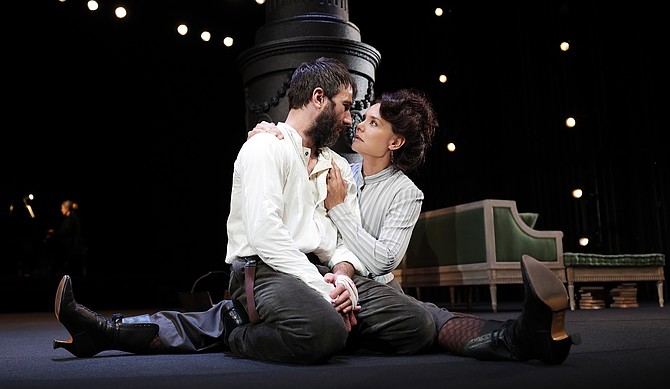
When I visited the Old Globe’s press page to find a photo to illustrate this review, I was almost certain I’d find the above image. And I’m so glad I did. It makes my job much easier. The image captures a moment of physical genius — whether it came from star Katie Holmes, director Barry Edelstein, movement/intimacy coordinator Chelsey Arce, or Ibsen adapter Erin Cressida Wilson. It captures Hedda Gabler.
Her posture is that of a carefree — careless? — child at play: seated on the ground, legs splayed straight out, toes pointed up. One might expect to see wildflowers piled in front of her, and little Hedda weaving them into a crown, oblivious to everything around her. And Hedda is a child: the beautiful, popular daughter of a general, she was never made to grow up. “My dream was to have parties!” she declares early on. Denied that, her greatest fear is that “I will bore myself to death here.” She looks around and says, “What am I supposed to do with myself?” Bereft of purpose, she craves distraction. She delights in an acquaintance’s story of an affair the way a housewife might delight in a tawdry soap opera, or the way social media addicts might delight in influencer drama. As for herself: “Six months and not a single flirtation,” she laments, even though those six months were spent on a honeymoon.
And she is oblivious. When the man to whom she directs this lament calls her bluff, she is embarrassed and alarmed. She wanted flirtation, not fornication. Later, when she tries her hand at a vulgar proposition, the man replies, “Is that what you want?” and she is forced to admit, “Probably not.” Throughout the play’s brisk 90 minutes, she acts with thoughtless impulsivity — even her great crime near the play’s end feels like the act of a child lashing out after being hurt. She’s a bit wicked, but she’s no schemer.
But of course, Hedda is also not a child, and it’s not wildflowers between her legs, capturing her attention. It’s a man, a man with whom she has a history, a man who is at least partly to blame for her predicament. It’s noteworthy that in this moment, Hedda clings to him, but he does not cling to her. They are so close, and she is so open, but they are not intimate. “We all need someone to live for,” declares the grieving aunt of Hedda’s new husband. And that is precisely what Hedda lacks. (It seems telling that there is no mention of her mother, only the distant father who bequeathed her the pistols she casually brandishes now and then.) Instead, she dreads “the constant presence of one single person” — a person she is supposed to love. It is shocking when she expresses admiration for a man with “the will to break up with life.” But it grows less shocking upon reflection.
Ibsen’s play is over 130 years old, but Hedda Gabler remains a contemporary character, and so the play responds well to the use of blunt modern vernacular, even if the costumes and furnishings remain antique. (Gotta keep that woodstove!) The runtime might have been even shorter, but the awkward pause makes enough appearances to deserve its own billing. The tone is strange, even unsettling; here and there, the viewer may wonder, “Was that a joke? Ought I to laugh?” Maybe, maybe not.
Here's something you might be interested in.
Theater review: Hedda Gabler at The Old Globe
Katie Holmes stars as the famously complicated, ill-married woman

Theater review: Hedda Gabler at The Old Globe
Katie Holmes stars as the famously complicated, ill-married woman
At the end of the Old Globe’s adaptation of Henrik Ibsen’s masterful, quietly scathing Hedda Gabler, someone asks about the title character, “What kind of person does something like that?” It’s a fine question for discussion after the show, because everything that precedes the question helps to answer it. (And for some of us, the answer may be uncomfortably close to Flaubert’s famous “Madame Bovary, c’est moi.”)
When I visited the Old Globe’s press page to find a photo to illustrate this review, I was almost certain I’d find the above image. And I’m so glad I did. It makes my job much easier. The image captures a moment of physical genius — whether it came from star Katie Holmes, director Barry Edelstein, movement/intimacy coordinator Chelsey Arce, or Ibsen adapter Erin Cressida Wilson. It captures Hedda Gabler.
Her posture is that of a carefree — careless? — child at play: seated on the ground, legs splayed straight out, toes pointed up. One might expect to see wildflowers piled in front of her, and little Hedda weaving them into a crown, oblivious to everything around her. And Hedda is a child: the beautiful, popular daughter of a general, she was never made to grow up. “My dream was to have parties!” she declares early on. Denied that, her greatest fear is that “I will bore myself to death here.” She looks around and says, “What am I supposed to do with myself?” Bereft of purpose, she craves distraction. She delights in an acquaintance’s story of an affair the way a housewife might delight in a tawdry soap opera, or the way social media addicts might delight in influencer drama. As for herself: “Six months and not a single flirtation,” she laments, even though those six months were spent on a honeymoon.
And she is oblivious. When the man to whom she directs this lament calls her bluff, she is embarrassed and alarmed. She wanted flirtation, not fornication. Later, when she tries her hand at a vulgar proposition, the man replies, “Is that what you want?” and she is forced to admit, “Probably not.” Throughout the play’s brisk 90 minutes, she acts with thoughtless impulsivity — even her great crime near the play’s end feels like the act of a child lashing out after being hurt. She’s a bit wicked, but she’s no schemer.
But of course, Hedda is also not a child, and it’s not wildflowers between her legs, capturing her attention. It’s a man, a man with whom she has a history, a man who is at least partly to blame for her predicament. It’s noteworthy that in this moment, Hedda clings to him, but he does not cling to her. They are so close, and she is so open, but they are not intimate. “We all need someone to live for,” declares the grieving aunt of Hedda’s new husband. And that is precisely what Hedda lacks. (It seems telling that there is no mention of her mother, only the distant father who bequeathed her the pistols she casually brandishes now and then.) Instead, she dreads “the constant presence of one single person” — a person she is supposed to love. It is shocking when she expresses admiration for a man with “the will to break up with life.” But it grows less shocking upon reflection.
Ibsen’s play is over 130 years old, but Hedda Gabler remains a contemporary character, and so the play responds well to the use of blunt modern vernacular, even if the costumes and furnishings remain antique. (Gotta keep that woodstove!) The runtime might have been even shorter, but the awkward pause makes enough appearances to deserve its own billing. The tone is strange, even unsettling; here and there, the viewer may wonder, “Was that a joke? Ought I to laugh?” Maybe, maybe not.
Comments