

Here's something you might be interested in.
Ask a Hipster — Advice you didn't know you needed
Big Screen — Movie commentary
Blurt — Music's inside track
Booze News — San Diego spirits
Classical Music — Immortal beauty
Classifieds — Free and easy
Close to Home — What it’s like on the street where you live
Cover Stories — Front-page features
Drinks All Around — Bartenders' drink recipes
Excerpts — Literary and spiritual excerpts
Feast! — Food & drink reviews
Feature Stories — Local news & stories
Fishing Report — What’s getting hooked from ship and shore
From the Archives — Spotlight on the past
Golden Dreams — Talk of the town
The Gonzo Report — Making the musical scene, or at least reporting from it
Letters — Our inbox
Movies@Home — Local movie buffs share favorites
Movie Reviews — Our critics' picks and pans
Musician Interviews — Up close with local artists
Neighborhood News from Stringers — Hyperlocal news
News Ticker — News & politics
Obermeyer — San Diego politics illustrated
Outdoors — Weekly changes in flora and fauna
Overheard in San Diego — Eavesdropping illustrated
Poetry — The old and the new
Reader Travel — Travel section built by travelers
Reading — The hunt for intellectuals
Roam-O-Rama — SoCal's best hiking/biking trails
San Diego Beer — Inside San Diego suds
SD on the QT — Almost factual news
Sheep and Goats — Places of worship
Special Issues — The best of
Street Style — San Diego streets have style
Surf Diego — Real stories from those braving the waves
Theater — On stage in San Diego this week
Tin Fork — Silver spoon alternative
Under the Radar — Matt Potter's undercover work
Unforgettable — Long-ago San Diego
Unreal Estate — San Diego's priciest pads
Your Week — Daily event picks
Ed Bedford chews the Kraken at Kokopelli
From food cart to taco temple
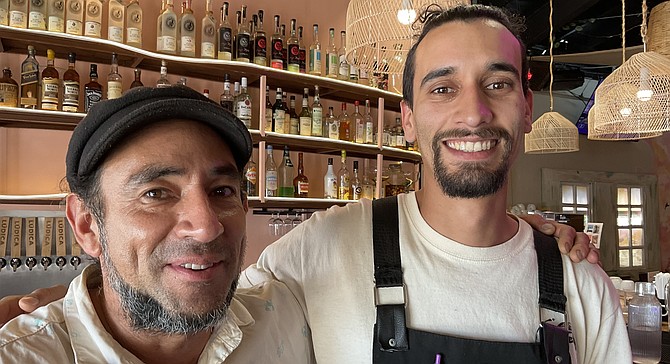
Pablo Campos with barman Isaak Guzman Pallan at Kokopelli.
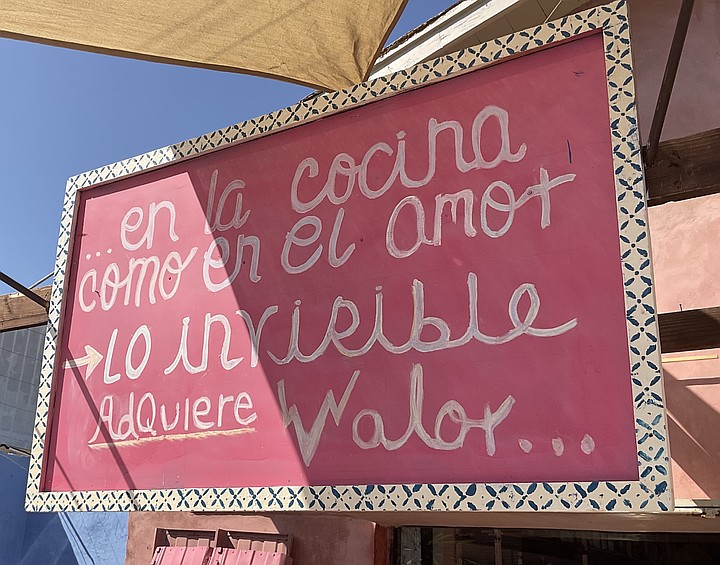
The flute-player is around here somewhere. Has to be. I’m on Río Colorado in the Colonia Marrón part of TJ, at the bougainvillea-and-canvas-shaded end of the calle. And ah. A sign. “In the kitchen, as in love, the invisible acquires value.” It reminds me of that other saying from the Mexican world: El amor is el principal condimento de una buena comida. Love is the main condiment of a good meal.
I’m relieved to see the sign, because I don’t see no names around. Just a few outside tables in the glaring sunshine that seems to be hitting in TJ harder than in San Diego today. I'm down here looking for a legendary name: “Kokopelli.” Last time I saw it, it was attached to a food cart made of tomato cartons on Madero, the avenue that runs parallel to Revolución. Actually, I couldn't see much of the food truck, because so many lunchtime office workers were crowded around it. That’s how much TJ had fallen for Guillermo “Oso” Campos, a graduate of Tijuana’s Culinary Art School, when he decided to make the street his culinary scene. I'm hoping to find him and his brother Pablo here in their new brick-and-mortal digs.
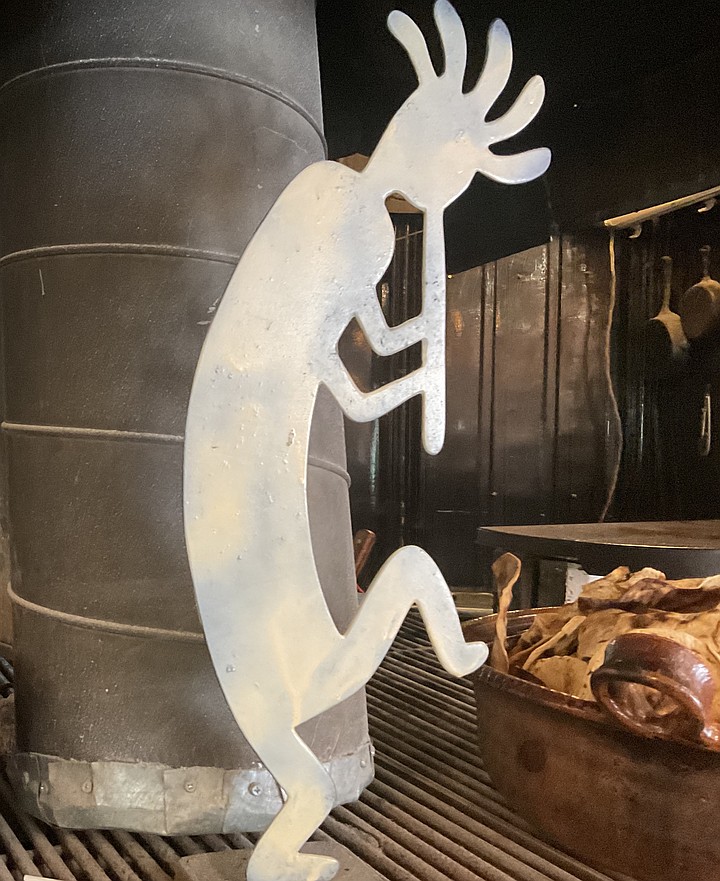
In the end, the only reason I find Kokopelli's new location is thanks to the flute-player himself: the dancing trickster god whose silhouette stands between the street and the kitchen. He's playing away as he always has for the Hopi people (as well as for what they call “the sunbathers,” local snakes who like to warm themselves in the morning sun). I straightaway start worrying that their prices may have taken an upward turn — overhead and all that. But have to say, it’s a cool space. A dozen triangular sun shades make you feel like a yacht race is going on over your head.
I start hearing other customers talking like the place is called Tras Horizonte. Beyond the horizon. I ask the guy at the bar, Isaak. He says the answer is yes, kinda. “It’s now known as ‘Tras Horizonte by Kokopelli.’ Same people, same crazy taco food. Uh, something to drink?”
Well, it’s about 2.30 pm here, but 5 o’clock somewhere, so I ask him about their beers. The fact that they have chevas here at Kokopelli is a step up from when they were a food cart. Interesting choices. A stout called “Grandma’s Breakfast.” Beer-makers from right here in Tijuana: Lúdica Brewery — “Playful Brewery.” Or Ensenada: a smoked Piloncillo stout. Piloncillo? “Little loaf" or "little pillow" — a reference to those cones of compressed unrefined dark brown sugar that you can buy at, say Mercado Hidalgo. I have to try this stout. It costs 100 pesos, about US$5. And yes, when I get it, it’s super dark, smoky, and with that overlay of unrefined, rum-like, earthy sweetness. Yum.
So now, food. Tacos, natch.
“Well,” says Isaak, “they do keep their classic tacos like the Kraken And the Gunpowder.”
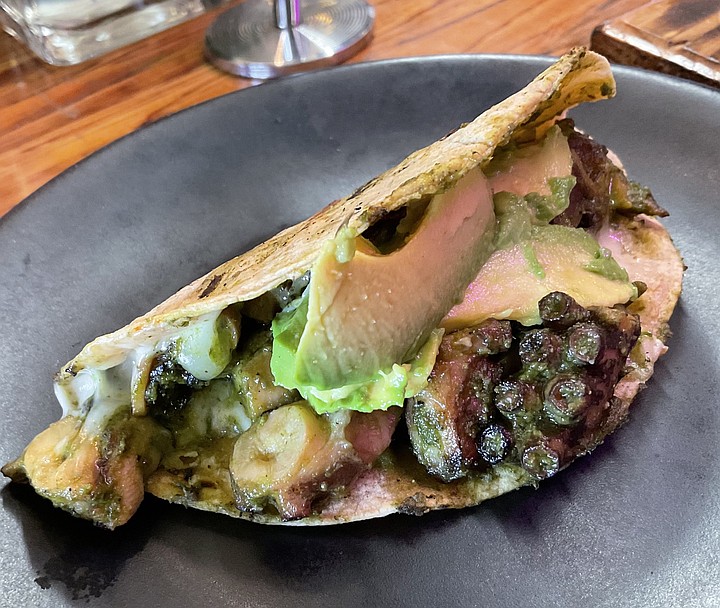
Oh yes. The Kraken, Oso’s famous taco from food cart days, about $5. Of course it’s octopus. "Release the Kraken!" Consists of pulpo asado — octopus grilled over mesquite — on a charred corn tortilla with Mexican pesto, grilled cheese and avocado. Pretty simple, but I have to get one. And mmm. Wickedly luscious in the delivery. I haven’t had octopus taste so good since, well, last time I was at Kokopelli’s food cart.
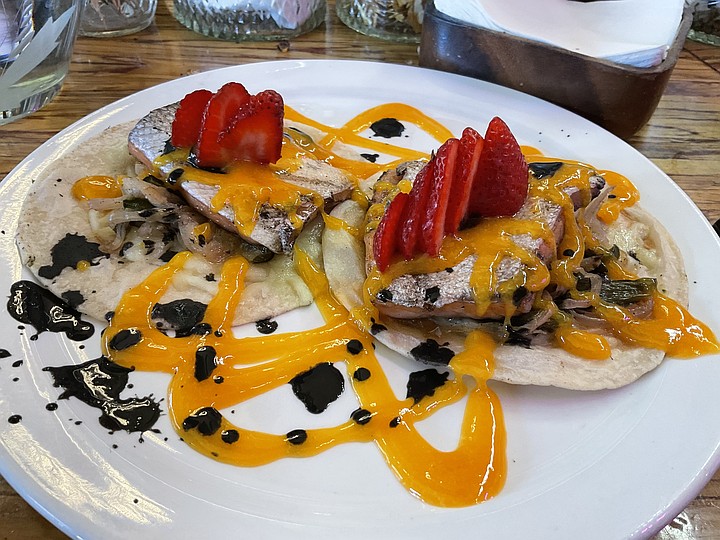
And the Gunpowder taco? It’s a riot of color. Basically smoked salmon with chilmole, a mash-up of chiles and mole, with grilled jack cheese, and rajas poblanas — roasted poblano pepper strips in a cream sauce, plus ribbons of golden sweet mango sauce, and black splots of octopus thrown at the plate. I see it because Pablo Campos has sat down next to me at the bar, toting this crazy rainbow taco dish. “Oso and I created these when we were seeing red about the Mexican elections,” he says, “so we put in the golden mango sauce for bile, red strawberries for blood, octopus ink to show our black anger! Here.”
He slides one of his two tacos over to my plate. Wow. “It’s too much for me anyway,” he says.
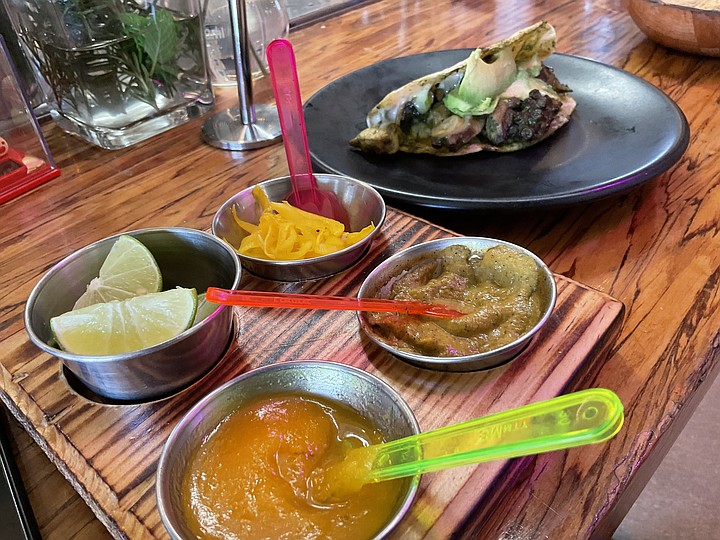
What can I do but, well, bite in? Ho boy. The silver-skinned salmon, the savory sauces, the sweet mango. Plus I add flavors from the plate of limes, onions with habanero, jalapeño and pineapple, and jalapeños mashed with pumpkin seeds. Beautiful combo add-ons!
Turns out The Gunpowder’s called the Pólvora. Oh yes. “Gunpowder” in Spanish. I think about sampling the chapulinas — fried crickets, packed with protein, with garlic and chile de arbol, $5). But no, I’m full already. So we just talk, while I quaff this Little Pillow stout.
“It was my grandma taught me how to cook,” says Pablo. I know his story is way-different than his brother’s: Oso graduated from the prestigious Culinary Arts School here in TJ, and then went straight to work with a three-star Michelin restaurant in the Netherlands. About five years later, he returned, and was going to start his own classy eatery here in TJ. Then the economic crisis of 2009 hit. The bottom fell out. That’s when he made the momentous decision to take his high-class cooking to the streets. Our good luck!
Yet Pablo is showing mixed feelings. “The truth? I miss those days,” he says. “We’ve become bigger, but I kind of hanker for those crazy days again, to go small again, to start over, in the street. Think of Hernán Cortez the Conquistador! He burned all his ships to force his men to commit to his New World venture. I miss that feeling, the fun of the struggle.”
We cock our ears. Is that a flute we hear playing?
The Place: Tras Horizonte by Kokopelli, Rio Colorado 9680, Colonia Marron 22015, Tijuana, +52.664.648-7806
Hours: 9am-9pm, Wednesday; 9am-11pm, Thursday; 9am-1am, Friday, Saturday; 9am-7pm, Sunday; closed Monday, Tuesday
Taxi from the border: $15
Here's something you might be interested in.
Ed Bedford chews the Kraken at Kokopelli
From food cart to taco temple

Ed Bedford chews the Kraken at Kokopelli
From food cart to taco temple
Pablo Campos with barman Isaak Guzman Pallan at Kokopelli.
The flute-player is around here somewhere. Has to be. I’m on Río Colorado in the Colonia Marrón part of TJ, at the bougainvillea-and-canvas-shaded end of the calle. And ah. A sign. “In the kitchen, as in love, the invisible acquires value.” It reminds me of that other saying from the Mexican world: El amor is el principal condimento de una buena comida. Love is the main condiment of a good meal.
I’m relieved to see the sign, because I don’t see no names around. Just a few outside tables in the glaring sunshine that seems to be hitting in TJ harder than in San Diego today. I'm down here looking for a legendary name: “Kokopelli.” Last time I saw it, it was attached to a food cart made of tomato cartons on Madero, the avenue that runs parallel to Revolución. Actually, I couldn't see much of the food truck, because so many lunchtime office workers were crowded around it. That’s how much TJ had fallen for Guillermo “Oso” Campos, a graduate of Tijuana’s Culinary Art School, when he decided to make the street his culinary scene. I'm hoping to find him and his brother Pablo here in their new brick-and-mortal digs.
In the end, the only reason I find Kokopelli's new location is thanks to the flute-player himself: the dancing trickster god whose silhouette stands between the street and the kitchen. He's playing away as he always has for the Hopi people (as well as for what they call “the sunbathers,” local snakes who like to warm themselves in the morning sun). I straightaway start worrying that their prices may have taken an upward turn — overhead and all that. But have to say, it’s a cool space. A dozen triangular sun shades make you feel like a yacht race is going on over your head.
I start hearing other customers talking like the place is called Tras Horizonte. Beyond the horizon. I ask the guy at the bar, Isaak. He says the answer is yes, kinda. “It’s now known as ‘Tras Horizonte by Kokopelli.’ Same people, same crazy taco food. Uh, something to drink?”
Well, it’s about 2.30 pm here, but 5 o’clock somewhere, so I ask him about their beers. The fact that they have chevas here at Kokopelli is a step up from when they were a food cart. Interesting choices. A stout called “Grandma’s Breakfast.” Beer-makers from right here in Tijuana: Lúdica Brewery — “Playful Brewery.” Or Ensenada: a smoked Piloncillo stout. Piloncillo? “Little loaf" or "little pillow" — a reference to those cones of compressed unrefined dark brown sugar that you can buy at, say Mercado Hidalgo. I have to try this stout. It costs 100 pesos, about US$5. And yes, when I get it, it’s super dark, smoky, and with that overlay of unrefined, rum-like, earthy sweetness. Yum.
So now, food. Tacos, natch.
“Well,” says Isaak, “they do keep their classic tacos like the Kraken And the Gunpowder.”
Oh yes. The Kraken, Oso’s famous taco from food cart days, about $5. Of course it’s octopus. "Release the Kraken!" Consists of pulpo asado — octopus grilled over mesquite — on a charred corn tortilla with Mexican pesto, grilled cheese and avocado. Pretty simple, but I have to get one. And mmm. Wickedly luscious in the delivery. I haven’t had octopus taste so good since, well, last time I was at Kokopelli’s food cart.
And the Gunpowder taco? It’s a riot of color. Basically smoked salmon with chilmole, a mash-up of chiles and mole, with grilled jack cheese, and rajas poblanas — roasted poblano pepper strips in a cream sauce, plus ribbons of golden sweet mango sauce, and black splots of octopus thrown at the plate. I see it because Pablo Campos has sat down next to me at the bar, toting this crazy rainbow taco dish. “Oso and I created these when we were seeing red about the Mexican elections,” he says, “so we put in the golden mango sauce for bile, red strawberries for blood, octopus ink to show our black anger! Here.”
He slides one of his two tacos over to my plate. Wow. “It’s too much for me anyway,” he says.
What can I do but, well, bite in? Ho boy. The silver-skinned salmon, the savory sauces, the sweet mango. Plus I add flavors from the plate of limes, onions with habanero, jalapeño and pineapple, and jalapeños mashed with pumpkin seeds. Beautiful combo add-ons!
Turns out The Gunpowder’s called the Pólvora. Oh yes. “Gunpowder” in Spanish. I think about sampling the chapulinas — fried crickets, packed with protein, with garlic and chile de arbol, $5). But no, I’m full already. So we just talk, while I quaff this Little Pillow stout.
“It was my grandma taught me how to cook,” says Pablo. I know his story is way-different than his brother’s: Oso graduated from the prestigious Culinary Arts School here in TJ, and then went straight to work with a three-star Michelin restaurant in the Netherlands. About five years later, he returned, and was going to start his own classy eatery here in TJ. Then the economic crisis of 2009 hit. The bottom fell out. That’s when he made the momentous decision to take his high-class cooking to the streets. Our good luck!
Yet Pablo is showing mixed feelings. “The truth? I miss those days,” he says. “We’ve become bigger, but I kind of hanker for those crazy days again, to go small again, to start over, in the street. Think of Hernán Cortez the Conquistador! He burned all his ships to force his men to commit to his New World venture. I miss that feeling, the fun of the struggle.”
We cock our ears. Is that a flute we hear playing?
The Place: Tras Horizonte by Kokopelli, Rio Colorado 9680, Colonia Marron 22015, Tijuana, +52.664.648-7806
Hours: 9am-9pm, Wednesday; 9am-11pm, Thursday; 9am-1am, Friday, Saturday; 9am-7pm, Sunday; closed Monday, Tuesday
Taxi from the border: $15
Comments