

Here's something you might be interested in.
Ask a Hipster — Advice you didn't know you needed
Big Screen — Movie commentary
Blurt — Music's inside track
Booze News — San Diego spirits
Classical Music — Immortal beauty
Classifieds — Free and easy
Close to Home — What it’s like on the street where you live
Cover Stories — Front-page features
Drinks All Around — Bartenders' drink recipes
Excerpts — Literary and spiritual excerpts
Feast! — Food & drink reviews
Feature Stories — Local news & stories
Fishing Report — What’s getting hooked from ship and shore
From the Archives — Spotlight on the past
Golden Dreams — Talk of the town
The Gonzo Report — Making the musical scene, or at least reporting from it
Letters — Our inbox
Movies@Home — Local movie buffs share favorites
Movie Reviews — Our critics' picks and pans
Musician Interviews — Up close with local artists
Neighborhood News from Stringers — Hyperlocal news
News Ticker — News & politics
Obermeyer — San Diego politics illustrated
Outdoors — Weekly changes in flora and fauna
Overheard in San Diego — Eavesdropping illustrated
Poetry — The old and the new
Reader Travel — Travel section built by travelers
Reading — The hunt for intellectuals
Roam-O-Rama — SoCal's best hiking/biking trails
San Diego Beer — Inside San Diego suds
SD on the QT — Almost factual news
Sheep and Goats — Places of worship
Special Issues — The best of
Street Style — San Diego streets have style
Surf Diego — Real stories from those braving the waves
Theater — On stage in San Diego this week
Tin Fork — Silver spoon alternative
Under the Radar — Matt Potter's undercover work
Unforgettable — Long-ago San Diego
Unreal Estate — San Diego's priciest pads
Your Week — Daily event picks
Players on a train
La Llorona on the Blue Line: a play in three trolleys
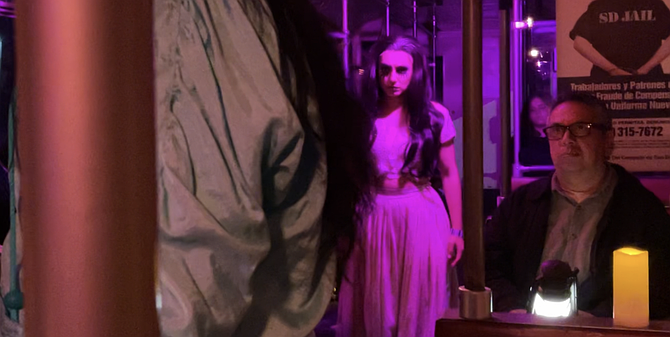
We’re at the end of the line, here at National City’s 24th Street station, where giant hopes came and went for San Diego, back in the late 1800s.
This was where they were expecting the grand trans-continental railroad to connect with San Diego. Indeed, the first trains from Back East did roll in here in November 1885, touching off one of the largest land booms in California. National City thought it had it made — that it would be, well, a National City. Today, the old wooden railway station they built still stands. It’s just the trains that aren’t coming in any more. LA made sure of that.
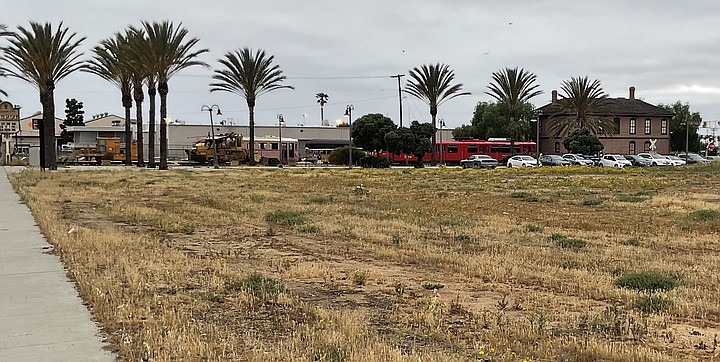
Back in 1885, this was going to be National City's version Grand Central Station.
But on this evening, there’s plenty happening in the three trolleys parked outside. They date back to 1920, 1946, and 1982. And tonight, they will host a kind of movable play: La Llorona On the Blue Line.
Here in the waiting room, the lights flicker out. In the dark, a couple of women scream.
“Alright alright!” says the conductor’s voice. “It’s just a power outage. Happens in the summer. Grab a lantern everybody. Train should be coming in shortly. Please be advised: these lanterns are property of the Blue Line. Turn them in at the end of your ride.”
Two women lunge at each other.
“But you’ve been gone away for a long time!”
“Keep your mouth shut!”
Things are definitely getting weird. The guard starts clicking tickets just as a beautiful yet ghastly woman in white stands up, shouting. “I am your worst nightmare! Have you started telling stories about me? That I’m a mother? That I’m a monster?”
Five minutes later, we, the audience, have been told to clamber aboard the second streetcar, the one from the 1920s. The woman in white comes too, scowling. We shrink back into our seats. Turns out she’s La Llorona, “the weeping one,” the mother from Mexican folklore who is said to have killed her children after her husband left her for another woman. Now, she has become a vengeful ghost who roams — always near water — looking for her children.
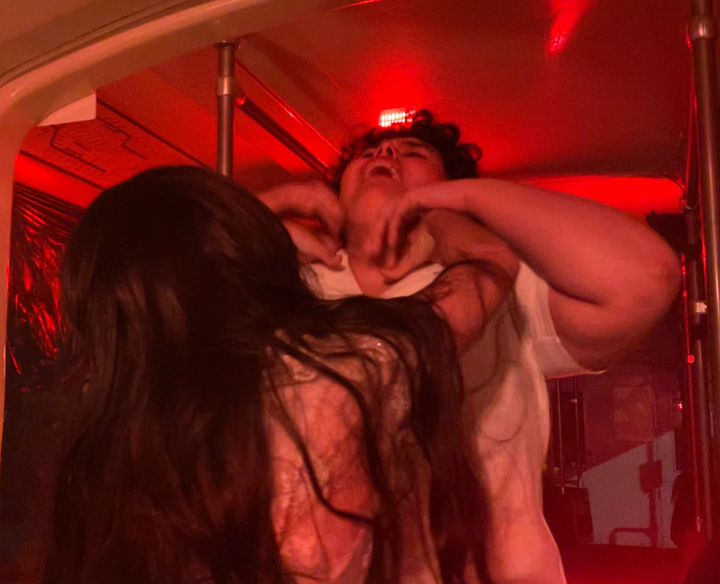
But tonight, she’s searching up and down the trolley aisles while the audience is sitting apprehensively, trying to keep their knees out of the way as the actors lunge past them.
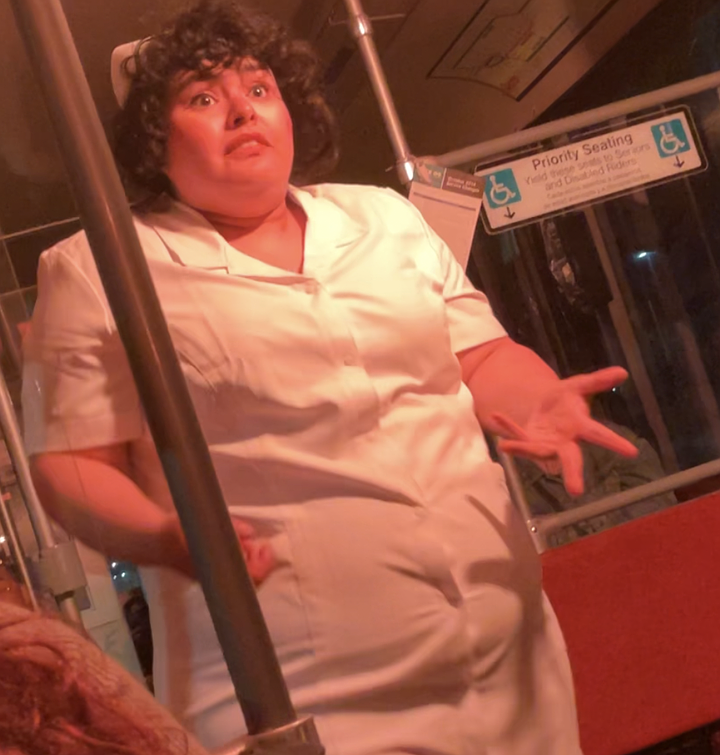
Charming, disturbing: Nurse Mary (Nancy Batres) faces La Llorona.
It’s an immersive kind of play. You get the openness between people that happens in real life when it’s standing room only in a rocking trolley car. People open up. A young woman is talking about trying to terminate a pregnancy. No big deal.
“I was inspired by stepping into these trains,” says playwright Mabelle Reynosa. “I was commissioned to write plays that were going to take place on board. And I didn’t know what I was going to write about. I knew that I wanted it to be a border play, but I didn’t know what it was until I first stepped into the cars and felt the energy.”
Reynosa wears black nail polish and black clothes, and flashes a cheeky smile that recalls Liza Minelli. I ask her what to watch for. “I write out of rage, I write for closure, and I write from curiosity,” she says. “What to watch for? Watch for who is telling the story. This story is about women. There is a line in there about, ‘Oh that’s not fair!’ This is the point! Back in 1920, there was no ‘fair’ for women. And even now, there is no ‘fair’ for women who fight back! Look at the swing against LGBTQ. So you’ve got to ask yourself, what are the stories that we’re hearing? Who’s telling them? And why are we believing those stories?”
As to the basic question: did La Llorona really kill her children? Or was it a lie put out by misogynist males? There is no answer in the play, only the question. I guess that’s a start.
Here's something you might be interested in.
Players on a train
La Llorona on the Blue Line: a play in three trolleys

Players on a train
La Llorona on the Blue Line: a play in three trolleys
We’re at the end of the line, here at National City’s 24th Street station, where giant hopes came and went for San Diego, back in the late 1800s.
This was where they were expecting the grand trans-continental railroad to connect with San Diego. Indeed, the first trains from Back East did roll in here in November 1885, touching off one of the largest land booms in California. National City thought it had it made — that it would be, well, a National City. Today, the old wooden railway station they built still stands. It’s just the trains that aren’t coming in any more. LA made sure of that.
Back in 1885, this was going to be National City's version Grand Central Station.
But on this evening, there’s plenty happening in the three trolleys parked outside. They date back to 1920, 1946, and 1982. And tonight, they will host a kind of movable play: La Llorona On the Blue Line.
Here in the waiting room, the lights flicker out. In the dark, a couple of women scream.
“Alright alright!” says the conductor’s voice. “It’s just a power outage. Happens in the summer. Grab a lantern everybody. Train should be coming in shortly. Please be advised: these lanterns are property of the Blue Line. Turn them in at the end of your ride.”
Two women lunge at each other.
“But you’ve been gone away for a long time!”
“Keep your mouth shut!”
Things are definitely getting weird. The guard starts clicking tickets just as a beautiful yet ghastly woman in white stands up, shouting. “I am your worst nightmare! Have you started telling stories about me? That I’m a mother? That I’m a monster?”
Five minutes later, we, the audience, have been told to clamber aboard the second streetcar, the one from the 1920s. The woman in white comes too, scowling. We shrink back into our seats. Turns out she’s La Llorona, “the weeping one,” the mother from Mexican folklore who is said to have killed her children after her husband left her for another woman. Now, she has become a vengeful ghost who roams — always near water — looking for her children.
But tonight, she’s searching up and down the trolley aisles while the audience is sitting apprehensively, trying to keep their knees out of the way as the actors lunge past them.
Charming, disturbing: Nurse Mary (Nancy Batres) faces La Llorona.
It’s an immersive kind of play. You get the openness between people that happens in real life when it’s standing room only in a rocking trolley car. People open up. A young woman is talking about trying to terminate a pregnancy. No big deal.
“I was inspired by stepping into these trains,” says playwright Mabelle Reynosa. “I was commissioned to write plays that were going to take place on board. And I didn’t know what I was going to write about. I knew that I wanted it to be a border play, but I didn’t know what it was until I first stepped into the cars and felt the energy.”
Reynosa wears black nail polish and black clothes, and flashes a cheeky smile that recalls Liza Minelli. I ask her what to watch for. “I write out of rage, I write for closure, and I write from curiosity,” she says. “What to watch for? Watch for who is telling the story. This story is about women. There is a line in there about, ‘Oh that’s not fair!’ This is the point! Back in 1920, there was no ‘fair’ for women. And even now, there is no ‘fair’ for women who fight back! Look at the swing against LGBTQ. So you’ve got to ask yourself, what are the stories that we’re hearing? Who’s telling them? And why are we believing those stories?”
As to the basic question: did La Llorona really kill her children? Or was it a lie put out by misogynist males? There is no answer in the play, only the question. I guess that’s a start.
Comments