

Here's something you might be interested in.
Ask a Hipster — Advice you didn't know you needed
Big Screen — Movie commentary
Blurt — Music's inside track
Booze News — San Diego spirits
Classical Music — Immortal beauty
Classifieds — Free and easy
Close to Home — What it’s like on the street where you live
Cover Stories — Front-page features
Drinks All Around — Bartenders' drink recipes
Excerpts — Literary and spiritual excerpts
Feast! — Food & drink reviews
Feature Stories — Local news & stories
Fishing Report — What’s getting hooked from ship and shore
From the Archives — Spotlight on the past
Golden Dreams — Talk of the town
The Gonzo Report — Making the musical scene, or at least reporting from it
Letters — Our inbox
Movies@Home — Local movie buffs share favorites
Movie Reviews — Our critics' picks and pans
Musician Interviews — Up close with local artists
Neighborhood News from Stringers — Hyperlocal news
News Ticker — News & politics
Obermeyer — San Diego politics illustrated
Outdoors — Weekly changes in flora and fauna
Overheard in San Diego — Eavesdropping illustrated
Poetry — The old and the new
Reader Travel — Travel section built by travelers
Reading — The hunt for intellectuals
Roam-O-Rama — SoCal's best hiking/biking trails
San Diego Beer — Inside San Diego suds
SD on the QT — Almost factual news
Sheep and Goats — Places of worship
Special Issues — The best of
Street Style — San Diego streets have style
Surf Diego — Real stories from those braving the waves
Theater — On stage in San Diego this week
Tin Fork — Silver spoon alternative
Under the Radar — Matt Potter's undercover work
Unforgettable — Long-ago San Diego
Unreal Estate — San Diego's priciest pads
Your Week — Daily event picks
Kitchen Creek petroglyph hunt gets interrupted by bees
Who's up for some acorn bread?
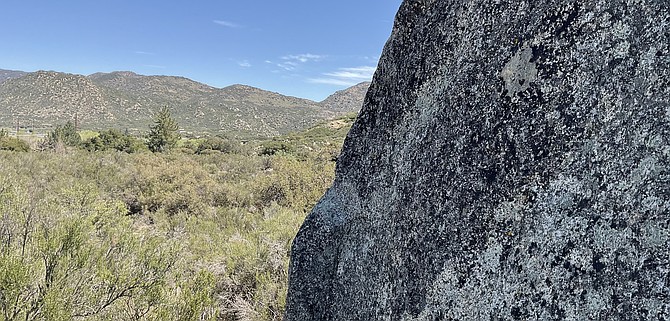
Granite makes for a long-lasting canvas.
“Bees!”
Kim jumps up and starts down towards the river flat. He’s flicking his face and neck.
I hear them too. Man! Now they’re buzzing me. I feel the pinch of their little stingers. Neck, hands, mouth. I’m up and lunging through the soft loam of untrampled leaf litter.
We had been sheltering in the shade of a big old oak tree up here on the way to the Kitchen Creek waterfall, on the southern flank of the Laguna mountains. The spot seemed good until Kim noticed the trunk was hollow. And that things seemed to be flying in and out of a two-foot opening in its side.
“This is crazy, man! Africanized? Carpenters? Sweat bees?”
No reply: we’re too busy swiping and spitting and jogging to talk. Also too busy watching our collective steps, because this soft-to-the-foot flood plain is pocked by gopher holes, rocks, shrubs, and scrub oaks. It's also home to who knows how many rattlers, warming themselves in the afternoon sun.
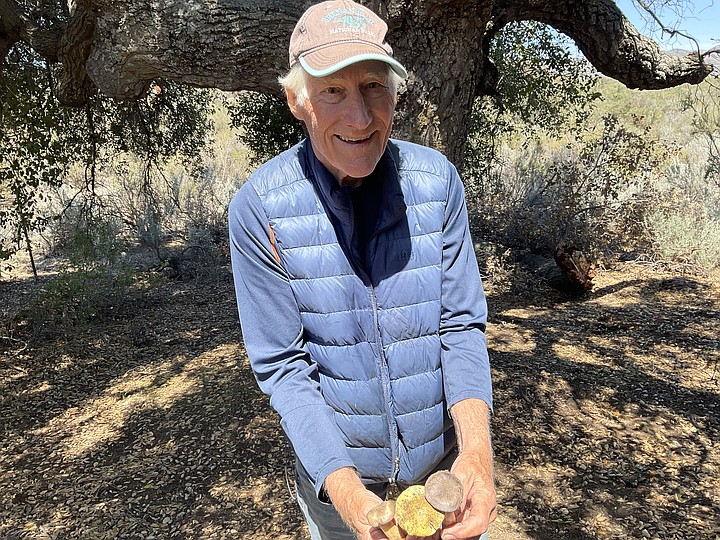
Kim Moreno and the mushrooms he's found on our way to Kitchen Creek.
Back in the day, this place would have been a common Kumeyaay go-to. How do we know? Once we’ve outdistanced the angry bees, we take a breather on a dome boulder, near (but not too near) another old oak. “Last time I was in this area,” Kim says, “my wife Pamela discovered petroglyphs on a rock. She swears it was not more recent graffiti. That’s why I wanted to come back.”
This dome granite boulder doesn’t show any signs of petroglyphs, but it does offer something else. “They were certainly here,” says Kim. He’s squatting a smooth, carved hole in the rock. Oh. Two of them.
“Morteros,” he says. “Acorn grinding holes. Just imagine, Kumeyaay women gathering right here, joking, singing, cracking acorns, pounding acorns, sifting acorn powder, soaking it in water to get the bitterness out of it, cooking it on a hot rock and making shawee, Kumeyaay bread mush. How many years ago? A hundred? Ten thousand?”
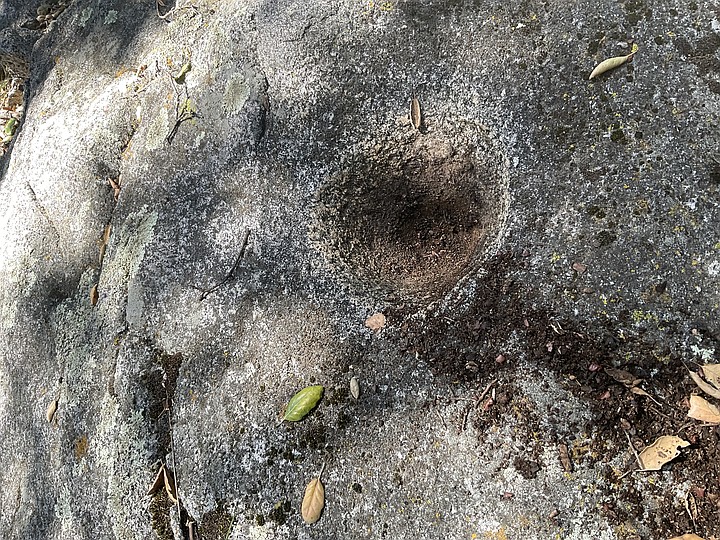
A mortero.
“Huh. Why don’t we make shawee?” I say. “A treasure trove of acorns drops every year. Sell it!”
“Spoken like a white man,” says Kim. “But good point. San Diego bread. Acorns are really good for you. Lots of potassium, iron, fiber. Millions drop every year. Most are unused.”
I try to feel if the ghosts of these women are hovering around us. What would they think? But I guess I’m just not that spirit-spotting kind of guy. “Maybe the shawee women set the bees on us,” says Kim.
“Day’s getting on,” I say. “Maybe we should keep walking.”
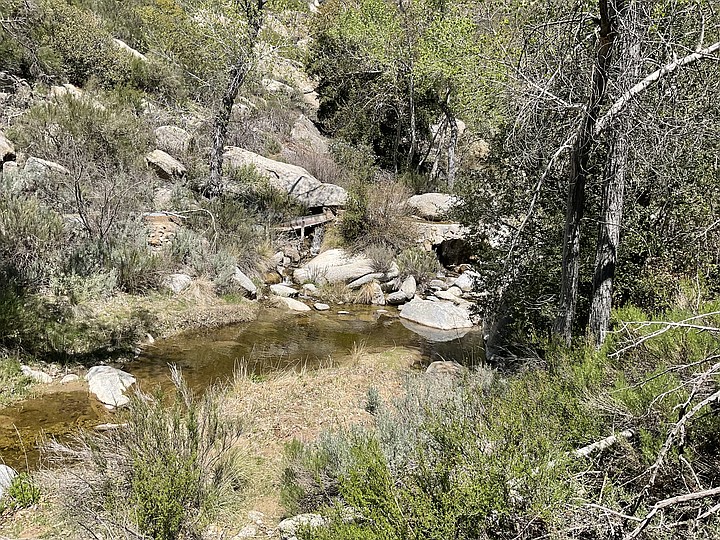
Water!
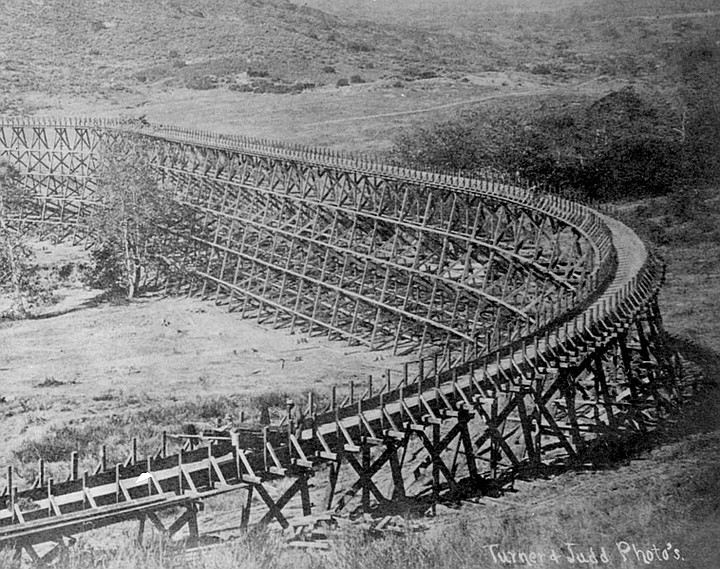
About an hour-plus in, we finally see a little creek glistening below us. Kitchen Creek. So named after early European settlers apparently took to gathering here for picnics. “See the flume?” says Kim. Oh yeah. He’s pointing to the far side of the creek. A dish-shaped raceway runs down it. Wood, Kim says, but half-wrecked. It follows the stream. Kim reckons they started building it in 1886, about the time they also built the magnificent San Diego flume: thirty-five miles long, the first city supply, a waterway built of redwood planks. An incredible piece of engineering.
*****
“What was that?!” asks Kim. It’s half an hour later, on the way down, light dropping. We’ve taken a circle to avoid that bee-bristling oak grove. I’m also thinking of coyote, gray foxes, raccoons, rattlers, or hey, they say there are even black bears up here. We listen. Crunch, crunch. Munch, munch. Then we see movement through the trees. Oh. It’s two hikers. Heading north. On the Pacific Crest Trail. They have broken out their energy bars as they near the end of their second day. Five months to go to walk to the Canadian border, 2650 miles away. That sure puts our bee problem into perspective.
Oh, and we never do find the rock art. Then again, there’s plenty more rocks to choose from out here.
Here's something you might be interested in.
Kitchen Creek petroglyph hunt gets interrupted by bees
Who's up for some acorn bread?

Kitchen Creek petroglyph hunt gets interrupted by bees
Who's up for some acorn bread?
Granite makes for a long-lasting canvas.
“Bees!”
Kim jumps up and starts down towards the river flat. He’s flicking his face and neck.
I hear them too. Man! Now they’re buzzing me. I feel the pinch of their little stingers. Neck, hands, mouth. I’m up and lunging through the soft loam of untrampled leaf litter.
We had been sheltering in the shade of a big old oak tree up here on the way to the Kitchen Creek waterfall, on the southern flank of the Laguna mountains. The spot seemed good until Kim noticed the trunk was hollow. And that things seemed to be flying in and out of a two-foot opening in its side.
“This is crazy, man! Africanized? Carpenters? Sweat bees?”
No reply: we’re too busy swiping and spitting and jogging to talk. Also too busy watching our collective steps, because this soft-to-the-foot flood plain is pocked by gopher holes, rocks, shrubs, and scrub oaks. It's also home to who knows how many rattlers, warming themselves in the afternoon sun.
Kim Moreno and the mushrooms he's found on our way to Kitchen Creek.
Back in the day, this place would have been a common Kumeyaay go-to. How do we know? Once we’ve outdistanced the angry bees, we take a breather on a dome boulder, near (but not too near) another old oak. “Last time I was in this area,” Kim says, “my wife Pamela discovered petroglyphs on a rock. She swears it was not more recent graffiti. That’s why I wanted to come back.”
This dome granite boulder doesn’t show any signs of petroglyphs, but it does offer something else. “They were certainly here,” says Kim. He’s squatting a smooth, carved hole in the rock. Oh. Two of them.
“Morteros,” he says. “Acorn grinding holes. Just imagine, Kumeyaay women gathering right here, joking, singing, cracking acorns, pounding acorns, sifting acorn powder, soaking it in water to get the bitterness out of it, cooking it on a hot rock and making shawee, Kumeyaay bread mush. How many years ago? A hundred? Ten thousand?”
A mortero.
“Huh. Why don’t we make shawee?” I say. “A treasure trove of acorns drops every year. Sell it!”
“Spoken like a white man,” says Kim. “But good point. San Diego bread. Acorns are really good for you. Lots of potassium, iron, fiber. Millions drop every year. Most are unused.”
I try to feel if the ghosts of these women are hovering around us. What would they think? But I guess I’m just not that spirit-spotting kind of guy. “Maybe the shawee women set the bees on us,” says Kim.
“Day’s getting on,” I say. “Maybe we should keep walking.”
Water!
About an hour-plus in, we finally see a little creek glistening below us. Kitchen Creek. So named after early European settlers apparently took to gathering here for picnics. “See the flume?” says Kim. Oh yeah. He’s pointing to the far side of the creek. A dish-shaped raceway runs down it. Wood, Kim says, but half-wrecked. It follows the stream. Kim reckons they started building it in 1886, about the time they also built the magnificent San Diego flume: thirty-five miles long, the first city supply, a waterway built of redwood planks. An incredible piece of engineering.
*****
“What was that?!” asks Kim. It’s half an hour later, on the way down, light dropping. We’ve taken a circle to avoid that bee-bristling oak grove. I’m also thinking of coyote, gray foxes, raccoons, rattlers, or hey, they say there are even black bears up here. We listen. Crunch, crunch. Munch, munch. Then we see movement through the trees. Oh. It’s two hikers. Heading north. On the Pacific Crest Trail. They have broken out their energy bars as they near the end of their second day. Five months to go to walk to the Canadian border, 2650 miles away. That sure puts our bee problem into perspective.
Oh, and we never do find the rock art. Then again, there’s plenty more rocks to choose from out here.
Comments