

Here's something you might be interested in.
Ask a Hipster — Advice you didn't know you needed
Big Screen — Movie commentary
Blurt — Music's inside track
Booze News — San Diego spirits
Classical Music — Immortal beauty
Classifieds — Free and easy
Close to Home — What it’s like on the street where you live
Cover Stories — Front-page features
Drinks All Around — Bartenders' drink recipes
Excerpts — Literary and spiritual excerpts
Feast! — Food & drink reviews
Feature Stories — Local news & stories
Fishing Report — What’s getting hooked from ship and shore
From the Archives — Spotlight on the past
Golden Dreams — Talk of the town
The Gonzo Report — Making the musical scene, or at least reporting from it
Letters — Our inbox
Movies@Home — Local movie buffs share favorites
Movie Reviews — Our critics' picks and pans
Musician Interviews — Up close with local artists
Neighborhood News from Stringers — Hyperlocal news
News Ticker — News & politics
Obermeyer — San Diego politics illustrated
Outdoors — Weekly changes in flora and fauna
Overheard in San Diego — Eavesdropping illustrated
Poetry — The old and the new
Reader Travel — Travel section built by travelers
Reading — The hunt for intellectuals
Roam-O-Rama — SoCal's best hiking/biking trails
San Diego Beer — Inside San Diego suds
SD on the QT — Almost factual news
Sheep and Goats — Places of worship
Special Issues — The best of
Street Style — San Diego streets have style
Surf Diego — Real stories from those braving the waves
Theater — On stage in San Diego this week
Tin Fork — Silver spoon alternative
Under the Radar — Matt Potter's undercover work
Unforgettable — Long-ago San Diego
Unreal Estate — San Diego's priciest pads
Your Week — Daily event picks
Fish Report: Great fishing off Colinet for the Liberty
Thresher sharks are on the menu, but watch that tail
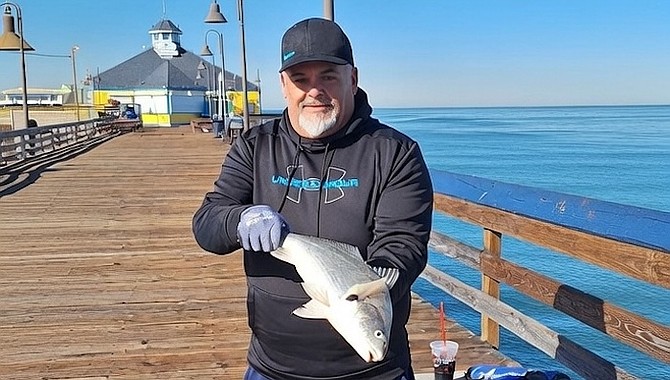
Angler Fabian Medina with a chunky spotfin croaker caught from Imperial Beach Pier.
Dock Totals 1/4 – 1/10: 774 anglers aboard 31 half-day to 3-day trips out of San Diego landings over the past week caught 2544 bonito, 23 calico bass, 2 halibut, 38 lingcod, 3 rock crab, 240 rockfish, 73 sand bass, 11 sanddab, 77 sculpin, 181 spiny lobster (343 released), 68 whitefish and 3 yellowtail.
Saltwater: Not too many folks made it out this past week. Mostly, it is down to local half day trips and a few 1.5-day runs down the coast into Mexican water for rockfish and a shot at yellowtail. And, of course, the long-range fleet that focuses more on the southern half of the Baja peninsula. As for the 1.5-day runs south, the 240 rockfish, 34 lingcod, and 3 yellowtail in this past week’s count were all caught on one. Liberty 1.5-day trip last weekend with 29 anglers aboard.
Though some anglers are getting a few yellowtail in the Colinet area, that bite gets much better further south. Pangeros out of San Quintin have been reporting good yellowtail fishing on deep-drop lures around the high spots south of San Martin Island, along with decent calico fishing in the kelps, and some impressive halibut off the lee side of the island. Further south, yellowtail continue to be the main catch along the beach, though conditions are just now clearing a bit for those wanting to look for bluefin further outside. There really hasn’t been much word on bluefin since this last round of weather.
Long range boats had a slowish week that began decently then ebbed into a lot of trolling while looking for willing schools of yellowfin. A few wahoo bit on the troll and some stops produced tuna, but conditions early-midweek were tough. But it should pick up soon enough, as conditions look good for the week ahead. Early in the week, the Independence found some decent yellowfin action outside of Bahia Magdalena with a couple good stops. Toward the end of the week, the Excel out on its 15-day Team Hoo trip reported slow fishing, opting to run south and east toward Puerto Vallarta area and still only finding some smaller tuna and a few big wahoo on the troll.
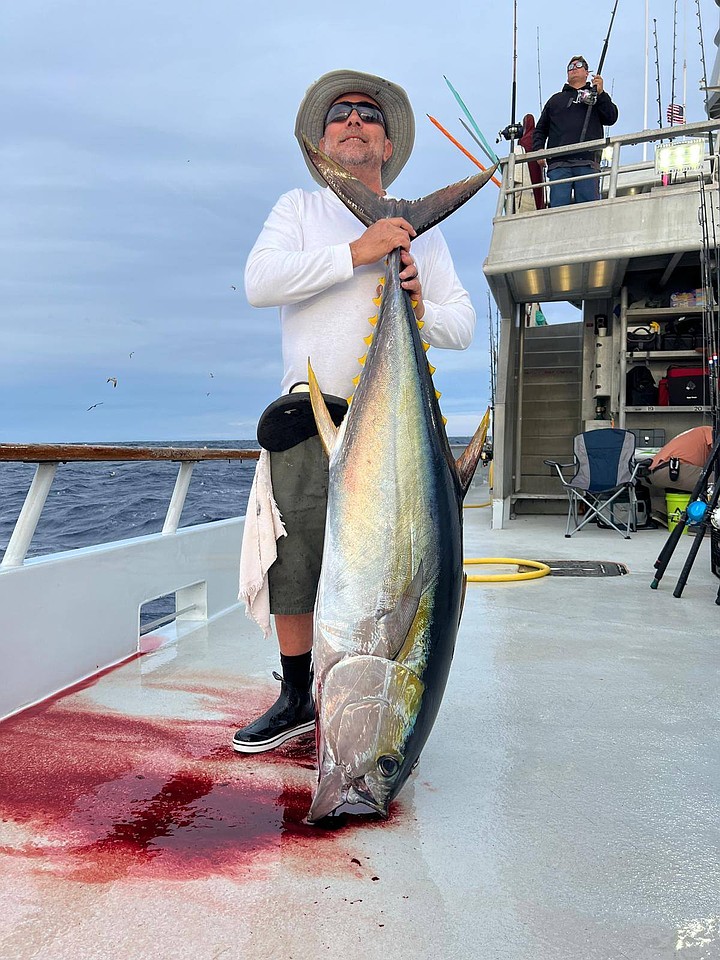 Though fishing was tough at times, anglers did get into some decent yellowfin down south, like this solid unit caught aboard the Independence early in the week.”
Local boats have been whacking away at bonito, with sand bass, whitefish, and sculpin other common catches for the half and three-quarter day runs. With the larger tide swings stirring up food, hoop-netters had really good results for lobster, with one out of every three bugs raised being a legal-sized keeper. Along the beaches, surf perch, yellowfin croaker, and spotfin croaker are the main catches, while folks fishing piers have also been getting bonito, mackerel, and rays and such.
A few thresher shark pups in the 4 to 5-foot range were caught off Imperial Beach Pier. Threshers are live-born larger than most might think. Thresher shark pups are born at a length of approximately 3.7 to 5.25 feet. After birth, juveniles of the common thresher species grow at a rate of about 1.6 feet per year, though they can live up to 50 years, so that rate slows as they get older. Their long tailfin is used to whip at mackerel, mostly, and other prey to stun then eat them. A few anglers, especially kayak anglers (myself included), know threshers can slap hard. Very hard.
Like makos, threshers can be good table fare if properly cleaned and prepared. As sharks don’t pee but rather get rid of urine through their skin, they can smell a bit like ammonia. I find that bleeding them, then cutting crosswise into steaks and cutting the skin off is best. Then I basically grill them until done in the center with basic steak seasonings is my favorite. Sometimes, soaking the meat, whether steaks or filets, of any shark in milk for an hour or two helps get rid of the ammonia smell if it lingers after removing the skin. Either way, if you catch a thresher, watch that tailfin. So, whether on the beach, bay, lake, or offshore, they’re out there so go out and get ‘em!
Here's something you might be interested in.
Fish Report: Great fishing off Colinet for the Liberty
Thresher sharks are on the menu, but watch that tail

Fish Report: Great fishing off Colinet for the Liberty
Thresher sharks are on the menu, but watch that tail
Angler Fabian Medina with a chunky spotfin croaker caught from Imperial Beach Pier.
Dock Totals 1/4 – 1/10: 774 anglers aboard 31 half-day to 3-day trips out of San Diego landings over the past week caught 2544 bonito, 23 calico bass, 2 halibut, 38 lingcod, 3 rock crab, 240 rockfish, 73 sand bass, 11 sanddab, 77 sculpin, 181 spiny lobster (343 released), 68 whitefish and 3 yellowtail.
Saltwater: Not too many folks made it out this past week. Mostly, it is down to local half day trips and a few 1.5-day runs down the coast into Mexican water for rockfish and a shot at yellowtail. And, of course, the long-range fleet that focuses more on the southern half of the Baja peninsula. As for the 1.5-day runs south, the 240 rockfish, 34 lingcod, and 3 yellowtail in this past week’s count were all caught on one. Liberty 1.5-day trip last weekend with 29 anglers aboard.
Though some anglers are getting a few yellowtail in the Colinet area, that bite gets much better further south. Pangeros out of San Quintin have been reporting good yellowtail fishing on deep-drop lures around the high spots south of San Martin Island, along with decent calico fishing in the kelps, and some impressive halibut off the lee side of the island. Further south, yellowtail continue to be the main catch along the beach, though conditions are just now clearing a bit for those wanting to look for bluefin further outside. There really hasn’t been much word on bluefin since this last round of weather.
Long range boats had a slowish week that began decently then ebbed into a lot of trolling while looking for willing schools of yellowfin. A few wahoo bit on the troll and some stops produced tuna, but conditions early-midweek were tough. But it should pick up soon enough, as conditions look good for the week ahead. Early in the week, the Independence found some decent yellowfin action outside of Bahia Magdalena with a couple good stops. Toward the end of the week, the Excel out on its 15-day Team Hoo trip reported slow fishing, opting to run south and east toward Puerto Vallarta area and still only finding some smaller tuna and a few big wahoo on the troll.
Though fishing was tough at times, anglers did get into some decent yellowfin down south, like this solid unit caught aboard the Independence early in the week.”Local boats have been whacking away at bonito, with sand bass, whitefish, and sculpin other common catches for the half and three-quarter day runs. With the larger tide swings stirring up food, hoop-netters had really good results for lobster, with one out of every three bugs raised being a legal-sized keeper. Along the beaches, surf perch, yellowfin croaker, and spotfin croaker are the main catches, while folks fishing piers have also been getting bonito, mackerel, and rays and such.
A few thresher shark pups in the 4 to 5-foot range were caught off Imperial Beach Pier. Threshers are live-born larger than most might think. Thresher shark pups are born at a length of approximately 3.7 to 5.25 feet. After birth, juveniles of the common thresher species grow at a rate of about 1.6 feet per year, though they can live up to 50 years, so that rate slows as they get older. Their long tailfin is used to whip at mackerel, mostly, and other prey to stun then eat them. A few anglers, especially kayak anglers (myself included), know threshers can slap hard. Very hard.
Like makos, threshers can be good table fare if properly cleaned and prepared. As sharks don’t pee but rather get rid of urine through their skin, they can smell a bit like ammonia. I find that bleeding them, then cutting crosswise into steaks and cutting the skin off is best. Then I basically grill them until done in the center with basic steak seasonings is my favorite. Sometimes, soaking the meat, whether steaks or filets, of any shark in milk for an hour or two helps get rid of the ammonia smell if it lingers after removing the skin. Either way, if you catch a thresher, watch that tailfin. So, whether on the beach, bay, lake, or offshore, they’re out there so go out and get ‘em!
Comments