

Here's something you might be interested in.
Ask a Hipster — Advice you didn't know you needed
Big Screen — Movie commentary
Blurt — Music's inside track
Booze News — San Diego spirits
Classical Music — Immortal beauty
Classifieds — Free and easy
Close to Home — What it’s like on the street where you live
Cover Stories — Front-page features
Drinks All Around — Bartenders' drink recipes
Excerpts — Literary and spiritual excerpts
Feast! — Food & drink reviews
Feature Stories — Local news & stories
Fishing Report — What’s getting hooked from ship and shore
From the Archives — Spotlight on the past
Golden Dreams — Talk of the town
The Gonzo Report — Making the musical scene, or at least reporting from it
Letters — Our inbox
Movies@Home — Local movie buffs share favorites
Movie Reviews — Our critics' picks and pans
Musician Interviews — Up close with local artists
Neighborhood News from Stringers — Hyperlocal news
News Ticker — News & politics
Obermeyer — San Diego politics illustrated
Outdoors — Weekly changes in flora and fauna
Overheard in San Diego — Eavesdropping illustrated
Poetry — The old and the new
Reader Travel — Travel section built by travelers
Reading — The hunt for intellectuals
Roam-O-Rama — SoCal's best hiking/biking trails
San Diego Beer — Inside San Diego suds
SD on the QT — Almost factual news
Sheep and Goats — Places of worship
Special Issues — The best of
Street Style — San Diego streets have style
Surf Diego — Real stories from those braving the waves
Theater — On stage in San Diego this week
Tin Fork — Silver spoon alternative
Under the Radar — Matt Potter's undercover work
Unforgettable — Long-ago San Diego
Unreal Estate — San Diego's priciest pads
Your Week — Daily event picks
Fish Report: Yellowfin, skipjack, dorado, and marlin close to home
Also: corvina or corbina?
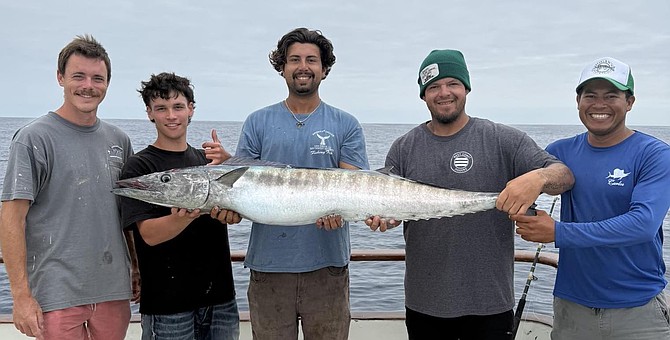
Nice wahoo caught aboard the American Angler just 168 miles south of Point Loma
Dock Totals 9/21 – 9/27: 3818 anglers aboard 151 half-day to 3-day trips out of San Diego landings over the past week caught 3914 bluefin tuna (to 200 pounds), 476 bonito, 8 cabezon, 64 calico bass, 27 dorado, 20 halibut, 44 lingcod, 56 rock crab, 3121 rockfish, 65 sand bass, 175 sanddab, 1255 sculpin, 112 sheephead, 95 skipjack tuna, 14 spiny lobster (32 released), 1 striped marlin (released), 588 whitefish, 2315 yellowfin tuna, and 229 yellowtail.
Saltwater: As I was making notes about this past week’s fishing, the American Angler reported a wahoo caught about 30 miles west of Punta Banda and 168 miles south of Point Loma. That fits with what has been going on over the last seven days, as yellowfin, skipjack, and bluefin have been popping up in the same areas to the south — along with a few more dorado and even a striped marlin in the half day to 3-day counts. The American Angler is on its Ken’s Custom Reels 8-day trip, which is why the wahoo is not reflected in the counts. But yellowfin, dorado, marlin, skipjack and now a wahoo, have been caught within 3-day range, as we are seeing epic fall fishing developing close to home over these last days of September.
The Tribute took a charter of 19 anglers a little further south than usual on an overnight trip, pushing some 80 miles by daybreak, and were rewarded with 90 yellowfin tuna on the deck by 9:30 in the morning in what can only be described as wide-open fishing. As warm water keeps pushing north, I expect to see this excellent pelagic fishing to continue well into October and hopefully November. We aren’t seeing the big numbers of dorado, but that they're in the mix, as are skipjack, and that bodes well for other warm-water species as we go forward.
Closer to home, yellowtail fishing has been very good for the few boats fishing coastal US waters down to the Coronado Islands. The New Seaforth had a fantastic Monday morning half day trip off La Jolla with 21 yellowtail and a pair of halibut, and though that turned out to be the standout day, rockfish, halibut, bonito, and sculpin have been biting very well. With boats focusing more on pelagic species, sand bass, calico bass, and sheephead numbers dropped quite a bit, while rockfish have been about the same. Either way, this is a great time of year to play hooky and take the kids out fishing. To help with that, the Dolphin will be running "Kids Fish Free Sundays" beginning this week on October 5.
On the beaches and piers, fishing has been good to excellent for barred surf perch, California corbina, yellowfin croaker, mackerel, and even bonito, along with some occasional good catches of thresher sharks and guitar fish. I’ve noticed lately that folks on social media fishing sites have been confusing the two corvinas and corbina we catch in our area. Briefly: California corbina have a downturned mouth made for feeding on sand crabs, ghost shrimp and sand worms. They have no teeth, usually have dark fins, and are very powerful swimmers as they spend much of their time in churning surf.

California corbina caught this week in Quinta Cristina just south of San Quintin, Baja California
Shortfin corvina often cruise San Diego Bay or are caught in mixed areas of rock and sand along the coast down to Baja Sur. Shortfin corvina have orange mouths and two distinct fangs in their upper jaw. Their fins will generally be dark, and their tailfin is slightly concave.
Proper orange mouth corvina also have fangs, but their fins are usually orange and they grow more than three times as large as shortfin corvina. They also have a distinct bump in their tailfin that sticks out at the center rather than inward. Both are sometimes confused with juvenile white seabass, but their fangs are the easiest way to tell the difference. (Juvenile white seabass will also have bars on their sides and a Zipper that runs along their belly.)
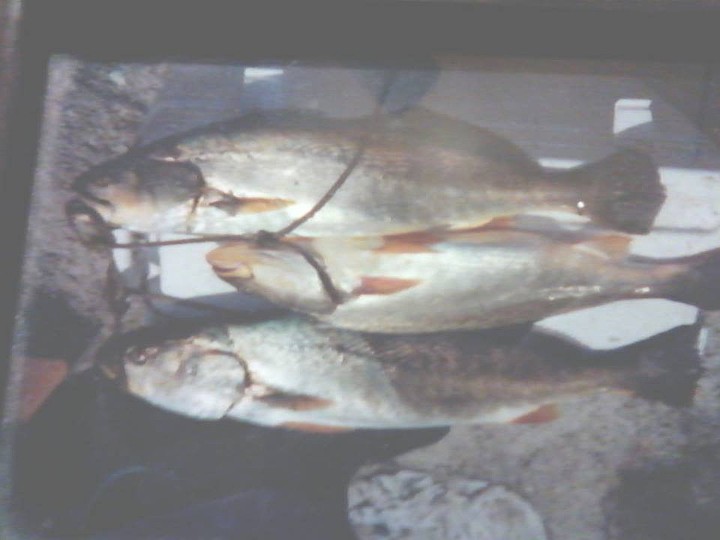
Orange mouth corvina from 28 to 34 inches long caught in 2001 by kayak in the Salton Sea
As of December 1, 2024, the International Game Fish Association shortfin corvina world record stood at 10 lbs 6 oz, with the fish caught in San Diego Bay, San Diego, California in June 2008. The orange mouth corvina world record is 54 lbs 3 oz. That fish was caught in coastal waters off Guayaquil, Ecuador in July 1992. I have caught all four species, with some of my last orange mouth corvina caught by kayak in the Salton Sea in 2001 or so. I have caught a few off Gonzaga Bay in 2015. I caught lots of shortfin corvina when in Bahia Asuncion, and my largest California corbina (5.7 pounds) and white seabass (55 pounds) were both caught post-2016 in San Quintin Bay. The world records for California corbina and white seabass are 7.25 pounds and 82.75 pounds, respectively.
Be sure to know what you are catching and follow the regs, and whether the beach, bay, lake, or offshore, they’re out there so go out and get ‘em!
Here's something you might be interested in.
Fish Report: Yellowfin, skipjack, dorado, and marlin close to home
Also: corvina or corbina?

Fish Report: Yellowfin, skipjack, dorado, and marlin close to home
Also: corvina or corbina?
Nice wahoo caught aboard the American Angler just 168 miles south of Point Loma
Dock Totals 9/21 – 9/27: 3818 anglers aboard 151 half-day to 3-day trips out of San Diego landings over the past week caught 3914 bluefin tuna (to 200 pounds), 476 bonito, 8 cabezon, 64 calico bass, 27 dorado, 20 halibut, 44 lingcod, 56 rock crab, 3121 rockfish, 65 sand bass, 175 sanddab, 1255 sculpin, 112 sheephead, 95 skipjack tuna, 14 spiny lobster (32 released), 1 striped marlin (released), 588 whitefish, 2315 yellowfin tuna, and 229 yellowtail.
Saltwater: As I was making notes about this past week’s fishing, the American Angler reported a wahoo caught about 30 miles west of Punta Banda and 168 miles south of Point Loma. That fits with what has been going on over the last seven days, as yellowfin, skipjack, and bluefin have been popping up in the same areas to the south — along with a few more dorado and even a striped marlin in the half day to 3-day counts. The American Angler is on its Ken’s Custom Reels 8-day trip, which is why the wahoo is not reflected in the counts. But yellowfin, dorado, marlin, skipjack and now a wahoo, have been caught within 3-day range, as we are seeing epic fall fishing developing close to home over these last days of September.
The Tribute took a charter of 19 anglers a little further south than usual on an overnight trip, pushing some 80 miles by daybreak, and were rewarded with 90 yellowfin tuna on the deck by 9:30 in the morning in what can only be described as wide-open fishing. As warm water keeps pushing north, I expect to see this excellent pelagic fishing to continue well into October and hopefully November. We aren’t seeing the big numbers of dorado, but that they're in the mix, as are skipjack, and that bodes well for other warm-water species as we go forward.
Closer to home, yellowtail fishing has been very good for the few boats fishing coastal US waters down to the Coronado Islands. The New Seaforth had a fantastic Monday morning half day trip off La Jolla with 21 yellowtail and a pair of halibut, and though that turned out to be the standout day, rockfish, halibut, bonito, and sculpin have been biting very well. With boats focusing more on pelagic species, sand bass, calico bass, and sheephead numbers dropped quite a bit, while rockfish have been about the same. Either way, this is a great time of year to play hooky and take the kids out fishing. To help with that, the Dolphin will be running "Kids Fish Free Sundays" beginning this week on October 5.
On the beaches and piers, fishing has been good to excellent for barred surf perch, California corbina, yellowfin croaker, mackerel, and even bonito, along with some occasional good catches of thresher sharks and guitar fish. I’ve noticed lately that folks on social media fishing sites have been confusing the two corvinas and corbina we catch in our area. Briefly: California corbina have a downturned mouth made for feeding on sand crabs, ghost shrimp and sand worms. They have no teeth, usually have dark fins, and are very powerful swimmers as they spend much of their time in churning surf.
California corbina caught this week in Quinta Cristina just south of San Quintin, Baja California
Shortfin corvina often cruise San Diego Bay or are caught in mixed areas of rock and sand along the coast down to Baja Sur. Shortfin corvina have orange mouths and two distinct fangs in their upper jaw. Their fins will generally be dark, and their tailfin is slightly concave.
Proper orange mouth corvina also have fangs, but their fins are usually orange and they grow more than three times as large as shortfin corvina. They also have a distinct bump in their tailfin that sticks out at the center rather than inward. Both are sometimes confused with juvenile white seabass, but their fangs are the easiest way to tell the difference. (Juvenile white seabass will also have bars on their sides and a Zipper that runs along their belly.)
Orange mouth corvina from 28 to 34 inches long caught in 2001 by kayak in the Salton Sea
As of December 1, 2024, the International Game Fish Association shortfin corvina world record stood at 10 lbs 6 oz, with the fish caught in San Diego Bay, San Diego, California in June 2008. The orange mouth corvina world record is 54 lbs 3 oz. That fish was caught in coastal waters off Guayaquil, Ecuador in July 1992. I have caught all four species, with some of my last orange mouth corvina caught by kayak in the Salton Sea in 2001 or so. I have caught a few off Gonzaga Bay in 2015. I caught lots of shortfin corvina when in Bahia Asuncion, and my largest California corbina (5.7 pounds) and white seabass (55 pounds) were both caught post-2016 in San Quintin Bay. The world records for California corbina and white seabass are 7.25 pounds and 82.75 pounds, respectively.
Be sure to know what you are catching and follow the regs, and whether the beach, bay, lake, or offshore, they’re out there so go out and get ‘em!
Comments