

Here's something you might be interested in.
Ask a Hipster — Advice you didn't know you needed
Big Screen — Movie commentary
Blurt — Music's inside track
Booze News — San Diego spirits
Classical Music — Immortal beauty
Classifieds — Free and easy
Close to Home — What it’s like on the street where you live
Cover Stories — Front-page features
Drinks All Around — Bartenders' drink recipes
Excerpts — Literary and spiritual excerpts
Feast! — Food & drink reviews
Feature Stories — Local news & stories
Fishing Report — What’s getting hooked from ship and shore
From the Archives — Spotlight on the past
Golden Dreams — Talk of the town
The Gonzo Report — Making the musical scene, or at least reporting from it
Letters — Our inbox
Movies@Home — Local movie buffs share favorites
Movie Reviews — Our critics' picks and pans
Musician Interviews — Up close with local artists
Neighborhood News from Stringers — Hyperlocal news
News Ticker — News & politics
Obermeyer — San Diego politics illustrated
Outdoors — Weekly changes in flora and fauna
Overheard in San Diego — Eavesdropping illustrated
Poetry — The old and the new
Reader Travel — Travel section built by travelers
Reading — The hunt for intellectuals
Roam-O-Rama — SoCal's best hiking/biking trails
San Diego Beer — Inside San Diego suds
SD on the QT — Almost factual news
Sheep and Goats — Places of worship
Special Issues — The best of
Street Style — San Diego streets have style
Surf Diego — Real stories from those braving the waves
Theater — On stage in San Diego this week
Tin Fork — Silver spoon alternative
Under the Radar — Matt Potter's undercover work
Unforgettable — Long-ago San Diego
Unreal Estate — San Diego's priciest pads
Your Week — Daily event picks
Now playing: COLONY (2026)
Technology may be our best friend, but even applied science can't outwit a horde of zombies on the run.
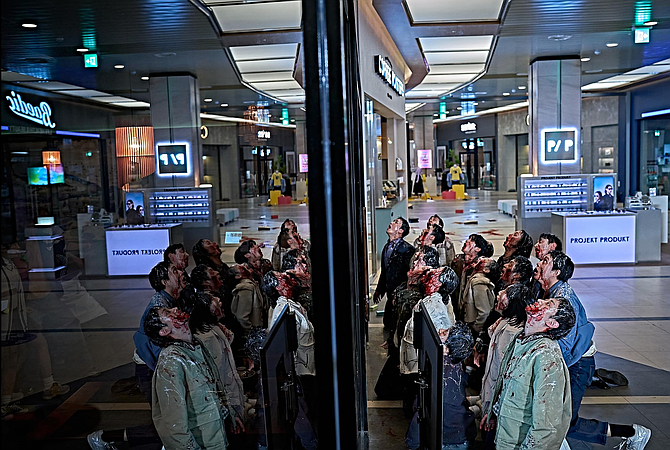
Colony: the malls are alive!
COLONY (2026) Yeon Sang-ho / Screenplay: Choi Kyu-seok & Yeon Sang-ho / Cinematography: Byun Bong-sun (2.35:1) / Design: Lee Mok-won / Editor: Han Mee-yeon / Composer: Chae Min-ju / Visual Effects: Sagar Shrinath / Producer: Hailey Yoomin Yang / Acted by: Jun Ji-hyun, Koo Kyo-hwa, Ji Chang-wook, Koo Kyo-hwan, Kim Shin-rok, Shin Hyun-been, Go Soo, and Kim Hyung-mook / South Korea / Distributor: Well Go / Rated R / Length: 123 mins.
Directed and co-written by Yeon Sang-ho (Train to Busan), Colony is a fast-paced, undead action-thriller set entirely in the fictional Dongwoori Building — a high-rise located in downtown Seoul that houses everything from a trendy shopping mall and office space to the Chains Bio biotechnology research center. It's technically not a zombie film — the undead here are indistinguishable hordes of mutant shoppers and businesspeople who operate under collective intelligence after being infected with an ever-evolving virus.
What begins in a sporting goods store slowly spreads throughout the skyscraper; the survivors struggle to make it to the roof, where a rescue crew awaits. With their heads held high and mouths agape, the baying, hive-minded freaks give off the impression of a roadshow production of Edvard Munch’s The Scream.
The moment government officials diagnose the attack as a pandemic, they quickly quarantine the entire building, stranding the dozen or so souls left alive. To Sang-ho's credit, whatever thematic parallels between fiction and reality he intends (one character cries “Fake news”), the social commentary never gets out of hand.
Among the living is Seo Yeong Cheol (Koo Kyo-hwan), a defrocked scientist who got booted out of Chains Bio, and who turns out to be the one responsible for the bioterrorist attack. (He was smart enough to inject himself with the antidote, which also gives him control over his creations as they move about the mall.) The most helpless observers are the policemen and scientists who must resign themselves to following the action on a monitor as if it's a POV video game.
Every new wrinkle takes the group in directions viewers are unlikely to expect. (Of particular note: a lab filled with infected chimps that make the Wicked Witch of the West's winged monkeys look like household pets.) Since Seo has the ability to see through the eyes of his creations, the group decides the safest way to communicate is through texting. Technology may be our best friend, but even applied science can't outwit a group of zombies on the run.
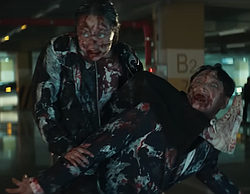
It’s clearly an homage to Dawn of the Dead, George Romero’s original shopping mall apocalypse, with two notable additions. Sang-ho’s fleet-footed, slowly-evolving mutants travel in packs, while Romero’s multitude of scraping step creatures were more individualized. (To paraphrase Preston Sturges’ Dan McGinty, they gotta crawl before they creep.) At first, they’re easily mollified, chewing on life-size cardboard cutouts. Only later do they develop a taste for the human race.
But the most striking departure between this and Romero’s ghoulish galleria is Sang-ho’s refusal to pin our expectations on any of his heroes and heroines, even the most sympathetic. It seems as soon as they take control, they have the bite put on them.
In the end, the lessons for survival that Romero taught us still ring true: beat ‘em or burn ‘em, they go up pretty easy.
Rating: ***
Trailer: THE COLONY
Here's something you might be interested in.
Now playing: COLONY (2026)
Technology may be our best friend, but even applied science can't outwit a horde of zombies on the run.

Now playing: COLONY (2026)
Technology may be our best friend, but even applied science can't outwit a horde of zombies on the run.
Colony: the malls are alive!
COLONY (2026) Yeon Sang-ho / Screenplay: Choi Kyu-seok & Yeon Sang-ho / Cinematography: Byun Bong-sun (2.35:1) / Design: Lee Mok-won / Editor: Han Mee-yeon / Composer: Chae Min-ju / Visual Effects: Sagar Shrinath / Producer: Hailey Yoomin Yang / Acted by: Jun Ji-hyun, Koo Kyo-hwa, Ji Chang-wook, Koo Kyo-hwan, Kim Shin-rok, Shin Hyun-been, Go Soo, and Kim Hyung-mook / South Korea / Distributor: Well Go / Rated R / Length: 123 mins.
Directed and co-written by Yeon Sang-ho (Train to Busan), Colony is a fast-paced, undead action-thriller set entirely in the fictional Dongwoori Building — a high-rise located in downtown Seoul that houses everything from a trendy shopping mall and office space to the Chains Bio biotechnology research center. It's technically not a zombie film — the undead here are indistinguishable hordes of mutant shoppers and businesspeople who operate under collective intelligence after being infected with an ever-evolving virus.
What begins in a sporting goods store slowly spreads throughout the skyscraper; the survivors struggle to make it to the roof, where a rescue crew awaits. With their heads held high and mouths agape, the baying, hive-minded freaks give off the impression of a roadshow production of Edvard Munch’s The Scream.
The moment government officials diagnose the attack as a pandemic, they quickly quarantine the entire building, stranding the dozen or so souls left alive. To Sang-ho's credit, whatever thematic parallels between fiction and reality he intends (one character cries “Fake news”), the social commentary never gets out of hand.
Among the living is Seo Yeong Cheol (Koo Kyo-hwan), a defrocked scientist who got booted out of Chains Bio, and who turns out to be the one responsible for the bioterrorist attack. (He was smart enough to inject himself with the antidote, which also gives him control over his creations as they move about the mall.) The most helpless observers are the policemen and scientists who must resign themselves to following the action on a monitor as if it's a POV video game.
Every new wrinkle takes the group in directions viewers are unlikely to expect. (Of particular note: a lab filled with infected chimps that make the Wicked Witch of the West's winged monkeys look like household pets.) Since Seo has the ability to see through the eyes of his creations, the group decides the safest way to communicate is through texting. Technology may be our best friend, but even applied science can't outwit a group of zombies on the run.
It’s clearly an homage to Dawn of the Dead, George Romero’s original shopping mall apocalypse, with two notable additions. Sang-ho’s fleet-footed, slowly-evolving mutants travel in packs, while Romero’s multitude of scraping step creatures were more individualized. (To paraphrase Preston Sturges’ Dan McGinty, they gotta crawl before they creep.) At first, they’re easily mollified, chewing on life-size cardboard cutouts. Only later do they develop a taste for the human race.
But the most striking departure between this and Romero’s ghoulish galleria is Sang-ho’s refusal to pin our expectations on any of his heroes and heroines, even the most sympathetic. It seems as soon as they take control, they have the bite put on them.
In the end, the lessons for survival that Romero taught us still ring true: beat ‘em or burn ‘em, they go up pretty easy.
Rating: ***
Trailer: THE COLONY