

Here's something you might be interested in.
Ask a Hipster — Advice you didn't know you needed
Big Screen — Movie commentary
Blurt — Music's inside track
Booze News — San Diego spirits
Classical Music — Immortal beauty
Classifieds — Free and easy
Close to Home — What it’s like on the street where you live
Cover Stories — Front-page features
Drinks All Around — Bartenders' drink recipes
Excerpts — Literary and spiritual excerpts
Feast! — Food & drink reviews
Feature Stories — Local news & stories
Fishing Report — What’s getting hooked from ship and shore
From the Archives — Spotlight on the past
Golden Dreams — Talk of the town
The Gonzo Report — Making the musical scene, or at least reporting from it
Letters — Our inbox
Movies@Home — Local movie buffs share favorites
Movie Reviews — Our critics' picks and pans
Musician Interviews — Up close with local artists
Neighborhood News from Stringers — Hyperlocal news
News Ticker — News & politics
Obermeyer — San Diego politics illustrated
Outdoors — Weekly changes in flora and fauna
Overheard in San Diego — Eavesdropping illustrated
Poetry — The old and the new
Reader Travel — Travel section built by travelers
Reading — The hunt for intellectuals
Roam-O-Rama — SoCal's best hiking/biking trails
San Diego Beer — Inside San Diego suds
SD on the QT — Almost factual news
Sheep and Goats — Places of worship
Special Issues — The best of
Street Style — San Diego streets have style
Surf Diego — Real stories from those braving the waves
Theater — On stage in San Diego this week
Tin Fork — Silver spoon alternative
Under the Radar — Matt Potter's undercover work
Unforgettable — Long-ago San Diego
Unreal Estate — San Diego's priciest pads
Your Week — Daily event picks
Pumpkin-spice season is here, twilight periods are at their shortest
September's new moon and tidal high and lows
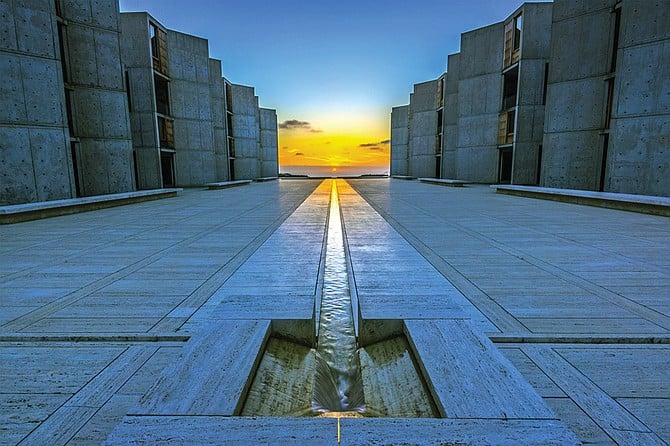
Twice a year the sunset lines up perfectly with the water channel at the Salk Institute in La Jolla: on the Fall Equinox and the Summer Equinox.
Fall Officially Begins at 11:19 am local time on Monday, September 22. It's not just the day that marks the beginning of PST (Pumpkin Spice Time), but also a good excuse to throw an equinox party. At equinox, the sun shines directly down on Earth’s equator. Fall will continue for another three months until the sun “moves” to its farthest southerly point on the winter solstice, December 21.
Equal Days And Nights – The word “equinox” comes from Latin aequus, meaning “equal,” and nox, “night.” On the equinox, day and night are nearly equal in length. Another consequence is that the sun at equinox always rises from a point on the horizon due east and later sets due west. You could calibrate a compass this way if you had access to a true (unobstructed) horizon. Another, more subtle consequence is that at mid-latitudes like ours, morning and evening twilight periods are shortest during equinox. From San Diego, the duration of twilight this week is about 90 minutes; last June, it was about 100 minutes.

Justin Bridle ventured down the cliffs from PLNU to get this colorful shot of the tide pools in La Jolla.
The Highest Tide For September (6.37 feet) is predicted for 8:04 pm on Thursday, September 18th. The month’s lowest tide (-0.62 feet) will occur the same day at 2:14 am. During September the tidal range is typically minimized. Starting in mid-October, extreme negative tides will begin to occur during the afternoon hours (a much more convenient time for exploring tidepools in the low-lying intertidal zone), and not much in the early morning. By December and January, the highest high tides will crest at nearly +7 feet during morning hours, and the lowest low tides will sink to nearly -2 feet during afternoon hours.
September 21 Marks The New Moon. The Waxing Crescent Moon phase begins and runs until the First Quarter Moon on September 29. At around 20 minutes after the time of sunset, look low in the southwestern sky, to the left of where the sun went down, and you will spot the moon’s thin crescent shape. Unlike in the spring season, during which the evening crescent moon “smiles” with upturned cusps, the autumn crescent-moon cusps point well to the left — toward the southern part of the sky.
Here's something you might be interested in.
Pumpkin-spice season is here, twilight periods are at their shortest
September's new moon and tidal high and lows

Pumpkin-spice season is here, twilight periods are at their shortest
September's new moon and tidal high and lows
Twice a year the sunset lines up perfectly with the water channel at the Salk Institute in La Jolla: on the Fall Equinox and the Summer Equinox.
Fall Officially Begins at 11:19 am local time on Monday, September 22. It's not just the day that marks the beginning of PST (Pumpkin Spice Time), but also a good excuse to throw an equinox party. At equinox, the sun shines directly down on Earth’s equator. Fall will continue for another three months until the sun “moves” to its farthest southerly point on the winter solstice, December 21.
Equal Days And Nights – The word “equinox” comes from Latin aequus, meaning “equal,” and nox, “night.” On the equinox, day and night are nearly equal in length. Another consequence is that the sun at equinox always rises from a point on the horizon due east and later sets due west. You could calibrate a compass this way if you had access to a true (unobstructed) horizon. Another, more subtle consequence is that at mid-latitudes like ours, morning and evening twilight periods are shortest during equinox. From San Diego, the duration of twilight this week is about 90 minutes; last June, it was about 100 minutes.
Justin Bridle ventured down the cliffs from PLNU to get this colorful shot of the tide pools in La Jolla.
The Highest Tide For September (6.37 feet) is predicted for 8:04 pm on Thursday, September 18th. The month’s lowest tide (-0.62 feet) will occur the same day at 2:14 am. During September the tidal range is typically minimized. Starting in mid-October, extreme negative tides will begin to occur during the afternoon hours (a much more convenient time for exploring tidepools in the low-lying intertidal zone), and not much in the early morning. By December and January, the highest high tides will crest at nearly +7 feet during morning hours, and the lowest low tides will sink to nearly -2 feet during afternoon hours.
September 21 Marks The New Moon. The Waxing Crescent Moon phase begins and runs until the First Quarter Moon on September 29. At around 20 minutes after the time of sunset, look low in the southwestern sky, to the left of where the sun went down, and you will spot the moon’s thin crescent shape. Unlike in the spring season, during which the evening crescent moon “smiles” with upturned cusps, the autumn crescent-moon cusps point well to the left — toward the southern part of the sky.
Comments