

Here's something you might be interested in.
Ask a Hipster — Advice you didn't know you needed
Big Screen — Movie commentary
Blurt — Music's inside track
Booze News — San Diego spirits
Classical Music — Immortal beauty
Classifieds — Free and easy
Close to Home — What it’s like on the street where you live
Cover Stories — Front-page features
Drinks All Around — Bartenders' drink recipes
Excerpts — Literary and spiritual excerpts
Feast! — Food & drink reviews
Feature Stories — Local news & stories
Fishing Report — What’s getting hooked from ship and shore
From the Archives — Spotlight on the past
Golden Dreams — Talk of the town
The Gonzo Report — Making the musical scene, or at least reporting from it
Letters — Our inbox
Movies@Home — Local movie buffs share favorites
Movie Reviews — Our critics' picks and pans
Musician Interviews — Up close with local artists
Neighborhood News from Stringers — Hyperlocal news
News Ticker — News & politics
Obermeyer — San Diego politics illustrated
Outdoors — Weekly changes in flora and fauna
Overheard in San Diego — Eavesdropping illustrated
Poetry — The old and the new
Reader Travel — Travel section built by travelers
Reading — The hunt for intellectuals
Roam-O-Rama — SoCal's best hiking/biking trails
San Diego Beer — Inside San Diego suds
SD on the QT — Almost factual news
Sheep and Goats — Places of worship
Special Issues — The best of
Street Style — San Diego streets have style
Surf Diego — Real stories from those braving the waves
Theater — On stage in San Diego this week
Tin Fork — Silver spoon alternative
Under the Radar — Matt Potter's undercover work
Unforgettable — Long-ago San Diego
Unreal Estate — San Diego's priciest pads
Your Week — Daily event picks
Two poems by Dante Alighieri for his 730th birthday
Translated by Dante Gabriel Rossetti (1828-1882)
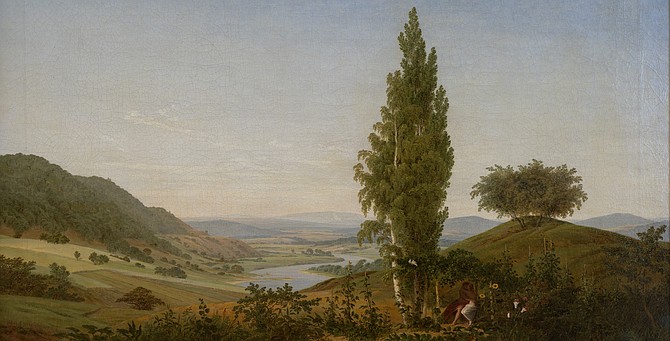
Detail from Summer by Caspar David Friedrich
Sestina of the Lady Pietra degli Scrovigni
To the dim light and the large circle of shade
I have clomb, and to the whitening of the hills,
There where we see no color in the grass.
Natheless my longing loses not its green,
It has so taken root in the hard stone
Which talks and hears as though it were a lady.
Utterly frozen is this youthful lady,
Even as the snow that lies within the shade;
For she is no more moved than is the stone
By the sweet season which makes warm the hills
And alters them afresh from white to green
Covering their sides again with flowers and grass.
When on her hair she sets a crown of grass
The thought has no more room for other lady,
Because she weaves the yellow with the green
So well that Love sits down there in the shade,—
Love who has shut me in among low hills
Faster than between walls of granite-stone.
She is more bright than is a precious stone;
The wound she gives may not be healed with grass:
I therefore have fled far o’er plains and hills
For refuge from so dangerous a lady;
But from her sunshine nothing can give shade,—
Not any hill, nor wall, nor summer-green.
A while ago, I saw her dressed in green,—
So fair, she might have wakened in a stone
This love which I do feel even for her shade;
And therefore, as one woos a graceful lady,
I wooed her in a field that was all grass
Girdled about with very lofty hills.
Yet shall the streams turn back and climb the hills
Before Love’s flame in this damp wood and green
Burn, as it burns within a youthful lady,
For my sake, who would sleep away in stone
My life, or feed like beasts upon the grass,
Only to see her garments cast a shade.
How dark soe’er the hills throw out their shade,
Under her summer green the beautiful lady
Covers it, like a stone cover’d in grass.
Sonnet
on the 9th of June 1290
Upon a day, came Sorrow in to me,
Saying, “I’ve come to stay with thee a while;”
And I perceived that she had usher’d Bile
And Pain into my house for company.
Wherefore I said, “Go forth—away with thee!”
But like a Greek she answer’d, full of guile,
And went on arguing in an easy style.
Then, looking, I saw Love come silently,
Habited in black raiment, smooth and new,
Having a black hat set upon his hair;
And certainly the tears he shed were true.
So that I ask’d, “What ails thee, trifler?”
Answering he said: “A grief to be gone through;
For our own lady’s dying, brother dear.”

Dante Alighieri (1295-1321) like Shakespeare, hardly needs an introduction. Nonetheless, here goes: Dante was an Italian poet and philospher best known for his Divine Comedy, which chronicles the poet’s imaginatively detailed journey from hell through purgatory to heaven. The poem is considered one of the greatest works of literature — of any age and all ages —and presents a rich tapestry of theology, philosophy, and science, all composed with a sublime lyrical eloquence. Although the exact date of Dante’s birth is unknown, references and allusions that the poet includes within the Divine Comedy place the date as likely sometime in May 1295.
Here's something you might be interested in.
Two poems by Dante Alighieri for his 730th birthday
Translated by Dante Gabriel Rossetti (1828-1882)

Two poems by Dante Alighieri for his 730th birthday
Translated by Dante Gabriel Rossetti (1828-1882)
Detail from Summer by Caspar David Friedrich
Sestina of the Lady Pietra degli Scrovigni
To the dim light and the large circle of shade
I have clomb, and to the whitening of the hills,
There where we see no color in the grass.
Natheless my longing loses not its green,
It has so taken root in the hard stone
Which talks and hears as though it were a lady.
Utterly frozen is this youthful lady,
Even as the snow that lies within the shade;
For she is no more moved than is the stone
By the sweet season which makes warm the hills
And alters them afresh from white to green
Covering their sides again with flowers and grass.
When on her hair she sets a crown of grass
The thought has no more room for other lady,
Because she weaves the yellow with the green
So well that Love sits down there in the shade,—
Love who has shut me in among low hills
Faster than between walls of granite-stone.
She is more bright than is a precious stone;
The wound she gives may not be healed with grass:
I therefore have fled far o’er plains and hills
For refuge from so dangerous a lady;
But from her sunshine nothing can give shade,—
Not any hill, nor wall, nor summer-green.
A while ago, I saw her dressed in green,—
So fair, she might have wakened in a stone
This love which I do feel even for her shade;
And therefore, as one woos a graceful lady,
I wooed her in a field that was all grass
Girdled about with very lofty hills.
Yet shall the streams turn back and climb the hills
Before Love’s flame in this damp wood and green
Burn, as it burns within a youthful lady,
For my sake, who would sleep away in stone
My life, or feed like beasts upon the grass,
Only to see her garments cast a shade.
How dark soe’er the hills throw out their shade,
Under her summer green the beautiful lady
Covers it, like a stone cover’d in grass.
Sonnet
on the 9th of June 1290
Upon a day, came Sorrow in to me,
Saying, “I’ve come to stay with thee a while;”
And I perceived that she had usher’d Bile
And Pain into my house for company.
Wherefore I said, “Go forth—away with thee!”
But like a Greek she answer’d, full of guile,
And went on arguing in an easy style.
Then, looking, I saw Love come silently,
Habited in black raiment, smooth and new,
Having a black hat set upon his hair;
And certainly the tears he shed were true.
So that I ask’d, “What ails thee, trifler?”
Answering he said: “A grief to be gone through;
For our own lady’s dying, brother dear.”
Dante Alighieri (1295-1321) like Shakespeare, hardly needs an introduction. Nonetheless, here goes: Dante was an Italian poet and philospher best known for his Divine Comedy, which chronicles the poet’s imaginatively detailed journey from hell through purgatory to heaven. The poem is considered one of the greatest works of literature — of any age and all ages —and presents a rich tapestry of theology, philosophy, and science, all composed with a sublime lyrical eloquence. Although the exact date of Dante’s birth is unknown, references and allusions that the poet includes within the Divine Comedy place the date as likely sometime in May 1295.
Comments