

Here's something you might be interested in.
Ask a Hipster — Advice you didn't know you needed
Big Screen — Movie commentary
Blurt — Music's inside track
Booze News — San Diego spirits
Classical Music — Immortal beauty
Classifieds — Free and easy
Close to Home — What it’s like on the street where you live
Cover Stories — Front-page features
Drinks All Around — Bartenders' drink recipes
Excerpts — Literary and spiritual excerpts
Feast! — Food & drink reviews
Feature Stories — Local news & stories
Fishing Report — What’s getting hooked from ship and shore
From the Archives — Spotlight on the past
Golden Dreams — Talk of the town
The Gonzo Report — Making the musical scene, or at least reporting from it
Letters — Our inbox
Movies@Home — Local movie buffs share favorites
Movie Reviews — Our critics' picks and pans
Musician Interviews — Up close with local artists
Neighborhood News from Stringers — Hyperlocal news
News Ticker — News & politics
Obermeyer — San Diego politics illustrated
Outdoors — Weekly changes in flora and fauna
Overheard in San Diego — Eavesdropping illustrated
Poetry — The old and the new
Reader Travel — Travel section built by travelers
Reading — The hunt for intellectuals
Roam-O-Rama — SoCal's best hiking/biking trails
San Diego Beer — Inside San Diego suds
SD on the QT — Almost factual news
Sheep and Goats — Places of worship
Special Issues — The best of
Street Style — San Diego streets have style
Surf Diego — Real stories from those braving the waves
Theater — On stage in San Diego this week
Tin Fork — Silver spoon alternative
Under the Radar — Matt Potter's undercover work
Unforgettable — Long-ago San Diego
Unreal Estate — San Diego's priciest pads
Your Week — Daily event picks
Theater Review: Sonnets from Suburbia
Spend an hour with San Diego’s self-appointed Laureate of Iambic Pentameter and Rhyme
Full disclosure: your humble correspondent has been known to bang out an occasional sonnet for the guest of honor at birthday parties. As party tricks go, it isn’t bad: the subject gets flattered and ribbed a bit, the crowd gets a little highbrow-goes-lowbrow diversion, and I get to hunker down in a corner and not socialize for half an hour or so. Everybody wins! I mention this because I suspect it makes me something of an ideal audience for Penny Peyser’s Sonnets from Suburbia, a solo act she is presenting at this year’s Fringe Festival. Not only because she gets the highbrow/lowbrow thing — at one point rhyming “thanks” and “Spanx” while adhering to the sonnet’s rigorous formal requirements — but because the whole show is about performance as protection.
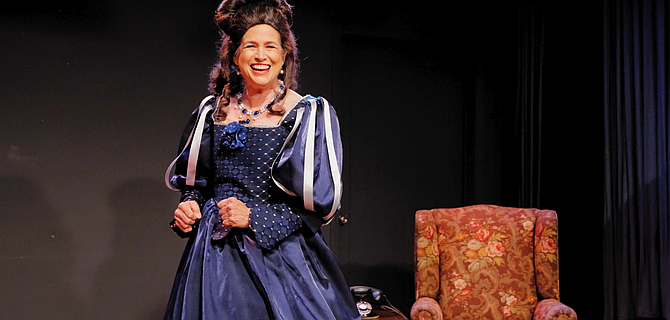
Peyser takes the stage as Lady Penelope, San Diego’s self-appointed Laureate of Iambic Pentameter and Rhyme, clad in Elizabethan dress — one that she has never washed, lest it reveal its age and decrepitude and dissolve. She’s not much for washing herself, either — “pits and tits, as they say” — and this too is a prophylactic tactic, a natural enforcement of social distancing. She does expect you to tidy up, however: “Oh, welcome back from quarantine/ I trust you’re keeping your hands clean.”
At first, the frequent references to the Covid quarantine and subsequent rise of isolation culture made me suspect that the act was a lockdown project that Peyser was reluctant to relinquish lo these several years later. But it turns out that when the world withdrew, it was just catching up with Lady P, or rather, the unhappy woman hiding behind her persona. “She’s not all hearts and flowers; you may hear/ Some slings and arrows from this sonneteer.” She knows that a proper clown never sheds a tear, and she does her best to keep things upbeat —alternating her spoken verse with songs sung over a ukulele’s peppy twang — but then there are these phone calls to deal with…and her therapist has moved to Idaho. (Though that really shouldn’t be a problem, post-Zoom.)
So what begins as an entertainment becomes an engagement — though not for us, not at first. “You came to the theater, some of you of your own free will,” she marvels, explaining her refusal to demand audience participation. But as her armor cracks, so does her resolve; near the end, we asked what rhymes with “pathetic.” And yet, this shortish show is not a downer, in part because Lady P holds onto hope in the face of death and all the rest of it, and in part because besides the highbrow/lowbrow thing, Peyser gets the silly/serious thing as well.
Here's something you might be interested in.
Theater Review: Sonnets from Suburbia
Spend an hour with San Diego’s self-appointed Laureate of Iambic Pentameter and Rhyme

Theater Review: Sonnets from Suburbia
Spend an hour with San Diego’s self-appointed Laureate of Iambic Pentameter and Rhyme
Full disclosure: your humble correspondent has been known to bang out an occasional sonnet for the guest of honor at birthday parties. As party tricks go, it isn’t bad: the subject gets flattered and ribbed a bit, the crowd gets a little highbrow-goes-lowbrow diversion, and I get to hunker down in a corner and not socialize for half an hour or so. Everybody wins! I mention this because I suspect it makes me something of an ideal audience for Penny Peyser’s Sonnets from Suburbia, a solo act she is presenting at this year’s Fringe Festival. Not only because she gets the highbrow/lowbrow thing — at one point rhyming “thanks” and “Spanx” while adhering to the sonnet’s rigorous formal requirements — but because the whole show is about performance as protection.
Peyser takes the stage as Lady Penelope, San Diego’s self-appointed Laureate of Iambic Pentameter and Rhyme, clad in Elizabethan dress — one that she has never washed, lest it reveal its age and decrepitude and dissolve. She’s not much for washing herself, either — “pits and tits, as they say” — and this too is a prophylactic tactic, a natural enforcement of social distancing. She does expect you to tidy up, however: “Oh, welcome back from quarantine/ I trust you’re keeping your hands clean.”
At first, the frequent references to the Covid quarantine and subsequent rise of isolation culture made me suspect that the act was a lockdown project that Peyser was reluctant to relinquish lo these several years later. But it turns out that when the world withdrew, it was just catching up with Lady P, or rather, the unhappy woman hiding behind her persona. “She’s not all hearts and flowers; you may hear/ Some slings and arrows from this sonneteer.” She knows that a proper clown never sheds a tear, and she does her best to keep things upbeat —alternating her spoken verse with songs sung over a ukulele’s peppy twang — but then there are these phone calls to deal with…and her therapist has moved to Idaho. (Though that really shouldn’t be a problem, post-Zoom.)
So what begins as an entertainment becomes an engagement — though not for us, not at first. “You came to the theater, some of you of your own free will,” she marvels, explaining her refusal to demand audience participation. But as her armor cracks, so does her resolve; near the end, we asked what rhymes with “pathetic.” And yet, this shortish show is not a downer, in part because Lady P holds onto hope in the face of death and all the rest of it, and in part because besides the highbrow/lowbrow thing, Peyser gets the silly/serious thing as well.
Comments