

Here's something you might be interested in.
Ask a Hipster — Advice you didn't know you needed
Big Screen — Movie commentary
Blurt — Music's inside track
Booze News — San Diego spirits
Classical Music — Immortal beauty
Classifieds — Free and easy
Close to Home — What it’s like on the street where you live
Cover Stories — Front-page features
Drinks All Around — Bartenders' drink recipes
Excerpts — Literary and spiritual excerpts
Feast! — Food & drink reviews
Feature Stories — Local news & stories
Fishing Report — What’s getting hooked from ship and shore
From the Archives — Spotlight on the past
Golden Dreams — Talk of the town
The Gonzo Report — Making the musical scene, or at least reporting from it
Letters — Our inbox
Movies@Home — Local movie buffs share favorites
Movie Reviews — Our critics' picks and pans
Musician Interviews — Up close with local artists
Neighborhood News from Stringers — Hyperlocal news
News Ticker — News & politics
Obermeyer — San Diego politics illustrated
Outdoors — Weekly changes in flora and fauna
Overheard in San Diego — Eavesdropping illustrated
Poetry — The old and the new
Reader Travel — Travel section built by travelers
Reading — The hunt for intellectuals
Roam-O-Rama — SoCal's best hiking/biking trails
San Diego Beer — Inside San Diego suds
SD on the QT — Almost factual news
Sheep and Goats — Places of worship
Special Issues — The best of
Street Style — San Diego streets have style
Surf Diego — Real stories from those braving the waves
Theater — On stage in San Diego this week
Tin Fork — Silver spoon alternative
Under the Radar — Matt Potter's undercover work
Unforgettable — Long-ago San Diego
Unreal Estate — San Diego's priciest pads
Your Week — Daily event picks
Theater review: Birthday Candles at North Coast Rep
What is life to a goldfish?
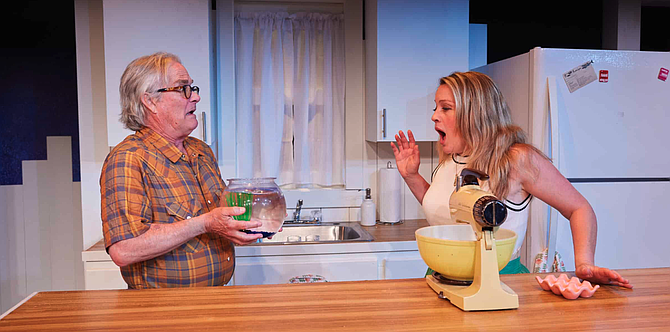
C.S. Lewis, among others, referred to eternity as an ever-present now, at one point writing, “the present is the point at which time touches eternity.” Noah Haidle, in his plus ca meme chose play Birthday Candles, cleverly embodies this concept via a creature that apparently does not worry about the future, and reputedly does not remember the past: the goldfish. Well, a little over a hundred goldfish, all of them named Atman, after the Hindu notion of the eternal, unchanging, innermost self.
Set against all of these fish is their owner Ernestine, who opens the play wondering if, at 17, she has wasted her life, and who ends it at something over 90, supremely unconcerned with the question. She begins by declaring that she will wage war against the everyday and surprise God as she prepares to play a gender-swapped version of Lear; she ends reciting Lear’s Act Five plea to Cordelia: “So we’ll live, and pray, and sing, and tell old tales, and laugh at gilded butterflies, and hear poor rogues talk of court news…and take upon’s the mystery of things, as if we were God’s spies.” Atman endures; Ernestine changes. As does the world around her. People come; people go. Some of the changes you can measure on the door jamb; most you can't.
And yet, her life is touched with an echo of that unchanging eternity, in the form of tradition. The play’s 90-minute runtime is given to the preparation of Ernestine’s birthday cake — or rather, a great many birthday cakes, all in the same kitchen, all of them the same, and in all of which her mother has said she may find “the story of the cosmos.” By the time we get to the second one, her mother has died. By the third, she has two children of her own, the younger of whom asks if, at 17, he has wasted his life. Her daughter angrily insists there are no patterns, but Ernestine does not break with the pattern she has made despite the chaos. So much else is breakable, and breaks: minds, bodies, hearts, families.
The play’s great virtue is its breezy speed. (Life is a but a breath, as Job reminds us.) If it slowed, all its idea-slinging would grow ponderous, and all its sadnesses would prove overwhelming. It would sink instead of skipping along. As it is, it does skip, and in so doing, manages to remain sweet despite the bitterness in the depths. The way a birthday cake — that delicious, cheery herald of impending death — should.
Here's something you might be interested in.
Theater review: Birthday Candles at North Coast Rep
What is life to a goldfish?

Theater review: Birthday Candles at North Coast Rep
What is life to a goldfish?
C.S. Lewis, among others, referred to eternity as an ever-present now, at one point writing, “the present is the point at which time touches eternity.” Noah Haidle, in his plus ca meme chose play Birthday Candles, cleverly embodies this concept via a creature that apparently does not worry about the future, and reputedly does not remember the past: the goldfish. Well, a little over a hundred goldfish, all of them named Atman, after the Hindu notion of the eternal, unchanging, innermost self.
Set against all of these fish is their owner Ernestine, who opens the play wondering if, at 17, she has wasted her life, and who ends it at something over 90, supremely unconcerned with the question. She begins by declaring that she will wage war against the everyday and surprise God as she prepares to play a gender-swapped version of Lear; she ends reciting Lear’s Act Five plea to Cordelia: “So we’ll live, and pray, and sing, and tell old tales, and laugh at gilded butterflies, and hear poor rogues talk of court news…and take upon’s the mystery of things, as if we were God’s spies.” Atman endures; Ernestine changes. As does the world around her. People come; people go. Some of the changes you can measure on the door jamb; most you can't.
And yet, her life is touched with an echo of that unchanging eternity, in the form of tradition. The play’s 90-minute runtime is given to the preparation of Ernestine’s birthday cake — or rather, a great many birthday cakes, all in the same kitchen, all of them the same, and in all of which her mother has said she may find “the story of the cosmos.” By the time we get to the second one, her mother has died. By the third, she has two children of her own, the younger of whom asks if, at 17, he has wasted his life. Her daughter angrily insists there are no patterns, but Ernestine does not break with the pattern she has made despite the chaos. So much else is breakable, and breaks: minds, bodies, hearts, families.
The play’s great virtue is its breezy speed. (Life is a but a breath, as Job reminds us.) If it slowed, all its idea-slinging would grow ponderous, and all its sadnesses would prove overwhelming. It would sink instead of skipping along. As it is, it does skip, and in so doing, manages to remain sweet despite the bitterness in the depths. The way a birthday cake — that delicious, cheery herald of impending death — should.