

Here's something you might be interested in.
Ask a Hipster — Advice you didn't know you needed
Big Screen — Movie commentary
Blurt — Music's inside track
Booze News — San Diego spirits
Classical Music — Immortal beauty
Classifieds — Free and easy
Close to Home — What it’s like on the street where you live
Cover Stories — Front-page features
Drinks All Around — Bartenders' drink recipes
Excerpts — Literary and spiritual excerpts
Feast! — Food & drink reviews
Feature Stories — Local news & stories
Fishing Report — What’s getting hooked from ship and shore
From the Archives — Spotlight on the past
Golden Dreams — Talk of the town
The Gonzo Report — Making the musical scene, or at least reporting from it
Letters — Our inbox
Movies@Home — Local movie buffs share favorites
Movie Reviews — Our critics' picks and pans
Musician Interviews — Up close with local artists
Neighborhood News from Stringers — Hyperlocal news
News Ticker — News & politics
Obermeyer — San Diego politics illustrated
Outdoors — Weekly changes in flora and fauna
Overheard in San Diego — Eavesdropping illustrated
Poetry — The old and the new
Reader Travel — Travel section built by travelers
Reading — The hunt for intellectuals
Roam-O-Rama — SoCal's best hiking/biking trails
San Diego Beer — Inside San Diego suds
SD on the QT — Almost factual news
Sheep and Goats — Places of worship
Special Issues — The best of
Street Style — San Diego streets have style
Surf Diego — Real stories from those braving the waves
Theater — On stage in San Diego this week
Tin Fork — Silver spoon alternative
Under the Radar — Matt Potter's undercover work
Unforgettable — Long-ago San Diego
Unreal Estate — San Diego's priciest pads
Your Week — Daily event picks
Tin Fork: Sticky rice and other delights
Food from the land of a million elephants — in Allied Gardens
“Lao food! Lao food!” calls a woman's voice through the loudspeaker. The voice gives a couple of whoops. “Ahan Lao! I’m making Laab Kung Lao. Homage to the OG! Ahan Lao!”
In this case, the OG (“Original Gangsta,” right? But you might as well say “Original Generation”) is her beloved mom — and dad, and other relatives from the home country. She’s here on stage at the Lao Food Festival to teach us how to cook a Laotian dish, and she’s talking about shrimp Laab, or larb, the Laotian dish, here at Allied Gardens Community Center.
“Larb” means “good luck.” The dish is a type of salad featuring raw shrimp that's been pounded into submission with a mortar and pestle. “It was the first dish I thought of because it pays homage to the O.G. The generation who sacrificed, gave up our Mekong life, and came over to America, right? So I thought if my mae (mom) or paw (dad) were here, what dish would they want to cook for themselves? And I was like, 'They would love for us to cook some Laab Kung Lao!' Minced shrimp salad!"
She says she wants to pay homage to her mae, "because she passed away last year. This dish is to honor her, to pay it forward, and to showcase the love. It’s not a dish that is for the mainstream. It’s food that we cook for ourselves. I’m just happy that we have a food festival for Lao, to celebrate us! Our Laotian ahan is so freaking delicious! It’s so saap! But do people know about it? I always hear people say, ‘Lao food is so under-RATed!’ I’m sick of hearing about it! What are we going to do about it?? You’d better make it famous! Don’t say ‘I’m eating papaya salad,’ but ‘I’m eating LAO papaya salad!’”
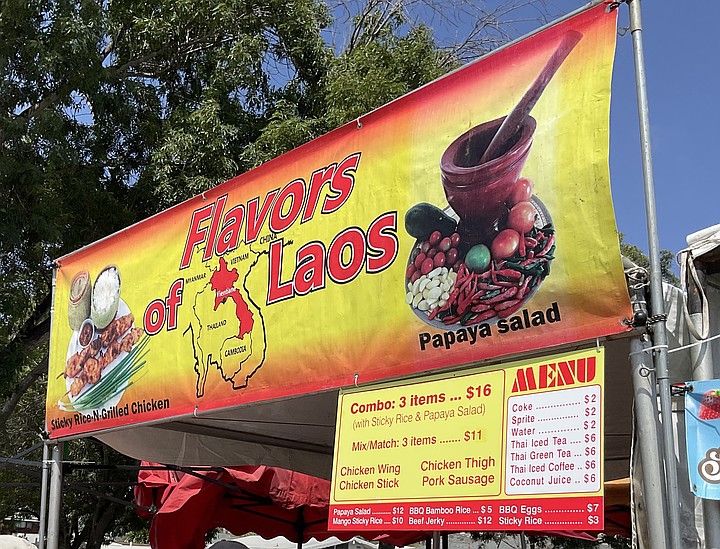
"Many people don't know about Laotian food, even when they're eating it!"
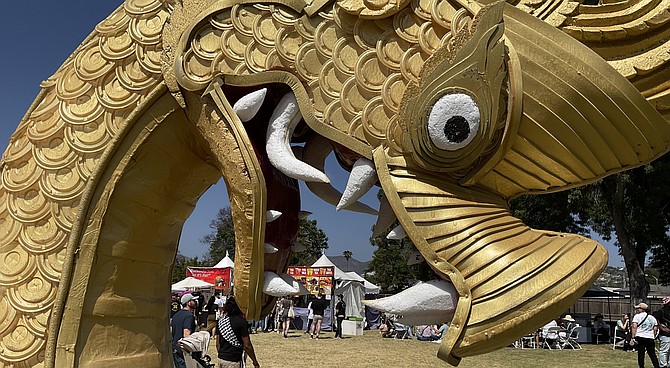
We’re gathered in a giant field in upper Mission Valley for the Lao food festival in Allied Gardens Community Park. Families wander around the food tents, Laotians, lone White Asians, schoolkids with their parents. It's a get-together for the 8000 Laotians who have settled here in San Diego since the Vietnam War — the biggest concentration of Lao immigrants anywhere in the United States.
“This is our third annual festival,” says Sam, who is working in a nearby tent, turning golden chicken thighs and wings on a grill with live flames licking up from below. “Because many people don’t know about Laotian food. Even when they’re eating it! You may have eaten Thai food, Vietnamese food. In these cuisines, you’re already sampling Lao food. But it never has been showcased. People don’t know what is Lao. People don’t even know where Laos is!”
This is when I notice rows of eggs baking in their shells on the edge rails of the same grill. Each egg has a hole cut into its top. “We call these Khai Ping,” says Sam. (His Laotian name is Phom.) “They are baked and seasoned eggs. We make a hole in the top of the uncooked egg, pour the egg white and yolk into a cup, add seasonings, stir it up, pour it back into the shell, seal it, and then let it bake slowly for at least a couple of hours. It makes a cheap and wonderful snack. And today, you can get eight for $7. Plus of course we have to have it with khao niew, Laotian sticky rice.”
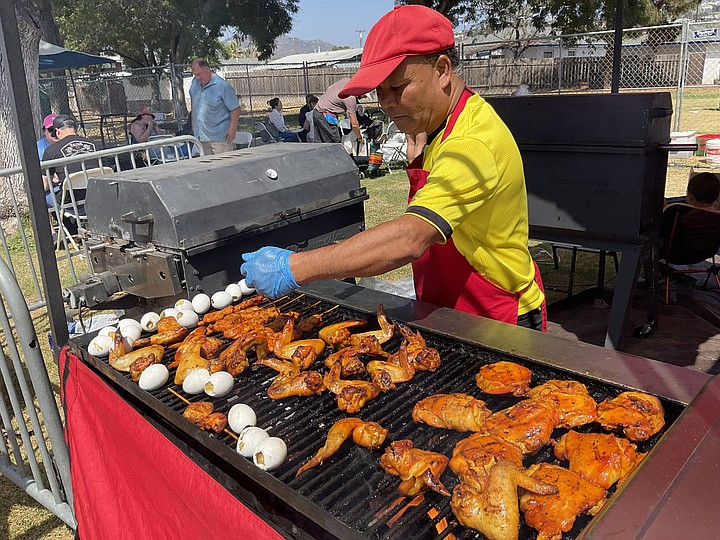
Which to eat first, the chicken or the egg?
It turns out that sweet, nutty, sticky rice originally came from the mountainous north of Laos, and is pretty much the national food. Sam reminds me that Laos is an inland country. Its water mainly flows along the mighty Mekong River, which runs from the Himalayas through six countries to Cambodia. Laos has faded in people’s consciousness these days, but back in the day — like around 1400 AD — it was Lan Xang, the land of a million elephants. Everybody kowtowed to the Lao Empire. It was the local superpower. Today, not so much. More Shangri-La than Singapore.
Sam is working under a banner that says “Flavors of Laos.” He continues, “This chicken here is grilled, but also I am roasting it first in this charcoal burner. Makes the meat smokey, moist inside. Then I grill it. The grilling adds the crispy outside.” The man’s not kidding. This golden chicken looks smoky, savory, spicy, and in the afternoon sunshine, Technicolor, totally irresistible. Three pieces for $11. Good deal. Wing, thigh, or skewers. Of course you have to add sticky rice ($3), and maybe a Lao beer.
Honestly, the walk-around combo I buy — three chicken thighs, rice and two scrumbo seasoned baked eggs — is more than I can eat. Pity, because tents all around are selling food I’ve never heard of, like Kwa mee ($15, a Lao version of Pad Thai noodle dish, turns out), BBQ bamboo rice ($5, flavored by the hollow bamboo section that its cooked in over a fire), and versions of that famous papaya salad ($12). Except, oh Lord, Mamuang Khao Niew, the one Lao dish everybody knows: sticky rice and mango, with coconut milk, ($10). Paradise! For that, I’ll let my belt out a notch.
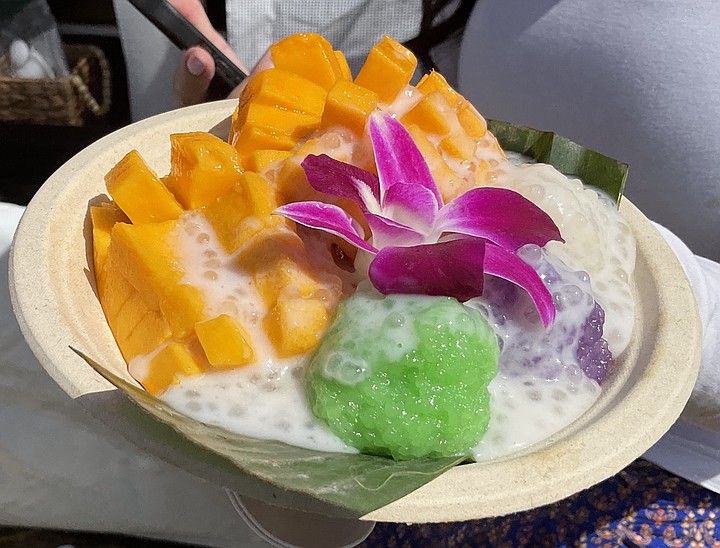
The belt loosener.
“You know why sticky rice is so famous?” asks my friend Alan, who’s here with me. “Because it was used as the mortar that holds together the stones of the Great Wall of China. True! Look it up. Lao sticky rice built the Great Wall of China!” And the incredible thing is, when you do look it up, respectable sites say the Chinese wall- builders would do that, mix sticky rice with lime, and slap it on as the perfect mortar.
Just shows: You never know what you’re eating. The girl with the mic was right: we’re not appreciating Ahan Lao.
The Place: Lao Food Festival, at Allied Gardens Community Park, 5155 Greenbrier Ave., Allied Gardens, 760-566-6232
Frequency: once a year
Here's something you might be interested in.
Tin Fork: Sticky rice and other delights
Food from the land of a million elephants — in Allied Gardens

Tin Fork: Sticky rice and other delights
Food from the land of a million elephants — in Allied Gardens
“Lao food! Lao food!” calls a woman's voice through the loudspeaker. The voice gives a couple of whoops. “Ahan Lao! I’m making Laab Kung Lao. Homage to the OG! Ahan Lao!”
In this case, the OG (“Original Gangsta,” right? But you might as well say “Original Generation”) is her beloved mom — and dad, and other relatives from the home country. She’s here on stage at the Lao Food Festival to teach us how to cook a Laotian dish, and she’s talking about shrimp Laab, or larb, the Laotian dish, here at Allied Gardens Community Center.
“Larb” means “good luck.” The dish is a type of salad featuring raw shrimp that's been pounded into submission with a mortar and pestle. “It was the first dish I thought of because it pays homage to the O.G. The generation who sacrificed, gave up our Mekong life, and came over to America, right? So I thought if my mae (mom) or paw (dad) were here, what dish would they want to cook for themselves? And I was like, 'They would love for us to cook some Laab Kung Lao!' Minced shrimp salad!"
She says she wants to pay homage to her mae, "because she passed away last year. This dish is to honor her, to pay it forward, and to showcase the love. It’s not a dish that is for the mainstream. It’s food that we cook for ourselves. I’m just happy that we have a food festival for Lao, to celebrate us! Our Laotian ahan is so freaking delicious! It’s so saap! But do people know about it? I always hear people say, ‘Lao food is so under-RATed!’ I’m sick of hearing about it! What are we going to do about it?? You’d better make it famous! Don’t say ‘I’m eating papaya salad,’ but ‘I’m eating LAO papaya salad!’”
"Many people don't know about Laotian food, even when they're eating it!"
We’re gathered in a giant field in upper Mission Valley for the Lao food festival in Allied Gardens Community Park. Families wander around the food tents, Laotians, lone White Asians, schoolkids with their parents. It's a get-together for the 8000 Laotians who have settled here in San Diego since the Vietnam War — the biggest concentration of Lao immigrants anywhere in the United States.
“This is our third annual festival,” says Sam, who is working in a nearby tent, turning golden chicken thighs and wings on a grill with live flames licking up from below. “Because many people don’t know about Laotian food. Even when they’re eating it! You may have eaten Thai food, Vietnamese food. In these cuisines, you’re already sampling Lao food. But it never has been showcased. People don’t know what is Lao. People don’t even know where Laos is!”
This is when I notice rows of eggs baking in their shells on the edge rails of the same grill. Each egg has a hole cut into its top. “We call these Khai Ping,” says Sam. (His Laotian name is Phom.) “They are baked and seasoned eggs. We make a hole in the top of the uncooked egg, pour the egg white and yolk into a cup, add seasonings, stir it up, pour it back into the shell, seal it, and then let it bake slowly for at least a couple of hours. It makes a cheap and wonderful snack. And today, you can get eight for $7. Plus of course we have to have it with khao niew, Laotian sticky rice.”
Which to eat first, the chicken or the egg?
It turns out that sweet, nutty, sticky rice originally came from the mountainous north of Laos, and is pretty much the national food. Sam reminds me that Laos is an inland country. Its water mainly flows along the mighty Mekong River, which runs from the Himalayas through six countries to Cambodia. Laos has faded in people’s consciousness these days, but back in the day — like around 1400 AD — it was Lan Xang, the land of a million elephants. Everybody kowtowed to the Lao Empire. It was the local superpower. Today, not so much. More Shangri-La than Singapore.
Sam is working under a banner that says “Flavors of Laos.” He continues, “This chicken here is grilled, but also I am roasting it first in this charcoal burner. Makes the meat smokey, moist inside. Then I grill it. The grilling adds the crispy outside.” The man’s not kidding. This golden chicken looks smoky, savory, spicy, and in the afternoon sunshine, Technicolor, totally irresistible. Three pieces for $11. Good deal. Wing, thigh, or skewers. Of course you have to add sticky rice ($3), and maybe a Lao beer.
Honestly, the walk-around combo I buy — three chicken thighs, rice and two scrumbo seasoned baked eggs — is more than I can eat. Pity, because tents all around are selling food I’ve never heard of, like Kwa mee ($15, a Lao version of Pad Thai noodle dish, turns out), BBQ bamboo rice ($5, flavored by the hollow bamboo section that its cooked in over a fire), and versions of that famous papaya salad ($12). Except, oh Lord, Mamuang Khao Niew, the one Lao dish everybody knows: sticky rice and mango, with coconut milk, ($10). Paradise! For that, I’ll let my belt out a notch.
The belt loosener.
“You know why sticky rice is so famous?” asks my friend Alan, who’s here with me. “Because it was used as the mortar that holds together the stones of the Great Wall of China. True! Look it up. Lao sticky rice built the Great Wall of China!” And the incredible thing is, when you do look it up, respectable sites say the Chinese wall- builders would do that, mix sticky rice with lime, and slap it on as the perfect mortar.
Just shows: You never know what you’re eating. The girl with the mic was right: we’re not appreciating Ahan Lao.
The Place: Lao Food Festival, at Allied Gardens Community Park, 5155 Greenbrier Ave., Allied Gardens, 760-566-6232
Frequency: once a year
Comments