

Here's something you might be interested in.
Ask a Hipster — Advice you didn't know you needed
Big Screen — Movie commentary
Blurt — Music's inside track
Booze News — San Diego spirits
Classical Music — Immortal beauty
Classifieds — Free and easy
Close to Home — What it’s like on the street where you live
Cover Stories — Front-page features
Drinks All Around — Bartenders' drink recipes
Excerpts — Literary and spiritual excerpts
Feast! — Food & drink reviews
Feature Stories — Local news & stories
Fishing Report — What’s getting hooked from ship and shore
From the Archives — Spotlight on the past
Golden Dreams — Talk of the town
The Gonzo Report — Making the musical scene, or at least reporting from it
Letters — Our inbox
Movies@Home — Local movie buffs share favorites
Movie Reviews — Our critics' picks and pans
Musician Interviews — Up close with local artists
Neighborhood News from Stringers — Hyperlocal news
News Ticker — News & politics
Obermeyer — San Diego politics illustrated
Outdoors — Weekly changes in flora and fauna
Overheard in San Diego — Eavesdropping illustrated
Poetry — The old and the new
Reader Travel — Travel section built by travelers
Reading — The hunt for intellectuals
Roam-O-Rama — SoCal's best hiking/biking trails
San Diego Beer — Inside San Diego suds
SD on the QT — Almost factual news
Sheep and Goats — Places of worship
Special Issues — The best of
Street Style — San Diego streets have style
Surf Diego — Real stories from those braving the waves
Theater — On stage in San Diego this week
Tin Fork — Silver spoon alternative
Under the Radar — Matt Potter's undercover work
Unforgettable — Long-ago San Diego
Unreal Estate — San Diego's priciest pads
Your Week — Daily event picks
The cloudless sulfur butterfly and its favorite hiding place, extreme low tides at an extreme early hour
Peak Milky Way viewing this week
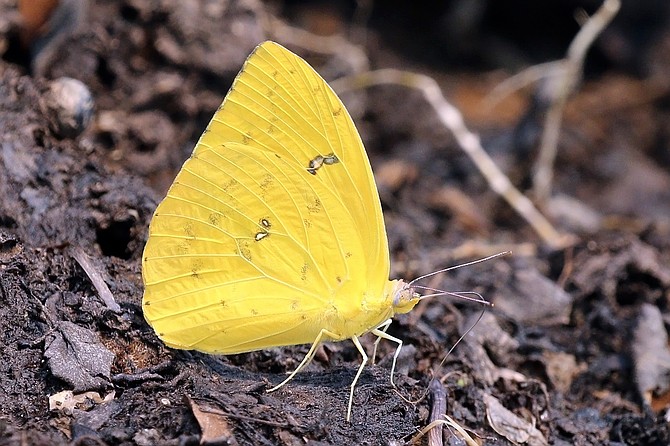
The lifespan of the Cloudless Sulfur Butterfly is only 2-4 weeks.
The Gold Medallion Tree (Cassia leptophylla) is one of San Diego’s most popular trees, and it has been blooming all around town for the past few weeks. The yellow flowers bloom in clusters at the tips of the branches — clusters which can grow to the size of a basketball on mature trees. Native to Brazil and introduced to California in the 1980s, it does well here because it is extremely drought tolerant, loves full sun, and will tolerate frost to 25 degrees Fahrenheit. It grows to about 25 feet tall with a 25-foot canopy, and is evergreen for most of the year. The yellow flowers on the tree now will drop in about a month, making way for the footlong pods that will drop in early fall.
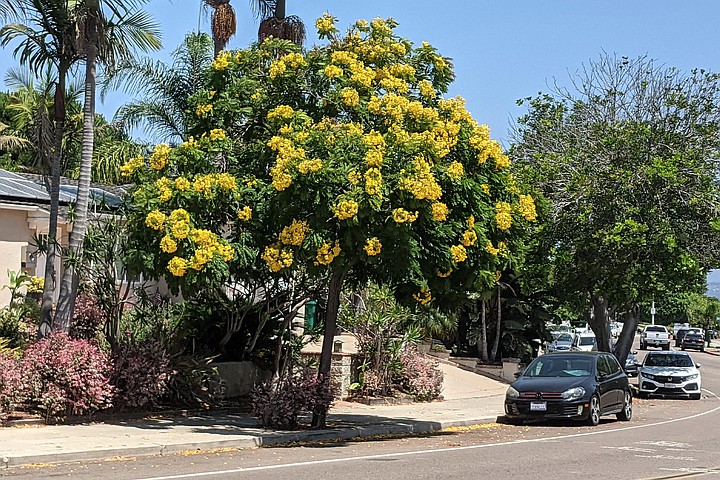
The Gold Medallion tree is blooming all over San Diego.
The Cloudless Sulfur Caterpillar uses the Gold Medallion tree as a host plant for pupating, and when the tree is blooming (as it is now), you’ll often see the Cloudless Sulfur butterfly (Phoebis sennae) fluttering around it. The adults are clever at camouflage, resting on flowers that match the color of their wings. Growing to just under two inches in size, the males are a bright lemon yellow, while the females are more of a golden yellow. Both genders have black spotting on the wings. Their rapid, darting movements are one way to easily differentiate them from other, similar species.

Hotel Del Coronado at very low tide
Extreme Low Tides Early This Week (the lowest levels for the month of August) occur during the wee hours of the morning. Wednesday, August 20, features a -1.02 foot tide at 2:39 am. On Thursday, August 21, there’s a -1.12 foot low tide at 3:17 am. Spring and summer extreme low tides typically occur at such inconvenient times of the day. Starting in October and continuing through the winter season, favorable low-tide episodes will coincide with afternoon hours, and it will be possible to make daylight inspections of the lowest and richest tidepools along San Diego County’s coastline.
On August 20, Venus and Jupiter form a dramatic triangle with the crescent Moon. This can best be seen around 5 am.

Milky Way with a couple of shooting stars. Taken just south of Lake Cuyamaca 7/23/2016.
The Milky Way Appears At Its Most Glorious during August summer evenings that are free of moonlight. (This year, these evenings occur from now through August 23.) You’ll need to be in the mountains or the desert to see it clearly; an excess of artificial light in or near the urbanized parts of San Diego County renders it all but invisible. The Milky Way seems to broaden and become generally brighter over the southern horizon, and runs up between Sagittarius and Scorpius in the south-southwest. When we gaze in this direction, we look toward the crowded heart of our galaxy, where millions of dim stars are so closely spaced in the sky that, taken together, they resemble puffs of steam.
Here's something you might be interested in.
The cloudless sulfur butterfly and its favorite hiding place, extreme low tides at an extreme early hour
Peak Milky Way viewing this week

The cloudless sulfur butterfly and its favorite hiding place, extreme low tides at an extreme early hour
Peak Milky Way viewing this week
The lifespan of the Cloudless Sulfur Butterfly is only 2-4 weeks.
The Gold Medallion Tree (Cassia leptophylla) is one of San Diego’s most popular trees, and it has been blooming all around town for the past few weeks. The yellow flowers bloom in clusters at the tips of the branches — clusters which can grow to the size of a basketball on mature trees. Native to Brazil and introduced to California in the 1980s, it does well here because it is extremely drought tolerant, loves full sun, and will tolerate frost to 25 degrees Fahrenheit. It grows to about 25 feet tall with a 25-foot canopy, and is evergreen for most of the year. The yellow flowers on the tree now will drop in about a month, making way for the footlong pods that will drop in early fall.
The Gold Medallion tree is blooming all over San Diego.
The Cloudless Sulfur Caterpillar uses the Gold Medallion tree as a host plant for pupating, and when the tree is blooming (as it is now), you’ll often see the Cloudless Sulfur butterfly (Phoebis sennae) fluttering around it. The adults are clever at camouflage, resting on flowers that match the color of their wings. Growing to just under two inches in size, the males are a bright lemon yellow, while the females are more of a golden yellow. Both genders have black spotting on the wings. Their rapid, darting movements are one way to easily differentiate them from other, similar species.
Hotel Del Coronado at very low tide
Extreme Low Tides Early This Week (the lowest levels for the month of August) occur during the wee hours of the morning. Wednesday, August 20, features a -1.02 foot tide at 2:39 am. On Thursday, August 21, there’s a -1.12 foot low tide at 3:17 am. Spring and summer extreme low tides typically occur at such inconvenient times of the day. Starting in October and continuing through the winter season, favorable low-tide episodes will coincide with afternoon hours, and it will be possible to make daylight inspections of the lowest and richest tidepools along San Diego County’s coastline.
On August 20, Venus and Jupiter form a dramatic triangle with the crescent Moon. This can best be seen around 5 am.
Milky Way with a couple of shooting stars. Taken just south of Lake Cuyamaca 7/23/2016.
The Milky Way Appears At Its Most Glorious during August summer evenings that are free of moonlight. (This year, these evenings occur from now through August 23.) You’ll need to be in the mountains or the desert to see it clearly; an excess of artificial light in or near the urbanized parts of San Diego County renders it all but invisible. The Milky Way seems to broaden and become generally brighter over the southern horizon, and runs up between Sagittarius and Scorpius in the south-southwest. When we gaze in this direction, we look toward the crowded heart of our galaxy, where millions of dim stars are so closely spaced in the sky that, taken together, they resemble puffs of steam.
Comments