

Here's something you might be interested in.
Ask a Hipster — Advice you didn't know you needed
Big Screen — Movie commentary
Blurt — Music's inside track
Booze News — San Diego spirits
Classical Music — Immortal beauty
Classifieds — Free and easy
Close to Home — What it’s like on the street where you live
Cover Stories — Front-page features
Drinks All Around — Bartenders' drink recipes
Excerpts — Literary and spiritual excerpts
Feast! — Food & drink reviews
Feature Stories — Local news & stories
Fishing Report — What’s getting hooked from ship and shore
From the Archives — Spotlight on the past
Golden Dreams — Talk of the town
The Gonzo Report — Making the musical scene, or at least reporting from it
Letters — Our inbox
Movies@Home — Local movie buffs share favorites
Movie Reviews — Our critics' picks and pans
Musician Interviews — Up close with local artists
Neighborhood News from Stringers — Hyperlocal news
News Ticker — News & politics
Obermeyer — San Diego politics illustrated
Outdoors — Weekly changes in flora and fauna
Overheard in San Diego — Eavesdropping illustrated
Poetry — The old and the new
Reader Travel — Travel section built by travelers
Reading — The hunt for intellectuals
Roam-O-Rama — SoCal's best hiking/biking trails
San Diego Beer — Inside San Diego suds
SD on the QT — Almost factual news
Sheep and Goats — Places of worship
Special Issues — The best of
Street Style — San Diego streets have style
Surf Diego — Real stories from those braving the waves
Theater — On stage in San Diego this week
Tin Fork — Silver spoon alternative
Under the Radar — Matt Potter's undercover work
Unforgettable — Long-ago San Diego
Unreal Estate — San Diego's priciest pads
Your Week — Daily event picks
Alison Luedecke: Master of the Queen of Instruments
When it comes to the organ, "“The feet, that’s the hard thing. You can play whole melodies with your feet."
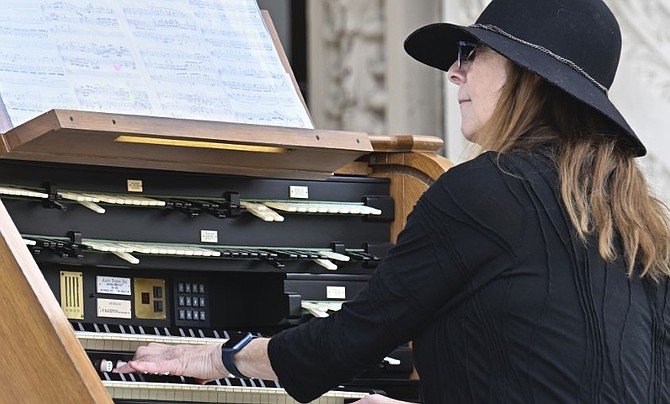
I asked organist Alison Luedecke how she first got into playing the Queen of Instruments. She recalls that her first childhood church had a pipe organ, which she liked the sound of, but she didn’t actually get her hands on one until she was 15. “We had moved to a new neighborhood, so a new church, and the priest was building a pipe organ.”
The priest, unusually, had a master’s degree in music, and was himself a very capable organist. “I wanted to make sure he heard me play the piano, because by then I was pretty good on the piano. He heard me and said, ‘I’ll give you organ lessons if you’ll play on Saturdays.”
That’s how it started. And it kept going and going: an organ scholarship, a sequence of church organ jobs — including one lasting more than 20 years at St. James’ Episcopal in La Jolla — and involvement with the National Association of Pastoral Musicians. Luedecke plays outside of churches, too. You can find her performing with San Diego Baroque, and occasionally at the Spreckels pavilion.
She likes keeping the Spreckels gigs occasional. “I really do love church," she says, speaking of her job at Nativity parish in Rancho Santa Fe, where she’s been for the last three years. If she were to be employed as San Diego’s civic organist, that would mean coming up with weekly theater organ concert programs. “I like coming up with really integrated liturgical services, and masses. Even my concerts at the church have some sort of a story, so it’s not just random pieces thrown together for a concert. I really like that."
Video:
Alison Luedecke: Vierne's Symphonie 1: Final
Her work at Nativity is supported by its pastor, Fr. Augustine Opalalic, and by a fund called The Founders’ Covenant, set up by founding members of the parish in the 1990s to support the church’s projects — including the project of promoting what Luedecke simply calls “good liturgy and good music." It might sound surprising that it could take a covenant to do such a thing, but Luedecke says that in the churches she grew up in, she never heard a really good choir or organ. “College was when I learned about the treasury of sacred music that has existed for hundreds of years in the Catholic Church. So now to finally be in a church where I get to do these pieces!?” she asks rhetorically, her gratification evident. “We do pieces from the 1400s all the way up to today. I like that a lot “
But it’s only very recently that Nativity has begun striving toward a goal that was conceived at the parish’s beginning, but then delayed time and time again: the installation of a new, grand pipe organ in place of the 35-year-old electronic organ that she has been coaxing into service. Luedecke has come full circle: where once she was the apprentice at the site of an organ installation, now she is the master.
It’s a massive undertaking, made at least a little easier by the fact that the church's designer had the mammoth instrument in mind from the outset, and installed steel reinforcement in the relevant sections of the floor and wall. Still, the church had to rebuild the underlying platform; there’s an architectural firm involved, and a structural engineer.
Luedecke provided specifications for the organ to its builders, Casavant Freres in Quebec. They’re building it now, and she’ll have to go and test it at the beginning of 2026. They can’t just send her a video or a recording. This is the way it’s always been done — the same way J.S. Bach would have gone and tested organs. After it passes the test, Casavant will disassemble it, pack it up, and have it driven to Rancho Santa Fe. Additional members of the team will fly to meet the organ and its handlers here. It will then take about a month to put it together on-site. Finally, Luedecke will work with them on “tonal finishing, adjusting each pipe so it sounds right in the room."
She says there’s not a lot for her to do with the organ at this stage, but she’s busy otherwise: Luedecke also does some teaching. These days, she has a small group, ranging in age from 13 to 60-something, that she instructs at San Diego’s Diocesan Center building, where their chapel has a pipe organ. They’re all people with piano experience who are getting used to the organ. “The feet, that’s the hard thing,” Luedecke says. “You can play whole melodies with your feet. You can play whole pieces with your feet.” These classes provide, at least for a few people at a time, an entry point to the tradition of the instrument and the music associated with it, both dear to the class’ instructor. “You have to have the opportunity for the next generation to get excited about it. Because it’s a lot of work to learn, and to be able to do it well."
Here's something you might be interested in.
Alison Luedecke: Master of the Queen of Instruments
When it comes to the organ, "“The feet, that’s the hard thing. You can play whole melodies with your feet."

Alison Luedecke: Master of the Queen of Instruments
When it comes to the organ, "“The feet, that’s the hard thing. You can play whole melodies with your feet."
I asked organist Alison Luedecke how she first got into playing the Queen of Instruments. She recalls that her first childhood church had a pipe organ, which she liked the sound of, but she didn’t actually get her hands on one until she was 15. “We had moved to a new neighborhood, so a new church, and the priest was building a pipe organ.”
The priest, unusually, had a master’s degree in music, and was himself a very capable organist. “I wanted to make sure he heard me play the piano, because by then I was pretty good on the piano. He heard me and said, ‘I’ll give you organ lessons if you’ll play on Saturdays.”
That’s how it started. And it kept going and going: an organ scholarship, a sequence of church organ jobs — including one lasting more than 20 years at St. James’ Episcopal in La Jolla — and involvement with the National Association of Pastoral Musicians. Luedecke plays outside of churches, too. You can find her performing with San Diego Baroque, and occasionally at the Spreckels pavilion.
She likes keeping the Spreckels gigs occasional. “I really do love church," she says, speaking of her job at Nativity parish in Rancho Santa Fe, where she’s been for the last three years. If she were to be employed as San Diego’s civic organist, that would mean coming up with weekly theater organ concert programs. “I like coming up with really integrated liturgical services, and masses. Even my concerts at the church have some sort of a story, so it’s not just random pieces thrown together for a concert. I really like that."
Video:
Alison Luedecke: Vierne's Symphonie 1: Final
Her work at Nativity is supported by its pastor, Fr. Augustine Opalalic, and by a fund called The Founders’ Covenant, set up by founding members of the parish in the 1990s to support the church’s projects — including the project of promoting what Luedecke simply calls “good liturgy and good music." It might sound surprising that it could take a covenant to do such a thing, but Luedecke says that in the churches she grew up in, she never heard a really good choir or organ. “College was when I learned about the treasury of sacred music that has existed for hundreds of years in the Catholic Church. So now to finally be in a church where I get to do these pieces!?” she asks rhetorically, her gratification evident. “We do pieces from the 1400s all the way up to today. I like that a lot “
But it’s only very recently that Nativity has begun striving toward a goal that was conceived at the parish’s beginning, but then delayed time and time again: the installation of a new, grand pipe organ in place of the 35-year-old electronic organ that she has been coaxing into service. Luedecke has come full circle: where once she was the apprentice at the site of an organ installation, now she is the master.
It’s a massive undertaking, made at least a little easier by the fact that the church's designer had the mammoth instrument in mind from the outset, and installed steel reinforcement in the relevant sections of the floor and wall. Still, the church had to rebuild the underlying platform; there’s an architectural firm involved, and a structural engineer.
Luedecke provided specifications for the organ to its builders, Casavant Freres in Quebec. They’re building it now, and she’ll have to go and test it at the beginning of 2026. They can’t just send her a video or a recording. This is the way it’s always been done — the same way J.S. Bach would have gone and tested organs. After it passes the test, Casavant will disassemble it, pack it up, and have it driven to Rancho Santa Fe. Additional members of the team will fly to meet the organ and its handlers here. It will then take about a month to put it together on-site. Finally, Luedecke will work with them on “tonal finishing, adjusting each pipe so it sounds right in the room."
She says there’s not a lot for her to do with the organ at this stage, but she’s busy otherwise: Luedecke also does some teaching. These days, she has a small group, ranging in age from 13 to 60-something, that she instructs at San Diego’s Diocesan Center building, where their chapel has a pipe organ. They’re all people with piano experience who are getting used to the organ. “The feet, that’s the hard thing,” Luedecke says. “You can play whole melodies with your feet. You can play whole pieces with your feet.” These classes provide, at least for a few people at a time, an entry point to the tradition of the instrument and the music associated with it, both dear to the class’ instructor. “You have to have the opportunity for the next generation to get excited about it. Because it’s a lot of work to learn, and to be able to do it well."
Comments