

Here's something you might be interested in.
Ask a Hipster — Advice you didn't know you needed
Big Screen — Movie commentary
Blurt — Music's inside track
Booze News — San Diego spirits
Classical Music — Immortal beauty
Classifieds — Free and easy
Close to Home — What it’s like on the street where you live
Cover Stories — Front-page features
Drinks All Around — Bartenders' drink recipes
Excerpts — Literary and spiritual excerpts
Feast! — Food & drink reviews
Feature Stories — Local news & stories
Fishing Report — What’s getting hooked from ship and shore
From the Archives — Spotlight on the past
Golden Dreams — Talk of the town
The Gonzo Report — Making the musical scene, or at least reporting from it
Letters — Our inbox
Movies@Home — Local movie buffs share favorites
Movie Reviews — Our critics' picks and pans
Musician Interviews — Up close with local artists
Neighborhood News from Stringers — Hyperlocal news
News Ticker — News & politics
Obermeyer — San Diego politics illustrated
Outdoors — Weekly changes in flora and fauna
Overheard in San Diego — Eavesdropping illustrated
Poetry — The old and the new
Reader Travel — Travel section built by travelers
Reading — The hunt for intellectuals
Roam-O-Rama — SoCal's best hiking/biking trails
San Diego Beer — Inside San Diego suds
SD on the QT — Almost factual news
Sheep and Goats — Places of worship
Special Issues — The best of
Street Style — San Diego streets have style
Surf Diego — Real stories from those braving the waves
Theater — On stage in San Diego this week
Tin Fork — Silver spoon alternative
Under the Radar — Matt Potter's undercover work
Unforgettable — Long-ago San Diego
Unreal Estate — San Diego's priciest pads
Your Week — Daily event picks
Travel Story: Hawaiian Interlude I and II
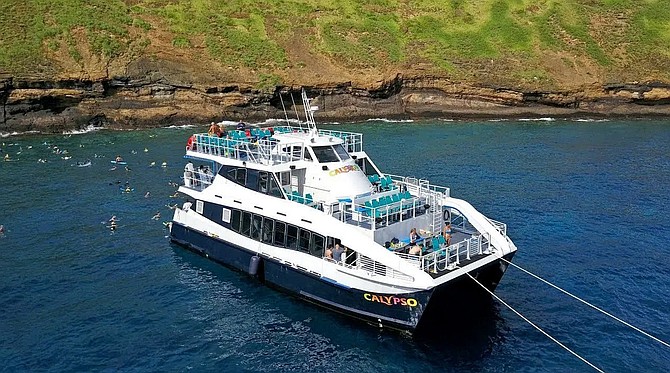
The Big Love Boat?
I
The spirit of Aloha can prove elusive, particularly at around 7:26 in the morning, as you sprint through a series of crowded parking lots and equally crowded docks in Maui’s Ma'alaea Harbor. The Calypso was set to leave in a few moments, and I was not about to lose out on my nonrefundable snorkeling journey to the Molokini Crater and Turtle Town. And whatever else it means, "Aloha" does not translate to panicked, desperate, money-minded determination.
I made it to the boat just before cast-off. As I caught my breath, I was handed a branded life preserver and made to pose for a photo on the gangway by Marley the boat photographer. Marley was a long, rail-thin young man with an even longer and thinner braid slipping downward out of his wild mop of hair.
The triple-decked boat was close to its capacity of 149 passengers when I arrived, so I was grateful to find a spot at a table on the second level with a good view. Wendell, as I will call him here, sat across from me. Tanned, squinty-eyed, sandy haired, and somewhat gawky, his face obscured by the kabuki effect of thick white mineral sunscreen mandated, he nevertheless reminded me of a man from a Dorothea Lange photograph. Very American, like a farmer or an old-time railway engineer. He was from Nevada, somewhere near Reno. I gathered from his conversation that although he had snorkeled before, he wasn’t altogether comfortable with this outing.
After a few moments, I started chatting a with Wendell and the two women who flanked him — Deborah and Susan, I’ll call them. We talked about kids, travel, Hawaii, and snorkeling. We paused our conversation when the time came to pay attention to the snorkeling lesson and get into the water.
I snorkeled. When I came back for lunch at the table, I noticed as the three briefly lowered their heads to pray. I couldn’t detect any of the words until the concluding “In Jesus’ name, Amen." And then, looking at Deborah, Susan said it: “Sister, could you please pass me a napkin?" Sister!
Calm down, David, I thought. You know that your Baptist family members call everyone “brother” and “sister." Or they could be literal sisters — they're close in age. But still, here they were, traveling with a man, and they were from Nevada, the state with the fifth highest population (by percentage) of LDS folks in the Union. I glanced at their hands. Susan wore no rings at all, while on the ring finger of each hand Deborah wore both an engagement ring and wedding band. Oh ho ho! A little subterfuge while travellng?
Alas, that is as far as my discoveries went. How could they have gone further? Look, guys, I’m cool. Very nonjudgmental. I really enjoyed Big Love on HBO. I’m also somewhat familiar with the fractious history of Mormon fundamentalist groups that object to the prohibition of plural marriage. I fear that would have been a non-starter.
Anyway, the way I'm going to tell it, I got to meet my first polygamists out on the sea, way out west, past the frontier lands that Wendell and Deborah and Susan’s Mormon ancestors made it to, past the westernmost expansion of the mainland, all the way into Polynesia, in those wild waters enlivened by the turtle and the humuhumunukunukuapuaʻa.
II
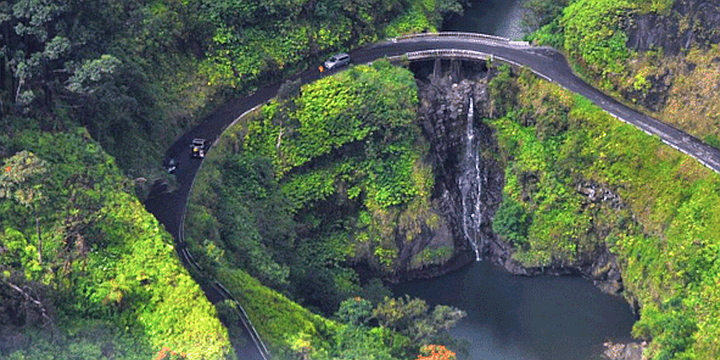
My wonderful wife tends not to feel wonderful in the car. Having survived a series of accidents, she is now a particularly skittish passenger, intensely alert to red lights and vehicles that seem to be drifting out of their lanes. She'd rather I not linger too long in the slow lane, and shuts down my efforts to change songs on Spotify while behind the wheel. So, when we decided to travel on Maui’s famous Road to Hana — “The Divorce Highway," a single-lane road widely regarded as hazardous (though just how hazardous is very debatable) — she had the good sense to sign us (and our kids) up for a guided tour. It would be better for everyone to be driven a pro who could handle the famously tricky turns, narrow jungly passages, and antiquated bridges that mark this circuitous tropical path. We could just sit back and appreciate the waterfalls and picturesque stilt houses.
Our driver, whom I will call Terry, seemed just right for the job. A physically solid 30-something with tattooed arms, he was raised on the island, and introduced himself over the van speaker as an army veteran who drove trucks in Iraq for three tours. Then, reaching further into the past, he noted that he was a descendant of King Kamehameha — I don’t remember which one, but there were five. Later on, while talking about the numerous different ethnic and national groups that have come to Hawaii, he described himself as a "plantation baby," someone in whom the blood lines of native Hawaiians and Filipino, Japanese, and Portugese transplants intermingled.
Terry liked to “talk story” as they say in Hawaii. I appreciated it. He sprinkled bits of local facts and lore as we made our way along the road with the five other passengers. Throughout the eight-hour trip I noticed Terry’s good-natured mood and chat lapse only once: when a white midwestern doctor called out a question to him from the back seat and began by calling him “braddah." The discomfort was palpable, though mercifully brief.
My nine-year-old Stella noticed the profusion of chickens throughout Maui and asked if people were allowed to take them home. They were not to be kept without permits, Terry said, though there is no law protecting the chickens from capture or slaughter. He added that the destruction of countless coops by hurricane winds over the years had liberated countless domesticated chickens and created the wild chicken population we could see today.
That reminded him of another connection between hurricanes and wildlife: torrential rains causing mudslides that dragged frantic animals down the lush Maui hillsides and into the ocean. Once there, the wounded animals attracted sharks. That, said Terry, was when when shark attacks were most likely to happen.
On a lighter note, Terry explained the symbolic significance of the flower that women in Hawaii wear behind one ear. A flower on the left indicates an unavailable, married woman. On the right, one who is unmarried. He showed us a picture of his girlfriend, taken before they’d met. She sported a large plumeria behind her right ear. “She’s so drunk. See how big the flower is? It means she was really lonely.”
As the hours passed, Terry seemed to grow more comfortable with us. This did not mean that we grew more comfortable with him. His comments became more personal. He reported that he used no caffeine and hadn’t eaten since dinner last night. This was not reassuring.
He meandered now and again back to his relationship. He told us about the little game that he and his girlfriend used to decide where to eat when they disagree. He told us a bit about his days off, and about her days off: “So she poured herself a drink, and I said to her, 'It’s six in the morning! What are you doing?' She said, ‘I’m not working today,' and I said, 'This isn't a day off, this is a problem!'” No one hazarded a reply.
That was around the seven-hour mark. We were almost back to the hotel dropoff point. I’m not sure exactly how Terry felt by the end, but we passengers were all tired in that unjustifiable way that comes from a day of sitting in a car and looking out a window.
Here's something you might be interested in.
Travel Story: Hawaiian Interlude I and II

Travel Story: Hawaiian Interlude I and II
The Big Love Boat?
I
The spirit of Aloha can prove elusive, particularly at around 7:26 in the morning, as you sprint through a series of crowded parking lots and equally crowded docks in Maui’s Ma'alaea Harbor. The Calypso was set to leave in a few moments, and I was not about to lose out on my nonrefundable snorkeling journey to the Molokini Crater and Turtle Town. And whatever else it means, "Aloha" does not translate to panicked, desperate, money-minded determination.
I made it to the boat just before cast-off. As I caught my breath, I was handed a branded life preserver and made to pose for a photo on the gangway by Marley the boat photographer. Marley was a long, rail-thin young man with an even longer and thinner braid slipping downward out of his wild mop of hair.
The triple-decked boat was close to its capacity of 149 passengers when I arrived, so I was grateful to find a spot at a table on the second level with a good view. Wendell, as I will call him here, sat across from me. Tanned, squinty-eyed, sandy haired, and somewhat gawky, his face obscured by the kabuki effect of thick white mineral sunscreen mandated, he nevertheless reminded me of a man from a Dorothea Lange photograph. Very American, like a farmer or an old-time railway engineer. He was from Nevada, somewhere near Reno. I gathered from his conversation that although he had snorkeled before, he wasn’t altogether comfortable with this outing.
After a few moments, I started chatting a with Wendell and the two women who flanked him — Deborah and Susan, I’ll call them. We talked about kids, travel, Hawaii, and snorkeling. We paused our conversation when the time came to pay attention to the snorkeling lesson and get into the water.
I snorkeled. When I came back for lunch at the table, I noticed as the three briefly lowered their heads to pray. I couldn’t detect any of the words until the concluding “In Jesus’ name, Amen." And then, looking at Deborah, Susan said it: “Sister, could you please pass me a napkin?" Sister!
Calm down, David, I thought. You know that your Baptist family members call everyone “brother” and “sister." Or they could be literal sisters — they're close in age. But still, here they were, traveling with a man, and they were from Nevada, the state with the fifth highest population (by percentage) of LDS folks in the Union. I glanced at their hands. Susan wore no rings at all, while on the ring finger of each hand Deborah wore both an engagement ring and wedding band. Oh ho ho! A little subterfuge while travellng?
Alas, that is as far as my discoveries went. How could they have gone further? Look, guys, I’m cool. Very nonjudgmental. I really enjoyed Big Love on HBO. I’m also somewhat familiar with the fractious history of Mormon fundamentalist groups that object to the prohibition of plural marriage. I fear that would have been a non-starter.
Anyway, the way I'm going to tell it, I got to meet my first polygamists out on the sea, way out west, past the frontier lands that Wendell and Deborah and Susan’s Mormon ancestors made it to, past the westernmost expansion of the mainland, all the way into Polynesia, in those wild waters enlivened by the turtle and the humuhumunukunukuapuaʻa.
II
My wonderful wife tends not to feel wonderful in the car. Having survived a series of accidents, she is now a particularly skittish passenger, intensely alert to red lights and vehicles that seem to be drifting out of their lanes. She'd rather I not linger too long in the slow lane, and shuts down my efforts to change songs on Spotify while behind the wheel. So, when we decided to travel on Maui’s famous Road to Hana — “The Divorce Highway," a single-lane road widely regarded as hazardous (though just how hazardous is very debatable) — she had the good sense to sign us (and our kids) up for a guided tour. It would be better for everyone to be driven a pro who could handle the famously tricky turns, narrow jungly passages, and antiquated bridges that mark this circuitous tropical path. We could just sit back and appreciate the waterfalls and picturesque stilt houses.
Our driver, whom I will call Terry, seemed just right for the job. A physically solid 30-something with tattooed arms, he was raised on the island, and introduced himself over the van speaker as an army veteran who drove trucks in Iraq for three tours. Then, reaching further into the past, he noted that he was a descendant of King Kamehameha — I don’t remember which one, but there were five. Later on, while talking about the numerous different ethnic and national groups that have come to Hawaii, he described himself as a "plantation baby," someone in whom the blood lines of native Hawaiians and Filipino, Japanese, and Portugese transplants intermingled.
Terry liked to “talk story” as they say in Hawaii. I appreciated it. He sprinkled bits of local facts and lore as we made our way along the road with the five other passengers. Throughout the eight-hour trip I noticed Terry’s good-natured mood and chat lapse only once: when a white midwestern doctor called out a question to him from the back seat and began by calling him “braddah." The discomfort was palpable, though mercifully brief.
My nine-year-old Stella noticed the profusion of chickens throughout Maui and asked if people were allowed to take them home. They were not to be kept without permits, Terry said, though there is no law protecting the chickens from capture or slaughter. He added that the destruction of countless coops by hurricane winds over the years had liberated countless domesticated chickens and created the wild chicken population we could see today.
That reminded him of another connection between hurricanes and wildlife: torrential rains causing mudslides that dragged frantic animals down the lush Maui hillsides and into the ocean. Once there, the wounded animals attracted sharks. That, said Terry, was when when shark attacks were most likely to happen.
On a lighter note, Terry explained the symbolic significance of the flower that women in Hawaii wear behind one ear. A flower on the left indicates an unavailable, married woman. On the right, one who is unmarried. He showed us a picture of his girlfriend, taken before they’d met. She sported a large plumeria behind her right ear. “She’s so drunk. See how big the flower is? It means she was really lonely.”
As the hours passed, Terry seemed to grow more comfortable with us. This did not mean that we grew more comfortable with him. His comments became more personal. He reported that he used no caffeine and hadn’t eaten since dinner last night. This was not reassuring.
He meandered now and again back to his relationship. He told us about the little game that he and his girlfriend used to decide where to eat when they disagree. He told us a bit about his days off, and about her days off: “So she poured herself a drink, and I said to her, 'It’s six in the morning! What are you doing?' She said, ‘I’m not working today,' and I said, 'This isn't a day off, this is a problem!'” No one hazarded a reply.
That was around the seven-hour mark. We were almost back to the hotel dropoff point. I’m not sure exactly how Terry felt by the end, but we passengers were all tired in that unjustifiable way that comes from a day of sitting in a car and looking out a window.
Comments