

Here's something you might be interested in.
Ask a Hipster — Advice you didn't know you needed
Big Screen — Movie commentary
Blurt — Music's inside track
Booze News — San Diego spirits
Classical Music — Immortal beauty
Classifieds — Free and easy
Close to Home — What it’s like on the street where you live
Cover Stories — Front-page features
Drinks All Around — Bartenders' drink recipes
Excerpts — Literary and spiritual excerpts
Feast! — Food & drink reviews
Feature Stories — Local news & stories
Fishing Report — What’s getting hooked from ship and shore
From the Archives — Spotlight on the past
Golden Dreams — Talk of the town
The Gonzo Report — Making the musical scene, or at least reporting from it
Letters — Our inbox
Movies@Home — Local movie buffs share favorites
Movie Reviews — Our critics' picks and pans
Musician Interviews — Up close with local artists
Neighborhood News from Stringers — Hyperlocal news
News Ticker — News & politics
Obermeyer — San Diego politics illustrated
Outdoors — Weekly changes in flora and fauna
Overheard in San Diego — Eavesdropping illustrated
Poetry — The old and the new
Reader Travel — Travel section built by travelers
Reading — The hunt for intellectuals
Roam-O-Rama — SoCal's best hiking/biking trails
San Diego Beer — Inside San Diego suds
SD on the QT — Almost factual news
Sheep and Goats — Places of worship
Special Issues — The best of
Street Style — San Diego streets have style
Surf Diego — Real stories from those braving the waves
Theater — On stage in San Diego this week
Tin Fork — Silver spoon alternative
Under the Radar — Matt Potter's undercover work
Unforgettable — Long-ago San Diego
Unreal Estate — San Diego's priciest pads
Your Week — Daily event picks
The Korean dish I'd been chasing for years
Hongdae Dakgalbi delivers on the promise of its name
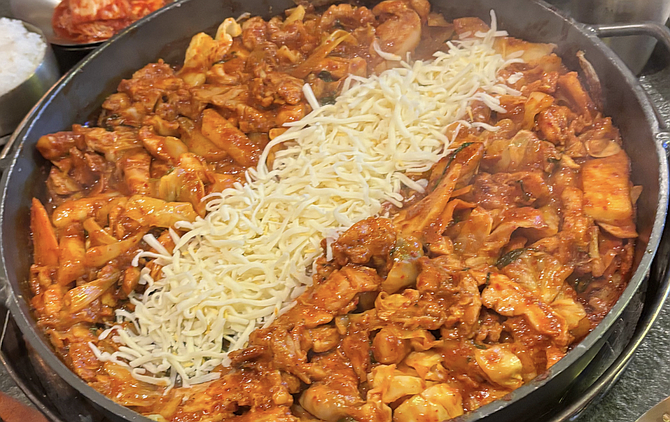
Then came the cheese. A glorious mound of cheese.
There’s a particular kind of nostalgia that comes from ordering a dish you once ate and loved in another place and realizing that the other place was integral to your enjoyment. While all the ingredients may be present in your attempt to recapture the delight, something important has gone missing.
After college, I spent two years in Korea, teaching English to elementary school students. I spent much of my time talking to kids who couldn’t understand me, and many of them had absolutely no interest in trying. But teaching paid the bills — in particular, the restaurant bills. Before my sojourn, I had no idea how good Korean food could be, or how varied. (Even now, I’m surprised at the way Korean food seems to fly so far under the radar when compared with other Asian cuisines.) And of all the meals I came to love there, dakgalbi was the one for which I’d go out of my way.
After I returned to the U.S., my problem wasn’t finding good dakgalbi. It was finding any dakgalbi at all. Even in cities with plenty of Korean restaurants, it rarely appeared on the menu. And when I did come across it, it was often given the fusion treatment — which meant smaller and less appetizing portions. They were recognizably dakgalbi, and they weren’t entirely bad. But they weren't what I remembered and loved.
Eventually, I went so long without the real deal that my memory of its particular joys began to fade. Then I got word of a new restaurant in the Convoy District specialized in the dish I’d been missing for years: Hongdae Dakgalbi. I gathered the troops, and off we went.
The setup immediately felt familiar. A giant pan arrived at the table, loaded with raw chicken, cabbage, carrots, rice cakes, and sauce. As it was in Korea, the preparation of the dish was part of the experience, with everything unfolding right there at the table.
Then came the cheese. A glorious mound of cheese. A thick layer of it ran through the middle of the pan. Then, exemplifying the Korean flair for the dramatic, out came the blowtorch to melt it and brown it. The top bubbled; the edges charred. Excessive? Probably. Necessary? Probably not. But that’s the appeal. And once everything gets mixed together, the cheese mellows the spice without overpowering it.
The chicken stayed tender, the rice cakes had the right texture, and the sauce landed in that sweet spot where there is heat but it doesn’t take over the entire meal. We added a bowl of gyeran-jjim, the soft, puffed Korean steamed egg, which always surprises me with its sheer volume.
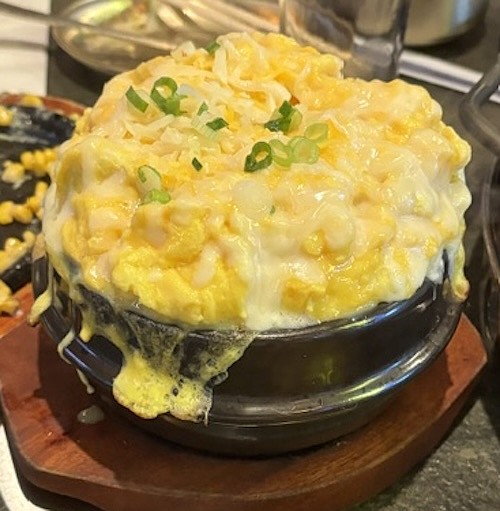
The voluminous steamed egg
What I liked most, though, was that the dakgalbi remained unpretentious. There was no hint of fusion, of trying to turn it into something it wasn’t. It was exactly as it should be: a fun, interactive experience that Korean cuisine does beautifully.
In the end, four fully grown men couldn’t take down a serving meant for three. An embarrassing but not unhappy defeat. We thought we could handle it, but we were vanquished by the sheer abundance.
Hongdae Dakgalbi perfectly recreated some of my fondest memories of Korea, transporting me back to that time and place. It was the first time since I left Seoul that a meal made me miss Korea instead of just remembering it.
Here's something you might be interested in.
The Korean dish I'd been chasing for years
Hongdae Dakgalbi delivers on the promise of its name

The Korean dish I'd been chasing for years
Hongdae Dakgalbi delivers on the promise of its name
Then came the cheese. A glorious mound of cheese.
There’s a particular kind of nostalgia that comes from ordering a dish you once ate and loved in another place and realizing that the other place was integral to your enjoyment. While all the ingredients may be present in your attempt to recapture the delight, something important has gone missing.
After college, I spent two years in Korea, teaching English to elementary school students. I spent much of my time talking to kids who couldn’t understand me, and many of them had absolutely no interest in trying. But teaching paid the bills — in particular, the restaurant bills. Before my sojourn, I had no idea how good Korean food could be, or how varied. (Even now, I’m surprised at the way Korean food seems to fly so far under the radar when compared with other Asian cuisines.) And of all the meals I came to love there, dakgalbi was the one for which I’d go out of my way.
After I returned to the U.S., my problem wasn’t finding good dakgalbi. It was finding any dakgalbi at all. Even in cities with plenty of Korean restaurants, it rarely appeared on the menu. And when I did come across it, it was often given the fusion treatment — which meant smaller and less appetizing portions. They were recognizably dakgalbi, and they weren’t entirely bad. But they weren't what I remembered and loved.
Eventually, I went so long without the real deal that my memory of its particular joys began to fade. Then I got word of a new restaurant in the Convoy District specialized in the dish I’d been missing for years: Hongdae Dakgalbi. I gathered the troops, and off we went.
The setup immediately felt familiar. A giant pan arrived at the table, loaded with raw chicken, cabbage, carrots, rice cakes, and sauce. As it was in Korea, the preparation of the dish was part of the experience, with everything unfolding right there at the table.
Then came the cheese. A glorious mound of cheese. A thick layer of it ran through the middle of the pan. Then, exemplifying the Korean flair for the dramatic, out came the blowtorch to melt it and brown it. The top bubbled; the edges charred. Excessive? Probably. Necessary? Probably not. But that’s the appeal. And once everything gets mixed together, the cheese mellows the spice without overpowering it.
The chicken stayed tender, the rice cakes had the right texture, and the sauce landed in that sweet spot where there is heat but it doesn’t take over the entire meal. We added a bowl of gyeran-jjim, the soft, puffed Korean steamed egg, which always surprises me with its sheer volume.
The voluminous steamed egg
What I liked most, though, was that the dakgalbi remained unpretentious. There was no hint of fusion, of trying to turn it into something it wasn’t. It was exactly as it should be: a fun, interactive experience that Korean cuisine does beautifully.
In the end, four fully grown men couldn’t take down a serving meant for three. An embarrassing but not unhappy defeat. We thought we could handle it, but we were vanquished by the sheer abundance.
Hongdae Dakgalbi perfectly recreated some of my fondest memories of Korea, transporting me back to that time and place. It was the first time since I left Seoul that a meal made me miss Korea instead of just remembering it.