

Here's something you might be interested in.
Ask a Hipster — Advice you didn't know you needed
Big Screen — Movie commentary
Blurt — Music's inside track
Booze News — San Diego spirits
Classical Music — Immortal beauty
Classifieds — Free and easy
Close to Home — What it’s like on the street where you live
Cover Stories — Front-page features
Drinks All Around — Bartenders' drink recipes
Excerpts — Literary and spiritual excerpts
Feast! — Food & drink reviews
Feature Stories — Local news & stories
Fishing Report — What’s getting hooked from ship and shore
From the Archives — Spotlight on the past
Golden Dreams — Talk of the town
The Gonzo Report — Making the musical scene, or at least reporting from it
Letters — Our inbox
Movies@Home — Local movie buffs share favorites
Movie Reviews — Our critics' picks and pans
Musician Interviews — Up close with local artists
Neighborhood News from Stringers — Hyperlocal news
News Ticker — News & politics
Obermeyer — San Diego politics illustrated
Outdoors — Weekly changes in flora and fauna
Overheard in San Diego — Eavesdropping illustrated
Poetry — The old and the new
Reader Travel — Travel section built by travelers
Reading — The hunt for intellectuals
Roam-O-Rama — SoCal's best hiking/biking trails
San Diego Beer — Inside San Diego suds
SD on the QT — Almost factual news
Sheep and Goats — Places of worship
Special Issues — The best of
Street Style — San Diego streets have style
Surf Diego — Real stories from those braving the waves
Theater — On stage in San Diego this week
Tin Fork — Silver spoon alternative
Under the Radar — Matt Potter's undercover work
Unforgettable — Long-ago San Diego
Unreal Estate — San Diego's priciest pads
Your Week — Daily event picks
A brief visit to Queen Califia's Magic Circle
“Niki” de Saint Phalle was one of few female sculptors to gain international recognition over the past 100 years.
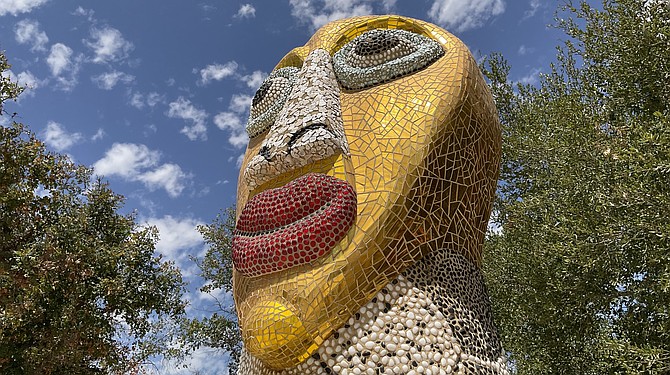
“Her insistence on exuberance, emotion, and sensuality, her pursuit of the figurative and her bold use of color have not endeared her to everyone in a minimalist age,” said critic Roger Cohen in the New York Times.
Oh man. Such a plenitude of art, such a dearth of people! I have come through a gate into a black-and-white-tiled garden of madly colored sculptures. This is “Queen Califia’s Magical Circle.” It’s in Kit Carson Park, outside Escondido, a sixteen-minute walk from the nearest bus stop. And it was created by “one of the most significant female artists of the twentieth century.”
Catherine Marie-Agnès Fal, “Niki” de Saint Phalle, was one of few female sculptors to gain international recognition over the past 100 years. It was mainly because she was so outrageous. And if she admitted to deep anger at her parents - her mother used to beat her, her father raped her — she ended up turning the emotions she felt into exuberant creations.
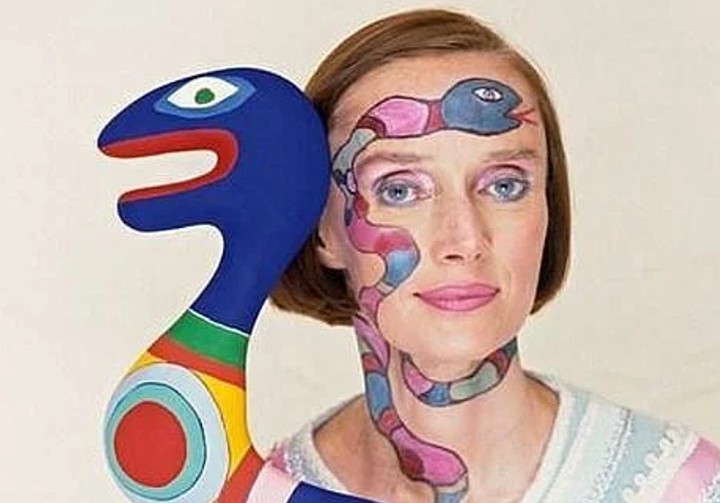
Portrait of the artist as an artist.
“Niki de St. Phalle was born in France in 1930,” says Howard Irwin. He’s sitting here with Joan Woodward. They’re today’s docents. “St. Phalle had an American mother, and a French count for a father. She spent her adolescence in New York City.”
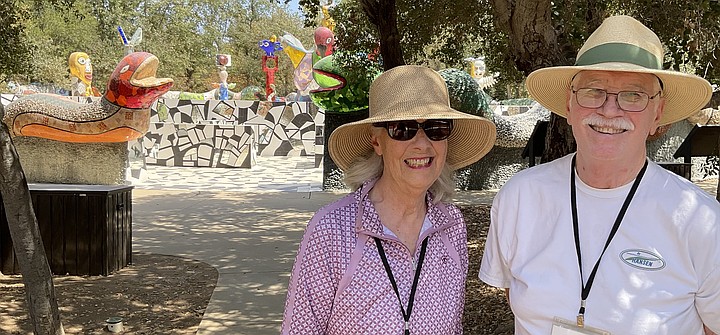
Howard and Joan, doting docents
What sort of kid was she? Irwin says she attended four different boarding schools and got kicked out of all of them. She married at 18, had a nervous breakdown when she was in her early twenties, and turned to artist therapy. She made a fetish of shooting her own paintings. “She called that tirs — ‘shots.’ Today, you would call it performance art. Another example: She and Salvador Dali built a large bull, dragged it into the ring after a bullfight, and blew it up.”
Saint Phalle had no formal training in sculpture, but some of the works that she started doing in the sixties were her nanas, which were large, strong, cheerfully distorted women. They were made out of fiberglass, and painted in bright colors. This Escondido “magical circle” — her last project — is no less spirited. It's a sort of maze, filled with imaginary creatures, protective deities, geometric symbols, crests, skulls, humans, and animals from the history of Southern California.
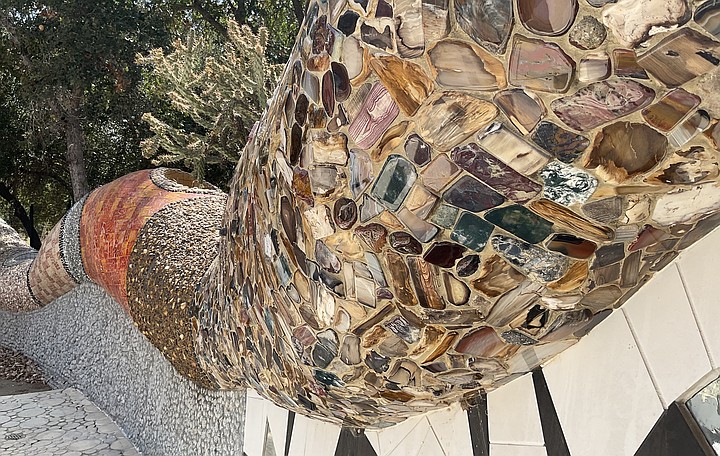
A splendid snake to meet on a walk in the park.
Saint Phalle moved to San Diego in 1994 for her health. She had damaged her lungs with some of the [fiberglass] materials she had used in her earlier works, like her Nanas. Her doctor told her she needed to live in a place with better weather. And so she had come and lived in La Jolla, and set up a studio in a warehouse in El Cajon. “She liked the people of San Diego,” says Irwin. “She thought our history was interesting. She had already come here earlier, in 1983, to build the Sun God, at UCSD [the first commission in the university’s famous Stuart Collection of public art]. Then she had this idea for a ‘magical sculpture garden.’ She went around to several cities with an offer to build one, and the City of Escondido said ‘Yes.’”
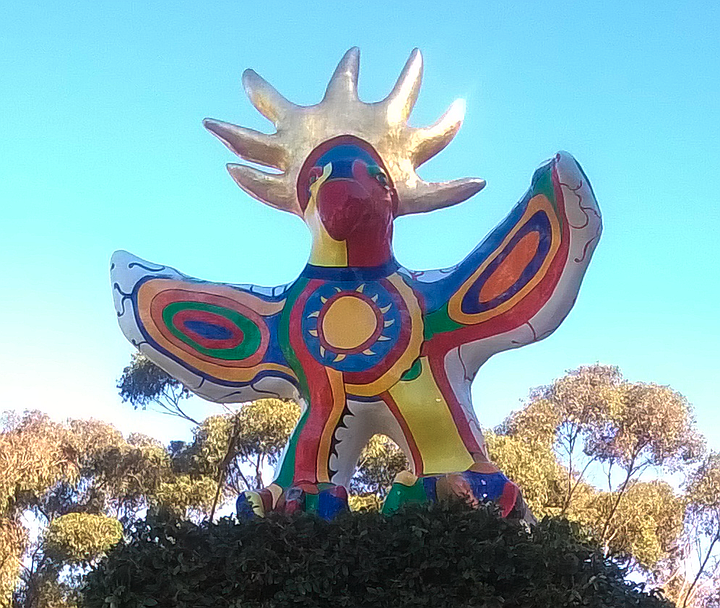
The UCSD Sun God
St Phalle’s problem was she didn’t have much time. Her illness was progressing. Escondido did everything to speed things up. They gave her this land. “She paid for the rest of it out of her own pocket,” says Irwin. “The project was started in 1999 and finished in 2003. She died in 2002, about a year before it was finished.”
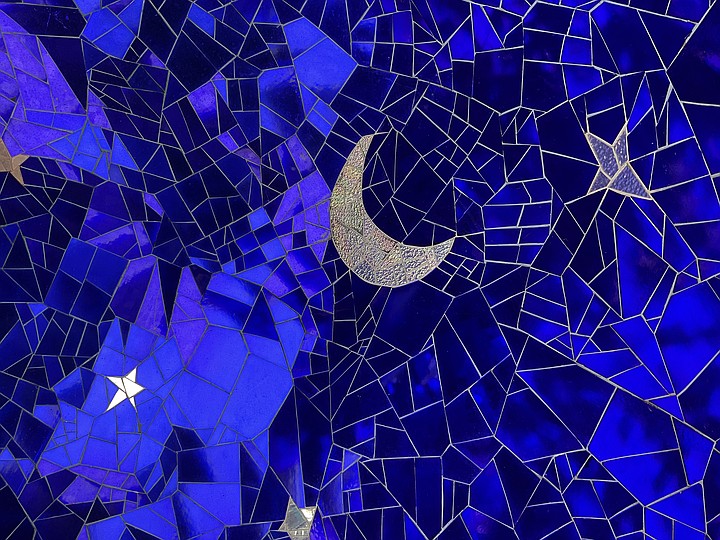
Darkness falls, but light endures.
So why has the world not embraced Nikki de Saint Phalle and put her on a pedestal with the likes of her friend Salvador Dali, or splatter painter Jackson Pollock, or Henry Moore, or Pablo Picasso? “Her insistence on exuberance, emotion, and sensuality, her pursuit of the figurative and her bold use of color have not endeared her to everyone in a minimalist age,” said critic Roger Cohen in the New York Times.
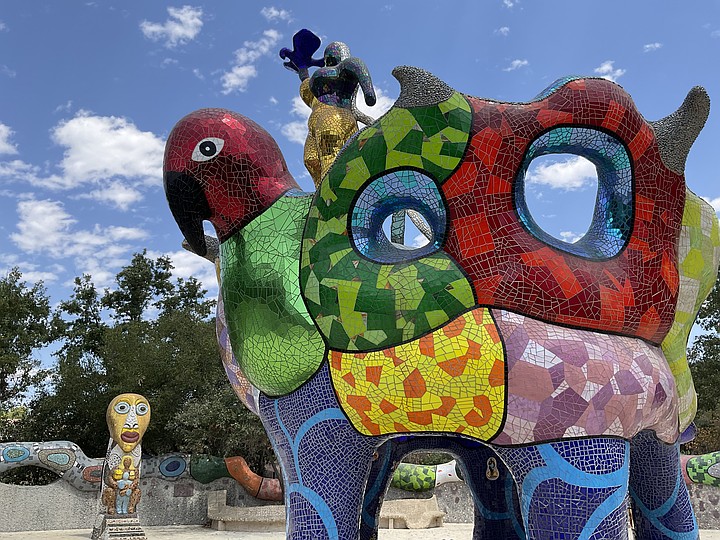
Exuberant insistence on color!
“Uh, we’re closing up,” says Joan Woodward suddenly.
But it’s only noon!
“We’d have longer hours, but we can’t get enough docents to supervise here. It’s a pity because we love the vibes, and this is world-class art.”
Here's something you might be interested in.
A brief visit to Queen Califia's Magic Circle
“Niki” de Saint Phalle was one of few female sculptors to gain international recognition over the past 100 years.

A brief visit to Queen Califia's Magic Circle
“Niki” de Saint Phalle was one of few female sculptors to gain international recognition over the past 100 years.
“Her insistence on exuberance, emotion, and sensuality, her pursuit of the figurative and her bold use of color have not endeared her to everyone in a minimalist age,” said critic Roger Cohen in the New York Times.
Oh man. Such a plenitude of art, such a dearth of people! I have come through a gate into a black-and-white-tiled garden of madly colored sculptures. This is “Queen Califia’s Magical Circle.” It’s in Kit Carson Park, outside Escondido, a sixteen-minute walk from the nearest bus stop. And it was created by “one of the most significant female artists of the twentieth century.”
Catherine Marie-Agnès Fal, “Niki” de Saint Phalle, was one of few female sculptors to gain international recognition over the past 100 years. It was mainly because she was so outrageous. And if she admitted to deep anger at her parents - her mother used to beat her, her father raped her — she ended up turning the emotions she felt into exuberant creations.
Portrait of the artist as an artist.
“Niki de St. Phalle was born in France in 1930,” says Howard Irwin. He’s sitting here with Joan Woodward. They’re today’s docents. “St. Phalle had an American mother, and a French count for a father. She spent her adolescence in New York City.”
Howard and Joan, doting docents
What sort of kid was she? Irwin says she attended four different boarding schools and got kicked out of all of them. She married at 18, had a nervous breakdown when she was in her early twenties, and turned to artist therapy. She made a fetish of shooting her own paintings. “She called that tirs — ‘shots.’ Today, you would call it performance art. Another example: She and Salvador Dali built a large bull, dragged it into the ring after a bullfight, and blew it up.”
Saint Phalle had no formal training in sculpture, but some of the works that she started doing in the sixties were her nanas, which were large, strong, cheerfully distorted women. They were made out of fiberglass, and painted in bright colors. This Escondido “magical circle” — her last project — is no less spirited. It's a sort of maze, filled with imaginary creatures, protective deities, geometric symbols, crests, skulls, humans, and animals from the history of Southern California.
A splendid snake to meet on a walk in the park.
Saint Phalle moved to San Diego in 1994 for her health. She had damaged her lungs with some of the [fiberglass] materials she had used in her earlier works, like her Nanas. Her doctor told her she needed to live in a place with better weather. And so she had come and lived in La Jolla, and set up a studio in a warehouse in El Cajon. “She liked the people of San Diego,” says Irwin. “She thought our history was interesting. She had already come here earlier, in 1983, to build the Sun God, at UCSD [the first commission in the university’s famous Stuart Collection of public art]. Then she had this idea for a ‘magical sculpture garden.’ She went around to several cities with an offer to build one, and the City of Escondido said ‘Yes.’”
The UCSD Sun God
St Phalle’s problem was she didn’t have much time. Her illness was progressing. Escondido did everything to speed things up. They gave her this land. “She paid for the rest of it out of her own pocket,” says Irwin. “The project was started in 1999 and finished in 2003. She died in 2002, about a year before it was finished.”
Darkness falls, but light endures.
So why has the world not embraced Nikki de Saint Phalle and put her on a pedestal with the likes of her friend Salvador Dali, or splatter painter Jackson Pollock, or Henry Moore, or Pablo Picasso? “Her insistence on exuberance, emotion, and sensuality, her pursuit of the figurative and her bold use of color have not endeared her to everyone in a minimalist age,” said critic Roger Cohen in the New York Times.
Exuberant insistence on color!
“Uh, we’re closing up,” says Joan Woodward suddenly.
But it’s only noon!
“We’d have longer hours, but we can’t get enough docents to supervise here. It’s a pity because we love the vibes, and this is world-class art.”
Comments