

Here's something you might be interested in.
Ask a Hipster — Advice you didn't know you needed
Big Screen — Movie commentary
Blurt — Music's inside track
Booze News — San Diego spirits
Classical Music — Immortal beauty
Classifieds — Free and easy
Close to Home — What it’s like on the street where you live
Cover Stories — Front-page features
Drinks All Around — Bartenders' drink recipes
Excerpts — Literary and spiritual excerpts
Feast! — Food & drink reviews
Feature Stories — Local news & stories
Fishing Report — What’s getting hooked from ship and shore
From the Archives — Spotlight on the past
Golden Dreams — Talk of the town
The Gonzo Report — Making the musical scene, or at least reporting from it
Letters — Our inbox
Movies@Home — Local movie buffs share favorites
Movie Reviews — Our critics' picks and pans
Musician Interviews — Up close with local artists
Neighborhood News from Stringers — Hyperlocal news
News Ticker — News & politics
Obermeyer — San Diego politics illustrated
Outdoors — Weekly changes in flora and fauna
Overheard in San Diego — Eavesdropping illustrated
Poetry — The old and the new
Reader Travel — Travel section built by travelers
Reading — The hunt for intellectuals
Roam-O-Rama — SoCal's best hiking/biking trails
San Diego Beer — Inside San Diego suds
SD on the QT — Almost factual news
Sheep and Goats — Places of worship
Special Issues — The best of
Street Style — San Diego streets have style
Surf Diego — Real stories from those braving the waves
Theater — On stage in San Diego this week
Tin Fork — Silver spoon alternative
Under the Radar — Matt Potter's undercover work
Unforgettable — Long-ago San Diego
Unreal Estate — San Diego's priciest pads
Your Week — Daily event picks
Robert Barry deconstructs the urban landscape at Gallery 21
"I'm interested in the ways things fit together" — or don't.
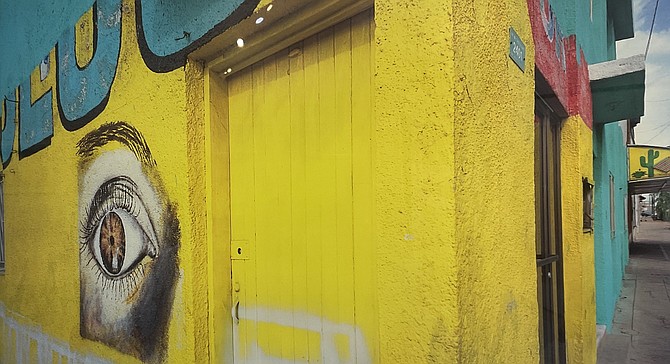
Is photography art?
Here’s my theory: The painter starts with a blank canvas and daubs his version of reality onto it. The photographer starts off capturing reality ready-made, and then subtracts from it in a way that expresses his feelings about it. That’s what it seems like in here, anyway, at the Spanish Village Art Center in Balboa Park. Robert Barry has filled Gallery 21 with photographs — but photos of objects more than of people. In fact, it seems this man can make abstract photographic art out of anything, even a stain in the tarmac.
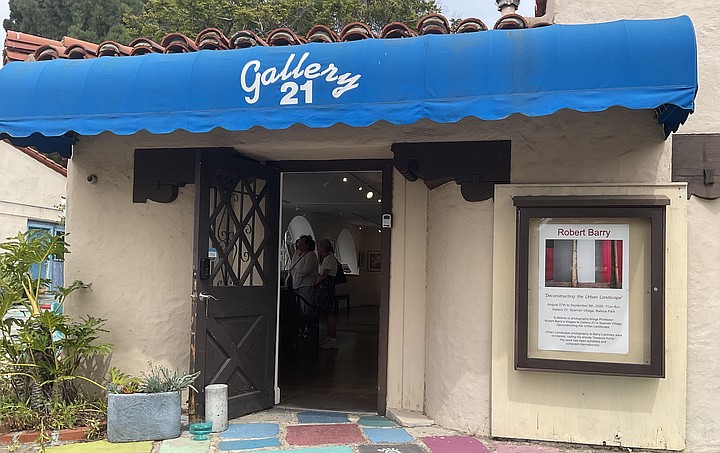
Welcome to Deconstructing the Urban Landscape. Photographer Robery Barry calls his shoots "treasure hunts."
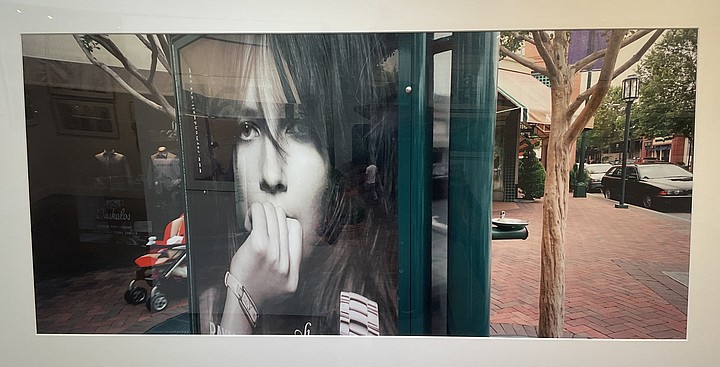
Right now — this is back in early September — I’m looking at a picture of signs.“Some people are so poor, all they have is money.” “Women Love Quitters.” “If you fail to plan, you plan to fail.” These sit alongside an image of a grainy, alarmed face. Nearby is a triptych of a red stroller, another girl’s face, and a Euro street scene. I guess I'm a sucker for people; I can’t stop looking at the beautiful, concerned face in the middle (which Barry says is actually just a snip from a watch ad).
But consider a photo called “Palm, Tihosuco,” which features an old house in Quintana Roo, down near the Mayan ruins of Tulum, Mexico. Here, as elsewhere, serendipity reigns. Barry has de-emphasized the house in favor of a close-focus of a palm frond that happened to be there. “I took this in a little town of three or four thousand people. It’s got that Moorish architecture, Spanish influence, and obviously the building is old. But the fresh palm frond in the front grabbed my attention. An architect would cut the branch down, but I focused on the palm’s fronds and its green color. It just jumps out at you. I’m kind of interested in the patina of things. The antiquity that you find in old villages down there can go back to the 16th century. And some cities have Mayan, Aztec, Olmec overlays.”
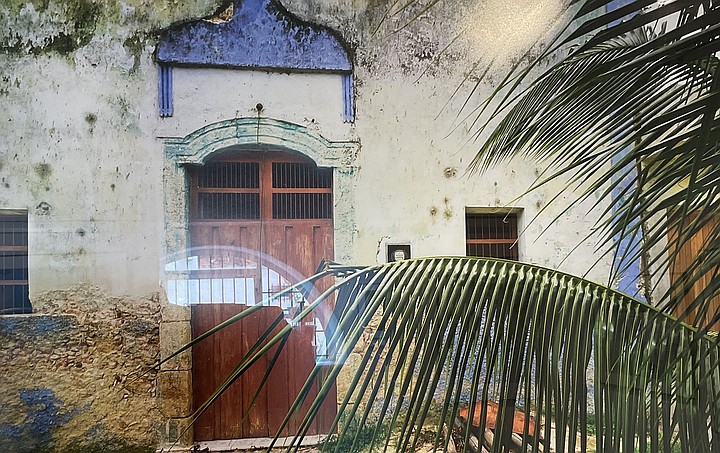
So how come he’s interested in the young, live, palm frond? “If you stood there, you probably wouldn’t even notice that,” he says. “But I edit [a scene] to find the most important thing. My brain just kind of does that. I’m interested in the way things fit together.”
Barry’s having to fit his active life into his wheelchair these days. He’s living with ALS, Lou Gherig’s disease. But it hasn’t stopped him holding this exhibition. “I did my first college photography class in 1977, he recalls, "was a photographer at UC Berkeley, and also Lawrence Livermore National Laboratory, then taught full time 1989-2015. I love to do photography most, but teaching is up there. I get to teach the thing I love. It doesn’t get much better than that.”
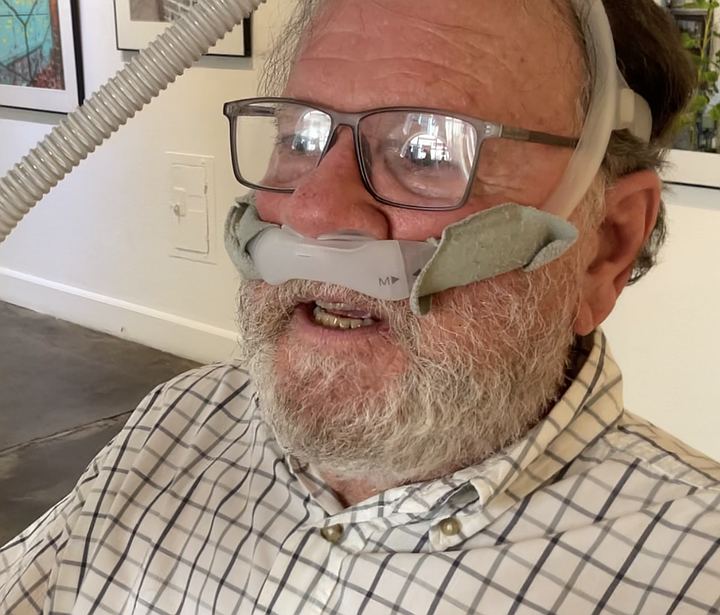
Robert Barry
Now we’re looking at, well, this picture of a stain in the tarmac: This one has divisions that go horizontally. There’s a splotch at the bottom, and then the tarmac, and then some cement that’s all cracked and spidering, with like a watercolor painting on the wall up above. “It’s just the relationship of all those things that don’t fit together,” Barry says. “I like taking the picture and forcing you to see a relationship. I guess I’ve trained myself. I go by, I see it, and I think ‘Oh wow.’”
Here's something you might be interested in.
Robert Barry deconstructs the urban landscape at Gallery 21
"I'm interested in the ways things fit together" — or don't.

Robert Barry deconstructs the urban landscape at Gallery 21
"I'm interested in the ways things fit together" — or don't.
Is photography art?
Here’s my theory: The painter starts with a blank canvas and daubs his version of reality onto it. The photographer starts off capturing reality ready-made, and then subtracts from it in a way that expresses his feelings about it. That’s what it seems like in here, anyway, at the Spanish Village Art Center in Balboa Park. Robert Barry has filled Gallery 21 with photographs — but photos of objects more than of people. In fact, it seems this man can make abstract photographic art out of anything, even a stain in the tarmac.
Welcome to Deconstructing the Urban Landscape. Photographer Robery Barry calls his shoots "treasure hunts."
Right now — this is back in early September — I’m looking at a picture of signs.“Some people are so poor, all they have is money.” “Women Love Quitters.” “If you fail to plan, you plan to fail.” These sit alongside an image of a grainy, alarmed face. Nearby is a triptych of a red stroller, another girl’s face, and a Euro street scene. I guess I'm a sucker for people; I can’t stop looking at the beautiful, concerned face in the middle (which Barry says is actually just a snip from a watch ad).
But consider a photo called “Palm, Tihosuco,” which features an old house in Quintana Roo, down near the Mayan ruins of Tulum, Mexico. Here, as elsewhere, serendipity reigns. Barry has de-emphasized the house in favor of a close-focus of a palm frond that happened to be there. “I took this in a little town of three or four thousand people. It’s got that Moorish architecture, Spanish influence, and obviously the building is old. But the fresh palm frond in the front grabbed my attention. An architect would cut the branch down, but I focused on the palm’s fronds and its green color. It just jumps out at you. I’m kind of interested in the patina of things. The antiquity that you find in old villages down there can go back to the 16th century. And some cities have Mayan, Aztec, Olmec overlays.”
So how come he’s interested in the young, live, palm frond? “If you stood there, you probably wouldn’t even notice that,” he says. “But I edit [a scene] to find the most important thing. My brain just kind of does that. I’m interested in the way things fit together.”
Barry’s having to fit his active life into his wheelchair these days. He’s living with ALS, Lou Gherig’s disease. But it hasn’t stopped him holding this exhibition. “I did my first college photography class in 1977, he recalls, "was a photographer at UC Berkeley, and also Lawrence Livermore National Laboratory, then taught full time 1989-2015. I love to do photography most, but teaching is up there. I get to teach the thing I love. It doesn’t get much better than that.”
Robert Barry
Now we’re looking at, well, this picture of a stain in the tarmac: This one has divisions that go horizontally. There’s a splotch at the bottom, and then the tarmac, and then some cement that’s all cracked and spidering, with like a watercolor painting on the wall up above. “It’s just the relationship of all those things that don’t fit together,” Barry says. “I like taking the picture and forcing you to see a relationship. I guess I’ve trained myself. I go by, I see it, and I think ‘Oh wow.’”
Comments