

Here's something you might be interested in.
Ask a Hipster — Advice you didn't know you needed
Big Screen — Movie commentary
Blurt — Music's inside track
Booze News — San Diego spirits
Classical Music — Immortal beauty
Classifieds — Free and easy
Close to Home — What it’s like on the street where you live
Cover Stories — Front-page features
Drinks All Around — Bartenders' drink recipes
Excerpts — Literary and spiritual excerpts
Feast! — Food & drink reviews
Feature Stories — Local news & stories
Fishing Report — What’s getting hooked from ship and shore
From the Archives — Spotlight on the past
Golden Dreams — Talk of the town
The Gonzo Report — Making the musical scene, or at least reporting from it
Letters — Our inbox
Movies@Home — Local movie buffs share favorites
Movie Reviews — Our critics' picks and pans
Musician Interviews — Up close with local artists
Neighborhood News from Stringers — Hyperlocal news
News Ticker — News & politics
Obermeyer — San Diego politics illustrated
Outdoors — Weekly changes in flora and fauna
Overheard in San Diego — Eavesdropping illustrated
Poetry — The old and the new
Reader Travel — Travel section built by travelers
Reading — The hunt for intellectuals
Roam-O-Rama — SoCal's best hiking/biking trails
San Diego Beer — Inside San Diego suds
SD on the QT — Almost factual news
Sheep and Goats — Places of worship
Special Issues — The best of
Street Style — San Diego streets have style
Surf Diego — Real stories from those braving the waves
Theater — On stage in San Diego this week
Tin Fork — Silver spoon alternative
Under the Radar — Matt Potter's undercover work
Unforgettable — Long-ago San Diego
Unreal Estate — San Diego's priciest pads
Your Week — Daily event picks
National City really, really doesn't want you to smoke or vape
New rules ban transfers of licenses to sell tobacco
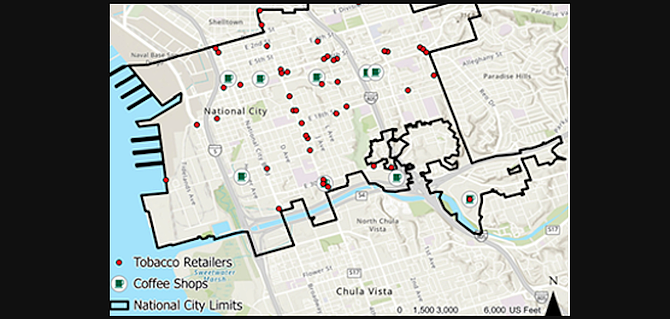
It’s the twilight years for tobacco stores in National City, where the city council narrowly approved an ordinance last week that bans new permits for such businesses within 1,000 feet of schools.
In the small city, with its stores clustered around arterials and collector streets, and schools typically within a block of the corridors, that means the majority of tobacco retailers.
“Most of them already are within 1,000 feet so when they get sold or transferred, they’re going away,” said city planner Martin Reeder.
For some, it could destroy years of investment. “If you cannot transfer the cigarette license to the new owner, then you can’t sell the store,” said Jack Bazzi, who owns Cozine's Liquor & Deli market.
As health advocates see it, National City is drowning in tobacco retailers. There are five times more of them than there are coffee shops.
Say San Diego, a youth advocacy group, initiated the change, having found that 12 of National City's 16 schools meet that distance criteria from tobacco shops. In a survey, hundreds of locals were in favor of the city passing regulations on tobacco.
The ordinance sets a cap on licenses at 54 – the current number of tobacco retailers. Those businesses will be grandfathered in, and will need a yearly permit to sell tobacco, while pharmacies can no longer sell it. New licenses can only be approved for businesses located more than 1,000 feet from schools, libraries and other youth facilities – and if the cap is not exceeded.
Over time, as the number of stores selling tobacco declines, the licensing program is expected to improve public health.
Vice mayor Marcus Bush said Sweetwater High School district data found that among students who vape, 42 percent buy their vapes at local stores.
While stores can’t legally sell to minors, Google Maps shows at least five vape or smoke shops within a one-mile radius of the campus, including shops along National City Blvd, near Plaza Blvd and Highland Ave.
Reeder said the city doesn’t know where kids are buying vapes. Say San Diego and Communities for Better Health did look into it, though, and came up with 75-80 percent compliance among the stores.
Vice mayor Bush asked that the city focus on its own data in the future. With an ordinance, there should be a decrease in the amount of youth vaping. If not, it points to the problem being more the illicit market.
“We could pass all the rules we want but if the illicit market is thriving then we’re limited in what we’re doing.”
Under the new licensing program, there will be one annual inspection and every two years, a decoy check for compliance.
Even though the council has been batting around ideas for regulations for almost a year, Reeder acknowledged that city staff did not reach out to local businesses.
At recent meetings, they had begun speaking out. Some said the cap on licenses and distance restrictions would limit opportunities for small businesses and favor large chains. Instead, they suggested stronger compliance checks, penalties and retail training.
The new ordinance, which takes effect 30 days from approval, passed after a heated council debate and rejection of a substitute motion by mayor Ron Morrison that would have allowed transfers from one owner to the next, and raised the cap on the number of licenses to 60 to account for possible errors. It also would have further delayed regulations, starting the entire process all over again.
“We’ve been prolonging this for a year,” said council member Jose Rodriguez, who made the final motion.
Here's something you might be interested in.
National City really, really doesn't want you to smoke or vape
New rules ban transfers of licenses to sell tobacco

National City really, really doesn't want you to smoke or vape
New rules ban transfers of licenses to sell tobacco
It’s the twilight years for tobacco stores in National City, where the city council narrowly approved an ordinance last week that bans new permits for such businesses within 1,000 feet of schools.
In the small city, with its stores clustered around arterials and collector streets, and schools typically within a block of the corridors, that means the majority of tobacco retailers.
“Most of them already are within 1,000 feet so when they get sold or transferred, they’re going away,” said city planner Martin Reeder.
For some, it could destroy years of investment. “If you cannot transfer the cigarette license to the new owner, then you can’t sell the store,” said Jack Bazzi, who owns Cozine's Liquor & Deli market.
As health advocates see it, National City is drowning in tobacco retailers. There are five times more of them than there are coffee shops.
Say San Diego, a youth advocacy group, initiated the change, having found that 12 of National City's 16 schools meet that distance criteria from tobacco shops. In a survey, hundreds of locals were in favor of the city passing regulations on tobacco.
The ordinance sets a cap on licenses at 54 – the current number of tobacco retailers. Those businesses will be grandfathered in, and will need a yearly permit to sell tobacco, while pharmacies can no longer sell it. New licenses can only be approved for businesses located more than 1,000 feet from schools, libraries and other youth facilities – and if the cap is not exceeded.
Over time, as the number of stores selling tobacco declines, the licensing program is expected to improve public health.
Vice mayor Marcus Bush said Sweetwater High School district data found that among students who vape, 42 percent buy their vapes at local stores.
While stores can’t legally sell to minors, Google Maps shows at least five vape or smoke shops within a one-mile radius of the campus, including shops along National City Blvd, near Plaza Blvd and Highland Ave.
Reeder said the city doesn’t know where kids are buying vapes. Say San Diego and Communities for Better Health did look into it, though, and came up with 75-80 percent compliance among the stores.
Vice mayor Bush asked that the city focus on its own data in the future. With an ordinance, there should be a decrease in the amount of youth vaping. If not, it points to the problem being more the illicit market.
“We could pass all the rules we want but if the illicit market is thriving then we’re limited in what we’re doing.”
Under the new licensing program, there will be one annual inspection and every two years, a decoy check for compliance.
Even though the council has been batting around ideas for regulations for almost a year, Reeder acknowledged that city staff did not reach out to local businesses.
At recent meetings, they had begun speaking out. Some said the cap on licenses and distance restrictions would limit opportunities for small businesses and favor large chains. Instead, they suggested stronger compliance checks, penalties and retail training.
The new ordinance, which takes effect 30 days from approval, passed after a heated council debate and rejection of a substitute motion by mayor Ron Morrison that would have allowed transfers from one owner to the next, and raised the cap on the number of licenses to 60 to account for possible errors. It also would have further delayed regulations, starting the entire process all over again.
“We’ve been prolonging this for a year,” said council member Jose Rodriguez, who made the final motion.
Comments