

Here's something you might be interested in.
Ask a Hipster — Advice you didn't know you needed
Big Screen — Movie commentary
Blurt — Music's inside track
Booze News — San Diego spirits
Classical Music — Immortal beauty
Classifieds — Free and easy
Close to Home — What it’s like on the street where you live
Cover Stories — Front-page features
Drinks All Around — Bartenders' drink recipes
Excerpts — Literary and spiritual excerpts
Feast! — Food & drink reviews
Feature Stories — Local news & stories
Fishing Report — What’s getting hooked from ship and shore
From the Archives — Spotlight on the past
Golden Dreams — Talk of the town
The Gonzo Report — Making the musical scene, or at least reporting from it
Letters — Our inbox
Movies@Home — Local movie buffs share favorites
Movie Reviews — Our critics' picks and pans
Musician Interviews — Up close with local artists
Neighborhood News from Stringers — Hyperlocal news
News Ticker — News & politics
Obermeyer — San Diego politics illustrated
Outdoors — Weekly changes in flora and fauna
Overheard in San Diego — Eavesdropping illustrated
Poetry — The old and the new
Reader Travel — Travel section built by travelers
Reading — The hunt for intellectuals
Roam-O-Rama — SoCal's best hiking/biking trails
San Diego Beer — Inside San Diego suds
SD on the QT — Almost factual news
Sheep and Goats — Places of worship
Special Issues — The best of
Street Style — San Diego streets have style
Surf Diego — Real stories from those braving the waves
Theater — On stage in San Diego this week
Tin Fork — Silver spoon alternative
Under the Radar — Matt Potter's undercover work
Unforgettable — Long-ago San Diego
Unreal Estate — San Diego's priciest pads
Your Week — Daily event picks
Sunset time changes most rapidly, Fall migrant birds are showing up
Smoggy days are coming; Check out the Summer Triangle
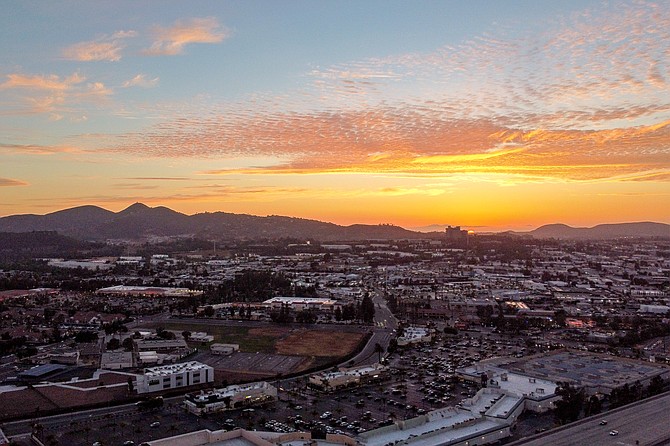
A late Summer sunset over Escondido
The Time of Sunset Changes most rapidly at this time of the year. This is mainly because the sun is quickly swinging south along the ecliptic (its apparent path through the background stars). From San Diego's latitude, the sun is now setting about 75 seconds earlier every day (equivalent to about nine minutes earlier per week), and its setting position along the horizon shifts southward about one half degree per day.
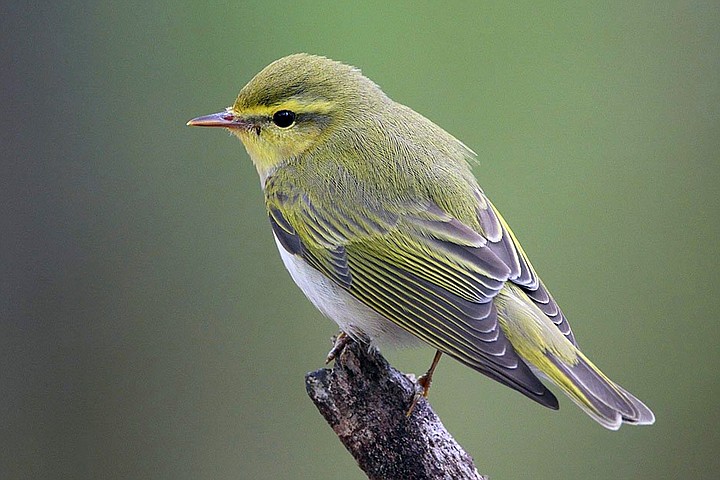
The Orange-Crowned warbler is one of the more common California warblers.
Fall Migrant Birds such as wood warblers can be seen at Cabrillo National Monument and its vicinity on Point Loma, Torrey Pines State Reserve, and other parks and open spaces near the San Diego coast. Cooper’s or marsh hawks and even peregrine falcons may be seen following or pursuing these smaller birds.
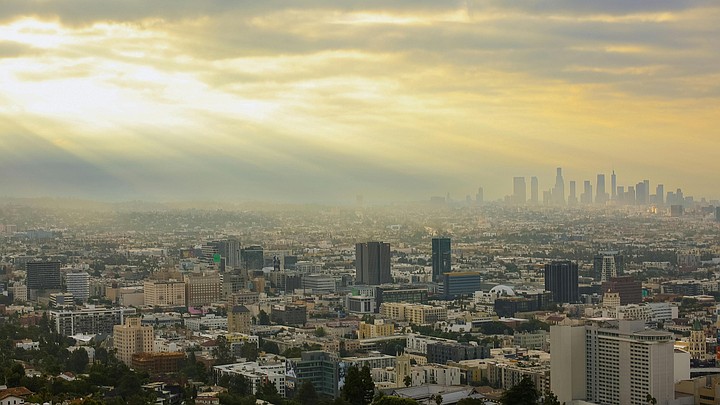
Smog from the Los Angeles basin can make its way down to San Diego with help from Santa Ana winds.
The Smoggiest Days Of The Year are most likely to occur during the next several weeks. Persistent temperature inversions (warmer air overlying cool marine air) are frequent at this time of year. These inversions conspire with the mountainous topography of East County to trap locally generated air pollution under a low-lying lid. During the worst episodes, San Diego County’s coastal area is the hapless recipient of additional smog sneaking down from the Los Angeles Basin. This often occurs when a Santa Ana wind condition begins to weaken: L.A. smog blown offshore by a Santa Ana may get pushed back our way when the normal sea breeze returns.
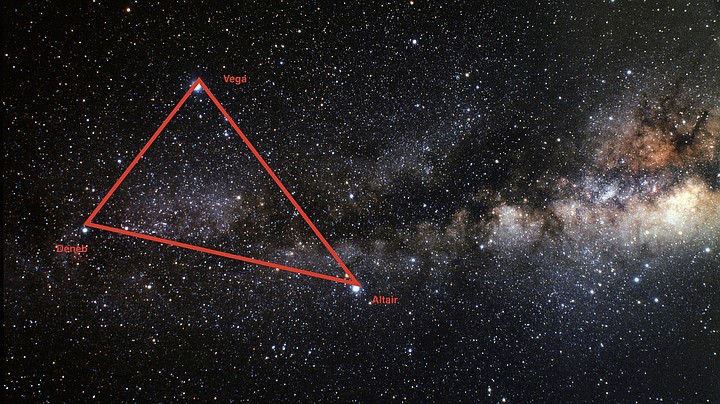
The Summer Triangle, a triangluar configuration of the stars Vega (Lyrae), Altair (Aquilae), et Deneb (Cygni).
Early Fall Is A Great Time for stargazing, nights are getting longer and temperatures are cooling down. How soon after sunset can you locate the big Summer Triangle? Look for the brightest star high in the Eastern sky, that's Vega, the top and brightest star of the triangle. Altair is lower and to the right of Vega, and the second brightest of the three. Deneb is below and to the left of Vega. Despite the name, the Summer Triangle is partially visible though most of the year. Moving into Fall and Winter it moves up and into the Western sky until January. In the Spring, the triangle is visible in early morning hours in the Eastern sky.
Here's something you might be interested in.
Sunset time changes most rapidly, Fall migrant birds are showing up
Smoggy days are coming; Check out the Summer Triangle

Sunset time changes most rapidly, Fall migrant birds are showing up
Smoggy days are coming; Check out the Summer Triangle
A late Summer sunset over Escondido
The Time of Sunset Changes most rapidly at this time of the year. This is mainly because the sun is quickly swinging south along the ecliptic (its apparent path through the background stars). From San Diego's latitude, the sun is now setting about 75 seconds earlier every day (equivalent to about nine minutes earlier per week), and its setting position along the horizon shifts southward about one half degree per day.
The Orange-Crowned warbler is one of the more common California warblers.
Fall Migrant Birds such as wood warblers can be seen at Cabrillo National Monument and its vicinity on Point Loma, Torrey Pines State Reserve, and other parks and open spaces near the San Diego coast. Cooper’s or marsh hawks and even peregrine falcons may be seen following or pursuing these smaller birds.
Smog from the Los Angeles basin can make its way down to San Diego with help from Santa Ana winds.
The Smoggiest Days Of The Year are most likely to occur during the next several weeks. Persistent temperature inversions (warmer air overlying cool marine air) are frequent at this time of year. These inversions conspire with the mountainous topography of East County to trap locally generated air pollution under a low-lying lid. During the worst episodes, San Diego County’s coastal area is the hapless recipient of additional smog sneaking down from the Los Angeles Basin. This often occurs when a Santa Ana wind condition begins to weaken: L.A. smog blown offshore by a Santa Ana may get pushed back our way when the normal sea breeze returns.
The Summer Triangle, a triangluar configuration of the stars Vega (Lyrae), Altair (Aquilae), et Deneb (Cygni).
Early Fall Is A Great Time for stargazing, nights are getting longer and temperatures are cooling down. How soon after sunset can you locate the big Summer Triangle? Look for the brightest star high in the Eastern sky, that's Vega, the top and brightest star of the triangle. Altair is lower and to the right of Vega, and the second brightest of the three. Deneb is below and to the left of Vega. Despite the name, the Summer Triangle is partially visible though most of the year. Moving into Fall and Winter it moves up and into the Western sky until January. In the Spring, the triangle is visible in early morning hours in the Eastern sky.
Comments