

Here's something you might be interested in.
Ask a Hipster — Advice you didn't know you needed
Big Screen — Movie commentary
Blurt — Music's inside track
Booze News — San Diego spirits
Classical Music — Immortal beauty
Classifieds — Free and easy
Close to Home — What it’s like on the street where you live
Cover Stories — Front-page features
Drinks All Around — Bartenders' drink recipes
Excerpts — Literary and spiritual excerpts
Feast! — Food & drink reviews
Feature Stories — Local news & stories
Fishing Report — What’s getting hooked from ship and shore
From the Archives — Spotlight on the past
Golden Dreams — Talk of the town
The Gonzo Report — Making the musical scene, or at least reporting from it
Letters — Our inbox
Movies@Home — Local movie buffs share favorites
Movie Reviews — Our critics' picks and pans
Musician Interviews — Up close with local artists
Neighborhood News from Stringers — Hyperlocal news
News Ticker — News & politics
Obermeyer — San Diego politics illustrated
Outdoors — Weekly changes in flora and fauna
Overheard in San Diego — Eavesdropping illustrated
Poetry — The old and the new
Reader Travel — Travel section built by travelers
Reading — The hunt for intellectuals
Roam-O-Rama — SoCal's best hiking/biking trails
San Diego Beer — Inside San Diego suds
SD on the QT — Almost factual news
Sheep and Goats — Places of worship
Special Issues — The best of
Street Style — San Diego streets have style
Surf Diego — Real stories from those braving the waves
Theater — On stage in San Diego this week
Tin Fork — Silver spoon alternative
Under the Radar — Matt Potter's undercover work
Unforgettable — Long-ago San Diego
Unreal Estate — San Diego's priciest pads
Your Week — Daily event picks
Emerging emergency for the Eucalyptus
Australian pest finds its way to Australian trees in San Diego

Eucalyptus's new enemy: the dotted paropsine leaf beetle
Australia has given us many fine things: Margot Robbie and Chris Hemsworth, Tyrell’s Old Patch Shiraz – and even Rob Machado, the standout surfer who is something of a celebrity along the North County coast, where he’s lived since childhood.
But, in the case of the dotted paropsine leaf beetle (Paropsis atomaria), Australia clearly did not send us their best. This prolific beetle has recently invaded San Diego, attacking defenseless eucalyptus trees across the county and throughout Southern California. The Aussie interloper feeds on the nutrient-rich eucalyptus leaves, weakening and in some cases destroying the trees — and, experts suggest, making them vulnerable to the spread of fire.
First discovered in LA in 2022, the dotted paropsine tends to be oval-shaped and approximately 3/8 of an inch long, sporting yellow and orange markings and black spots on its wings. It has the look of a large and menacing ladybug, and is capable of stripping entire branches of their leaves.
While the beetle feeds on a variety of eucalyptus species, most from Australia, it doesn’t have exclusive rights, notes Pamela Horsley, a member of San Diego National History Museum’s entomology team. “Two other tortoise beetles and quite a few other pests already affect eucalyptus in California.”

SavATree's Erik Lindberg says that the dotted paropsine poses a unique threat
Erik Lindberg, an arborist with SavATree, says of the dotted paropsine, “They literally just start multiplying, and then they spread to different parts of town.” Lindberg, who is certified by the International Society of Arboriculture, says that the beetle is unique in that it has “at least two generations per year.” Essentially, they’re double teaming the poor eucalyptus trees, with both adult beetles and their larvae feeding on the leaves at the same time. This accelerates the rate of defoliation and, over time, can lead to the death of the tree. “That we’re seeing the beetle at various life stages year-around indicates that it loves these conditions in San Diego right now. It's very successful at reproducing” — and spreading.
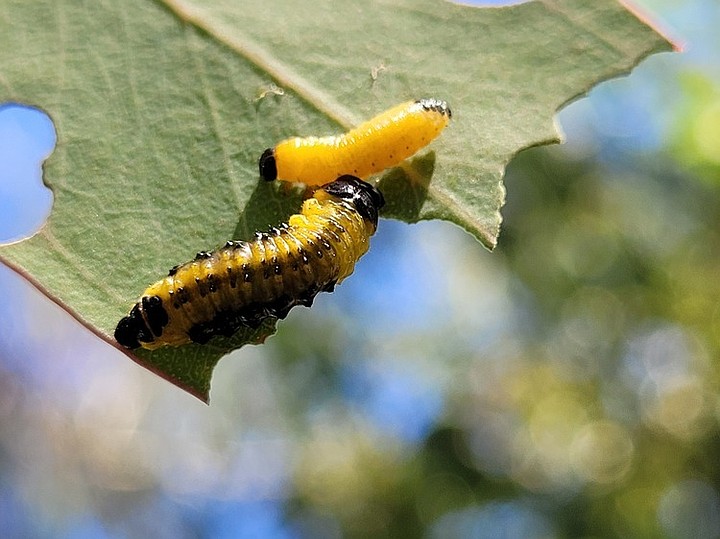
Dotted paropsine larvae, munching away
Australia, of course, is the native habitat of many eucalyptus species; some people have compared San Diego’s landscape and flora to that of Perth, Australia, which also features an abundance of eucalyptus trees. How did we get here? A driving force was the California Tree Culture Act of 1868, which urged the planting of trees to fill out the state’s largely dry terrain. In the late 19th and early 20th centuries, millions of eucalyptus trees were planted in and around San Diego, particularly in Rancho Santa Fe. The idea was to use them for timber and railroad ties. However, according to the Rancho Santa Fe Association, the eucalyptus wood wasn’t suitable for the railroads.
The unsuitable trees eventually spread throughout the county and became a dominant feature of landscapes around Poway, Scripps Ranch and UCSD. They’re also a common sight in our canyons and parks, from Balboa Park to Kate Sessions Park by Mount Soledad. And for a century, the trees flourished undisturbed. According to the University of California’s Agriculture and Natural Resources (ANR) department, it took over 100 years for the first major eucalyptus tree pest, the longhorned borer (Phoracantha semipunctata), to appear on the scene in 1984.
Lindberg explained that eucalyptus trees tend to keep their leaves for at least a couple of years, which allows for photosynthesis and the generation of new leaves. The introduction of the Australian pest, which rapidly feeds on the eucalyptus’ leaf tissue, disrupts this pattern. “It's destroying those leaves. And so, the tree isn’t able to use those leaves to produce nutrients for itself. And it's not able to kind of flush out new leaves at the rate of something like a maple tree, or some of the more deciduous oak trees that put out new leaves each year.” If the infestation isn’t mitigated, some eucalyptus trees could die. “With progressive defoliation, the tree is not producing leaves fast enough and can’t cope with some of these stressors under these really high infestations. That doesn't happen overnight; that happens with successive feeding over a couple of years. But without taking action, that’s the worst-case scenario.”
Dead eucalyptus trees would become more brittle and could fall over. Further, “the drier wood would be like a tinder box with some of the fires that come through,” says Lindberg. Consider 2007’s Witch Creek Fire, which started in San Ysabel and quickly expanded to neighboring communities, destroying over 1000 homes. One takeaway from that disaster was that insect-infected, dead trees provide fuel for wildfires. The culprit in that case was said to be the Goldspotted Oak Borer, which in conjunction with other pests contributed to widespread tree carnage, literally adding fuel to the fire.
How to fight back
Given that the dotted paropsine leaf beetle is still new on the scene, research on how to control infestations and avoid future tree mortality is limited. Christopher Shogren of the University of California ANR recommends “pruning out infested branches” and removing fallen leaves with signs of beetle larva. (Heavily infested trees that could accelerate wildfires and should be removed.) Doing so provides the best chance to destroy the insect – or at least prevent it from spreading. That’s what Poway officials did in the wake of the Witch Creek fires, removing thousands of dead and infected trees. “Branches could potentially be removed in the winter if there is infestation, and a controlled burn could help eradicate the pests for these affected branches,” said the Natural History Museum’s Horsley.
Lindberg said treatment protocols used on pests from the same insect family as the dotted paropsine beetle are proving effective on the newcomer. These treatments include full year sprays, systemic bark applications, direct tree injections, or soil applications.
Preventing the leaf beetle from spreading is paramount, adds the University of California’s Shogren. “The beetles tend to congregate in high numbers, and during heavy infestations, it’s common to see multiple larval stages and adults clustering on different parts of the tree, as well as on the ground surrounding it.” Their research suggests that younger eucalyptus trees are especially vulnerable to infestation. Recommendations include monitoring “newly planted eucalyptus trees for signs of beetle damage” and inspecting trees regularly to catch infestations early.
Here's something you might be interested in.
Emerging emergency for the Eucalyptus
Australian pest finds its way to Australian trees in San Diego

Emerging emergency for the Eucalyptus
Australian pest finds its way to Australian trees in San Diego
Eucalyptus's new enemy: the dotted paropsine leaf beetle
Australia has given us many fine things: Margot Robbie and Chris Hemsworth, Tyrell’s Old Patch Shiraz – and even Rob Machado, the standout surfer who is something of a celebrity along the North County coast, where he’s lived since childhood.
But, in the case of the dotted paropsine leaf beetle (Paropsis atomaria), Australia clearly did not send us their best. This prolific beetle has recently invaded San Diego, attacking defenseless eucalyptus trees across the county and throughout Southern California. The Aussie interloper feeds on the nutrient-rich eucalyptus leaves, weakening and in some cases destroying the trees — and, experts suggest, making them vulnerable to the spread of fire.
First discovered in LA in 2022, the dotted paropsine tends to be oval-shaped and approximately 3/8 of an inch long, sporting yellow and orange markings and black spots on its wings. It has the look of a large and menacing ladybug, and is capable of stripping entire branches of their leaves.
While the beetle feeds on a variety of eucalyptus species, most from Australia, it doesn’t have exclusive rights, notes Pamela Horsley, a member of San Diego National History Museum’s entomology team. “Two other tortoise beetles and quite a few other pests already affect eucalyptus in California.”
SavATree's Erik Lindberg says that the dotted paropsine poses a unique threat
Erik Lindberg, an arborist with SavATree, says of the dotted paropsine, “They literally just start multiplying, and then they spread to different parts of town.” Lindberg, who is certified by the International Society of Arboriculture, says that the beetle is unique in that it has “at least two generations per year.” Essentially, they’re double teaming the poor eucalyptus trees, with both adult beetles and their larvae feeding on the leaves at the same time. This accelerates the rate of defoliation and, over time, can lead to the death of the tree. “That we’re seeing the beetle at various life stages year-around indicates that it loves these conditions in San Diego right now. It's very successful at reproducing” — and spreading.
Dotted paropsine larvae, munching away
Australia, of course, is the native habitat of many eucalyptus species; some people have compared San Diego’s landscape and flora to that of Perth, Australia, which also features an abundance of eucalyptus trees. How did we get here? A driving force was the California Tree Culture Act of 1868, which urged the planting of trees to fill out the state’s largely dry terrain. In the late 19th and early 20th centuries, millions of eucalyptus trees were planted in and around San Diego, particularly in Rancho Santa Fe. The idea was to use them for timber and railroad ties. However, according to the Rancho Santa Fe Association, the eucalyptus wood wasn’t suitable for the railroads.
The unsuitable trees eventually spread throughout the county and became a dominant feature of landscapes around Poway, Scripps Ranch and UCSD. They’re also a common sight in our canyons and parks, from Balboa Park to Kate Sessions Park by Mount Soledad. And for a century, the trees flourished undisturbed. According to the University of California’s Agriculture and Natural Resources (ANR) department, it took over 100 years for the first major eucalyptus tree pest, the longhorned borer (Phoracantha semipunctata), to appear on the scene in 1984.
Lindberg explained that eucalyptus trees tend to keep their leaves for at least a couple of years, which allows for photosynthesis and the generation of new leaves. The introduction of the Australian pest, which rapidly feeds on the eucalyptus’ leaf tissue, disrupts this pattern. “It's destroying those leaves. And so, the tree isn’t able to use those leaves to produce nutrients for itself. And it's not able to kind of flush out new leaves at the rate of something like a maple tree, or some of the more deciduous oak trees that put out new leaves each year.” If the infestation isn’t mitigated, some eucalyptus trees could die. “With progressive defoliation, the tree is not producing leaves fast enough and can’t cope with some of these stressors under these really high infestations. That doesn't happen overnight; that happens with successive feeding over a couple of years. But without taking action, that’s the worst-case scenario.”
Dead eucalyptus trees would become more brittle and could fall over. Further, “the drier wood would be like a tinder box with some of the fires that come through,” says Lindberg. Consider 2007’s Witch Creek Fire, which started in San Ysabel and quickly expanded to neighboring communities, destroying over 1000 homes. One takeaway from that disaster was that insect-infected, dead trees provide fuel for wildfires. The culprit in that case was said to be the Goldspotted Oak Borer, which in conjunction with other pests contributed to widespread tree carnage, literally adding fuel to the fire.
How to fight back
Given that the dotted paropsine leaf beetle is still new on the scene, research on how to control infestations and avoid future tree mortality is limited. Christopher Shogren of the University of California ANR recommends “pruning out infested branches” and removing fallen leaves with signs of beetle larva. (Heavily infested trees that could accelerate wildfires and should be removed.) Doing so provides the best chance to destroy the insect – or at least prevent it from spreading. That’s what Poway officials did in the wake of the Witch Creek fires, removing thousands of dead and infected trees. “Branches could potentially be removed in the winter if there is infestation, and a controlled burn could help eradicate the pests for these affected branches,” said the Natural History Museum’s Horsley.
Lindberg said treatment protocols used on pests from the same insect family as the dotted paropsine beetle are proving effective on the newcomer. These treatments include full year sprays, systemic bark applications, direct tree injections, or soil applications.
Preventing the leaf beetle from spreading is paramount, adds the University of California’s Shogren. “The beetles tend to congregate in high numbers, and during heavy infestations, it’s common to see multiple larval stages and adults clustering on different parts of the tree, as well as on the ground surrounding it.” Their research suggests that younger eucalyptus trees are especially vulnerable to infestation. Recommendations include monitoring “newly planted eucalyptus trees for signs of beetle damage” and inspecting trees regularly to catch infestations early.
Comments