

Here's something you might be interested in.
Ask a Hipster — Advice you didn't know you needed
Big Screen — Movie commentary
Blurt — Music's inside track
Booze News — San Diego spirits
Classical Music — Immortal beauty
Classifieds — Free and easy
Close to Home — What it’s like on the street where you live
Cover Stories — Front-page features
Drinks All Around — Bartenders' drink recipes
Excerpts — Literary and spiritual excerpts
Feast! — Food & drink reviews
Feature Stories — Local news & stories
Fishing Report — What’s getting hooked from ship and shore
From the Archives — Spotlight on the past
Golden Dreams — Talk of the town
The Gonzo Report — Making the musical scene, or at least reporting from it
Letters — Our inbox
Movies@Home — Local movie buffs share favorites
Movie Reviews — Our critics' picks and pans
Musician Interviews — Up close with local artists
Neighborhood News from Stringers — Hyperlocal news
News Ticker — News & politics
Obermeyer — San Diego politics illustrated
Outdoors — Weekly changes in flora and fauna
Overheard in San Diego — Eavesdropping illustrated
Poetry — The old and the new
Reader Travel — Travel section built by travelers
Reading — The hunt for intellectuals
Roam-O-Rama — SoCal's best hiking/biking trails
San Diego Beer — Inside San Diego suds
SD on the QT — Almost factual news
Sheep and Goats — Places of worship
Special Issues — The best of
Street Style — San Diego streets have style
Surf Diego — Real stories from those braving the waves
Theater — On stage in San Diego this week
Tin Fork — Silver spoon alternative
Under the Radar — Matt Potter's undercover work
Unforgettable — Long-ago San Diego
Unreal Estate — San Diego's priciest pads
Your Week — Daily event picks
Leucadia expels the non-natives
But all of them?
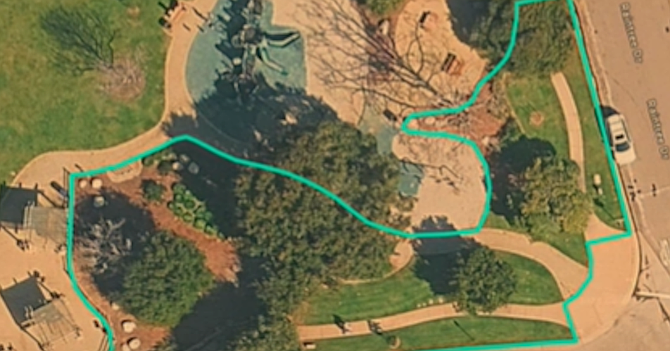
Native plant area of Leucadia Oaks Park. "We narrowed it down to what we know is typically native to the San Diego area.”
In Leucadia Oaks Park, over a former flower field, the city of Encinitas plans to grow a native plant garden that will teach residents how to achieve similar results in their own yards.
Last week, the city council chose a preferred design for the garden, which will be located in the southeast corner of the park at 1511 Vulcan Ave. A more detailed plan will follow after more reaction from the public.
Native landscapes support the goals of the city’s climate action plan by storing atmospheric carbon in soil and roots, conserving water, reducing rainfall runoff, and providing shade.
Although the city has been working on a native plant ordinance for over four years, it has yet to adopt it, but the fiscal year 2024 budget included $150,000 toward hiring a consultant to develop a simplified one– funds that will be used for the garden.
As part of the city’s in-progress draft native plant ordinance, demonstration gardens like this one will be built in parks around the city.
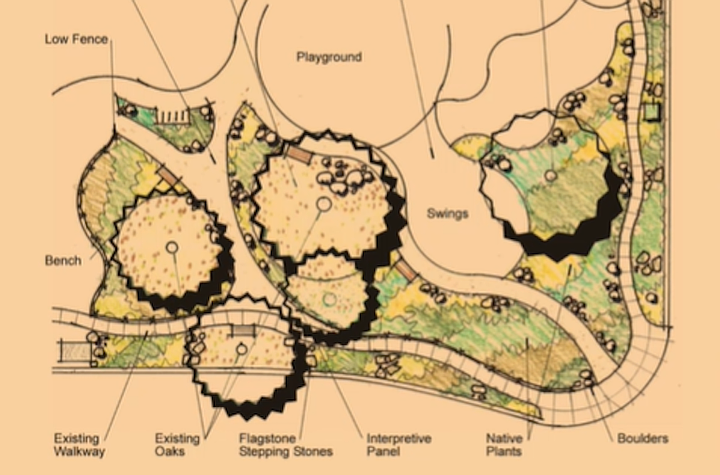
Demonstration garden concept
The project, which is managed by the Parks and Recreation Department, is intended to show people what to plant from season to season to increase biodiversity, attract pollinators, and save water.
“We started wide and narrowed it down to what we know is typically native to the San Diego area,” said Howard Pierce, a consultant for MW Peltz and Associates.
In meeting with stakeholder groups, they discussed whether plants or paths should go under the oak trees, and settled on using their leaf litter as mulch. Should they use natives from Baja – or just San Diego?
The consensus was to stick with California plants, and ones that grow locally, Pierce said. Native species have evolved over thousands of years alongside local wildlife, fungi, and microbes, and are central to thriving ecosystems. To achieve ample diversity, they came up with categories of pollinators and transitional woodland plants that can handle shade.
They also talked about how to keep people and pets from straying off the paths. “We didn’t want to create a free for all” with people wandering haphazardly though the garden, “but we also didn’t want to fence it off where you couldn’t access it, or felt separated from the plants.”
Officials said the plot currently has some existing landscaping, turf, native oaks, sycamore and a few non-native trees. In earlier stakeholder meetings, everyone agreed the oaks should be saved.
Among the plants considered “highly local” to Encinitas is a long string of oaks: Torrey's Hybrid Oak; Coast Live Oak; Scrub Oak; Nuttall's Scrub Oak; and Engelmann Oak.
Not so, the three non-native trees. One, an ash said to be ailing, was suggested to be removed as part of the project.
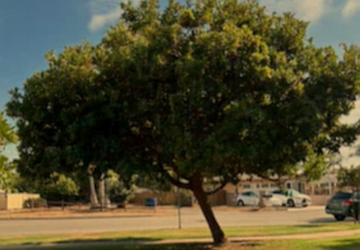
Non-native marina madrone, or strawberry tree
Mark Wisniewski, the arborist who originally proposed a native plant demonstration garden at Leucadia Oaks Park, said all three non-natives should go. One tree, a Japanese blueberry, has dead branches in its canopy and a mass of compacted roots at its base. Another is a non-native marina madrone, or strawberry tree, a hybrid. “This is a great area to display native plants,” being an entry to the garden.
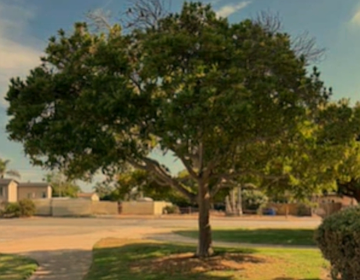
Non-native Japanese blueberry
Of the baywood ash with dieback in its canopy, “several have been removed in the past,” he noted.
“It would allow the oak next to it to have a larger canopy.”
Plans for the garden also drew criticism over the possible removal of mature, non-native trees.
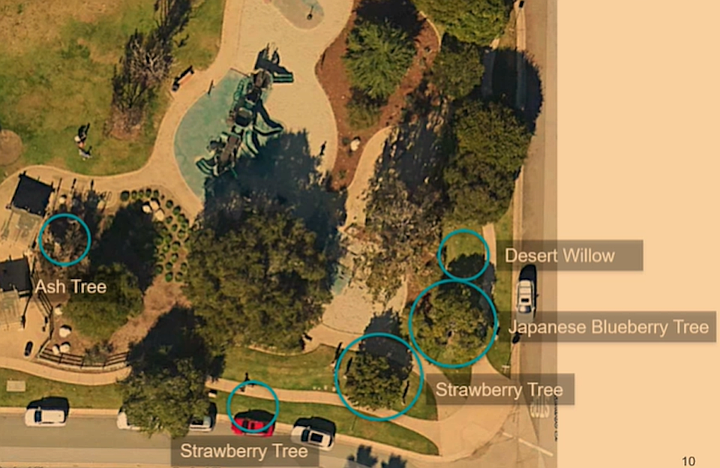
Non-natives slated to go
Tony Gurnoe, an advocate of native plants and a former director of Conservation Horticulture at the San Diego Botanic Garden, said he supported every element of the proposal – except the removal of existing trees.
It would diminish the urban forest canopy and reduce biodiversity as bird nesting, feeding and perching habitat is lost, he warned. “The city's own draft Native Plant Ordinance only proposes to require 50% native species,” so what local residential growers will need to see demonstrated is the successful fusion of “appropriate exotic ornamental plant species and regionally native plant species.”
“Simply plant underneath the existing trees.”
Others said if the city wants to increase the use of native plants, it’s a mistake to vilify them as the cause of canopy loss.
Deputy mayor Joy Lyndes said she thinks a native garden, especially a demonstration garden, should have only natives, but nevertheless the city has its mature, non-native trees. She suggested a transition plan for those trees over time.
“In other words, they live there now, we can keep them to provide their shade.” Once the city has a strategy for the native garden, it might turn out those trees won’t thrive there anyway, she added.
Here's something you might be interested in.
Leucadia expels the non-natives
But all of them?

Leucadia expels the non-natives
But all of them?
Native plant area of Leucadia Oaks Park. "We narrowed it down to what we know is typically native to the San Diego area.”
In Leucadia Oaks Park, over a former flower field, the city of Encinitas plans to grow a native plant garden that will teach residents how to achieve similar results in their own yards.
Last week, the city council chose a preferred design for the garden, which will be located in the southeast corner of the park at 1511 Vulcan Ave. A more detailed plan will follow after more reaction from the public.
Native landscapes support the goals of the city’s climate action plan by storing atmospheric carbon in soil and roots, conserving water, reducing rainfall runoff, and providing shade.
Although the city has been working on a native plant ordinance for over four years, it has yet to adopt it, but the fiscal year 2024 budget included $150,000 toward hiring a consultant to develop a simplified one– funds that will be used for the garden.
As part of the city’s in-progress draft native plant ordinance, demonstration gardens like this one will be built in parks around the city.
Demonstration garden concept
The project, which is managed by the Parks and Recreation Department, is intended to show people what to plant from season to season to increase biodiversity, attract pollinators, and save water.
“We started wide and narrowed it down to what we know is typically native to the San Diego area,” said Howard Pierce, a consultant for MW Peltz and Associates.
In meeting with stakeholder groups, they discussed whether plants or paths should go under the oak trees, and settled on using their leaf litter as mulch. Should they use natives from Baja – or just San Diego?
The consensus was to stick with California plants, and ones that grow locally, Pierce said. Native species have evolved over thousands of years alongside local wildlife, fungi, and microbes, and are central to thriving ecosystems. To achieve ample diversity, they came up with categories of pollinators and transitional woodland plants that can handle shade.
They also talked about how to keep people and pets from straying off the paths. “We didn’t want to create a free for all” with people wandering haphazardly though the garden, “but we also didn’t want to fence it off where you couldn’t access it, or felt separated from the plants.”
Officials said the plot currently has some existing landscaping, turf, native oaks, sycamore and a few non-native trees. In earlier stakeholder meetings, everyone agreed the oaks should be saved.
Among the plants considered “highly local” to Encinitas is a long string of oaks: Torrey's Hybrid Oak; Coast Live Oak; Scrub Oak; Nuttall's Scrub Oak; and Engelmann Oak.
Not so, the three non-native trees. One, an ash said to be ailing, was suggested to be removed as part of the project.
Non-native marina madrone, or strawberry tree
Mark Wisniewski, the arborist who originally proposed a native plant demonstration garden at Leucadia Oaks Park, said all three non-natives should go. One tree, a Japanese blueberry, has dead branches in its canopy and a mass of compacted roots at its base. Another is a non-native marina madrone, or strawberry tree, a hybrid. “This is a great area to display native plants,” being an entry to the garden.
Non-native Japanese blueberry
Of the baywood ash with dieback in its canopy, “several have been removed in the past,” he noted.
“It would allow the oak next to it to have a larger canopy.”
Plans for the garden also drew criticism over the possible removal of mature, non-native trees.
Non-natives slated to go
Tony Gurnoe, an advocate of native plants and a former director of Conservation Horticulture at the San Diego Botanic Garden, said he supported every element of the proposal – except the removal of existing trees.
It would diminish the urban forest canopy and reduce biodiversity as bird nesting, feeding and perching habitat is lost, he warned. “The city's own draft Native Plant Ordinance only proposes to require 50% native species,” so what local residential growers will need to see demonstrated is the successful fusion of “appropriate exotic ornamental plant species and regionally native plant species.”
“Simply plant underneath the existing trees.”
Others said if the city wants to increase the use of native plants, it’s a mistake to vilify them as the cause of canopy loss.
Deputy mayor Joy Lyndes said she thinks a native garden, especially a demonstration garden, should have only natives, but nevertheless the city has its mature, non-native trees. She suggested a transition plan for those trees over time.
“In other words, they live there now, we can keep them to provide their shade.” Once the city has a strategy for the native garden, it might turn out those trees won’t thrive there anyway, she added.
Comments