

Here's something you might be interested in.
Ask a Hipster — Advice you didn't know you needed
Big Screen — Movie commentary
Blurt — Music's inside track
Booze News — San Diego spirits
Classical Music — Immortal beauty
Classifieds — Free and easy
Close to Home — What it’s like on the street where you live
Cover Stories — Front-page features
Drinks All Around — Bartenders' drink recipes
Excerpts — Literary and spiritual excerpts
Feast! — Food & drink reviews
Feature Stories — Local news & stories
Fishing Report — What’s getting hooked from ship and shore
From the Archives — Spotlight on the past
Golden Dreams — Talk of the town
The Gonzo Report — Making the musical scene, or at least reporting from it
Letters — Our inbox
Movies@Home — Local movie buffs share favorites
Movie Reviews — Our critics' picks and pans
Musician Interviews — Up close with local artists
Neighborhood News from Stringers — Hyperlocal news
News Ticker — News & politics
Obermeyer — San Diego politics illustrated
Outdoors — Weekly changes in flora and fauna
Overheard in San Diego — Eavesdropping illustrated
Poetry — The old and the new
Reader Travel — Travel section built by travelers
Reading — The hunt for intellectuals
Roam-O-Rama — SoCal's best hiking/biking trails
San Diego Beer — Inside San Diego suds
SD on the QT — Almost factual news
Sheep and Goats — Places of worship
Special Issues — The best of
Street Style — San Diego streets have style
Surf Diego — Real stories from those braving the waves
Theater — On stage in San Diego this week
Tin Fork — Silver spoon alternative
Under the Radar — Matt Potter's undercover work
Unforgettable — Long-ago San Diego
Unreal Estate — San Diego's priciest pads
Your Week — Daily event picks
The tale of the Timbercaster
A tree fell in Hillcrest; now it makes a sound

Tom Gorman, Jim Weaver and his Timbercaster, Tai Harbinson, and Jeff Lzzarini at Mark's Guitar in Chula Vista.
it seems that not even the low-character, high-density redevelopment of Hillcrest can take away that neighborhood's ongoing contributions to the arts. Jim Weaver’s new Timbercaster guitar started life as just another roadside podocarpus tree on 6th Avenue in Banker’s Hill near Balboa Park. When a housing development displaced the tree, Dan Herbst of Urban Timber came to the rescue in his tiny Toyota truck to salvage the wood and squirrel it away for future possibilities. More than 10 years later, it has found a second life as Weaver’s custom Fender.
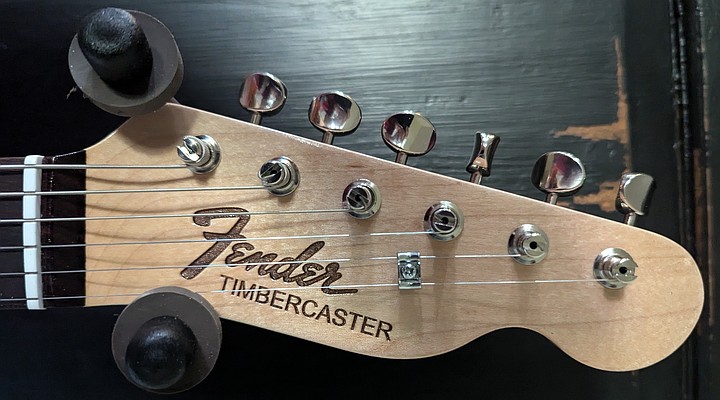
The first, but not the last, Timbercaster.
Weaver, now retired from his career as president of a medical transport company, hooked up with Urban Timber out of sheer curiosity: his bike rides often took him past Urban Timber’s former HQ on the waterfront in Chula Vista. “As a fan of woodworking,” Weaver said, “I would see the slabs and logs, and one day I pulled in to see what they had.” His relationship with the place and its people grew from there.
Urban Timber saves felled trees destined for the chipper and gives them new lives as lumber, furniture, decor, siding, public projects, art, and now, musical instruments. Weaver got to know Herbst and his partner Jessica Van Arsdale, and bought a few pieces of wood for his home projects, including some olive from Clark Gable’s ranch that became a music stand. (Weaver has a penchant for recycling and reusing: 30 years ago, he was instrumental in waste hauler Laidlaw’s first-ever recycling program for the City of Chula Vista.)
Now 74, Weaver recently picked up an electric guitar a relative had left in his care while deployed with the Navy and started taking lessons. He started restoring another guitar— a 1921 Maybell tenor acoustic — that he inherited from his wife’s father. He played in the Cockayne Family Orchestra, popular in the Southeast at the turn of the 20th century. Before long, it occurred to Weaver that he could have his own electric guitar made from salvaged wood, courtesy of his friends at Urban Timber.
The slab of podocarpus that became the Timbercaster, Herbst said, “was hiding in the racks until Jim came along.” Podocarpus macrophyllus, an evergreen in the pine family, is native to Japan, and is popular in San Diego as a street tree because it forms a dense shade canopy and can grow in loamy soil. But Herbst said that it’s not used much in woodworking, because it tends to “misbehave as it dries." Happily, the piece Weaver selected had already been through several years of air-drying, reshaping, and kiln-drying to make it usable. Herbst had long recognized that its unique grain and luster would make something beautiful one day — he just didn’t know what.
“The piece that Jim got was a part of the tree where a limb was branching out, so the grain was really swirly,” Herbst said. It was also big enough for two guitar bodies; Guitar enthusiast and woodworker Tom Gorman bought the other body for a sister Timbercaster. Weaver says he provided a Fender Telecaster template, and Herbst cut out the bodies, leaving a live edge as he did so "out of respect for the wood, and the journey it has been through." Herbst sanded it and routed the edges for the final sculpting, and Gorman applied lacquer for a stunning finish.
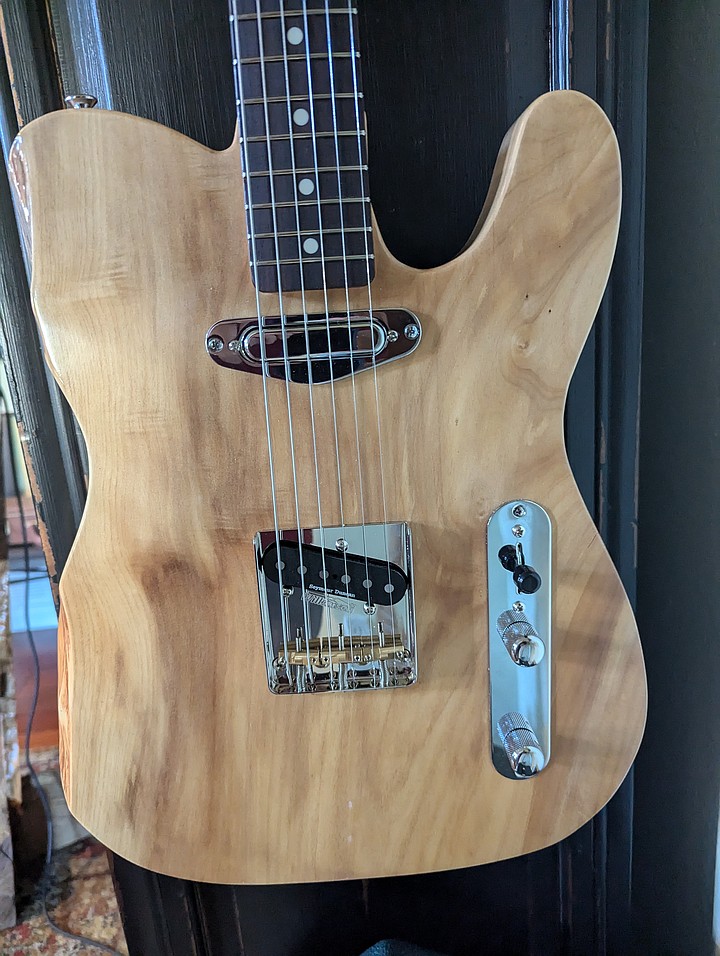
The Timbercaster, complete with live edge.
For head, neck, strings, and pick-ups, the solid body went to the Repair Zone in Kearny Mesa, where expert luthier Fred Marotta has repaired stringed instruments (including some famous Fenders) for 40 years. He is one of the foremost experts on Telecasters in Southern California. “All the guys down there raved about how the wood’s quality truly affected the tone and sound,” Weaver said, “and they have played some pretty expensive guitars. They said they had never seen a podocarpus body and a live edge, either.”

Frank Marotta at the Repair Zone.
Marotta’s project of building guitars out of old barn wood — Barncasters — gave Weaver the idea for the name, which would "pay tribute to Dan and Jessica at Urban Timber, who are doing the right thing with these pieces of wood that would otherwise be at the end of their life cycle.” Next up: another Timbercaster, this one made of black oak that tumbled in a storm after being struck by lightning on land that was once 19th-century African-American pioneer Nate Harrison’s Palomar Mountain ranch.
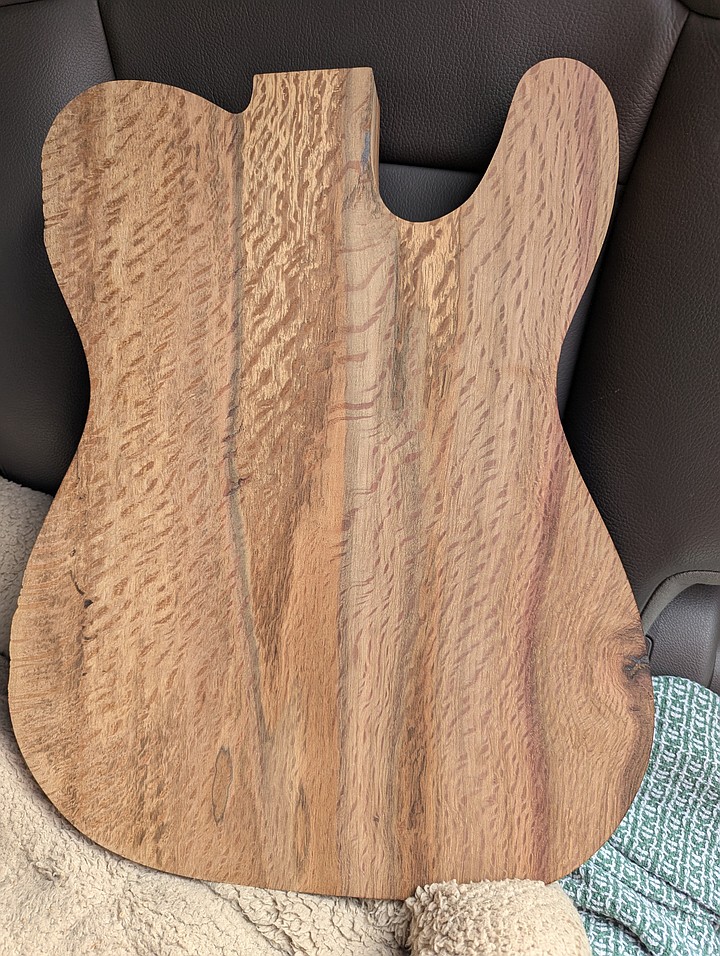
Unfinished body of the next Timbercaster, made of black oak from Nate Harrison's Palomar ranch
Here's something you might be interested in.
The tale of the Timbercaster
A tree fell in Hillcrest; now it makes a sound

The tale of the Timbercaster
A tree fell in Hillcrest; now it makes a sound
Tom Gorman, Jim Weaver and his Timbercaster, Tai Harbinson, and Jeff Lzzarini at Mark's Guitar in Chula Vista.
it seems that not even the low-character, high-density redevelopment of Hillcrest can take away that neighborhood's ongoing contributions to the arts. Jim Weaver’s new Timbercaster guitar started life as just another roadside podocarpus tree on 6th Avenue in Banker’s Hill near Balboa Park. When a housing development displaced the tree, Dan Herbst of Urban Timber came to the rescue in his tiny Toyota truck to salvage the wood and squirrel it away for future possibilities. More than 10 years later, it has found a second life as Weaver’s custom Fender.
The first, but not the last, Timbercaster.
Weaver, now retired from his career as president of a medical transport company, hooked up with Urban Timber out of sheer curiosity: his bike rides often took him past Urban Timber’s former HQ on the waterfront in Chula Vista. “As a fan of woodworking,” Weaver said, “I would see the slabs and logs, and one day I pulled in to see what they had.” His relationship with the place and its people grew from there.
Urban Timber saves felled trees destined for the chipper and gives them new lives as lumber, furniture, decor, siding, public projects, art, and now, musical instruments. Weaver got to know Herbst and his partner Jessica Van Arsdale, and bought a few pieces of wood for his home projects, including some olive from Clark Gable’s ranch that became a music stand. (Weaver has a penchant for recycling and reusing: 30 years ago, he was instrumental in waste hauler Laidlaw’s first-ever recycling program for the City of Chula Vista.)
Now 74, Weaver recently picked up an electric guitar a relative had left in his care while deployed with the Navy and started taking lessons. He started restoring another guitar— a 1921 Maybell tenor acoustic — that he inherited from his wife’s father. He played in the Cockayne Family Orchestra, popular in the Southeast at the turn of the 20th century. Before long, it occurred to Weaver that he could have his own electric guitar made from salvaged wood, courtesy of his friends at Urban Timber.
The slab of podocarpus that became the Timbercaster, Herbst said, “was hiding in the racks until Jim came along.” Podocarpus macrophyllus, an evergreen in the pine family, is native to Japan, and is popular in San Diego as a street tree because it forms a dense shade canopy and can grow in loamy soil. But Herbst said that it’s not used much in woodworking, because it tends to “misbehave as it dries." Happily, the piece Weaver selected had already been through several years of air-drying, reshaping, and kiln-drying to make it usable. Herbst had long recognized that its unique grain and luster would make something beautiful one day — he just didn’t know what.
“The piece that Jim got was a part of the tree where a limb was branching out, so the grain was really swirly,” Herbst said. It was also big enough for two guitar bodies; Guitar enthusiast and woodworker Tom Gorman bought the other body for a sister Timbercaster. Weaver says he provided a Fender Telecaster template, and Herbst cut out the bodies, leaving a live edge as he did so "out of respect for the wood, and the journey it has been through." Herbst sanded it and routed the edges for the final sculpting, and Gorman applied lacquer for a stunning finish.
The Timbercaster, complete with live edge.
For head, neck, strings, and pick-ups, the solid body went to the Repair Zone in Kearny Mesa, where expert luthier Fred Marotta has repaired stringed instruments (including some famous Fenders) for 40 years. He is one of the foremost experts on Telecasters in Southern California. “All the guys down there raved about how the wood’s quality truly affected the tone and sound,” Weaver said, “and they have played some pretty expensive guitars. They said they had never seen a podocarpus body and a live edge, either.”
Frank Marotta at the Repair Zone.
Marotta’s project of building guitars out of old barn wood — Barncasters — gave Weaver the idea for the name, which would "pay tribute to Dan and Jessica at Urban Timber, who are doing the right thing with these pieces of wood that would otherwise be at the end of their life cycle.” Next up: another Timbercaster, this one made of black oak that tumbled in a storm after being struck by lightning on land that was once 19th-century African-American pioneer Nate Harrison’s Palomar Mountain ranch.
Unfinished body of the next Timbercaster, made of black oak from Nate Harrison's Palomar ranch