

Here's something you might be interested in.
Ask a Hipster — Advice you didn't know you needed
Big Screen — Movie commentary
Blurt — Music's inside track
Booze News — San Diego spirits
Classical Music — Immortal beauty
Classifieds — Free and easy
Close to Home — What it’s like on the street where you live
Cover Stories — Front-page features
Drinks All Around — Bartenders' drink recipes
Excerpts — Literary and spiritual excerpts
Feast! — Food & drink reviews
Feature Stories — Local news & stories
Fishing Report — What’s getting hooked from ship and shore
From the Archives — Spotlight on the past
Golden Dreams — Talk of the town
The Gonzo Report — Making the musical scene, or at least reporting from it
Letters — Our inbox
Movies@Home — Local movie buffs share favorites
Movie Reviews — Our critics' picks and pans
Musician Interviews — Up close with local artists
Neighborhood News from Stringers — Hyperlocal news
News Ticker — News & politics
Obermeyer — San Diego politics illustrated
Outdoors — Weekly changes in flora and fauna
Overheard in San Diego — Eavesdropping illustrated
Poetry — The old and the new
Reader Travel — Travel section built by travelers
Reading — The hunt for intellectuals
Roam-O-Rama — SoCal's best hiking/biking trails
San Diego Beer — Inside San Diego suds
SD on the QT — Almost factual news
Sheep and Goats — Places of worship
Special Issues — The best of
Street Style — San Diego streets have style
Surf Diego — Real stories from those braving the waves
Theater — On stage in San Diego this week
Tin Fork — Silver spoon alternative
Under the Radar — Matt Potter's undercover work
Unforgettable — Long-ago San Diego
Unreal Estate — San Diego's priciest pads
Your Week — Daily event picks
Fish Report: Rockfish Allowed only in water deeper than 300 Feet
Don’t poke the fish!
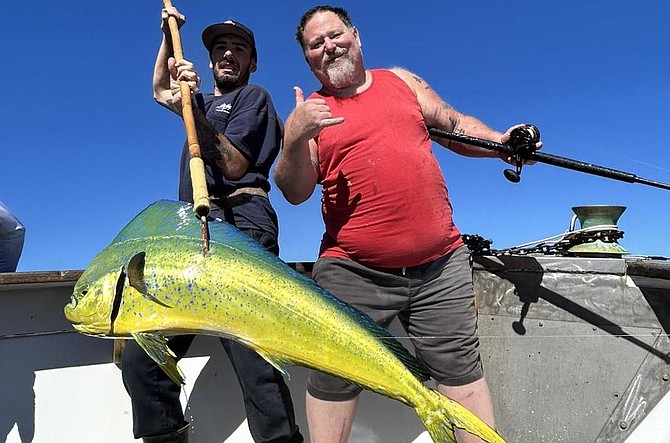
Brilliantly colored dorado caught aboard an early October 1.5-day trip
Dock Totals 9/28 – 10/4: 2875 anglers aboard 139 half-day to 3-day trips out of San Diego landings over the past week caught 3 barracuda, 2376 bluefin tuna (to 200 pounds), 508 bonito, 3 cabezon, 100 calico bass, 134 dorado, 5 halibut, 22 lingcod, 2 mako shark, 96 rock crab, 3992 rockfish, 23 sand bass, 406 sculpin, 143 sheephead, 245 skipjack tuna, 169 spiny lobster (350 released), 2 striped marlin, 804 whitefish, 12 white seabass, 1914 yellowfin tuna, and 1307 yellowtail.
Saltwater: As of October 1, rockfish can be caught only if they are seaward of the fifty-fathom (300 feet) line. Targeting rockfish in water deeper than 300 feet requires heavier gear and weights to get the bait down to where the fish are congregated. Most boats will be fishing in the 400- to 600-foot depth range, which also means fish will suffer barotrauma more often as they are brought up through the water column. For that reason, sportfishing and private boats are required to have descending devices aboard if targeting rockfish.
A descending device gives a fish with barotrauma the best chance of survival. There is another method that some folks use, but it is actually frowned upon by marine biologists: poking or puncturing the "swim bladder" that usually protrudes from a fish’s mouth when they suffer barotrauma. Notably, it is usually not the swim bladder but the stomach that is protruding as it is pushed out by the inflated bladder. Further, puncturing either is pretty much a death warrant for the fish. Sure, if you puncture the protruding sack and push it back inside, the fish will be able to swim down as though it is fine. But the fish will most likely die of infection. Just don’t do it.
And while fish with barotrauma may look like they aren’t going to survive, given their bulging eyes that often look "shattered" and protruding stomachs or vents, they actually tend to recover — as long as they are returned to the depths as quickly as possible. Here is an informative video on descending devices in which you can see the eyes clearing as the fish goes down.
Nearshore rockfish are closed now until April 1, 2026: that includes black, black and yellow, blue, brown, calico, China, copper, gopher, grass, kelp, and olive rockfishes, treefish, cabezon, and greenlings. Though lingcod are actually a greenling and not a cod, they are classed with shelf and slope rockfish and are legal to take through the rest of the year as long as they are caught in water that is deeper than 300 feet. All rockfish will be closed from January 1, 2026, until they reopen at all depths on April 1.

Solid bluefin tuna caught aboard the Searcher 3-day Chad Grosdidier charter
Though we did have some strong afternoon winds offshore along the Baja Coast, boats have been doing quite well on yellowfin, skipjack, and bluefin tuna 25 to 50 miles outside of Ensenada. There are also some dorado and striped marlin showing up out there within 1.5-day range. Bluefin are still being caught from the outer banks past San Clemente Island down to northern Baja, while most of the yellowfin and skipjack are coming from south of the border. As warm water is still being pushed up by systems that form off the Mexican mainland and move north along the Peninsula on the Pacific side, there is always a chance of running into yellowfin, skipjack, dorado, and even marlin in U.S. waters closer to home.
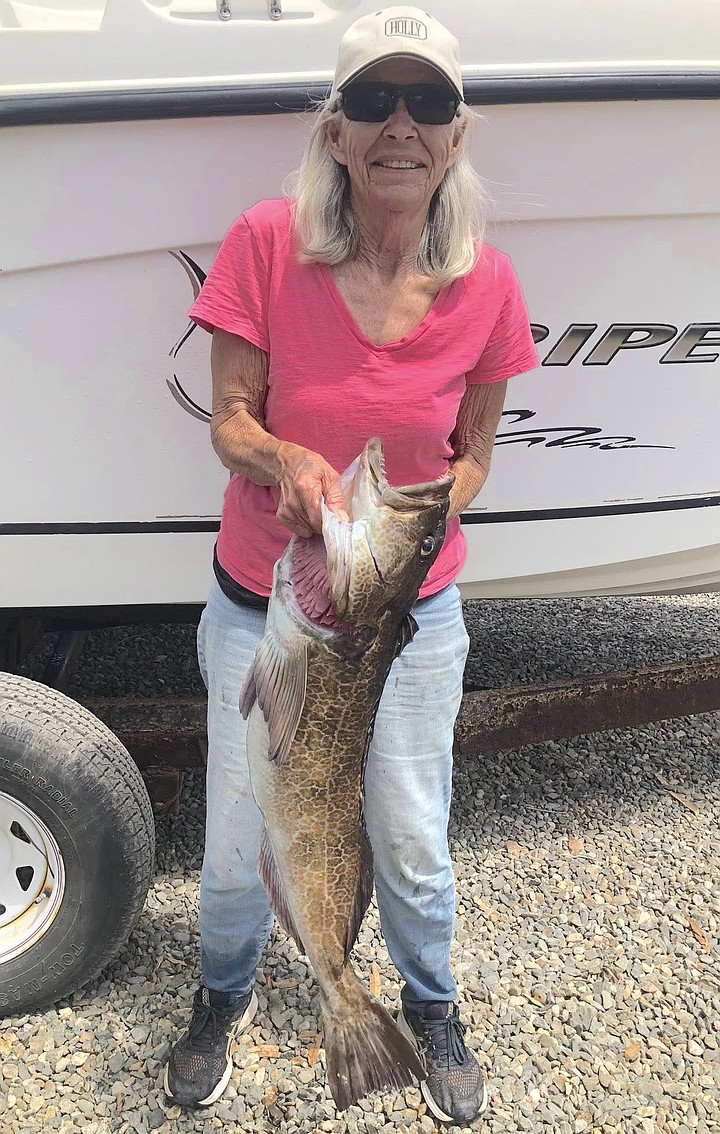
Friend of the Fish Report Susan Dugan with a solid lingcod caught near Isla San Martin this past month
Along the coast — and occasionally around floating debris offshore — yellowtail have been active and biting well for sportboats and pangeros running out of Ensenada. Victor Blackfin of Blackfin Sportfishing has been reporting some solid bluefin catches on offshore trips as they have been shifting focus from rockfish to pelagics. Lingcod fishing has been very good along the coast, especially down around Isla San Martin and the banks just south of there. Friends that have gone out recently have been posting pictures of nice lings up to 20 pounds, along with some solid reds in the mix. Mexico doesn’t have any vedas, or closed season or depth on rockfish, so there is always the option of cruising down to Ensenada or San Quintin…or any coastal town down to about the mid-peninsula, where rockfish begin to thin out due to the warmer water. As long as the weather holds and conditions remain favorable, October is going to be a very good fishing month for the fleet. So, whether the beach, bay, lake, or offshore, they’re out there so go out and get ‘em!
Here's something you might be interested in.
Fish Report: Rockfish Allowed only in water deeper than 300 Feet
Don’t poke the fish!

Fish Report: Rockfish Allowed only in water deeper than 300 Feet
Don’t poke the fish!
Brilliantly colored dorado caught aboard an early October 1.5-day trip
Dock Totals 9/28 – 10/4: 2875 anglers aboard 139 half-day to 3-day trips out of San Diego landings over the past week caught 3 barracuda, 2376 bluefin tuna (to 200 pounds), 508 bonito, 3 cabezon, 100 calico bass, 134 dorado, 5 halibut, 22 lingcod, 2 mako shark, 96 rock crab, 3992 rockfish, 23 sand bass, 406 sculpin, 143 sheephead, 245 skipjack tuna, 169 spiny lobster (350 released), 2 striped marlin, 804 whitefish, 12 white seabass, 1914 yellowfin tuna, and 1307 yellowtail.
Saltwater: As of October 1, rockfish can be caught only if they are seaward of the fifty-fathom (300 feet) line. Targeting rockfish in water deeper than 300 feet requires heavier gear and weights to get the bait down to where the fish are congregated. Most boats will be fishing in the 400- to 600-foot depth range, which also means fish will suffer barotrauma more often as they are brought up through the water column. For that reason, sportfishing and private boats are required to have descending devices aboard if targeting rockfish.
A descending device gives a fish with barotrauma the best chance of survival. There is another method that some folks use, but it is actually frowned upon by marine biologists: poking or puncturing the "swim bladder" that usually protrudes from a fish’s mouth when they suffer barotrauma. Notably, it is usually not the swim bladder but the stomach that is protruding as it is pushed out by the inflated bladder. Further, puncturing either is pretty much a death warrant for the fish. Sure, if you puncture the protruding sack and push it back inside, the fish will be able to swim down as though it is fine. But the fish will most likely die of infection. Just don’t do it.
And while fish with barotrauma may look like they aren’t going to survive, given their bulging eyes that often look "shattered" and protruding stomachs or vents, they actually tend to recover — as long as they are returned to the depths as quickly as possible. Here is an informative video on descending devices in which you can see the eyes clearing as the fish goes down.
Nearshore rockfish are closed now until April 1, 2026: that includes black, black and yellow, blue, brown, calico, China, copper, gopher, grass, kelp, and olive rockfishes, treefish, cabezon, and greenlings. Though lingcod are actually a greenling and not a cod, they are classed with shelf and slope rockfish and are legal to take through the rest of the year as long as they are caught in water that is deeper than 300 feet. All rockfish will be closed from January 1, 2026, until they reopen at all depths on April 1.
Solid bluefin tuna caught aboard the Searcher 3-day Chad Grosdidier charter
Though we did have some strong afternoon winds offshore along the Baja Coast, boats have been doing quite well on yellowfin, skipjack, and bluefin tuna 25 to 50 miles outside of Ensenada. There are also some dorado and striped marlin showing up out there within 1.5-day range. Bluefin are still being caught from the outer banks past San Clemente Island down to northern Baja, while most of the yellowfin and skipjack are coming from south of the border. As warm water is still being pushed up by systems that form off the Mexican mainland and move north along the Peninsula on the Pacific side, there is always a chance of running into yellowfin, skipjack, dorado, and even marlin in U.S. waters closer to home.
Friend of the Fish Report Susan Dugan with a solid lingcod caught near Isla San Martin this past month
Along the coast — and occasionally around floating debris offshore — yellowtail have been active and biting well for sportboats and pangeros running out of Ensenada. Victor Blackfin of Blackfin Sportfishing has been reporting some solid bluefin catches on offshore trips as they have been shifting focus from rockfish to pelagics. Lingcod fishing has been very good along the coast, especially down around Isla San Martin and the banks just south of there. Friends that have gone out recently have been posting pictures of nice lings up to 20 pounds, along with some solid reds in the mix. Mexico doesn’t have any vedas, or closed season or depth on rockfish, so there is always the option of cruising down to Ensenada or San Quintin…or any coastal town down to about the mid-peninsula, where rockfish begin to thin out due to the warmer water. As long as the weather holds and conditions remain favorable, October is going to be a very good fishing month for the fleet. So, whether the beach, bay, lake, or offshore, they’re out there so go out and get ‘em!
Comments