

Here's something you might be interested in.
Ask a Hipster — Advice you didn't know you needed
Big Screen — Movie commentary
Blurt — Music's inside track
Booze News — San Diego spirits
Classical Music — Immortal beauty
Classifieds — Free and easy
Close to Home — What it’s like on the street where you live
Cover Stories — Front-page features
Drinks All Around — Bartenders' drink recipes
Excerpts — Literary and spiritual excerpts
Feast! — Food & drink reviews
Feature Stories — Local news & stories
Fishing Report — What’s getting hooked from ship and shore
From the Archives — Spotlight on the past
Golden Dreams — Talk of the town
The Gonzo Report — Making the musical scene, or at least reporting from it
Letters — Our inbox
Movies@Home — Local movie buffs share favorites
Movie Reviews — Our critics' picks and pans
Musician Interviews — Up close with local artists
Neighborhood News from Stringers — Hyperlocal news
News Ticker — News & politics
Obermeyer — San Diego politics illustrated
Outdoors — Weekly changes in flora and fauna
Overheard in San Diego — Eavesdropping illustrated
Poetry — The old and the new
Reader Travel — Travel section built by travelers
Reading — The hunt for intellectuals
Roam-O-Rama — SoCal's best hiking/biking trails
San Diego Beer — Inside San Diego suds
SD on the QT — Almost factual news
Sheep and Goats — Places of worship
Special Issues — The best of
Street Style — San Diego streets have style
Surf Diego — Real stories from those braving the waves
Theater — On stage in San Diego this week
Tin Fork — Silver spoon alternative
Under the Radar — Matt Potter's undercover work
Unforgettable — Long-ago San Diego
Unreal Estate — San Diego's priciest pads
Your Week — Daily event picks
Oleander is coloring our medians, coastal wildflowers are hanging in there
Daylight is increasing and quarter moon is tonight
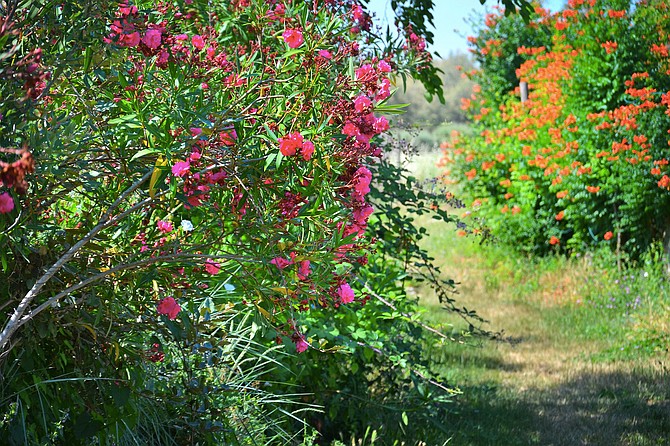
Because Oleander are heat, drought, and salt tolerant they do well in most San Diego climates.
Oleander, a consistent spring/summer bloomer that is widely planted in front and backyards throughout the county, is putting on a fine show in the medians of certain area thoroughfares and freeways, especially Interstate 5 in North County. Alternating bands of white, pink, and red flash by the traveler, punctuated by an occasional splash of out-of-sequence color — perhaps a subtle attention-getter designed to keep sleepy drivers awake. Most gardeners are aware of oleander’s toxic characteristics, but if they're not, they should be: all parts are poisonous if ingested.
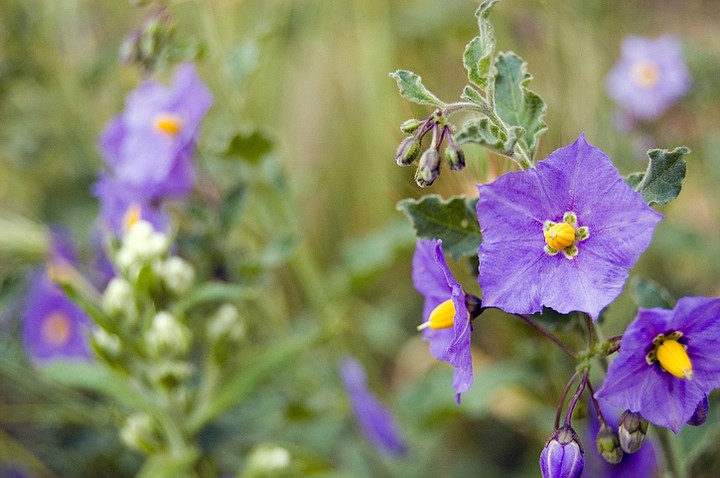
Spring wildflowers like purple nightshade can still be found in cooler coastal enclaves.
Spring Wildflowers may have largely dried up in most areas of San Diego County, but in cooler coastal enclaves such as Cabrillo National Monument and Torrey Pines State Reserve, several kinds remain as we head toward summer. Look for paintbrush, purple nightshade, coreopsis, sea fig, popcorn flower, and red monkey flower, among others.
Enjoy the Increasing Daylight! By the end of May, we will be seeing 14 hours between sunrise and sunset! The days will continue to get longer until the summer solstice on June 21.
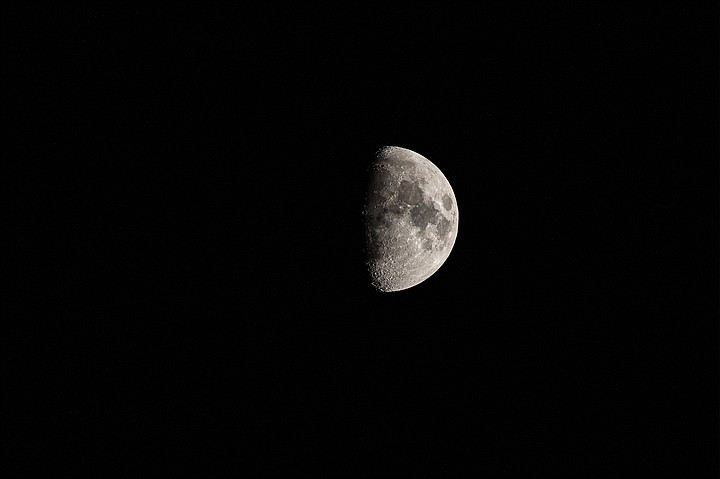
First-quarter Moon
The Last-Quarter Moon Rises This Morning at 1:37 am, reaching it's apex at 4:59 am. Why is it called a quarter moon and not a half moon? Because it is a quarter of the way through its cycle, which runs from new moon to full moon and back. The right side of the moon is illuminated during the first quarter and the left side during the third quarter. And despite being half in shadow, the quarter moon provides more surface details of the moon’s face than a full moon, when the sun is shining straight onto the moon’s surface. It's all about he angle: a quarter moon gets more shadowing light, showing off more of the moon’s mountains and craters.
Here's something you might be interested in.
Oleander is coloring our medians, coastal wildflowers are hanging in there
Daylight is increasing and quarter moon is tonight

Oleander is coloring our medians, coastal wildflowers are hanging in there
Daylight is increasing and quarter moon is tonight
Because Oleander are heat, drought, and salt tolerant they do well in most San Diego climates.
Oleander, a consistent spring/summer bloomer that is widely planted in front and backyards throughout the county, is putting on a fine show in the medians of certain area thoroughfares and freeways, especially Interstate 5 in North County. Alternating bands of white, pink, and red flash by the traveler, punctuated by an occasional splash of out-of-sequence color — perhaps a subtle attention-getter designed to keep sleepy drivers awake. Most gardeners are aware of oleander’s toxic characteristics, but if they're not, they should be: all parts are poisonous if ingested.
Spring wildflowers like purple nightshade can still be found in cooler coastal enclaves.
Spring Wildflowers may have largely dried up in most areas of San Diego County, but in cooler coastal enclaves such as Cabrillo National Monument and Torrey Pines State Reserve, several kinds remain as we head toward summer. Look for paintbrush, purple nightshade, coreopsis, sea fig, popcorn flower, and red monkey flower, among others.
Enjoy the Increasing Daylight! By the end of May, we will be seeing 14 hours between sunrise and sunset! The days will continue to get longer until the summer solstice on June 21.
First-quarter Moon
The Last-Quarter Moon Rises This Morning at 1:37 am, reaching it's apex at 4:59 am. Why is it called a quarter moon and not a half moon? Because it is a quarter of the way through its cycle, which runs from new moon to full moon and back. The right side of the moon is illuminated during the first quarter and the left side during the third quarter. And despite being half in shadow, the quarter moon provides more surface details of the moon’s face than a full moon, when the sun is shining straight onto the moon’s surface. It's all about he angle: a quarter moon gets more shadowing light, showing off more of the moon’s mountains and craters.
Comments