

Here's something you might be interested in.
Ask a Hipster — Advice you didn't know you needed
Big Screen — Movie commentary
Blurt — Music's inside track
Booze News — San Diego spirits
Classical Music — Immortal beauty
Classifieds — Free and easy
Close to Home — What it’s like on the street where you live
Cover Stories — Front-page features
Drinks All Around — Bartenders' drink recipes
Excerpts — Literary and spiritual excerpts
Feast! — Food & drink reviews
Feature Stories — Local news & stories
Fishing Report — What’s getting hooked from ship and shore
From the Archives — Spotlight on the past
Golden Dreams — Talk of the town
The Gonzo Report — Making the musical scene, or at least reporting from it
Letters — Our inbox
Movies@Home — Local movie buffs share favorites
Movie Reviews — Our critics' picks and pans
Musician Interviews — Up close with local artists
Neighborhood News from Stringers — Hyperlocal news
News Ticker — News & politics
Obermeyer — San Diego politics illustrated
Outdoors — Weekly changes in flora and fauna
Overheard in San Diego — Eavesdropping illustrated
Poetry — The old and the new
Reader Travel — Travel section built by travelers
Reading — The hunt for intellectuals
Roam-O-Rama — SoCal's best hiking/biking trails
San Diego Beer — Inside San Diego suds
SD on the QT — Almost factual news
Sheep and Goats — Places of worship
Special Issues — The best of
Street Style — San Diego streets have style
Surf Diego — Real stories from those braving the waves
Theater — On stage in San Diego this week
Tin Fork — Silver spoon alternative
Under the Radar — Matt Potter's undercover work
Unforgettable — Long-ago San Diego
Unreal Estate — San Diego's priciest pads
Your Week — Daily event picks
Island Mallow is a local bloomer, Summer Solstice on Friday
Ocean water temps are on the rise and Mercury is shining bright
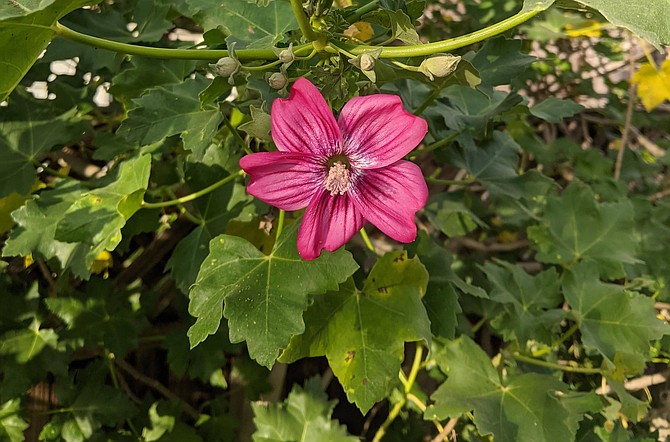
Island Mallow is also a favorite of butterflies, birds and gophers.
Malva Rosa (Malva Assurgentiflora) Is An Evergreen Mallow endemic to Southern California. Often called "Island Mallow," since it is native only to the Channel Islands, but it can be found in coastal mainland California as well as Guatemala, western South America, New Zealand and Australia. It produces a pink-lavender showy flower very similar to hibiscus from spring into summer. Malva Rosa grows naturally as a sprawling hedge, but can also be trained as a small tree. It prefers well-drained soil and full to partial sun; it also grows extremely fast and can reach 10' tall and 10' wide. Its conservation status is listed as "at risk," but it can be seen blooming in parts of coastal San Diego right now.
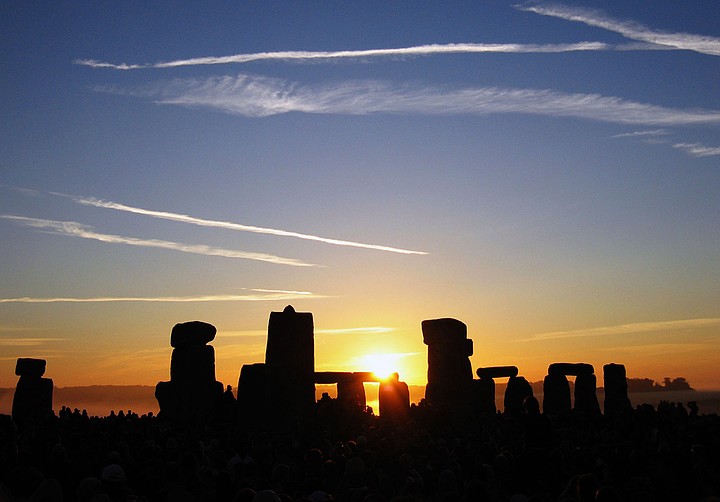
The Sun rising over Stonehenge in southern England on the June solstice.
Summer Solstice, The Time When The Sun Reaches Its Northernmost Point in the sky, occurs this year at 7:41 am on Friday, June 20. The summer solstice not only marks the beginning of summer for the Northern Hemisphere; it also means that the daylight hours are maximized. San Diegans now enjoy approximately 14 hours of daylight each day, in contrast to the meager 10 hours or so we experience in December. Anytime this week or next, try checking your shadow at 12:50 pm (the local daylight time in San Diego that is currently equivalent to astronomical noon). The sun will be only 10 degrees south of straight overhead, and so objects will cast shadows nearly straight down. A lesser known consequence of the summer solstice is that our twilight periods are longer than usual. Evening and morning twilight periods are now lasting more than 90 minutes.
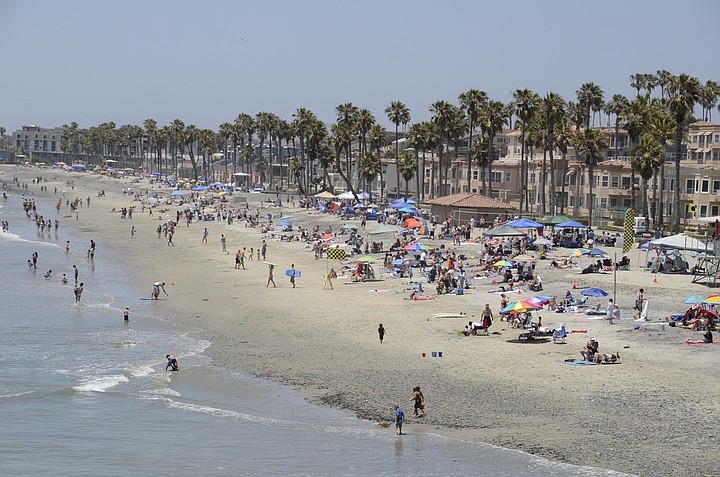
Crowds on Oceanside beach, just north of pier, June 22, 2013. Photo Weatherston.
Ocean Water Temperatures Are Rising into the mid-60s this month, perhaps to reach the low 70s in August. The usual early-summer cool weather along San Diego's coastline, disappointing to many tourists, is mostly caused by the sluggish warming of the ocean water. The payoff will come later: as the ocean gives up heat absorbed during the sunny summer months, we'll enjoy warm days and evenings well into autumn.
Mercury Will Be At It's Brightest magnitude in 2025 now through June 30. Look low in the Northwestern sky at around 9pm.
Here's something you might be interested in.
Island Mallow is a local bloomer, Summer Solstice on Friday
Ocean water temps are on the rise and Mercury is shining bright

Island Mallow is a local bloomer, Summer Solstice on Friday
Ocean water temps are on the rise and Mercury is shining bright
Island Mallow is also a favorite of butterflies, birds and gophers.
Malva Rosa (Malva Assurgentiflora) Is An Evergreen Mallow endemic to Southern California. Often called "Island Mallow," since it is native only to the Channel Islands, but it can be found in coastal mainland California as well as Guatemala, western South America, New Zealand and Australia. It produces a pink-lavender showy flower very similar to hibiscus from spring into summer. Malva Rosa grows naturally as a sprawling hedge, but can also be trained as a small tree. It prefers well-drained soil and full to partial sun; it also grows extremely fast and can reach 10' tall and 10' wide. Its conservation status is listed as "at risk," but it can be seen blooming in parts of coastal San Diego right now.
The Sun rising over Stonehenge in southern England on the June solstice.
Summer Solstice, The Time When The Sun Reaches Its Northernmost Point in the sky, occurs this year at 7:41 am on Friday, June 20. The summer solstice not only marks the beginning of summer for the Northern Hemisphere; it also means that the daylight hours are maximized. San Diegans now enjoy approximately 14 hours of daylight each day, in contrast to the meager 10 hours or so we experience in December. Anytime this week or next, try checking your shadow at 12:50 pm (the local daylight time in San Diego that is currently equivalent to astronomical noon). The sun will be only 10 degrees south of straight overhead, and so objects will cast shadows nearly straight down. A lesser known consequence of the summer solstice is that our twilight periods are longer than usual. Evening and morning twilight periods are now lasting more than 90 minutes.
Crowds on Oceanside beach, just north of pier, June 22, 2013. Photo Weatherston.
Ocean Water Temperatures Are Rising into the mid-60s this month, perhaps to reach the low 70s in August. The usual early-summer cool weather along San Diego's coastline, disappointing to many tourists, is mostly caused by the sluggish warming of the ocean water. The payoff will come later: as the ocean gives up heat absorbed during the sunny summer months, we'll enjoy warm days and evenings well into autumn.
Mercury Will Be At It's Brightest magnitude in 2025 now through June 30. Look low in the Northwestern sky at around 9pm.
Comments