

Here's something you might be interested in.
Ask a Hipster — Advice you didn't know you needed
Big Screen — Movie commentary
Blurt — Music's inside track
Booze News — San Diego spirits
Classical Music — Immortal beauty
Classifieds — Free and easy
Close to Home — What it’s like on the street where you live
Cover Stories — Front-page features
Drinks All Around — Bartenders' drink recipes
Excerpts — Literary and spiritual excerpts
Feast! — Food & drink reviews
Feature Stories — Local news & stories
Fishing Report — What’s getting hooked from ship and shore
From the Archives — Spotlight on the past
Golden Dreams — Talk of the town
The Gonzo Report — Making the musical scene, or at least reporting from it
Letters — Our inbox
Movies@Home — Local movie buffs share favorites
Movie Reviews — Our critics' picks and pans
Musician Interviews — Up close with local artists
Neighborhood News from Stringers — Hyperlocal news
News Ticker — News & politics
Obermeyer — San Diego politics illustrated
Outdoors — Weekly changes in flora and fauna
Overheard in San Diego — Eavesdropping illustrated
Poetry — The old and the new
Reader Travel — Travel section built by travelers
Reading — The hunt for intellectuals
Roam-O-Rama — SoCal's best hiking/biking trails
San Diego Beer — Inside San Diego suds
SD on the QT — Almost factual news
Sheep and Goats — Places of worship
Special Issues — The best of
Street Style — San Diego streets have style
Surf Diego — Real stories from those braving the waves
Theater — On stage in San Diego this week
Tin Fork — Silver spoon alternative
Under the Radar — Matt Potter's undercover work
Unforgettable — Long-ago San Diego
Unreal Estate — San Diego's priciest pads
Your Week — Daily event picks
Terribly tardy theater review: Merry Me at Diversionary Theatre
Lesbian laugher must close this weekend
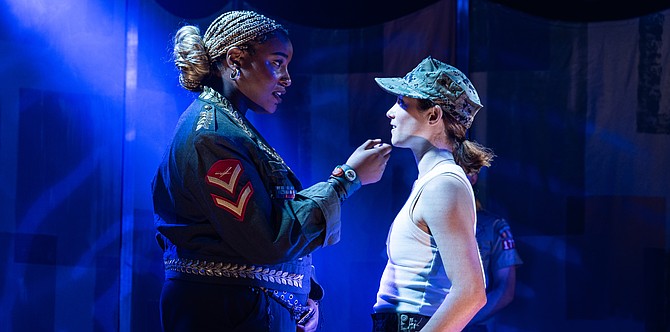
Let us make merry!
The note from dramaturg Jesse Marchese lets us know that Hansol Jung’s exercise in “lesbian camp” is “stupid smart, a dramaturgical mashup of theatrical sources from throughout history.” Those sources include Euripides’ Iphigenia at Aulis, Wycherly’s The Country Wife, Kushner’s Angels in America, Wilder’s Our Town, and Marvel’s Avengers: Infinity War. In narrative terms, this means that the angel from Angels in America, equipped with “eight vaginas and many more dicks” like a sexual Seraphim, descends to earth to let a military psychologist know that heaven was taken with Thanos’ plan to reduce the population — what with the rise in despair and the dwindling of merries (sort of a feminine “jollies”) — and so needs her to set about taking an axe to the source of human misery: cisgendered males of European descent. Only then will heaven remove the blackout which has descended upon the psychologist’s frustrated army, a blackout which has rendered military vehicles inoperable and cell phones useless — “no porn, no calling Mommy” — but has, mercifully, spared vibrators. Which is a good thing, because otherwise, how would young wife Mrs. Memnon get satisfaction after her husband Private Willy has finished his well-intentioned but disappointing business?
Mind you, all this is background, a setup for the real answer to that question, which is also the answer to how Lt. Shane Horn, the play’s true protagonist, will finally get some merries of her own. She’s just come out of solitary for “sexing up the general’s wife,” but she remains isolated — a master at giving pleasure, she suffers from “a sad, broken pussy” that, as she lays out to the good doctor of psychology, must remain dysfunctional through four acts so that she may arrive that sex that is “better than other sex because it took five acts.” A consummation devoutly to be wished, especially when everyone else’s wishes are being granted. (At one point, a group of ladies begs Horne for relief, and before wading into the fray, she cracks her knuckles and neck like an action hero preparing for a fight. The difference being that an action hero doesn’t end up with a cramped tongue afterwards.)
About that general’s wife: she’s also Private Willy’s mother, as unhappy with her husband’s attentions as her son’s wife is with his. The general is, after all, one of those cisgendered males, “an angry, impotent man with nuclear power at the tip of his impotent wits.”
Jung’s play is very horny and very cheeky. It is also very self-conscious. Our angelic narrator lets us know that her performance takes a lot of focus, and asks us to follow her to the corner of the stage while she distracts us from one scene’s setup. Later, she bemoans the lack of axe murders by saying, “It’s page 83, what’s taking so long?” Characters communicate via telephones made from strings and cups, then remind us that they aren’t telephones, but strings and cups. What it isn’t is terribly interested in resolving its own story. Come show’s end, various plotlines are tied off with a tossed-off bit of narration. It turns out the real quest was the merries we made along the way. It’s probably possible to combine Greek tragedy with Restoration comedy and superhero action into a more cohesive whole, but it almost certainly wouldn’t be as much fun. And Merry Me is fun, thanks in large part to Winnie Beasley’s outsized charisma as Lt. Horne and Vanessa Stalling’s energetic direction — or should that be direction of energy?
Here's something you might be interested in.
Terribly tardy theater review: Merry Me at Diversionary Theatre
Lesbian laugher must close this weekend

Terribly tardy theater review: Merry Me at Diversionary Theatre
Lesbian laugher must close this weekend
Let us make merry!
The note from dramaturg Jesse Marchese lets us know that Hansol Jung’s exercise in “lesbian camp” is “stupid smart, a dramaturgical mashup of theatrical sources from throughout history.” Those sources include Euripides’ Iphigenia at Aulis, Wycherly’s The Country Wife, Kushner’s Angels in America, Wilder’s Our Town, and Marvel’s Avengers: Infinity War. In narrative terms, this means that the angel from Angels in America, equipped with “eight vaginas and many more dicks” like a sexual Seraphim, descends to earth to let a military psychologist know that heaven was taken with Thanos’ plan to reduce the population — what with the rise in despair and the dwindling of merries (sort of a feminine “jollies”) — and so needs her to set about taking an axe to the source of human misery: cisgendered males of European descent. Only then will heaven remove the blackout which has descended upon the psychologist’s frustrated army, a blackout which has rendered military vehicles inoperable and cell phones useless — “no porn, no calling Mommy” — but has, mercifully, spared vibrators. Which is a good thing, because otherwise, how would young wife Mrs. Memnon get satisfaction after her husband Private Willy has finished his well-intentioned but disappointing business?
Mind you, all this is background, a setup for the real answer to that question, which is also the answer to how Lt. Shane Horn, the play’s true protagonist, will finally get some merries of her own. She’s just come out of solitary for “sexing up the general’s wife,” but she remains isolated — a master at giving pleasure, she suffers from “a sad, broken pussy” that, as she lays out to the good doctor of psychology, must remain dysfunctional through four acts so that she may arrive that sex that is “better than other sex because it took five acts.” A consummation devoutly to be wished, especially when everyone else’s wishes are being granted. (At one point, a group of ladies begs Horne for relief, and before wading into the fray, she cracks her knuckles and neck like an action hero preparing for a fight. The difference being that an action hero doesn’t end up with a cramped tongue afterwards.)
About that general’s wife: she’s also Private Willy’s mother, as unhappy with her husband’s attentions as her son’s wife is with his. The general is, after all, one of those cisgendered males, “an angry, impotent man with nuclear power at the tip of his impotent wits.”
Jung’s play is very horny and very cheeky. It is also very self-conscious. Our angelic narrator lets us know that her performance takes a lot of focus, and asks us to follow her to the corner of the stage while she distracts us from one scene’s setup. Later, she bemoans the lack of axe murders by saying, “It’s page 83, what’s taking so long?” Characters communicate via telephones made from strings and cups, then remind us that they aren’t telephones, but strings and cups. What it isn’t is terribly interested in resolving its own story. Come show’s end, various plotlines are tied off with a tossed-off bit of narration. It turns out the real quest was the merries we made along the way. It’s probably possible to combine Greek tragedy with Restoration comedy and superhero action into a more cohesive whole, but it almost certainly wouldn’t be as much fun. And Merry Me is fun, thanks in large part to Winnie Beasley’s outsized charisma as Lt. Horne and Vanessa Stalling’s energetic direction — or should that be direction of energy?
Comments