

Here's something you might be interested in.
Ask a Hipster — Advice you didn't know you needed
Big Screen — Movie commentary
Blurt — Music's inside track
Booze News — San Diego spirits
Classical Music — Immortal beauty
Classifieds — Free and easy
Close to Home — What it’s like on the street where you live
Cover Stories — Front-page features
Drinks All Around — Bartenders' drink recipes
Excerpts — Literary and spiritual excerpts
Feast! — Food & drink reviews
Feature Stories — Local news & stories
Fishing Report — What’s getting hooked from ship and shore
From the Archives — Spotlight on the past
Golden Dreams — Talk of the town
The Gonzo Report — Making the musical scene, or at least reporting from it
Letters — Our inbox
Movies@Home — Local movie buffs share favorites
Movie Reviews — Our critics' picks and pans
Musician Interviews — Up close with local artists
Neighborhood News from Stringers — Hyperlocal news
News Ticker — News & politics
Obermeyer — San Diego politics illustrated
Outdoors — Weekly changes in flora and fauna
Overheard in San Diego — Eavesdropping illustrated
Poetry — The old and the new
Reader Travel — Travel section built by travelers
Reading — The hunt for intellectuals
Roam-O-Rama — SoCal's best hiking/biking trails
San Diego Beer — Inside San Diego suds
SD on the QT — Almost factual news
Sheep and Goats — Places of worship
Special Issues — The best of
Street Style — San Diego streets have style
Surf Diego — Real stories from those braving the waves
Theater — On stage in San Diego this week
Tin Fork — Silver spoon alternative
Under the Radar — Matt Potter's undercover work
Unforgettable — Long-ago San Diego
Unreal Estate — San Diego's priciest pads
Your Week — Daily event picks
County loses State Supreme Court appeal over rural traffic measurements
Living in the middle of nowhere means it takes a while to drive somewhere
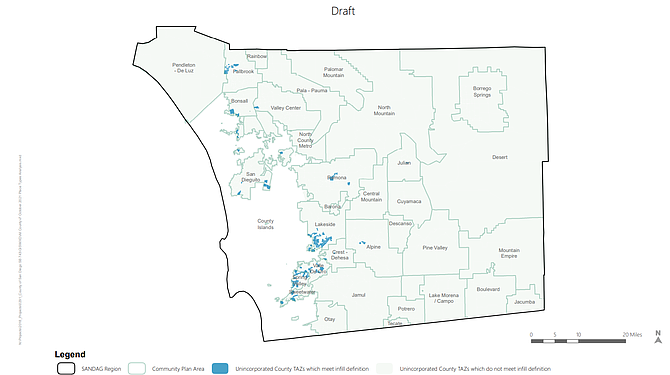
The county has lost another round in its long battle with environmental groups over the way it measures the traffic generated by rural developments. This time, it was a ruling by the California Supreme Court, making it more likely that this will serve as the county’s last attempt to hold on to its current transportation study guide. The guide isn’t mandated by the state, but what is mandated is planning that evaluates the transportation impacts of developments.
As the lawsuit notes, housing projects in unincorporated areas typically generate more vehicle trips than the county average, because residents regularly travel to urban areas nearer the coast for jobs, shopping and recreation.
The original guide, adopted in 2020, required an analysis of vehicle miles traveled as mandated by state law (SB 743) to address climate change, but it considered travel only within unincorporated areas, making a given project’s footprint seem smaller than it would be otherwise. This despite the fact that in 2018, the state had released new guidance making it clear the entire county should be used for analysis.
SB 743 shifted how traffic impacts were measured under environmental review. The yardstick was no longer “level of service” — looking at congestion or delay — but the number of vehicle trips a project would incur. It therefore promoted infill near transit. (According to the state's website, over half of all development in the state could forgo transportation analysis and mitigation entirely, including housing projects that generate fewer than 110 trips per day.) When it came to unincorporated areas, the county claimed to be working in compliance with the law by focusing on rural infill and small lots. All that was missing was the transit.
A few months after the county adopted its guide, Cleveland National Forest Foundation and Coastal Environmental Rights Foundation filed a lawsuit in San Diego Superior Court, claiming the plan was incorrectly assessing traffic and failed to curb driving. The guidelines were supposed to describe “thresholds of significance” when trips need to be reduced or mitigated. However, according to the lawsuit, the plan exempted most potential developments — including those generating fewer than 110 trips per day — from having to examine their trip generation.
The county was falling back on its 2011 General Plan update, which adopted a village concept that was meant to sprawl-proof areas like Lakeside and Ramona by concentrating growth in existing “village centers” where services, jobs, and houses coincided. They exempted certain developments from detailed transportation studies because these infill projects were thought to have minimal impact. However, it seems that local conditions matter. Given the limited options for transportation in San Diego's unincorporated areas, rural development can mean longer drives and more emissions than in other areas.
Faced with legal challenges, the Board of Supervisors in Sept 2021 voted unanimously to rescind the transportation study guide. A year later, a new draft which set vehicle miles thresholds and screening criteria was adopted. But once again, a lawsuit by environmental groups soon followed. This time, the complaint concerned oversimplified infill and small project thresholds — “an attempt to streamline [Vehicle Miles Traveled] analysis” — and lack of a numeric VMT target. The court upheld the county’s thresholds, but the groups won on appeal regarding insufficient evidence to support the thresholds. And in its appeal to the state Supreme Court, the County still couldn’t show that their infill threshold would have a negligible effect on traffic.
The loss doesn't mean all rural housing projects will be tossed out along with the transportation study guide. Under state law, the county can still approve projects that have significant traffic impacts.
Damon Davis, a transportation specialist for the County, says they are awaiting direction from the lower courts and the Board of Supervisors on the study guide. “We expect to be directed to remove the small project and infill screening criteria from the guide,” he says. “Projects that have not gotten discretionary approval and are relying on either one of those screening criteria will need to determine another path forward.”
One possibility for some developments may be to incorporate VMT in the “small project” formula. "This could result in a sliding scale of average daily traffic allowed for small project determination, depending on where in the county the project is located.”
Here's something you might be interested in.
County loses State Supreme Court appeal over rural traffic measurements
Living in the middle of nowhere means it takes a while to drive somewhere

County loses State Supreme Court appeal over rural traffic measurements
Living in the middle of nowhere means it takes a while to drive somewhere
The county has lost another round in its long battle with environmental groups over the way it measures the traffic generated by rural developments. This time, it was a ruling by the California Supreme Court, making it more likely that this will serve as the county’s last attempt to hold on to its current transportation study guide. The guide isn’t mandated by the state, but what is mandated is planning that evaluates the transportation impacts of developments.
As the lawsuit notes, housing projects in unincorporated areas typically generate more vehicle trips than the county average, because residents regularly travel to urban areas nearer the coast for jobs, shopping and recreation.
The original guide, adopted in 2020, required an analysis of vehicle miles traveled as mandated by state law (SB 743) to address climate change, but it considered travel only within unincorporated areas, making a given project’s footprint seem smaller than it would be otherwise. This despite the fact that in 2018, the state had released new guidance making it clear the entire county should be used for analysis.
SB 743 shifted how traffic impacts were measured under environmental review. The yardstick was no longer “level of service” — looking at congestion or delay — but the number of vehicle trips a project would incur. It therefore promoted infill near transit. (According to the state's website, over half of all development in the state could forgo transportation analysis and mitigation entirely, including housing projects that generate fewer than 110 trips per day.) When it came to unincorporated areas, the county claimed to be working in compliance with the law by focusing on rural infill and small lots. All that was missing was the transit.
A few months after the county adopted its guide, Cleveland National Forest Foundation and Coastal Environmental Rights Foundation filed a lawsuit in San Diego Superior Court, claiming the plan was incorrectly assessing traffic and failed to curb driving. The guidelines were supposed to describe “thresholds of significance” when trips need to be reduced or mitigated. However, according to the lawsuit, the plan exempted most potential developments — including those generating fewer than 110 trips per day — from having to examine their trip generation.
The county was falling back on its 2011 General Plan update, which adopted a village concept that was meant to sprawl-proof areas like Lakeside and Ramona by concentrating growth in existing “village centers” where services, jobs, and houses coincided. They exempted certain developments from detailed transportation studies because these infill projects were thought to have minimal impact. However, it seems that local conditions matter. Given the limited options for transportation in San Diego's unincorporated areas, rural development can mean longer drives and more emissions than in other areas.
Faced with legal challenges, the Board of Supervisors in Sept 2021 voted unanimously to rescind the transportation study guide. A year later, a new draft which set vehicle miles thresholds and screening criteria was adopted. But once again, a lawsuit by environmental groups soon followed. This time, the complaint concerned oversimplified infill and small project thresholds — “an attempt to streamline [Vehicle Miles Traveled] analysis” — and lack of a numeric VMT target. The court upheld the county’s thresholds, but the groups won on appeal regarding insufficient evidence to support the thresholds. And in its appeal to the state Supreme Court, the County still couldn’t show that their infill threshold would have a negligible effect on traffic.
The loss doesn't mean all rural housing projects will be tossed out along with the transportation study guide. Under state law, the county can still approve projects that have significant traffic impacts.
Damon Davis, a transportation specialist for the County, says they are awaiting direction from the lower courts and the Board of Supervisors on the study guide. “We expect to be directed to remove the small project and infill screening criteria from the guide,” he says. “Projects that have not gotten discretionary approval and are relying on either one of those screening criteria will need to determine another path forward.”
One possibility for some developments may be to incorporate VMT in the “small project” formula. "This could result in a sliding scale of average daily traffic allowed for small project determination, depending on where in the county the project is located.”
Comments