

Here's something you might be interested in.
Ask a Hipster — Advice you didn't know you needed
Big Screen — Movie commentary
Blurt — Music's inside track
Booze News — San Diego spirits
Classical Music — Immortal beauty
Classifieds — Free and easy
Close to Home — What it’s like on the street where you live
Cover Stories — Front-page features
Drinks All Around — Bartenders' drink recipes
Excerpts — Literary and spiritual excerpts
Feast! — Food & drink reviews
Feature Stories — Local news & stories
Fishing Report — What’s getting hooked from ship and shore
From the Archives — Spotlight on the past
Golden Dreams — Talk of the town
The Gonzo Report — Making the musical scene, or at least reporting from it
Letters — Our inbox
Movies@Home — Local movie buffs share favorites
Movie Reviews — Our critics' picks and pans
Musician Interviews — Up close with local artists
Neighborhood News from Stringers — Hyperlocal news
News Ticker — News & politics
Obermeyer — San Diego politics illustrated
Outdoors — Weekly changes in flora and fauna
Overheard in San Diego — Eavesdropping illustrated
Poetry — The old and the new
Reader Travel — Travel section built by travelers
Reading — The hunt for intellectuals
Roam-O-Rama — SoCal's best hiking/biking trails
San Diego Beer — Inside San Diego suds
SD on the QT — Almost factual news
Sheep and Goats — Places of worship
Special Issues — The best of
Street Style — San Diego streets have style
Surf Diego — Real stories from those braving the waves
Theater — On stage in San Diego this week
Tin Fork — Silver spoon alternative
Under the Radar — Matt Potter's undercover work
Unforgettable — Long-ago San Diego
Unreal Estate — San Diego's priciest pads
Your Week — Daily event picks
Fish Report: Sand bass bite wide open
Also: It's time to do the stingray shuffle
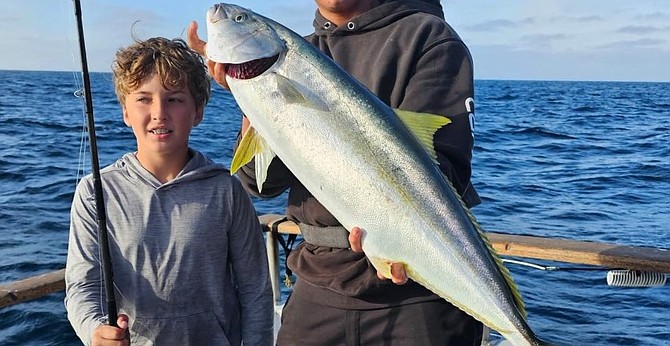
Young angler with a solid yellowtail caught while fishing aboard the Tribute this past week.
Dock Totals 7/6 – 7/12: 4524 anglers aboard 164 half-day to 3-day trips out of San Diego landings over the past week caught 8 barracuda, 1 black seabass (released), 1795 bluefin tuna (to 130 pounds), 2 bonito, 2 cabezon, 305 calico bass, 10 halibut, 2 lingcod, 1221 rockfish, 1 rock sole, 10145 sand bass, 510 sculpin, 35 sheephead, 1 thresher shark (released), 550 whitefish, 1 white seabass, 2 yellowfin tuna, and 608 yellowtail.
Saltwater: This past week featured some of the best sand bass fishing I have heard about in, well, forever. As the limit was reduced this year to four fish per angler per day, I kind of thought the population must be stressed, but looking at over 10,000 legal sized sand bass just for the ½ to 3-day boats from our four landings might indicate otherwise. Yup, that is not a typo: 10,145 sand bass were caught and kept in a week. It was limit-style fishing for every boat that targeted them, with many more released.
You need to be careful with that limit of four, as there is an aggregate limit of five bass total of all three basses we commonly catch: sand bass, calico bass, and spotted bay bass. The wide-open sand bass bite also accounts for the low rockfish numbers; most of the short run boats fished the flats rather than the deeper reefs, and thus rockfish numbers dropped to about 25% of the previous week. Tube baits, live bait, and fresh dead squid dropped to the bottom worked the best on the bass.
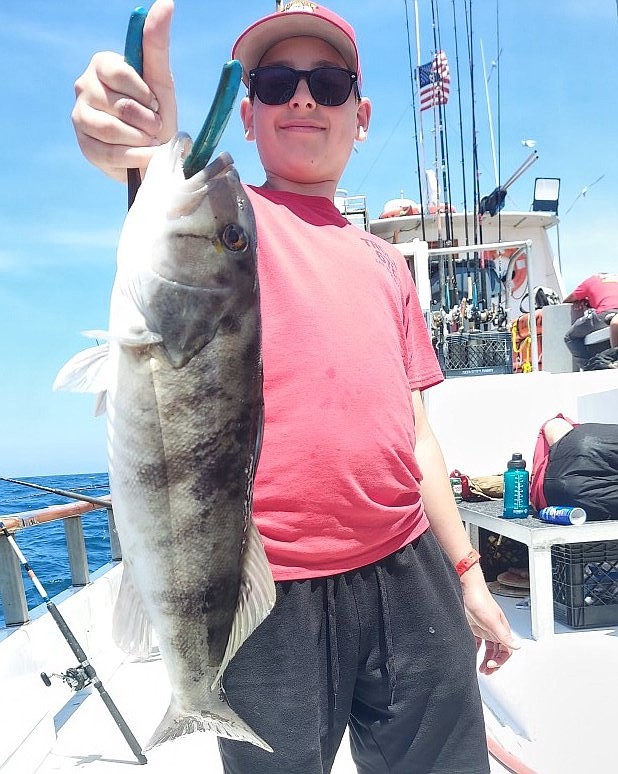
A solid sand bass for this angler caught during a wide open bite while fishing aboard the Daily Double.
Two more yellowfin were reported this week for the short run boats fishing south, but private boaters and longer run boats caught a few more, along with some smaller dorado south of Isla San Martin, about 160 miles south of the border. That is always a good sign: water is warming off the coast of Baja, and though we’ve yet to see any hurricane action pushing more warm water north, it can only get better from here as we progress through the season.
Surf fishing has been excellent for barred surf perch, with a few halibut and corbina in the mix. We’re seeing more corbina along the Southern California coast, while the batch spawning halibut are being caught from beaches further south along northern Baja’s cool water trends below Punta Banda and San Quintin. Surf perch are in the latter stage of their spawning cycle, and are being caught in their normal haunts on both sides of the border. With the perch, it is more of a timing thing, as lately, they tend to slow down in the midday hours and bite better in the morning and evening.
With the water warming up on the inside, stingrays are starting to slide into the surf zone, so be sure and employ the "stingray shuffle" when wading in the swash. It’s really simple: just slide your feet along the bottom rather than striding, and you will usually spook any rays away without stepping on them.
But simple or no, I still might forget if I see something popping up and run to cast at it. I often get so into fishing that I forget…until I feel the rubbery skin of a ray as I walk into it. Knock on wood, I have yet to be stung after over 50 years of fishing the surf. I really do not know how I have avoided that misery through all these years, especially when I fish several times a week in places where stingrays are thick. But luck or no luck, I still do the shuffle whenever I remember it, because I have been with friends who have not been so lucky. It is, according to their wails and grimaces, a very painful thing. If stung, the only relief is water so hot (about 110 degrees for 45 minutes) you can barely stand it. If you're on a beach with lifeguards, they usually have the means to help, but the best bet, always, is to utilize the shuffle.
Bluefin tuna continue to bite well for the fleet chasing them, at least most of the time. I have seen a few videos posted by sportboats that have rolled up on boiling tuna that just would not bite any offered bait or lures. Sometimes, they are feeding on small baits, and using heavier but smaller profile jigs might work. Other times, they may be deep down, feeding on squid, which often explains why they’re not biting well on jigs or baitfish. Squid are often a large part of the Pacific bluefin tuna diet, and, unlike other tunas, their highly developed endothermic system allows them to travel quickly through the large temperature drops. As a result, they dive deeper in the water column to depths we do not generally see other tunas occupying to feed.
Still, the numbers have been good, and though the average size is a bit smaller, there are still plenty of bluefin well over 100 pounds being caught. The trick seems to be having a wide range of gear and terminal tackle, so that you can adjust presentations to match what they are feeding on at any given time. Deep drop jigs are still working best when the fish are holding deeper and at night, while live bait is the better producer when the fish are up and feeding on the surface in daylight hours. Whether the beach, bay, lake, or offshore, they’re out there so go out and get ‘em!
Here's something you might be interested in.
Fish Report: Sand bass bite wide open
Also: It's time to do the stingray shuffle

Fish Report: Sand bass bite wide open
Also: It's time to do the stingray shuffle
Young angler with a solid yellowtail caught while fishing aboard the Tribute this past week.
Dock Totals 7/6 – 7/12: 4524 anglers aboard 164 half-day to 3-day trips out of San Diego landings over the past week caught 8 barracuda, 1 black seabass (released), 1795 bluefin tuna (to 130 pounds), 2 bonito, 2 cabezon, 305 calico bass, 10 halibut, 2 lingcod, 1221 rockfish, 1 rock sole, 10145 sand bass, 510 sculpin, 35 sheephead, 1 thresher shark (released), 550 whitefish, 1 white seabass, 2 yellowfin tuna, and 608 yellowtail.
Saltwater: This past week featured some of the best sand bass fishing I have heard about in, well, forever. As the limit was reduced this year to four fish per angler per day, I kind of thought the population must be stressed, but looking at over 10,000 legal sized sand bass just for the ½ to 3-day boats from our four landings might indicate otherwise. Yup, that is not a typo: 10,145 sand bass were caught and kept in a week. It was limit-style fishing for every boat that targeted them, with many more released.
You need to be careful with that limit of four, as there is an aggregate limit of five bass total of all three basses we commonly catch: sand bass, calico bass, and spotted bay bass. The wide-open sand bass bite also accounts for the low rockfish numbers; most of the short run boats fished the flats rather than the deeper reefs, and thus rockfish numbers dropped to about 25% of the previous week. Tube baits, live bait, and fresh dead squid dropped to the bottom worked the best on the bass.
A solid sand bass for this angler caught during a wide open bite while fishing aboard the Daily Double.
Two more yellowfin were reported this week for the short run boats fishing south, but private boaters and longer run boats caught a few more, along with some smaller dorado south of Isla San Martin, about 160 miles south of the border. That is always a good sign: water is warming off the coast of Baja, and though we’ve yet to see any hurricane action pushing more warm water north, it can only get better from here as we progress through the season.
Surf fishing has been excellent for barred surf perch, with a few halibut and corbina in the mix. We’re seeing more corbina along the Southern California coast, while the batch spawning halibut are being caught from beaches further south along northern Baja’s cool water trends below Punta Banda and San Quintin. Surf perch are in the latter stage of their spawning cycle, and are being caught in their normal haunts on both sides of the border. With the perch, it is more of a timing thing, as lately, they tend to slow down in the midday hours and bite better in the morning and evening.
With the water warming up on the inside, stingrays are starting to slide into the surf zone, so be sure and employ the "stingray shuffle" when wading in the swash. It’s really simple: just slide your feet along the bottom rather than striding, and you will usually spook any rays away without stepping on them.
But simple or no, I still might forget if I see something popping up and run to cast at it. I often get so into fishing that I forget…until I feel the rubbery skin of a ray as I walk into it. Knock on wood, I have yet to be stung after over 50 years of fishing the surf. I really do not know how I have avoided that misery through all these years, especially when I fish several times a week in places where stingrays are thick. But luck or no luck, I still do the shuffle whenever I remember it, because I have been with friends who have not been so lucky. It is, according to their wails and grimaces, a very painful thing. If stung, the only relief is water so hot (about 110 degrees for 45 minutes) you can barely stand it. If you're on a beach with lifeguards, they usually have the means to help, but the best bet, always, is to utilize the shuffle.
Bluefin tuna continue to bite well for the fleet chasing them, at least most of the time. I have seen a few videos posted by sportboats that have rolled up on boiling tuna that just would not bite any offered bait or lures. Sometimes, they are feeding on small baits, and using heavier but smaller profile jigs might work. Other times, they may be deep down, feeding on squid, which often explains why they’re not biting well on jigs or baitfish. Squid are often a large part of the Pacific bluefin tuna diet, and, unlike other tunas, their highly developed endothermic system allows them to travel quickly through the large temperature drops. As a result, they dive deeper in the water column to depths we do not generally see other tunas occupying to feed.
Still, the numbers have been good, and though the average size is a bit smaller, there are still plenty of bluefin well over 100 pounds being caught. The trick seems to be having a wide range of gear and terminal tackle, so that you can adjust presentations to match what they are feeding on at any given time. Deep drop jigs are still working best when the fish are holding deeper and at night, while live bait is the better producer when the fish are up and feeding on the surface in daylight hours. Whether the beach, bay, lake, or offshore, they’re out there so go out and get ‘em!
Comments