

Here's something you might be interested in.
Ask a Hipster — Advice you didn't know you needed
Big Screen — Movie commentary
Blurt — Music's inside track
Booze News — San Diego spirits
Classical Music — Immortal beauty
Classifieds — Free and easy
Close to Home — What it’s like on the street where you live
Cover Stories — Front-page features
Drinks All Around — Bartenders' drink recipes
Excerpts — Literary and spiritual excerpts
Feast! — Food & drink reviews
Feature Stories — Local news & stories
Fishing Report — What’s getting hooked from ship and shore
From the Archives — Spotlight on the past
Golden Dreams — Talk of the town
The Gonzo Report — Making the musical scene, or at least reporting from it
Letters — Our inbox
Movies@Home — Local movie buffs share favorites
Movie Reviews — Our critics' picks and pans
Musician Interviews — Up close with local artists
Neighborhood News from Stringers — Hyperlocal news
News Ticker — News & politics
Obermeyer — San Diego politics illustrated
Outdoors — Weekly changes in flora and fauna
Overheard in San Diego — Eavesdropping illustrated
Poetry — The old and the new
Reader Travel — Travel section built by travelers
Reading — The hunt for intellectuals
Roam-O-Rama — SoCal's best hiking/biking trails
San Diego Beer — Inside San Diego suds
SD on the QT — Almost factual news
Sheep and Goats — Places of worship
Special Issues — The best of
Street Style — San Diego streets have style
Surf Diego — Real stories from those braving the waves
Theater — On stage in San Diego this week
Tin Fork — Silver spoon alternative
Under the Radar — Matt Potter's undercover work
Unforgettable — Long-ago San Diego
Unreal Estate — San Diego's priciest pads
Your Week — Daily event picks
Fish Report: Bluefin explode over Fourth of July Weekend
Also: release female surf perch when they're spawning
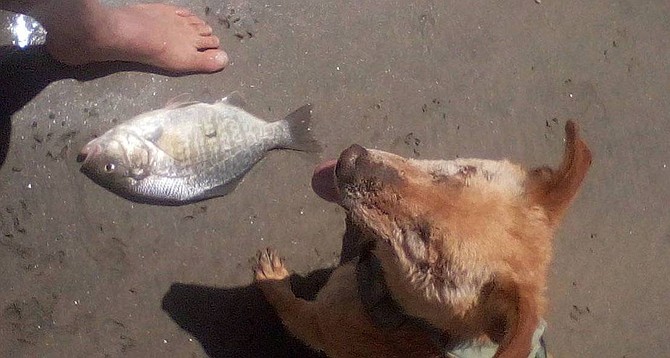
Even a dog with no eyes can see that the surf fishing is heating up. This barred surf perch with its solid anal fin is a female.
Dock Totals 6/29 – 7/5: 3988 anglers aboard 154 half-day to 3-day trips out of San Diego landings over the past week caught 21 barracuda, 2390 bluefin tuna (to 200 pounds), 98 bonito, 7 cabezon, 912 calico bass, 9 croaker, 10 halibut, 66 lingcod, 5803 rockfish, 1 rock sole, 846 sand bass, 335 sculpin, 74 sheephead, 1 triggerfish, 481 whitefish, 5 white seabass, 2 yellowfin tuna, and 144 yellowtail.
Saltwater: In a week that featured off and on windy conditions that "greened" up the water inside, the calico bass that were the hot ticket the previous week were biting slower, with the catch total dropping from over 4000 to under 1000 caught for the week. Sand bass numbers also fell off to a little more than half of the previous week’s count. Rockfish numbers went up about 30 percent for the boats fishing further offshore and down the coast in cleaner water.
Yellowtail are biting better at the Coronado Islands and the high spots down the coast, with limit-style fishing on surface irons just outside Ensenada and San Quintin, while bluefin numbers tripled as they moved closer to Point Loma and began biting better during daylight hours. As of this writing, sportfishing operators and private boaters are reporting schools of foaming bluefin tuna as close as twenty miles west of Point Loma and "for as far as the eye can see."
Most of those bluefin caught during daytime have been on fly-lined bait and weighed between 20 and 50 pounds, while the majority of larger tuna (from 50 to 200 pounds) have been caught during the night on tuna bombs and deep-drop jigs. With the fish so close, full-day boats have been able to get on top of them, as have the reverse 1.5-day runs that allow anglers to fish through the night and day close to home.
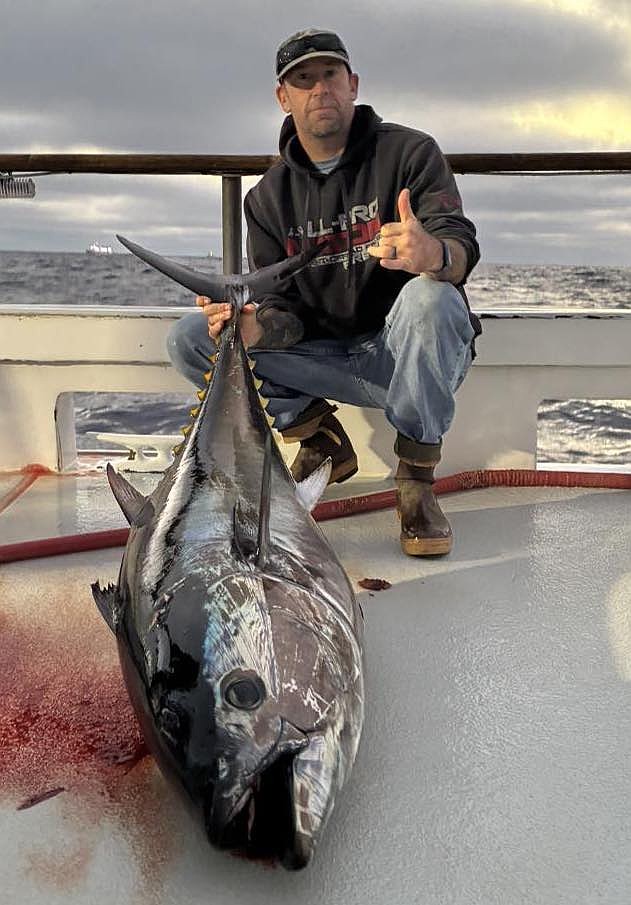
Solid daytime bluefin tuna caught aboard the Tribute 1.5-day run during the fourth of July holiday.
Though no dorado have been reported caught anywhere down the coast until you get close to the southern end of the Baja Peninsula, a couple of yellowfin tuna were reported caught aboard the Aztec 2.5-day run, along with 41 bluefin and 4 yellowtail for its 25 anglers. Dorado usually show about when yellowfin do — that is, as the water warms — but both species have been mostly absent over the past couple seasons off northern Baja. The 2022-2023 seasons had record dorado catches, including the over 30,000 caught just by the half- to 3-day San Diego fleet in August of 2022. Notably, much of that number was caught north of the border, where the limit is ten fish, as opposed to the two-dorado limit in Mexican waters.
Surf fishing has been heating up over the past few weeks along the Southern California and Northern Baja beaches. (Surf perch, like many species of fish, generally return to the area they were born when it comes time to spawn.) With perch in spawning mode, it is important to recommend releasing the pregnant females. Barred surf perch give birth to live fry, and when stressed or dying, they will often birth their young in the bucket. Here is an important thing to note: those baby perch in the bucket count toward your limit.
If a female perch is hooked deep and doesn’t look as though it will survive, an angler can often release the fry by opening the vent enough for the fry to come out. Try to do so deeper in the swash to give them their best chance of survival. A female spawns about two dozen baby perch on average, and not many will survive naturally, due to predation. But by releasing the baby perch, you will at least give them a chance. Pregnant female perch will have a distended belly. Females can also be identified by the anal fin that runs from behind the vent toward the tail. A male perch will have an indentation about halfway along the fin; female perch have a solid anal fin with no indentation.
In Southern California, the daily limit for barred surf perch is ten fish. This can be in addition to other species of perch, such as redtail surf perch, with a total bag limit of 20 fish. But taking pregnant females can reduce the number of fish in following years. I have seen this in Mexico where the numbers can fluctuate wildly from year to year. For the past two years, surf perch fishing has been excellent along the beaches in San Quintin. But about 8 years ago, it was exceptionally slow. I won a tournament in 2017 with a 1.17-pound barred surf perch. There were over 100 entrants in that tournament and only maybe 50 perch weighed. Last year and this year, I have caught perch larger than that almost every time I have been fishing, and 30 fish caught and released is not really an exceptional day. Seeing as how I fish at least five times per week while I take my blind dog to let her run free on the beach, that seems like clear evidence of a population rebound.
When there is a good run here in rural Mexico — where regulations are rarely enforced, and folks catch and sell hundreds of barred surf perch with shore-based gill nets — one or two great years can lead to several slower years as the overall population stock recovers. When it's slow like that, the gill netters seek other species. Dorado are a sustainable species, given their rapid growth, short lives, and early-in-life spawning. Thanks to the ban on commercial take and two-fish limit in Mexico, the species has remained healthy in population, but, I wonder if those two excellent years for dorado in US waters with those ten-fish limits is part of why they were pretty much a no-show for most of the Pacific side of Baja in 2024.
Whether the beach, bay, lake, or offshore, they’re out there so go out and get ‘em!
Here's something you might be interested in.
Fish Report: Bluefin explode over Fourth of July Weekend
Also: release female surf perch when they're spawning

Fish Report: Bluefin explode over Fourth of July Weekend
Also: release female surf perch when they're spawning
Even a dog with no eyes can see that the surf fishing is heating up. This barred surf perch with its solid anal fin is a female.
Dock Totals 6/29 – 7/5: 3988 anglers aboard 154 half-day to 3-day trips out of San Diego landings over the past week caught 21 barracuda, 2390 bluefin tuna (to 200 pounds), 98 bonito, 7 cabezon, 912 calico bass, 9 croaker, 10 halibut, 66 lingcod, 5803 rockfish, 1 rock sole, 846 sand bass, 335 sculpin, 74 sheephead, 1 triggerfish, 481 whitefish, 5 white seabass, 2 yellowfin tuna, and 144 yellowtail.
Saltwater: In a week that featured off and on windy conditions that "greened" up the water inside, the calico bass that were the hot ticket the previous week were biting slower, with the catch total dropping from over 4000 to under 1000 caught for the week. Sand bass numbers also fell off to a little more than half of the previous week’s count. Rockfish numbers went up about 30 percent for the boats fishing further offshore and down the coast in cleaner water.
Yellowtail are biting better at the Coronado Islands and the high spots down the coast, with limit-style fishing on surface irons just outside Ensenada and San Quintin, while bluefin numbers tripled as they moved closer to Point Loma and began biting better during daylight hours. As of this writing, sportfishing operators and private boaters are reporting schools of foaming bluefin tuna as close as twenty miles west of Point Loma and "for as far as the eye can see."
Most of those bluefin caught during daytime have been on fly-lined bait and weighed between 20 and 50 pounds, while the majority of larger tuna (from 50 to 200 pounds) have been caught during the night on tuna bombs and deep-drop jigs. With the fish so close, full-day boats have been able to get on top of them, as have the reverse 1.5-day runs that allow anglers to fish through the night and day close to home.
Solid daytime bluefin tuna caught aboard the Tribute 1.5-day run during the fourth of July holiday.
Though no dorado have been reported caught anywhere down the coast until you get close to the southern end of the Baja Peninsula, a couple of yellowfin tuna were reported caught aboard the Aztec 2.5-day run, along with 41 bluefin and 4 yellowtail for its 25 anglers. Dorado usually show about when yellowfin do — that is, as the water warms — but both species have been mostly absent over the past couple seasons off northern Baja. The 2022-2023 seasons had record dorado catches, including the over 30,000 caught just by the half- to 3-day San Diego fleet in August of 2022. Notably, much of that number was caught north of the border, where the limit is ten fish, as opposed to the two-dorado limit in Mexican waters.
Surf fishing has been heating up over the past few weeks along the Southern California and Northern Baja beaches. (Surf perch, like many species of fish, generally return to the area they were born when it comes time to spawn.) With perch in spawning mode, it is important to recommend releasing the pregnant females. Barred surf perch give birth to live fry, and when stressed or dying, they will often birth their young in the bucket. Here is an important thing to note: those baby perch in the bucket count toward your limit.
If a female perch is hooked deep and doesn’t look as though it will survive, an angler can often release the fry by opening the vent enough for the fry to come out. Try to do so deeper in the swash to give them their best chance of survival. A female spawns about two dozen baby perch on average, and not many will survive naturally, due to predation. But by releasing the baby perch, you will at least give them a chance. Pregnant female perch will have a distended belly. Females can also be identified by the anal fin that runs from behind the vent toward the tail. A male perch will have an indentation about halfway along the fin; female perch have a solid anal fin with no indentation.
In Southern California, the daily limit for barred surf perch is ten fish. This can be in addition to other species of perch, such as redtail surf perch, with a total bag limit of 20 fish. But taking pregnant females can reduce the number of fish in following years. I have seen this in Mexico where the numbers can fluctuate wildly from year to year. For the past two years, surf perch fishing has been excellent along the beaches in San Quintin. But about 8 years ago, it was exceptionally slow. I won a tournament in 2017 with a 1.17-pound barred surf perch. There were over 100 entrants in that tournament and only maybe 50 perch weighed. Last year and this year, I have caught perch larger than that almost every time I have been fishing, and 30 fish caught and released is not really an exceptional day. Seeing as how I fish at least five times per week while I take my blind dog to let her run free on the beach, that seems like clear evidence of a population rebound.
When there is a good run here in rural Mexico — where regulations are rarely enforced, and folks catch and sell hundreds of barred surf perch with shore-based gill nets — one or two great years can lead to several slower years as the overall population stock recovers. When it's slow like that, the gill netters seek other species. Dorado are a sustainable species, given their rapid growth, short lives, and early-in-life spawning. Thanks to the ban on commercial take and two-fish limit in Mexico, the species has remained healthy in population, but, I wonder if those two excellent years for dorado in US waters with those ten-fish limits is part of why they were pretty much a no-show for most of the Pacific side of Baja in 2024.
Whether the beach, bay, lake, or offshore, they’re out there so go out and get ‘em!
Comments