

Here's something you might be interested in.
Ask a Hipster — Advice you didn't know you needed
Big Screen — Movie commentary
Blurt — Music's inside track
Booze News — San Diego spirits
Classical Music — Immortal beauty
Classifieds — Free and easy
Close to Home — What it’s like on the street where you live
Cover Stories — Front-page features
Drinks All Around — Bartenders' drink recipes
Excerpts — Literary and spiritual excerpts
Feast! — Food & drink reviews
Feature Stories — Local news & stories
Fishing Report — What’s getting hooked from ship and shore
From the Archives — Spotlight on the past
Golden Dreams — Talk of the town
The Gonzo Report — Making the musical scene, or at least reporting from it
Letters — Our inbox
Movies@Home — Local movie buffs share favorites
Movie Reviews — Our critics' picks and pans
Musician Interviews — Up close with local artists
Neighborhood News from Stringers — Hyperlocal news
News Ticker — News & politics
Obermeyer — San Diego politics illustrated
Outdoors — Weekly changes in flora and fauna
Overheard in San Diego — Eavesdropping illustrated
Poetry — The old and the new
Reader Travel — Travel section built by travelers
Reading — The hunt for intellectuals
Roam-O-Rama — SoCal's best hiking/biking trails
San Diego Beer — Inside San Diego suds
SD on the QT — Almost factual news
Sheep and Goats — Places of worship
Special Issues — The best of
Street Style — San Diego streets have style
Surf Diego — Real stories from those braving the waves
Theater — On stage in San Diego this week
Tin Fork — Silver spoon alternative
Under the Radar — Matt Potter's undercover work
Unforgettable — Long-ago San Diego
Unreal Estate — San Diego's priciest pads
Your Week — Daily event picks
Paradise Valley Road orphans fighting AT&T
No mayor, no city council, no county supervisor
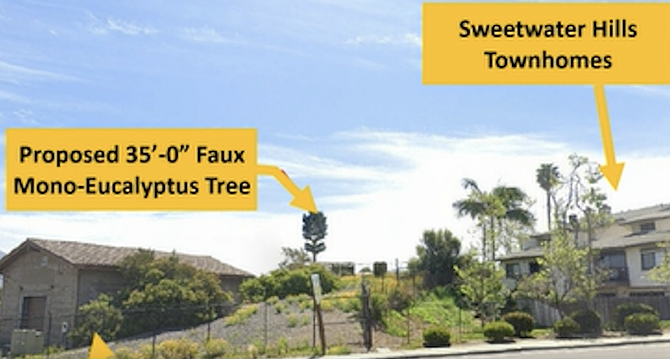
Everyone wants what the service cell towers provide – as long as the tower isn’t next door.
In coastal towns like La Jolla and Encinitas, home dwellers have been scoring victories over projects proposed near homes, but things went down differently on Paradise Valley Road in unincorporated Spring Valley, an area that doesn’t even have a supervisor to represent them.
The county last week was poised to deny a crowd-funded appeal of a 35-foot tower on a site owned by the County Water Authority next to dozens of townhomes and a daycare. The appeal raises so many issues of fairness, the board of supervisors has continued it to Sept. 11 to give time for further review.
County zoning rules are part of the problem. Oddly enough, the county’s adopted setback from schools and daycares for small cell sites is 300 feet but for large projects like the tower it’s only 50 feet.
Maggie Winterton, who lives ib Sweetwater Townhomes on the corner of Elkelton and Paradise Valley Rd,, appealed AT&T’s revised project that was approved by the county planning commission in February, citing, for one, the county’s inconsistent setback policies. The company had sought an alternate site for the tower but after a landowner backed out, instead proposed moving it back 11 feet. Winterton pleaded with supervisors last week, saying it was still much too close.
“Lost in those comments was that it's 60 feet from those condos. Sixty feet. Well, 62.”
It would also be less than 300 feet from a daycare center, which the county’s small cell wireless ordinance doesn’t allow – but since it’s a large tower, the setback is only 50 feet.
The rollout of 5G and higher has made it harder than ever for communities to refuse projects because the telecom industry has pushed into law a federal rule that prevents local review of small cell sites, making the permit process a simple ministerial decision.
But cities can still employ zoning regulations, design standards and other measures to influence their location and design, as long as the rules do not “effectively prohibit or discriminate against wireless services.”
San Diego County’s small cell ordinance was updated in 2019 in response to the federal law that opened the door for small wireless sites to pop up in every corner. Left out of the update were large towers, which planning staff explained are mostly located in rural areas to provide broader coverage.
The Paradise Valley site, zoned Office-Professional, straddles the line between country and city.
Board chair Terra Lawson-Remer pointed out that larger towers typically face more stringent review. “The reason large towers have smaller setbacks is because the idea is that, hey it goes to the planning commission, it goes to neighborhood review, it goes to us, so all along the way there’s checks.”
So, in places where a 50-foot setback for a tower might be a bad idea, it won’t be quietly waved through because it’s not a ministerial process.
“The safeguard is going to the planning commission and going to the board, and obviously we have a problem because a representative for this community is not here.”
The project had one local review in 2023 by the Spring Valley Community Planning Group before it went to the commission (which initially turned it down, prompting an appeal and revisions from AT&T). A vote to oppose the tower failed to pass, with six for and six against.
Lawson-Remer said the single vote in a community without a representative was insufficient. “We do need to figure out better zoning requirements about setbacks so this doesn’t happen again.”
Another sticky issue was the lack of environmental review, which Winterton said was needed due to the nearby daycare center, fire risk from a diesel generator on the site, and potential contamination of the Sweetwater aqueduct and reservoir.
County staff argued the project was evaluated by the San Miguel Fire Protection District; that county staff found no risk to Sweetwater Aqueduct or reservoir; and there were no significant environmental impacts or circumstances regarding the nearness to the daycare center.
Had it been a small cell facility, the daycare center would have required a 300-foot setback due to issues like “visual clutter.” Officials pointed out that federal law doesn’t allow them to consider health concerns in the placement of wireless facilities.
However, in La Jolla and other coastal cities, health concerns have been a top reason for opposing projects. AT&T recently withdrew a 30-foot tower proposed for a La Jolla bike path that was 100 to 750 feet from homes, a senior center, a preschool and a park after massive pushback from residents.
In an email, Winterton calls it “a stark contrast” with the project in her unincorporated neighborhood, which already struggles with the dust and noise of a rock quarry taller than the townhomes.
“A major point for us in our appeal is the unfairness as we don’t have a supervisor, a mayor, a city council…and we’ve been opposing this vocally for two years.”
Here's something you might be interested in.
Paradise Valley Road orphans fighting AT&T
No mayor, no city council, no county supervisor

Paradise Valley Road orphans fighting AT&T
No mayor, no city council, no county supervisor
Everyone wants what the service cell towers provide – as long as the tower isn’t next door.
In coastal towns like La Jolla and Encinitas, home dwellers have been scoring victories over projects proposed near homes, but things went down differently on Paradise Valley Road in unincorporated Spring Valley, an area that doesn’t even have a supervisor to represent them.
The county last week was poised to deny a crowd-funded appeal of a 35-foot tower on a site owned by the County Water Authority next to dozens of townhomes and a daycare. The appeal raises so many issues of fairness, the board of supervisors has continued it to Sept. 11 to give time for further review.
County zoning rules are part of the problem. Oddly enough, the county’s adopted setback from schools and daycares for small cell sites is 300 feet but for large projects like the tower it’s only 50 feet.
Maggie Winterton, who lives ib Sweetwater Townhomes on the corner of Elkelton and Paradise Valley Rd,, appealed AT&T’s revised project that was approved by the county planning commission in February, citing, for one, the county’s inconsistent setback policies. The company had sought an alternate site for the tower but after a landowner backed out, instead proposed moving it back 11 feet. Winterton pleaded with supervisors last week, saying it was still much too close.
“Lost in those comments was that it's 60 feet from those condos. Sixty feet. Well, 62.”
It would also be less than 300 feet from a daycare center, which the county’s small cell wireless ordinance doesn’t allow – but since it’s a large tower, the setback is only 50 feet.
The rollout of 5G and higher has made it harder than ever for communities to refuse projects because the telecom industry has pushed into law a federal rule that prevents local review of small cell sites, making the permit process a simple ministerial decision.
But cities can still employ zoning regulations, design standards and other measures to influence their location and design, as long as the rules do not “effectively prohibit or discriminate against wireless services.”
San Diego County’s small cell ordinance was updated in 2019 in response to the federal law that opened the door for small wireless sites to pop up in every corner. Left out of the update were large towers, which planning staff explained are mostly located in rural areas to provide broader coverage.
The Paradise Valley site, zoned Office-Professional, straddles the line between country and city.
Board chair Terra Lawson-Remer pointed out that larger towers typically face more stringent review. “The reason large towers have smaller setbacks is because the idea is that, hey it goes to the planning commission, it goes to neighborhood review, it goes to us, so all along the way there’s checks.”
So, in places where a 50-foot setback for a tower might be a bad idea, it won’t be quietly waved through because it’s not a ministerial process.
“The safeguard is going to the planning commission and going to the board, and obviously we have a problem because a representative for this community is not here.”
The project had one local review in 2023 by the Spring Valley Community Planning Group before it went to the commission (which initially turned it down, prompting an appeal and revisions from AT&T). A vote to oppose the tower failed to pass, with six for and six against.
Lawson-Remer said the single vote in a community without a representative was insufficient. “We do need to figure out better zoning requirements about setbacks so this doesn’t happen again.”
Another sticky issue was the lack of environmental review, which Winterton said was needed due to the nearby daycare center, fire risk from a diesel generator on the site, and potential contamination of the Sweetwater aqueduct and reservoir.
County staff argued the project was evaluated by the San Miguel Fire Protection District; that county staff found no risk to Sweetwater Aqueduct or reservoir; and there were no significant environmental impacts or circumstances regarding the nearness to the daycare center.
Had it been a small cell facility, the daycare center would have required a 300-foot setback due to issues like “visual clutter.” Officials pointed out that federal law doesn’t allow them to consider health concerns in the placement of wireless facilities.
However, in La Jolla and other coastal cities, health concerns have been a top reason for opposing projects. AT&T recently withdrew a 30-foot tower proposed for a La Jolla bike path that was 100 to 750 feet from homes, a senior center, a preschool and a park after massive pushback from residents.
In an email, Winterton calls it “a stark contrast” with the project in her unincorporated neighborhood, which already struggles with the dust and noise of a rock quarry taller than the townhomes.
“A major point for us in our appeal is the unfairness as we don’t have a supervisor, a mayor, a city council…and we’ve been opposing this vocally for two years.”
Comments