

Here's something you might be interested in.
Ask a Hipster — Advice you didn't know you needed
Big Screen — Movie commentary
Blurt — Music's inside track
Booze News — San Diego spirits
Classical Music — Immortal beauty
Classifieds — Free and easy
Close to Home — What it’s like on the street where you live
Cover Stories — Front-page features
Drinks All Around — Bartenders' drink recipes
Excerpts — Literary and spiritual excerpts
Feast! — Food & drink reviews
Feature Stories — Local news & stories
Fishing Report — What’s getting hooked from ship and shore
From the Archives — Spotlight on the past
Golden Dreams — Talk of the town
The Gonzo Report — Making the musical scene, or at least reporting from it
Letters — Our inbox
Movies@Home — Local movie buffs share favorites
Movie Reviews — Our critics' picks and pans
Musician Interviews — Up close with local artists
Neighborhood News from Stringers — Hyperlocal news
News Ticker — News & politics
Obermeyer — San Diego politics illustrated
Outdoors — Weekly changes in flora and fauna
Overheard in San Diego — Eavesdropping illustrated
Poetry — The old and the new
Reader Travel — Travel section built by travelers
Reading — The hunt for intellectuals
Roam-O-Rama — SoCal's best hiking/biking trails
San Diego Beer — Inside San Diego suds
SD on the QT — Almost factual news
Sheep and Goats — Places of worship
Special Issues — The best of
Street Style — San Diego streets have style
Surf Diego — Real stories from those braving the waves
Theater — On stage in San Diego this week
Tin Fork — Silver spoon alternative
Under the Radar — Matt Potter's undercover work
Unforgettable — Long-ago San Diego
Unreal Estate — San Diego's priciest pads
Your Week — Daily event picks
Migrating gray whales visible from ocean outlooks, 14-hour nights trigger poinsettias
Winter solstice occurs December 21, ideal conditions for Ursid meteor shower
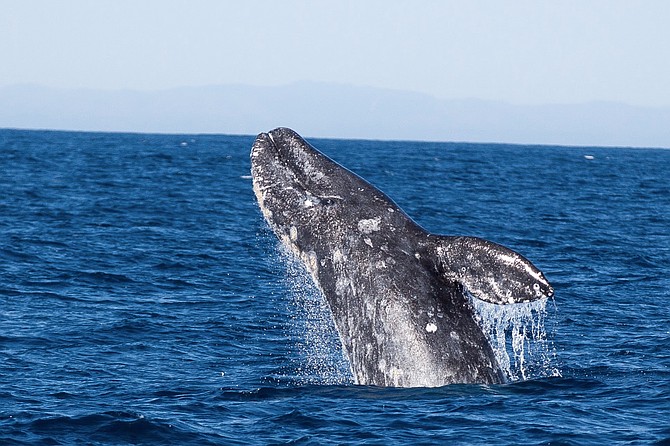
A gray whale breaches off the coast of Point Loma.
Gray Whale Migration Off San Diego County’s Coast peaks from now until February. The best view spots from land are high points close to the surf. Aside from the whale watching overlook at Cabrillo National Monument, try Sunset Cliffs, the pocket parks and dead-end streets from Pacific Beach to Scripps Park in La Jolla, various ocean overlooks on the trail system at Torrey Pines State Reserve, the cliffs opposite Carmel Valley Road south of Del Mar, overlooks opposite Lomas Santa Fe Drive in Solana Beach, and various cliff-top view points and beach access stairways in Encinitas and Leucadia. Scan the ocean a few hundred yards to a couple of miles out using high-power binoculars. Best times for viewing are about 9 am to noon.

Poinsettias prefer bright, indirect sunlight – direct sunlight can scorch their delicate leaves.
Poinsettias, A Favorite Of Backyard Gardeners, are now exhibiting their scarlet, petal-like bracts, just in time for the holidays. The onset of 14-hour-long nights triggers their behavior: In San Diego, this condition is met just before the date of winter solstice.
Winter Solstice, The Moment When The Sun Reaches Its Southernmost Point on the celestial sphere, occurs this year at 7:03 am, Sunday, December 21. This event signals the beginning of winter in the Northern Hemisphere and the beginning of summer in the Southern Hemisphere. With only about ten hours of daylight, San Diego must endure its darkest and gloomiest nights this week and next. During the day, the sun takes its lowest arc in the sky, struggling to an altitude of only 34 degrees (as seen from San Diego), then quickly sinks toward the horizon. Conversely, it’s the longest night, and the Moon takes its highest path along the sky and is above the horizon longer than any moon.
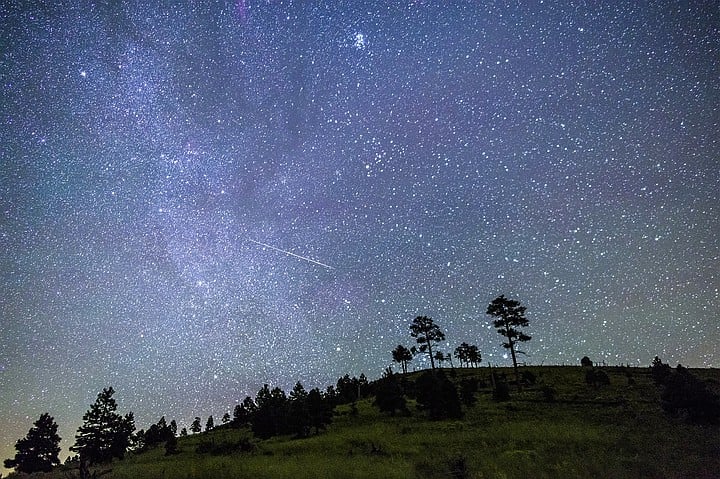
The Ursid Meteor Shower Will Peak overnight on December 21–22. The Ursids peak every year near the winter solstice. This shower typically only produces 5-10 meteors per hour, but the good news is that this year, the Ursids will happen during a waxing crescent moon, only 2% visible, so dark skies will make for optimal viewing conditions. Meteors radiate from the Ursa Minor constellation but can appear anywhere in the sky. If the sky fully cooperates and is both dark and clear, it will also be cold, so bundle up, grab a blanket and some hot cocoa, and enjoy the show.
Here's something you might be interested in.
Migrating gray whales visible from ocean outlooks, 14-hour nights trigger poinsettias
Winter solstice occurs December 21, ideal conditions for Ursid meteor shower

Migrating gray whales visible from ocean outlooks, 14-hour nights trigger poinsettias
Winter solstice occurs December 21, ideal conditions for Ursid meteor shower
A gray whale breaches off the coast of Point Loma.
Gray Whale Migration Off San Diego County’s Coast peaks from now until February. The best view spots from land are high points close to the surf. Aside from the whale watching overlook at Cabrillo National Monument, try Sunset Cliffs, the pocket parks and dead-end streets from Pacific Beach to Scripps Park in La Jolla, various ocean overlooks on the trail system at Torrey Pines State Reserve, the cliffs opposite Carmel Valley Road south of Del Mar, overlooks opposite Lomas Santa Fe Drive in Solana Beach, and various cliff-top view points and beach access stairways in Encinitas and Leucadia. Scan the ocean a few hundred yards to a couple of miles out using high-power binoculars. Best times for viewing are about 9 am to noon.
Poinsettias prefer bright, indirect sunlight – direct sunlight can scorch their delicate leaves.
Poinsettias, A Favorite Of Backyard Gardeners, are now exhibiting their scarlet, petal-like bracts, just in time for the holidays. The onset of 14-hour-long nights triggers their behavior: In San Diego, this condition is met just before the date of winter solstice.
Winter Solstice, The Moment When The Sun Reaches Its Southernmost Point on the celestial sphere, occurs this year at 7:03 am, Sunday, December 21. This event signals the beginning of winter in the Northern Hemisphere and the beginning of summer in the Southern Hemisphere. With only about ten hours of daylight, San Diego must endure its darkest and gloomiest nights this week and next. During the day, the sun takes its lowest arc in the sky, struggling to an altitude of only 34 degrees (as seen from San Diego), then quickly sinks toward the horizon. Conversely, it’s the longest night, and the Moon takes its highest path along the sky and is above the horizon longer than any moon.
The Ursid Meteor Shower Will Peak overnight on December 21–22. The Ursids peak every year near the winter solstice. This shower typically only produces 5-10 meteors per hour, but the good news is that this year, the Ursids will happen during a waxing crescent moon, only 2% visible, so dark skies will make for optimal viewing conditions. Meteors radiate from the Ursa Minor constellation but can appear anywhere in the sky. If the sky fully cooperates and is both dark and clear, it will also be cold, so bundle up, grab a blanket and some hot cocoa, and enjoy the show.
Comments