

Here's something you might be interested in.
Ask a Hipster — Advice you didn't know you needed
Big Screen — Movie commentary
Blurt — Music's inside track
Booze News — San Diego spirits
Classical Music — Immortal beauty
Classifieds — Free and easy
Close to Home — What it’s like on the street where you live
Cover Stories — Front-page features
Drinks All Around — Bartenders' drink recipes
Excerpts — Literary and spiritual excerpts
Feast! — Food & drink reviews
Feature Stories — Local news & stories
Fishing Report — What’s getting hooked from ship and shore
From the Archives — Spotlight on the past
Golden Dreams — Talk of the town
The Gonzo Report — Making the musical scene, or at least reporting from it
Letters — Our inbox
Movies@Home — Local movie buffs share favorites
Movie Reviews — Our critics' picks and pans
Musician Interviews — Up close with local artists
Neighborhood News from Stringers — Hyperlocal news
News Ticker — News & politics
Obermeyer — San Diego politics illustrated
Outdoors — Weekly changes in flora and fauna
Overheard in San Diego — Eavesdropping illustrated
Poetry — The old and the new
Reader Travel — Travel section built by travelers
Reading — The hunt for intellectuals
Roam-O-Rama — SoCal's best hiking/biking trails
San Diego Beer — Inside San Diego suds
SD on the QT — Almost factual news
Sheep and Goats — Places of worship
Special Issues — The best of
Street Style — San Diego streets have style
Surf Diego — Real stories from those braving the waves
Theater — On stage in San Diego this week
Tin Fork — Silver spoon alternative
Under the Radar — Matt Potter's undercover work
Unforgettable — Long-ago San Diego
Unreal Estate — San Diego's priciest pads
Your Week — Daily event picks
Fish Report: Monchong, anyone?
Milk, it does a shark good
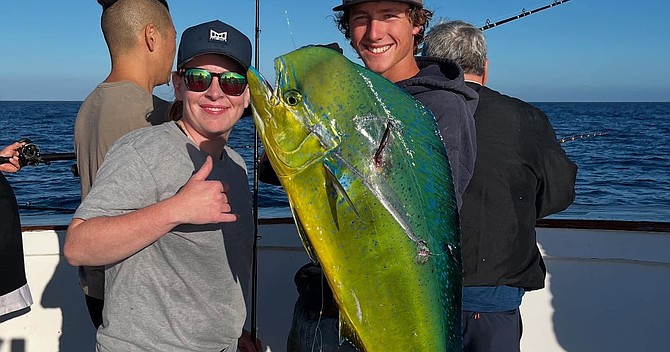
This brilliantly colored dorado caught within one-day range aboard the Old Glory was the only one reported by the ½ to 3-day fleet this past week.
Dock Totals 8/17 – 8/23: 4457 anglers aboard 192 half-day to 3-day trips out of San Diego landings over the past week caught 226 barracuda, 3026 bluefin tuna (to 200 pounds), 208 bonito, 3 cabezon, 913 calico bass, 1 dorado, 4 halibut, 25 lingcod, 2 mako shark, 1 monchong, 3222 rockfish, 2 rock sole, 342 sand bass, 27 sanddab, 438 sculpin, 219 sheephead, 1 thresher shark, 2 triggerfish, 1308 whitefish, and 894 yellowtail.
Saltwater: Every now and then a species pops up in the fish counts that we do not see very often. Occasional opah or triggerfish are the usual culprits, and once in a whle, we still see an albacore. But even more scarce is the monchong, or sickle pomfret, that was caught aboard the Legend 3-day trip that returned to the dock on August 20.
Monchong are more often caught off Hawaii as a food fish; they are not generally targeted by commercial or recreational operations, but are more caught as by-catch by long liners fishing in deeper water. They inhabit warmer regions to a couple thousand feet deep, and thus are not all that well studied. Though they can be found in water as shallow as 150 feet, they are most abundant at 900 feet or deeper. Monchong are very oily fish, loaded with Omega 3s, are considered very healthy. As author Rebecca Gardon noted in her piece for Catalina Offshore Products: "Delicate yet decadent, monchong has a highly transparent, clear, white flesh with pinkish tones that cooks up snow white and flaky. It is firm in texture with a moderately sweet, rich flavor similar to black cod.”
We don’t usually get any black cod either, but both species can be found occasionally at fish markets like fishmonger Tommy Gomes’ Tunaville Market and Grocery, the Tuna Harbor Dockside Market, and, of course, Catalina Offshore Products. We San Diegans are very fortunate to have such a wide availability of fresh seafood brought in every week by the commercial fleets that often fish areas where sportboats cannot go.
With safety always at the forefront for the sportfishing fleet, boats tend to remain within a couple hundred miles off California and Baja. Though long-range trips may travel up to a thousand miles from port, they will tend to fish areas where, if an emergency arises, help can get to them in fairly short order. Much of the commercial fleet will fish over 500 miles west of the coast, where they can load up on species we do not normally see closer in, like the albacore that still pass Southern California during their annual migrations — albeit too far for the recreational boats to target. Our fish markets and commercial operations allow that, on just about any given day, we can find fresh caught seafood readily available.
There was one dorado in the counts this past week for the short-run fleet that was caught outside the Coronado Islands, but we still haven’t seen much of the warmer species within 3-day range. It is still mostly bluefin tuna and yellowtail, though the latter was down in number from the week previous. The bluefin have also been off and on again, but their numbers were up about 35% from the week previous. The best bet to land either species is on any 1.5- to 3-day run either west to the San Clemente Island area, or south to the Coronado Islands and high spots to the southwest. Any Coronado Island or Baja coastal trip will require a passport, the offshore trips not so much, unless they plan to fish in Mexican water at any point.
A few sharks made it into the counts, two makos and a thresher. Both are excellent for table fare if kept iced and skinned. As sharks basically pee through their skin, they can have an ammonia smell, so preparation is key. I will usually steak them, remove the skin, then put the filets in crushed ice for a few hours before sealing and freezing. Make sure the filets are patted dry before vac-sealing and they will stay viable in the freezer for months. Another trick to offset any ammonia odor is to soak the thawed or fresh filets or steaks in milk for an hour before cooking. Soaking shark in milk reduces the strong ammonia smell because the casein protein in milk binds to and neutralizes the urea compounds in the shark's flesh, which would otherwise break down into ammonia.
One problem we had during in keeping sharks during my days as a deckhand was the number of anglers on the deck. Threshers can be dangerous at either end: their whipping tails can cause damage as well as their teeth, and both species can come in hot and frantic. Oftentimes, a shark may just be released at the boat, especially when on crowded half-day trips. But, if you catch one and want to keep it, the crews are adept at handling and subduing any threat that a shark might pose. Longer run trips are usually less crowded, and dealing with a toothy thrashing fish is a bit easier with some elbow room.
While bluefin and yellowtail are the main targets for the short run fleet, long range boats have been whacking yellowfin and wahoo down south off the Ridge and out at Alijos Rocks. Boats working the coast off southern Baja have been reporting excellent yellowtail along with pargo and grouper in the rocks. It’s the prime time of year for our fisheries, so whether the beach, bay, lake, or offshore, they’re out there so go out and get ‘em!
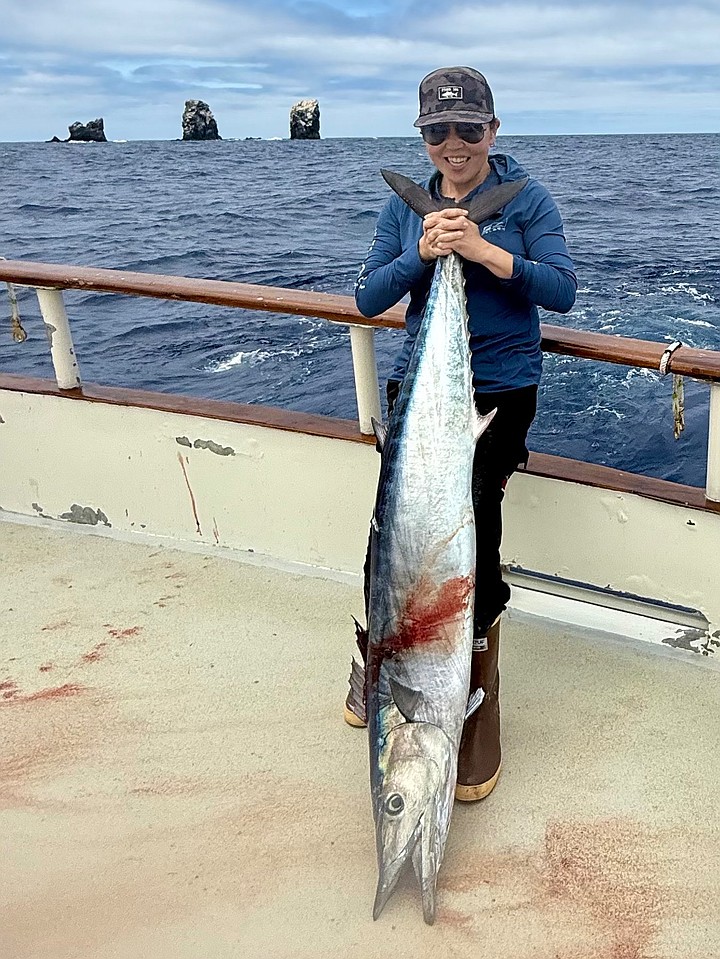
A large wahoo taken aboard the American Angler at Alijos Rocks, 542-miles south of Point Loma.
Here's something you might be interested in.
Fish Report: Monchong, anyone?
Milk, it does a shark good

Fish Report: Monchong, anyone?
Milk, it does a shark good
This brilliantly colored dorado caught within one-day range aboard the Old Glory was the only one reported by the ½ to 3-day fleet this past week.
Dock Totals 8/17 – 8/23: 4457 anglers aboard 192 half-day to 3-day trips out of San Diego landings over the past week caught 226 barracuda, 3026 bluefin tuna (to 200 pounds), 208 bonito, 3 cabezon, 913 calico bass, 1 dorado, 4 halibut, 25 lingcod, 2 mako shark, 1 monchong, 3222 rockfish, 2 rock sole, 342 sand bass, 27 sanddab, 438 sculpin, 219 sheephead, 1 thresher shark, 2 triggerfish, 1308 whitefish, and 894 yellowtail.
Saltwater: Every now and then a species pops up in the fish counts that we do not see very often. Occasional opah or triggerfish are the usual culprits, and once in a whle, we still see an albacore. But even more scarce is the monchong, or sickle pomfret, that was caught aboard the Legend 3-day trip that returned to the dock on August 20.
Monchong are more often caught off Hawaii as a food fish; they are not generally targeted by commercial or recreational operations, but are more caught as by-catch by long liners fishing in deeper water. They inhabit warmer regions to a couple thousand feet deep, and thus are not all that well studied. Though they can be found in water as shallow as 150 feet, they are most abundant at 900 feet or deeper. Monchong are very oily fish, loaded with Omega 3s, are considered very healthy. As author Rebecca Gardon noted in her piece for Catalina Offshore Products: "Delicate yet decadent, monchong has a highly transparent, clear, white flesh with pinkish tones that cooks up snow white and flaky. It is firm in texture with a moderately sweet, rich flavor similar to black cod.”
We don’t usually get any black cod either, but both species can be found occasionally at fish markets like fishmonger Tommy Gomes’ Tunaville Market and Grocery, the Tuna Harbor Dockside Market, and, of course, Catalina Offshore Products. We San Diegans are very fortunate to have such a wide availability of fresh seafood brought in every week by the commercial fleets that often fish areas where sportboats cannot go.
With safety always at the forefront for the sportfishing fleet, boats tend to remain within a couple hundred miles off California and Baja. Though long-range trips may travel up to a thousand miles from port, they will tend to fish areas where, if an emergency arises, help can get to them in fairly short order. Much of the commercial fleet will fish over 500 miles west of the coast, where they can load up on species we do not normally see closer in, like the albacore that still pass Southern California during their annual migrations — albeit too far for the recreational boats to target. Our fish markets and commercial operations allow that, on just about any given day, we can find fresh caught seafood readily available.
There was one dorado in the counts this past week for the short-run fleet that was caught outside the Coronado Islands, but we still haven’t seen much of the warmer species within 3-day range. It is still mostly bluefin tuna and yellowtail, though the latter was down in number from the week previous. The bluefin have also been off and on again, but their numbers were up about 35% from the week previous. The best bet to land either species is on any 1.5- to 3-day run either west to the San Clemente Island area, or south to the Coronado Islands and high spots to the southwest. Any Coronado Island or Baja coastal trip will require a passport, the offshore trips not so much, unless they plan to fish in Mexican water at any point.
A few sharks made it into the counts, two makos and a thresher. Both are excellent for table fare if kept iced and skinned. As sharks basically pee through their skin, they can have an ammonia smell, so preparation is key. I will usually steak them, remove the skin, then put the filets in crushed ice for a few hours before sealing and freezing. Make sure the filets are patted dry before vac-sealing and they will stay viable in the freezer for months. Another trick to offset any ammonia odor is to soak the thawed or fresh filets or steaks in milk for an hour before cooking. Soaking shark in milk reduces the strong ammonia smell because the casein protein in milk binds to and neutralizes the urea compounds in the shark's flesh, which would otherwise break down into ammonia.
One problem we had during in keeping sharks during my days as a deckhand was the number of anglers on the deck. Threshers can be dangerous at either end: their whipping tails can cause damage as well as their teeth, and both species can come in hot and frantic. Oftentimes, a shark may just be released at the boat, especially when on crowded half-day trips. But, if you catch one and want to keep it, the crews are adept at handling and subduing any threat that a shark might pose. Longer run trips are usually less crowded, and dealing with a toothy thrashing fish is a bit easier with some elbow room.
While bluefin and yellowtail are the main targets for the short run fleet, long range boats have been whacking yellowfin and wahoo down south off the Ridge and out at Alijos Rocks. Boats working the coast off southern Baja have been reporting excellent yellowtail along with pargo and grouper in the rocks. It’s the prime time of year for our fisheries, so whether the beach, bay, lake, or offshore, they’re out there so go out and get ‘em!
A large wahoo taken aboard the American Angler at Alijos Rocks, 542-miles south of Point Loma.