

Here's something you might be interested in.
Ask a Hipster — Advice you didn't know you needed
Big Screen — Movie commentary
Blurt — Music's inside track
Booze News — San Diego spirits
Classical Music — Immortal beauty
Classifieds — Free and easy
Close to Home — What it’s like on the street where you live
Cover Stories — Front-page features
Drinks All Around — Bartenders' drink recipes
Excerpts — Literary and spiritual excerpts
Feast! — Food & drink reviews
Feature Stories — Local news & stories
Fishing Report — What’s getting hooked from ship and shore
From the Archives — Spotlight on the past
Golden Dreams — Talk of the town
The Gonzo Report — Making the musical scene, or at least reporting from it
Letters — Our inbox
Movies@Home — Local movie buffs share favorites
Movie Reviews — Our critics' picks and pans
Musician Interviews — Up close with local artists
Neighborhood News from Stringers — Hyperlocal news
News Ticker — News & politics
Obermeyer — San Diego politics illustrated
Outdoors — Weekly changes in flora and fauna
Overheard in San Diego — Eavesdropping illustrated
Poetry — The old and the new
Reader Travel — Travel section built by travelers
Reading — The hunt for intellectuals
Roam-O-Rama — SoCal's best hiking/biking trails
San Diego Beer — Inside San Diego suds
SD on the QT — Almost factual news
Sheep and Goats — Places of worship
Special Issues — The best of
Street Style — San Diego streets have style
Surf Diego — Real stories from those braving the waves
Theater — On stage in San Diego this week
Tin Fork — Silver spoon alternative
Under the Radar — Matt Potter's undercover work
Unforgettable — Long-ago San Diego
Unreal Estate — San Diego's priciest pads
Your Week — Daily event picks
Anomalies & Curiosities of Cinema: CARTOON ALL-STARS TO THE RESCUE (1990)
Of all the characters represented, Bugs is far and away the most likely to know how to pack a blunt.
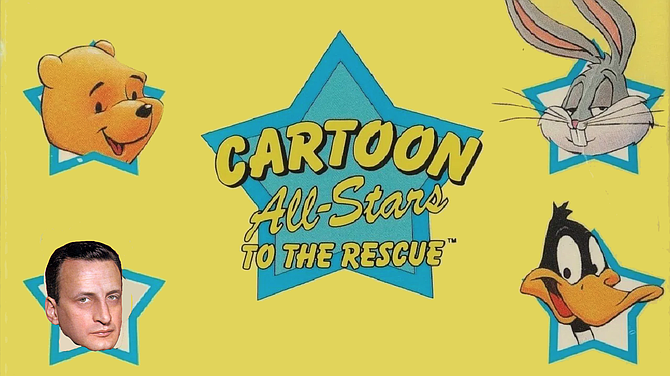
Turn 'em on!
CARTOON ALL-STARS TO THE RESCUE (1990) Directors: Milton Gray, Marsh Lamore, Bob Shellhorn, & Mike Svayko / Writers: Duane Poole & Tom Swale / Art Directors: Takashi Masunaga & Don Morgan / Editor: Jay Bixsen / With: Bugs Bunny, Daffy Duck, Winnie the Pooh, The Smurfs, Michelangelo (Turtle, not sculptor), Alvin and the Chipmunks, Barbara Bush, Slimer, Muppet Babies, George H. W. Bush, Garfield, ALF, and, George C. Scott / Video Distributors: Buena Vista and McDonald’s / Produced by: The Academy of Television Arts & Sciences Foundation & Southern Star Productions / USA / Length: 32 mins.
Cartoon All-Stars to the Rescue marked the first time a narrative program of any kind was simulcast on ABC, CBS, NBC and Fox. Shown once — on April 21, 1990 — the so-called social-guidance film-cum-animated public service announcement was sponsored by Ronald McDonald Children's Charities, produced by Roy Disney, and later released on VHS by Buena Vista Home Video. Disney and McDonald’s: Lifting kids to a better tomorrow, one historical stereotype and greasy hamburger at a time.
The half-hour crossover classic aired without commercials. Two minutes were added to the video release to accommodate an introduction by the first President Bush, his wife, Barbara, and their dog, Millie. Picking up where Nancy Reagan’s headline-grabbing Just Say No! campaign left off, Mrs. Bush calls what is to come “A powerful story of a teenager dealing with drug and alcohol abuse.” Papa Bush promises, “Some of your favorite cartoon characters will show you how drugs and alcohol abuse can ruin your life.” Republican strategists, no doubt pickled after a four-martini lunch, arrived at the condescending conclusion that Muppet Babies and Smurfs were the best conduits to put a dent in the war on drugs and keep kids off dope.
By the time the show aired, I was old enough to have long ago given up on Saturday morning cartoons, and so I might never have been aware of it had it not been for that fateful afternoon when I found a nondescript Blu-ray copy while scanning the racks in La Mesa’s Re-Animated Records. According to IMDB, the agreement stipulated that the special, a one-shot deal, was not to be rerun in perpetuity. To this day, it has yet to make official the leap from tape to disc, and it probably never will. The copy I found was a bootleg of the VHS tape burned onto a Blu-ray.
Of the dozens of characters who appear, only two, Bugs Bunny and Daffy Duck, qualify as all-stars. (If I’m in a good mood, I might add Winnie the Pooh and Alvin, Simon, and Theodore to the roster.) After that, it’s a poor man’s Who Framed Roger Rabbit? (No surprise there, really: one doesn't expect Disney to risk exposing Donald and Mickey to a contact high.) The demarcation line between All-Stars and mutts is drawn at Unca’ Donald’s cookie-cutter foils, Huey, Dewey, and Louie, insufferable Smurfs, Muppet Rabies, and TV dregs like ALF and Garfield. The latter lets loose a string of food jokes that are slow and silly enough to convince the viewer that it might be the munchies doing the talking.
The story involves teenage Michael stealing money from his little sister Corey’s piggy bank to buy weed. Corey’s bedroom is a merchandiser’s dream: the toys and posters represent all of the major and minor animation studios in operation at the time. The characters come to life and help Corey, deep in denial, track down her pot-shooting junkie brother. But it might be too late: hop-head Michael has taken to wearing sunglasses at night.
Of all the characters represented, Bugs is far and away the most likely to know how to pack a blunt. He borrows the keys to Wile E. Coyote’s time machine and takes Michael back to a simpler time, when the world was viewed in black-and-white. Later, we hop on a psychedelic roller-coaster ride through Michael’s brain — a teenage trip designed with 2001 in mind. There’s even a show-stopping musical number, "Wonderful Ways to Say No," with lyrics by Howard Ashman and music by Alan Menken, fresh off The Little Mermaid. For some reason, Daffy, a born songbird, is nowhere in sight.
Nothing, and I mean nothing, prepared me for the villain in the piece: a smoggy wisp of a drug-pusher who flies under the handle “Smoke.” The voice sounded terribly familiar, as though I’d heard it countless times throughout my life. No... It can’t be. Can it? It is! To quote Goldie Hawn on Oscar night, “Oh my God, it’s George C. Scott!” If the animators had a sense of humor, they would have directed “Hardcore” Scott to scream, “Turn ‘em on!...TURN ‘EM ONNNN!” while trying to recruit Donald’s nephews.
From the stylized backgrounds to the distinct hand-drawn limited animation — defined by strong outlines and flat character shading — this truly is a fascinating cartoon curio of its time. Roll up a fatty, put a towel under the door, and just say “Yes!” to this rich slice of cartoon propaganda.
Watch it now on YouTube!
Here's something you might be interested in.
Anomalies & Curiosities of Cinema: CARTOON ALL-STARS TO THE RESCUE (1990)
Of all the characters represented, Bugs is far and away the most likely to know how to pack a blunt.

Anomalies & Curiosities of Cinema: CARTOON ALL-STARS TO THE RESCUE (1990)
Of all the characters represented, Bugs is far and away the most likely to know how to pack a blunt.
Turn 'em on!
CARTOON ALL-STARS TO THE RESCUE (1990) Directors: Milton Gray, Marsh Lamore, Bob Shellhorn, & Mike Svayko / Writers: Duane Poole & Tom Swale / Art Directors: Takashi Masunaga & Don Morgan / Editor: Jay Bixsen / With: Bugs Bunny, Daffy Duck, Winnie the Pooh, The Smurfs, Michelangelo (Turtle, not sculptor), Alvin and the Chipmunks, Barbara Bush, Slimer, Muppet Babies, George H. W. Bush, Garfield, ALF, and, George C. Scott / Video Distributors: Buena Vista and McDonald’s / Produced by: The Academy of Television Arts & Sciences Foundation & Southern Star Productions / USA / Length: 32 mins.
Cartoon All-Stars to the Rescue marked the first time a narrative program of any kind was simulcast on ABC, CBS, NBC and Fox. Shown once — on April 21, 1990 — the so-called social-guidance film-cum-animated public service announcement was sponsored by Ronald McDonald Children's Charities, produced by Roy Disney, and later released on VHS by Buena Vista Home Video. Disney and McDonald’s: Lifting kids to a better tomorrow, one historical stereotype and greasy hamburger at a time.
The half-hour crossover classic aired without commercials. Two minutes were added to the video release to accommodate an introduction by the first President Bush, his wife, Barbara, and their dog, Millie. Picking up where Nancy Reagan’s headline-grabbing Just Say No! campaign left off, Mrs. Bush calls what is to come “A powerful story of a teenager dealing with drug and alcohol abuse.” Papa Bush promises, “Some of your favorite cartoon characters will show you how drugs and alcohol abuse can ruin your life.” Republican strategists, no doubt pickled after a four-martini lunch, arrived at the condescending conclusion that Muppet Babies and Smurfs were the best conduits to put a dent in the war on drugs and keep kids off dope.
By the time the show aired, I was old enough to have long ago given up on Saturday morning cartoons, and so I might never have been aware of it had it not been for that fateful afternoon when I found a nondescript Blu-ray copy while scanning the racks in La Mesa’s Re-Animated Records. According to IMDB, the agreement stipulated that the special, a one-shot deal, was not to be rerun in perpetuity. To this day, it has yet to make official the leap from tape to disc, and it probably never will. The copy I found was a bootleg of the VHS tape burned onto a Blu-ray.
Of the dozens of characters who appear, only two, Bugs Bunny and Daffy Duck, qualify as all-stars. (If I’m in a good mood, I might add Winnie the Pooh and Alvin, Simon, and Theodore to the roster.) After that, it’s a poor man’s Who Framed Roger Rabbit? (No surprise there, really: one doesn't expect Disney to risk exposing Donald and Mickey to a contact high.) The demarcation line between All-Stars and mutts is drawn at Unca’ Donald’s cookie-cutter foils, Huey, Dewey, and Louie, insufferable Smurfs, Muppet Rabies, and TV dregs like ALF and Garfield. The latter lets loose a string of food jokes that are slow and silly enough to convince the viewer that it might be the munchies doing the talking.
The story involves teenage Michael stealing money from his little sister Corey’s piggy bank to buy weed. Corey’s bedroom is a merchandiser’s dream: the toys and posters represent all of the major and minor animation studios in operation at the time. The characters come to life and help Corey, deep in denial, track down her pot-shooting junkie brother. But it might be too late: hop-head Michael has taken to wearing sunglasses at night.
Of all the characters represented, Bugs is far and away the most likely to know how to pack a blunt. He borrows the keys to Wile E. Coyote’s time machine and takes Michael back to a simpler time, when the world was viewed in black-and-white. Later, we hop on a psychedelic roller-coaster ride through Michael’s brain — a teenage trip designed with 2001 in mind. There’s even a show-stopping musical number, "Wonderful Ways to Say No," with lyrics by Howard Ashman and music by Alan Menken, fresh off The Little Mermaid. For some reason, Daffy, a born songbird, is nowhere in sight.
Nothing, and I mean nothing, prepared me for the villain in the piece: a smoggy wisp of a drug-pusher who flies under the handle “Smoke.” The voice sounded terribly familiar, as though I’d heard it countless times throughout my life. No... It can’t be. Can it? It is! To quote Goldie Hawn on Oscar night, “Oh my God, it’s George C. Scott!” If the animators had a sense of humor, they would have directed “Hardcore” Scott to scream, “Turn ‘em on!...TURN ‘EM ONNNN!” while trying to recruit Donald’s nephews.
From the stylized backgrounds to the distinct hand-drawn limited animation — defined by strong outlines and flat character shading — this truly is a fascinating cartoon curio of its time. Roll up a fatty, put a towel under the door, and just say “Yes!” to this rich slice of cartoon propaganda.
Watch it now on YouTube!