

Here's something you might be interested in.
Ask a Hipster — Advice you didn't know you needed
Big Screen — Movie commentary
Blurt — Music's inside track
Booze News — San Diego spirits
Classical Music — Immortal beauty
Classifieds — Free and easy
Close to Home — What it’s like on the street where you live
Cover Stories — Front-page features
Drinks All Around — Bartenders' drink recipes
Excerpts — Literary and spiritual excerpts
Feast! — Food & drink reviews
Feature Stories — Local news & stories
Fishing Report — What’s getting hooked from ship and shore
From the Archives — Spotlight on the past
Golden Dreams — Talk of the town
The Gonzo Report — Making the musical scene, or at least reporting from it
Letters — Our inbox
Movies@Home — Local movie buffs share favorites
Movie Reviews — Our critics' picks and pans
Musician Interviews — Up close with local artists
Neighborhood News from Stringers — Hyperlocal news
News Ticker — News & politics
Obermeyer — San Diego politics illustrated
Outdoors — Weekly changes in flora and fauna
Overheard in San Diego — Eavesdropping illustrated
Poetry — The old and the new
Reader Travel — Travel section built by travelers
Reading — The hunt for intellectuals
Roam-O-Rama — SoCal's best hiking/biking trails
San Diego Beer — Inside San Diego suds
SD on the QT — Almost factual news
Sheep and Goats — Places of worship
Special Issues — The best of
Street Style — San Diego streets have style
Surf Diego — Real stories from those braving the waves
Theater — On stage in San Diego this week
Tin Fork — Silver spoon alternative
Under the Radar — Matt Potter's undercover work
Unforgettable — Long-ago San Diego
Unreal Estate — San Diego's priciest pads
Your Week — Daily event picks
Fine for Hitler
Frizzle-topped Stooge first to publicly ridicule Schicklegruber
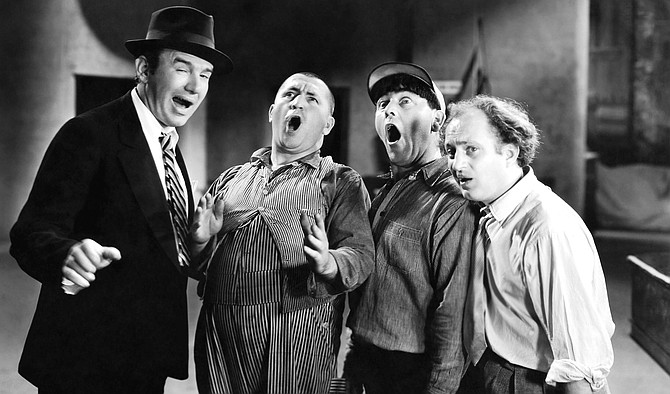
Ted Healy and his Stooges as they appeared in Dancing Lady.
Who was the first politically persuasive actor in Hollywood to openly ridicule Adolf Hitler on screen? Fredric March? Melvyn Douglas? George Murphy?
Would you believe Larry Fine, aka the Stooge in the middle?
Before The Three Stooges became a staple of Columbia Pictures, the boys signed a two-year contract with the prestigious Metro-Goldwyn-Mayer where they were billed as part of the act, “Ted Healy and His Stooges.” (M-G-M famously nicknamed their small-scale rival “Siberia.”) Healy, a notoriously abusive drunk, didn't make the jump to Columbia. The Stooges parted ways with him due to a combination of financial exploitation, his volatile behavior, and a desire for creative independence. (Healy was pulling in $30,000 a week but only paying his co-stars a measly $100 per Stooge.)
Healy died in 1937 — the coroner's report attributed his death to kidney failure after being pummeled by a trio of drunken college boys. Off the record, Healy was actually beaten unconscious by major MGM star Wallace Beery, future James Bond producer Albert "Cubby" Broccoli, and mobster Pat DiCicco. The studio, looking to prevent a murder rap against one of their star players, fabricated the college student story, sent Beery out of the country on a cruise, and pressured the coroner to alter the report to protect their valuable star from a murder scandal.
Healy died broke, and the Stooges, along with other Hollywood stars, stepped up and founded a trust to support his widow and newborn son.
While at Metro, the trio not only appeared in early two-strip Technicolor shorts during their brief 1933–1934 contract, they also worked opposite studio superstars Joan Crawford and Clark Gable.
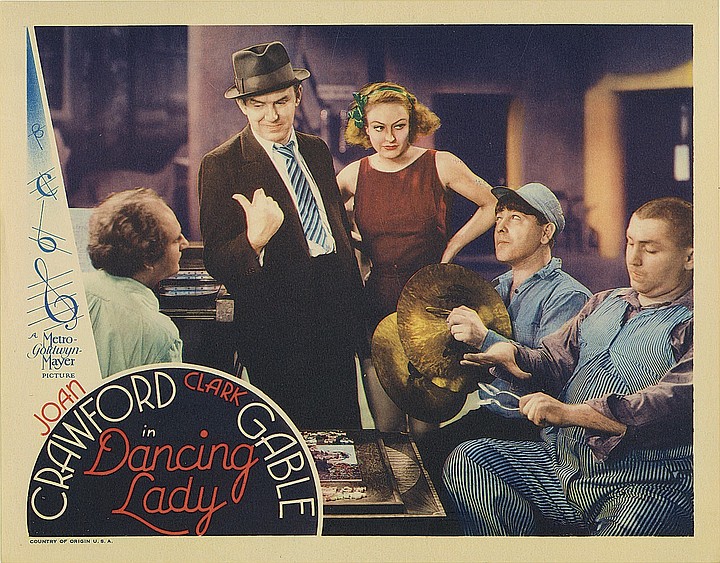
Lobby Card featuring Healy, The Three Stooges, and Joan Crawford.
According to the Los Angeles Times, “Some may be surprised to learn, given Hollywood’s liberal reputation of today, that back then studio moguls were overwhelmingly conservative.” Socialist author Upton Sinclair (The Jungle, Oil!) ran for Governor of California on the Democratic ticket in 1934. Studio boss Louis B. Mayer demanded that studio employees donate one day's pay to defeat Sinclair and produced early fake-news attack ads in cinemas.
According to film historian David Stenn, “Unwilling to alienate a lucrative foreign market, M-G-M not only ignored Germany’s persecution of Jews, but let Dancing Lady literally sing praises to the birthplace of pretzels, beer, and the Nazi Party.”
A running gag in the film involving Larry Fine and a jigsaw puzzle was, oddly, never resolved. While sleuthing through a 1933 copy of Variety, Stenn found the answer to a question that for years had left viewers puzzled. The Variety reporter mistakenly credits Curly as the puzzle master who finds the puzzle's last piece. Once in place, it revealed that the puzzle depicts Hitler. “Oy! Oy! It’s Hitler,” Fine said — before wiping the table clean of the puzzle.
But censors, fearing that an unfavorable comment might cause “official criticism,” suggested that the line be cut — and Metro complied. Rather than ruffle any feathers, the top brass at the Jewish-run studio cut Larry’s reaction. As Stenn put it, “the Hays Office put Hitler first.” Stenn also found the missing footage intact in a 1960 print made for television. The footage, lost for over 90 years, can now be seen.
Video:
Dancing Lady censored scene
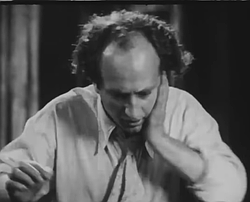
Mazel Tov to Stenn for putting a lid on this long lost-black hole in Stoogiology.
Here's something you might be interested in.
Fine for Hitler
Frizzle-topped Stooge first to publicly ridicule Schicklegruber

Fine for Hitler
Frizzle-topped Stooge first to publicly ridicule Schicklegruber
Ted Healy and his Stooges as they appeared in Dancing Lady.
Who was the first politically persuasive actor in Hollywood to openly ridicule Adolf Hitler on screen? Fredric March? Melvyn Douglas? George Murphy?
Would you believe Larry Fine, aka the Stooge in the middle?
Before The Three Stooges became a staple of Columbia Pictures, the boys signed a two-year contract with the prestigious Metro-Goldwyn-Mayer where they were billed as part of the act, “Ted Healy and His Stooges.” (M-G-M famously nicknamed their small-scale rival “Siberia.”) Healy, a notoriously abusive drunk, didn't make the jump to Columbia. The Stooges parted ways with him due to a combination of financial exploitation, his volatile behavior, and a desire for creative independence. (Healy was pulling in $30,000 a week but only paying his co-stars a measly $100 per Stooge.)
Healy died in 1937 — the coroner's report attributed his death to kidney failure after being pummeled by a trio of drunken college boys. Off the record, Healy was actually beaten unconscious by major MGM star Wallace Beery, future James Bond producer Albert "Cubby" Broccoli, and mobster Pat DiCicco. The studio, looking to prevent a murder rap against one of their star players, fabricated the college student story, sent Beery out of the country on a cruise, and pressured the coroner to alter the report to protect their valuable star from a murder scandal.
Healy died broke, and the Stooges, along with other Hollywood stars, stepped up and founded a trust to support his widow and newborn son.
While at Metro, the trio not only appeared in early two-strip Technicolor shorts during their brief 1933–1934 contract, they also worked opposite studio superstars Joan Crawford and Clark Gable.
Lobby Card featuring Healy, The Three Stooges, and Joan Crawford.
According to the Los Angeles Times, “Some may be surprised to learn, given Hollywood’s liberal reputation of today, that back then studio moguls were overwhelmingly conservative.” Socialist author Upton Sinclair (The Jungle, Oil!) ran for Governor of California on the Democratic ticket in 1934. Studio boss Louis B. Mayer demanded that studio employees donate one day's pay to defeat Sinclair and produced early fake-news attack ads in cinemas.
According to film historian David Stenn, “Unwilling to alienate a lucrative foreign market, M-G-M not only ignored Germany’s persecution of Jews, but let Dancing Lady literally sing praises to the birthplace of pretzels, beer, and the Nazi Party.”
A running gag in the film involving Larry Fine and a jigsaw puzzle was, oddly, never resolved. While sleuthing through a 1933 copy of Variety, Stenn found the answer to a question that for years had left viewers puzzled. The Variety reporter mistakenly credits Curly as the puzzle master who finds the puzzle's last piece. Once in place, it revealed that the puzzle depicts Hitler. “Oy! Oy! It’s Hitler,” Fine said — before wiping the table clean of the puzzle.
But censors, fearing that an unfavorable comment might cause “official criticism,” suggested that the line be cut — and Metro complied. Rather than ruffle any feathers, the top brass at the Jewish-run studio cut Larry’s reaction. As Stenn put it, “the Hays Office put Hitler first.” Stenn also found the missing footage intact in a 1960 print made for television. The footage, lost for over 90 years, can now be seen.
Video:
Dancing Lady censored scene
Mazel Tov to Stenn for putting a lid on this long lost-black hole in Stoogiology.
Comments