

Here's something you might be interested in.
Ask a Hipster — Advice you didn't know you needed
Big Screen — Movie commentary
Blurt — Music's inside track
Booze News — San Diego spirits
Classical Music — Immortal beauty
Classifieds — Free and easy
Close to Home — What it’s like on the street where you live
Cover Stories — Front-page features
Drinks All Around — Bartenders' drink recipes
Excerpts — Literary and spiritual excerpts
Feast! — Food & drink reviews
Feature Stories — Local news & stories
Fishing Report — What’s getting hooked from ship and shore
From the Archives — Spotlight on the past
Golden Dreams — Talk of the town
The Gonzo Report — Making the musical scene, or at least reporting from it
Letters — Our inbox
Movies@Home — Local movie buffs share favorites
Movie Reviews — Our critics' picks and pans
Musician Interviews — Up close with local artists
Neighborhood News from Stringers — Hyperlocal news
News Ticker — News & politics
Obermeyer — San Diego politics illustrated
Outdoors — Weekly changes in flora and fauna
Overheard in San Diego — Eavesdropping illustrated
Poetry — The old and the new
Reader Travel — Travel section built by travelers
Reading — The hunt for intellectuals
Roam-O-Rama — SoCal's best hiking/biking trails
San Diego Beer — Inside San Diego suds
SD on the QT — Almost factual news
Sheep and Goats — Places of worship
Special Issues — The best of
Street Style — San Diego streets have style
Surf Diego — Real stories from those braving the waves
Theater — On stage in San Diego this week
Tin Fork — Silver spoon alternative
Under the Radar — Matt Potter's undercover work
Unforgettable — Long-ago San Diego
Unreal Estate — San Diego's priciest pads
Your Week — Daily event picks
San Francisco poet W.S. di Piero wrote on art for the Reader
Photography under the educated eye

Di Piero – 20 years of tightly written words on San Diego and L.A. art
Poet W.S. di Piero, a recipient of Guggenheim, Lila Wallace-Readers Digest awards, and the Ruth Lilly Poetry Prize, wrote on art for the San Diego Reader from 2000 through 2019.
Among his stories:
Sally Mann wanted imagery that looked bruised by history
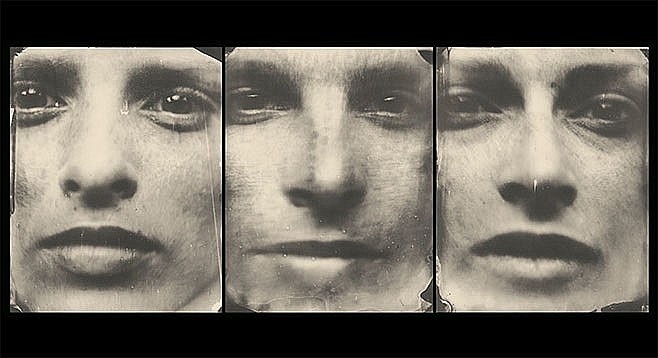
Sally Mann, American, born 1951, Triptych, 2004, Gelatin silver prints
The history of photography tracks the cultural history of childhood and the innocence we like to think abides there. When the inventor of photography, Henry Fox Talbot, made images of his family in the 1840s, people hadn’t yet developed the camera-ready selves that in 21st century America even children develop very early. Between Fox Talbot’s big slow box camera and our own speed-freak smart Phones, photography has kept watch over, pursued, infancy and childhood. Fox Talbot’s dressed-up children, dressed and posed as miniaturized adults, are stiff and a bit stuffy. In the 1890s, Julia Margaret Cameron depicted children as idealized emanations of time, softened, bemused, and aspirational. Images by Charles Dodgson (Lewis Carroll) are proprietary, vaguely yearning, and treat children as nearly untouchable artifacts of time. Closer to our time came, in hopscotch order: Helen Levitt’s hundreds of pictures of New York street kids inventing themselves and an ongoing theatricality; Ralph Meatyard’s weirdly sinister rural pastorals of kids in oversized Halloween masks like shrunken, ominous adults; Robert Frank’s shadowy views of children, especially his own, as tender hostages to fortune; Diane Arbus’s estranged and estranging presentations of young people as aloof as her adult subjects....
Deep, unusual Mexico in photos
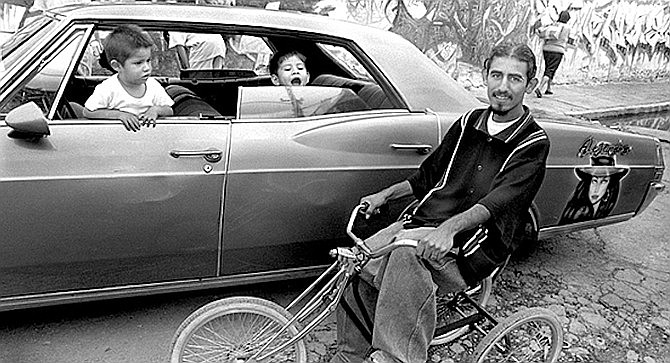
Federico Gama photo. Gangsters of many kinds tend to be religious sentimentalists.
Modern Masters from Latin America reminds us, if we need to be reminded, that Modernism knew no borders. Point/Counterpoint, a compelling selection of 19 contemporary Mexican photographers currently at the Museum of Photographic Arts, has borders on its mind, the actual physical borderlands separating Mexico from North America and the social, moral, and political borders that define human activities. Smaller in size than the Pérez Simón exhibition, Point/Counterpoint has more dash and punch, and a generous breadth of visual idioms, from street photography to conceptualism to ethnography....

di Piero: "He took me to a drive-in to see Gregory Peck in Pork Chop Hill.
(Story about di Piero's father) ....In the summer of 1959, he took me to a drive-in to see Gregory Peck in Pork Chop Hill. It was raining hard. His heavy presence, the envelope of rain and car, the tinny intimacy of the sound box, they made me feel safe — just about the only time I ever felt so....
See all stories by di Piero in the Reader.
Here's something you might be interested in.
San Francisco poet W.S. di Piero wrote on art for the Reader
Photography under the educated eye

San Francisco poet W.S. di Piero wrote on art for the Reader
Photography under the educated eye
Di Piero – 20 years of tightly written words on San Diego and L.A. art
Poet W.S. di Piero, a recipient of Guggenheim, Lila Wallace-Readers Digest awards, and the Ruth Lilly Poetry Prize, wrote on art for the San Diego Reader from 2000 through 2019.
Among his stories:
Sally Mann wanted imagery that looked bruised by history
Sally Mann, American, born 1951, Triptych, 2004, Gelatin silver prints
The history of photography tracks the cultural history of childhood and the innocence we like to think abides there. When the inventor of photography, Henry Fox Talbot, made images of his family in the 1840s, people hadn’t yet developed the camera-ready selves that in 21st century America even children develop very early. Between Fox Talbot’s big slow box camera and our own speed-freak smart Phones, photography has kept watch over, pursued, infancy and childhood. Fox Talbot’s dressed-up children, dressed and posed as miniaturized adults, are stiff and a bit stuffy. In the 1890s, Julia Margaret Cameron depicted children as idealized emanations of time, softened, bemused, and aspirational. Images by Charles Dodgson (Lewis Carroll) are proprietary, vaguely yearning, and treat children as nearly untouchable artifacts of time. Closer to our time came, in hopscotch order: Helen Levitt’s hundreds of pictures of New York street kids inventing themselves and an ongoing theatricality; Ralph Meatyard’s weirdly sinister rural pastorals of kids in oversized Halloween masks like shrunken, ominous adults; Robert Frank’s shadowy views of children, especially his own, as tender hostages to fortune; Diane Arbus’s estranged and estranging presentations of young people as aloof as her adult subjects....
Deep, unusual Mexico in photos
Federico Gama photo. Gangsters of many kinds tend to be religious sentimentalists.
Modern Masters from Latin America reminds us, if we need to be reminded, that Modernism knew no borders. Point/Counterpoint, a compelling selection of 19 contemporary Mexican photographers currently at the Museum of Photographic Arts, has borders on its mind, the actual physical borderlands separating Mexico from North America and the social, moral, and political borders that define human activities. Smaller in size than the Pérez Simón exhibition, Point/Counterpoint has more dash and punch, and a generous breadth of visual idioms, from street photography to conceptualism to ethnography....
di Piero: "He took me to a drive-in to see Gregory Peck in Pork Chop Hill.
(Story about di Piero's father) ....In the summer of 1959, he took me to a drive-in to see Gregory Peck in Pork Chop Hill. It was raining hard. His heavy presence, the envelope of rain and car, the tinny intimacy of the sound box, they made me feel safe — just about the only time I ever felt so....
See all stories by di Piero in the Reader.