

Here's something you might be interested in.
Ask a Hipster — Advice you didn't know you needed
Big Screen — Movie commentary
Blurt — Music's inside track
Booze News — San Diego spirits
Classical Music — Immortal beauty
Classifieds — Free and easy
Close to Home — What it’s like on the street where you live
Cover Stories — Front-page features
Drinks All Around — Bartenders' drink recipes
Excerpts — Literary and spiritual excerpts
Feast! — Food & drink reviews
Feature Stories — Local news & stories
Fishing Report — What’s getting hooked from ship and shore
From the Archives — Spotlight on the past
Golden Dreams — Talk of the town
The Gonzo Report — Making the musical scene, or at least reporting from it
Letters — Our inbox
Movies@Home — Local movie buffs share favorites
Movie Reviews — Our critics' picks and pans
Musician Interviews — Up close with local artists
Neighborhood News from Stringers — Hyperlocal news
News Ticker — News & politics
Obermeyer — San Diego politics illustrated
Outdoors — Weekly changes in flora and fauna
Overheard in San Diego — Eavesdropping illustrated
Poetry — The old and the new
Reader Travel — Travel section built by travelers
Reading — The hunt for intellectuals
Roam-O-Rama — SoCal's best hiking/biking trails
San Diego Beer — Inside San Diego suds
SD on the QT — Almost factual news
Sheep and Goats — Places of worship
Special Issues — The best of
Street Style — San Diego streets have style
Surf Diego — Real stories from those braving the waves
Theater — On stage in San Diego this week
Tin Fork — Silver spoon alternative
Under the Radar — Matt Potter's undercover work
Unforgettable — Long-ago San Diego
Unreal Estate — San Diego's priciest pads
Your Week — Daily event picks
Max Miller – San Diego's literary giant of the 1930s
First three chapters of I Cover the Waterfront
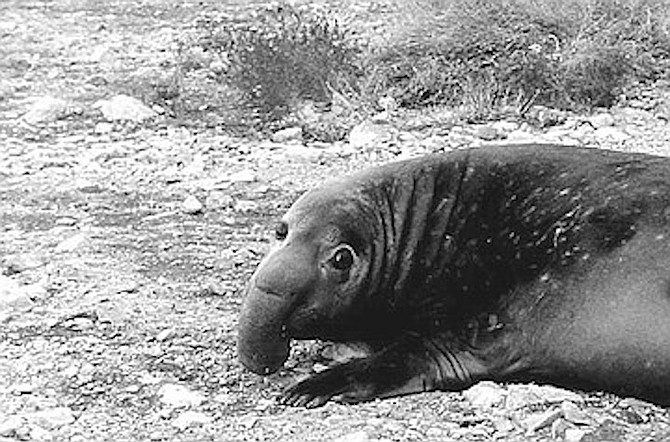
The only syndicate stories I am ever sure of selling are about elephant seals.
Early in the past century, Riverside, Washington, was a disreputable dockside community on a bluff above the Snohomish River. Max Carlton Miller, born in Traverse City, Michigan, spent his youth in Riverside, as some residents boast to this day.
His imagination and creativity surfaced early. In 1914, Miller, then a mere 15 years old, claimed to have spotted a sea serpent at the mouth of the river. A lad with such precocity was clearly college material, and he went on to attend the University of Washington. In his 20s, the adventure-loving young man traveled to the South Seas and to China.
^^^^^^^^^^^
The Reader has started this series of its best stories from the past 52 years — 2600 cover stories and some remarkable interior features — to help make up for the loss of its physical edition, which was once large enough to hold whole oceans of print. These stories will feature all the original illustrations and photos (plus easy-to-read typography).
^^^^^^^^^^^
He landed a job with the San Diego Sun, a Scripps-Howard newspaper that struggled to compete with the Copley-owned Evening Tribune and San Diego Union. The Sun “was a crummy paper — a third paper with a third-paper mentality,” recalls noted journalist and former congressman Lionel Van Deerlin, who in 1937 took over Miller’s desk at the Sun.
The newspaper’s two-story office was at Seventh and B, across from what is now Symphony Towers. Van Deerlin would bring a sandwich each day, “and before noon, the mice would get to it,” he recalls.
“It was dank down in the pressroom, but the editing and writing were done upstairs, and people seemed happy,” says Norman Roberts of La Jolla, who was then a high school intern assisting in the photography department.
It may have been a third-rate paper, but it was staffed by some who became giants of San Diego journalism. Dick Pourade, who later wrote several San Diego histories, was there. So was Eileen Jackson, who went on to become the city’s social arbiter for six decades. The majordomo was Magner White, who had won the city’s first Pulitzer Prize in 1924 for his vivid description of an eclipse of the sun. However, to beat a deadline, “the story was written in advance of the eclipse,” laughs Van Deerlin. (Today, that could lead to a disqualification, perhaps ex post facto.)
All three papers had reporters covering the San Diego waterfront, and Max Miller of the Sun was the best by far, agree old-timers who can remember San Diego in the Depression-wracked 1930s.
Thus, to San Diegans, it was no surprise that in 1932, Miller authored a book named I Cover the Waterfront.
What was surprising is that this earthy book immediately became a runaway best seller, garnering rave reviews from publications and/or critics known for their stuffiness.
Said the then-insufferably haughty and Eastern-centric New Yorker, “It’s a book you really ought to read.” The old gray lady, the New York Times, dubbed the book “distinctive, original, unusual, fresh in tone and manner, with a quaint whimsicality of feeling and expression.”
Enthused Harry Carr of the Los Angeles Times, “This book has the touch of something dangerously like pure genius.”
Wow. That was high praise for a book of vignettes about San Diego’s waterfront — an area of seedy saloons, brothels, hard-toiling fishermen, hard-drinking dock workers, hard-bitten con men, and hard-up sailors that the preachers wanted to sanitize and city fathers wanted to keep hidden.
As those who devour the Reader’s serialization of I Cover the Waterfront will quickly learn, the book is, indeed, a work of genius. Only Max Miller could have written so penetratingly and concisely of the demise of the henpecked Johnny Lafferty. Or of the gangly, publicity-loving Charles Lindbergh, before he gained world celebrity. Or of the hermit on the rattlesnake-infested Mexican island who, on rare trips to the mainland, headed straight for Mrs. Morgan’s Boarding House for Girls, which really wasn’t a boarding house, “but the police do not interfere other than to visit [Mrs. Morgan] in a social way,” Miller tells us. One of Mrs. Morgan’s — er, uh — boarders winds up with the hermit on the island, but I am not going to spoil your fun. Read it yourself.
Miller seldom came to the office, recalls Roberts. “He had an office at the waterfront, where he hung out.” It was upstairs in the tugboat office, in a room belonging to a publicity agent. Today, such coziness with publicists would be ethically forbidden.
But like all Sun reporters, Miller had to come to the office for a weekly staff meeting, and his biting account of it will hit home with every journalist and most workers in corporations — but again, you have to read it yourself.
The book — and particularly its title — inspired other artists. There was a movie by the name starring Claudette Colbert. The flick bore almost no resemblance to the book, other than that a bordello was called a boarding house and the male star was a cynical, hard-drinking waterfront reporter. (More on that below.) The film originated the phrase “Not tonight, Josephine!” After it came out, Variety promptly labeled it a studio job that was unrelated to the book.
In 1933 came a wonderful song, “I Cover the Waterfront,” by Johnny Green and Edward Heyman. It was an instant hit — so electrifying that the producers of the movie reportedly dubbed its music into what may have been a remake. It has been said that the movie originally had another name but picked up the Waterfront moniker after the song took off. (That rumor has been challenged.) The song has since become a staple of the jazz repertoire, performed by such stars as Billie Holiday, Frank Sinatra, Artie Shaw, Charlie Parker, and Cannonball Adderley.
Miller “was eternally bitter because he didn’t make any money out of the movie version,” says Al JaCoby, who had several topside editor titles at the Union over many years. “I think what happened is that he sold the rights to the book to someone who then sold it to the movie producers.” Unfortunately, from a financial perspective, that’s show biz. That’s Hollywood. ’Twas ever thus.
What was Max Miller like? He was about five ten, stocky, with short hair, with a decidedly ruddy complexion and a cigarette dangling from his lips or in his fingers.
Why the ruddy complexion? “He was a drunk. Just like me,” said the self-effacing Joe Stone, a wit known for exaggerating his own perceived flaws. Stone wrote Miller’s obituary for the Union, wrote a Milleresque column for the Borrego Sun, and, until he died in late November at age 90, believed he might have been able to match Miller snort for snort.
Miller “was a lush,” says Van Deerlin. Union-Tribune columnist Neil Morgan, a lifelong friend and onetime competitor of Miller’s, puts it more gently: “It was rare that I ever went to that beautiful house on the cliffs without having some whiskey.”
Morgan was in college when he first read I Cover the Waterfront. Almost immediately after publication, Miller had become a cult figure on college campuses. While he was in the Navy in San Diego, Morgan read that Miller had lost the rubber raft with which he had gone snorkeling off the coast of that La Jolla oceanfront house he had purchased after the book had become a smash and he had quit the Sun.
Morgan commandeered a surplus raft and went to the posh home and presented the replacement raft. Miller was thrilled. And treated Morgan to a drink of lowgrade bourbon, which was just about all that was available in those days. (According to Roberts, it was probably Waterfill & Frazier, produced by a Kentucky distiller that had moved to Juárez in 1927, during Prohibition. It was widely, if dyspeptically, consumed in San Diego in those days.)
After his initial success, Miller published a book every year up to the Korean War, some 28 in all. Some were on San Diego, such as a book on La Jolla, The Town with the Funny Name. He returned to the waterfront theme. He wrote extensively on Baja California. He wrote military books and some corporate vanity tomes that brought him some money. “His books were lovely, beautifully crafted essays, contemplative pieces, very soft in terms of outlook and view — they just didn’t have the zing of that first one,” says Morgan.
Miller also returned to his`beloved prostitution theme. He teamed up with Fred Mazzulla, a Denver lawyer with a fascination for the history of 19th-century bordellos and a coauthor of the authoritative Brass Checks and Red Lights: Being a Pictorial Potpourri of Historical Prostitutes, Parlor Houses, Professors, Procuresses and Pimps.
After much correspondence on the topic of hookers and whorehouses, Mazzulla and Miller in the early 1960s coauthored Holladay Street, a history of 19th-century Denver prostitution. One section of that book engenders debate among Colorado historians to this day.
The book reported that on August 25, 1877, history’s only duel between two Colorado females took place. Mattie Silks and Katie Fulton were rival bordello madams. After a drinking bout, they decided to settle their dispute in a duel, according to the Miller/Mazzulla account. Each lady’s boyfriend served as a second. Katie allegedly missed Mattie but hit Mattie’s lover, who was standing beside her. It was only a flesh wound. Katie beat it out of town, but Mattie’s boyfriend survived and eventually married her. A musical, Mattie Got Her Gun, celebrates the alleged incident.
But other historians pooh-pooh the whole story, claiming that an earlier author had either invented the tale of the duel or had misinterpreted newspaper accounts of the ladies’ disagreement. In any case, documents at UCSD’s Mandeville Special Collections Library, where Miller’s extensive papers repose, indicate that Miller and Mazzulla meticulously researched every twist and turn, every bump and grind they reported upon.
In one letter, Mazzulla told Miller of an interview he had had with a long-retired lady of the evening. Mazzulla had asked her definitional questions, such as what “hustling” was all about. The former sportin’ lady told Mazzulla, “All girls hustle or hustled such as hotels, cribs, working windows, streets, street walkers, chippies and even call girls — in other words, all sporting girls hustle.”
But that book, too, garnered only a modest audience, despite its titillating subject. Miller, however, remained a toast of San Diego society. “People whom you would describe as name-droppers would be the ones to mention Max Miller,” says Van Deerlin. “Max Miller was everybody’s darling.”
He and his wife entertained the Beautiful People, particularly since social columnist Eileen Jackson was such a close friend. All played croquet on the lawn that sloped down to the ocean. But Miller sometimes dropped out in midgame. “We would go there. He would be barbecuing chicken. He would go in the house for 30 or 40 minutes or an hour, and he would slide out of his chair because of his drinking,” says JaCoby.
One of Miller’s drinking buddies was the famed columnist Ernie Pyle, also a Scripps-Howard writer. Before becoming a household word for his World War II columns, Pyle, along with his wife, traveled the U.S. writing columns and when in San Diego visited Sun staffers, particularly Miller. “Max knew Ernie for many years,” says JaCoby. “Max had quite a good library of books and had several Pyle books, all very affectionately inscribed — ‘Max, here is my latest, just wish it was as good as yours.’ ”
Miller was a naval officer in World War II. Friends say he squired Pyle around. There is a yarn that Pyle wanted to go to a small island in the Pacific. But Miller begged off that day; he had a hideous hangover. Pyle went to the island and was killed. Others suggest, however, that the story may be apocryphal. (People may be shocked to learn that on occasion, a few journalists — dedicated to truth as they may be — relate stories that stray somewhat from verisimilitude. Miller, it is said, sometimes fell into that category, especially when he was under the influence of the firewater that people erroneously call “truth serum.”)
But there was one activity in which Miller never strayed from his announced intentions. In the annual La Jolla Rough Water Swim, Miller always made sure he finished last, said Stone, and local media would regularly point that out.
And Miller was the expert whom the media consulted on San Diego and environs matters. Van Deerlin remembers a time when there was a raid on a Rosarito Beach hotel, and Americans were locked up for a week. Mexican relations became strained. A local radio station sent a reporter to interview Miller about the neighbors to the south. The reporter knew Miller’s fondness for the sauce. “It’s the funniest take,” says Van Deerlin. “It starts out as a serious interview. As the reporter plied him with booze, it got absolutely squashy. He [Miller] couldn’t get out a straight word.”
Following World War II, there was suddenly a strange presence in San Diego: a Democratic newspaper. After the Copley newspapers purchased the Sun at the time of its demise in the late ’30s, the Tribune and Union had had the market to themselves. But following the war, Clinton D. McKinnon launched the Journal, a Democratic paper. It featured a young columnist who was, very successfully, trying to write a Herb Caen–type column about San Diego.
He was Neil Morgan. To counter him, the Tribune brought back Max Miller as a regular columnist. Morgan and Miller could not have been more different. Morgan portrayed a postwar community beginning to experience big-city life. Miller wanted to keep San Diego small. He railed against tourism and tract homes.
Subdivision developers “seem to travel like a circus, except that a circus never leaves its tents behind each time,” he wrote, bemoaning once-quiet hills that become lined with ticky-tack homes.
“Come one and all, oh ye aged from Ohio and Iowa, come one and all and live free off the taxes in California,” Miller griped.
El Cajon, then as now, sponsored community events whose attendance figures were invariably exaggerated by the press. “Its parades and pageants have become — week by week — parade-ier and pageant-ier,” harrumphed Miller. He wrote a book on what he perceived as the California in-migration problem, And Bring All Your Folks, which hypothesized that with all the outsiders streaming in, Californians would be forced to move to islands off the coast. Then, in his unique prose, he explored those islands.
He complained that before the people had poured in, “San Diego harbor itself used to be a breeding water for whales — and by the hundreds.”
In retrospect, Miller was prematurely prescient about San Diego. Also, then as now, pro-environment and anti-developer views were taboo within the Copley organization.
In the columnizing contest of the time, Morgan was resonating with the public and Miller was not. So Copley bought the Journal too — mainly, it was said, to get Morgan. At the time, the Copley papers were headed by Bill Shea, who, by all reports, could match Miller swig for swig. They arranged a meeting, and Miller’s departure was handled with aplomb — plum brandy, perhaps.
For a while, Miller was book editor of the Union, says JaCoby. It didn’t last. As Sunday editor, JaCoby gave some writing assignments to Miller. “He wrote me a piece that was just awful,” recalls JaCoby. “Even so, this was Max Miller. I did a heavy job of editing and turned it into a good piece. I sent it out to him, said I had made changes, and asked him to look it over. It came back immediately. He said it was fine.”
Later, Shea’s assistant came to JaCoby and suggested that the Millers were short on funds. “He said I should pay Max double what I normally paid. He asked me what I usually paid. I said $1000 — five times what I normally paid,” recalls JaCoby.
“Double it,” ordered Shea’s assistant. La Jolla’s Beautiful People took care of each other then, as they do now.
That was in the 1960s. Max Miller, who died in 1967, had peaked in 1932 with I Cover the Waterfront. Indeed, he seemed to have foretold it in the last paragraph of I Cover the Waterfront, when he wrote, “I have written as much of a book as I can write.”
What happened? “It was like seeing someone going downhill,” says Van Deerlin. “He never matched the brilliance of the first book.” But Morgan has a different interpretation. “I Cover the Waterfront was widely said among publishers to have been rewritten by a very beautiful literary agent in New York who was in love with Max at the time,” says Morgan. “It was a nasty allegation, but it was a better book than any he wrote subsequently. I tend to believe the rumor of the publishing trade.”
Chapter One: The Damned and the Lost
I have been here so long that even the sea gulls must recognize me. They must pass the word along about me from generation to generation, from egg to egg.
Former friends of mine, members of my old university class, acquaintances my own age, have gone out to earn their 6000 a year. They have become managers, they have become editors, they have become artists. Yet here am I, what I was six years ago, a waterfront reporter.
True, I am called a good waterfront reporter in this city, as if the humiliation were not already great enough in itself. I shudder at the compliment, yet should feel fortunate in a way that so far I have escaped the word veteran. When I am called not only the best waterfront reporter but also the veteran waterfront reporter, then for sure all hope is dissolved. And I need look ahead then, only to that day when the company presents me with a fountain pen and a final check.
I am nearing 28, and should I by accident be invited to a home where literature is discussed, or styles, or Europe, the best I could do would be tocrawl into the backyard. There I could sit tossing pebbles into the fountain until the hostess found me out. If she compelled me to come back into the house and join the conversation, my topics would have to be of swordfishing, or of lobstering, or of hunting sardines in the dark of the moon, or of fleet gunnery practice, or of cotton shipments. The predicament has passed beyond my control. I am one of those creatures who remain permanent, who stay in one place, that successful men on returning home may see for the happiness of comparison. I am of the damned and the lost, and yet I do know more than I did six years ago when I first came here, a graduate in liberal arts.
I existed my first season on this waterfront buoyed by that common hope of mankind that by next year I would write a book, a novel composed of the characters I met. Quite tidily, too, I would insert my own silent sufferings, such as eating at the lunch counter downstairs where the sugar bowl is always chucked with brown lumps. These fishermen will dip coffee spoons back into it for the third or fourth helping. But instead of writing of this, I learned instead to take the lazy man’s course and drink my coffee without sugar.
The second year blended into the third. The characters I had picked out for my novel gradually became more blurred to my complete understanding. Nobody was definitely good, nobody was definitely bad. The more I knew of them, the less positive I became of which stand to take, and for a novel a writer does need a villain; a writer needs several of them. Even Evangeline, the brown-haired waitress, proved a disappointment to my plans. I had selected her to be the waterfront harlot. I had a drab death already prescribed for her, a death in which she would fling herself from the tugboat pier with only the silver moon as witness. The gentle bosom of the bay would cleanse her of her sorrow, would baptise her anew, and she would be carried by the tide to sea with a look of peace upon her world-wronged face. But unfortunately Evangeline does not need cleansing. In fact, she has a home and a husband, rather a nice chap. He is a quartermaster on a destroyer based here. And even now I can hardly forgive Evangeline for this trick on me.
Of course, if a writer were really desperate for harlots there are plenty of them around here. They follow the fleet from port to port as regularly as the wake of the vessels, but a person has to be an expert to distinguish them. I see the girls come down to the float where the shoreboats land, but often enough they turn out to be dutiful wives or high school daughters. And the sailors, especially, are wise enough to keep their mouths shut until they know for sure.
At any rate the original characters I selected for my book never did show up. I have yet to see them. I do not know what has happened to them, but I have waited six years. I can wait no longer; I am getting too old, so must go ahead with what I already have on hand.
My studio, by the way, is upstairs in the tugboat office. The room is not mine. It belongs to the publicity agent of the deep-sea fishing barge. Until this book he has been a critic of all I write. When my news stories concerned his fishing barge, he clipped them out. He keeps a scrapbook to show his employer at the end of the season. Some of my writings are being saved. I underestimated myself.
The walls of this room are decorated with pictures of bluefin, yellowfin, skipjack, barracuda, and mackerel. These are my inspiration. They are the leftover pictures he could not peddle to the papers. Men are holding the fish. The pictures where women are holding the fish are peddled. They were printed. He has none of them left but he keeps the others here.
The shingles of the roof show through the ceiling. The roof slopes so low on the south side that a person cannot stand up there. The room is quite small, and in summer stuffy with a sort of cobweb stuffiness.
Frequently the tugboat operators come up to see the publicity agent, my lone encouragement. They have questions to be answered, yet mostly they desire to read his library. The book in it is Rabelais, illustrated. He keeps it locked in the middle drawer to the right. The operators must not take the book downstairs to the pier, but must read it in the room, and first must see that their hands are wiped of grease. He keeps an eye secretly on them as they read; he is deathly afraid that one of them with a pencil might some day add insulting shadows to the naked ladies. And all this, then, is the ultimate of my literary environment. I who would have consented six years ago to have done book reviews while waiting for the job of theater critic.
The two windows, small and unmovable, furnish a clear sweep of the harbor through their film of dirt. The sea gulls come and perch near the window ledges. The birds stare in at me and I stare out at them. During these interviews we both carry rather silly expressions, for neither of us seems to know what he is going to do next. They act as if they, too, have read up on the universe around us and are wise to the fact that in this jumble of orbits we are foolish to have ambitions, that we are foolish to do anything all day long except eat. In a million million years the whole show will be ended anyhow, and so why should they or I acquire wrinkles trying to amount to something? Whereupon, we merely stand and stare, passengers on the same boat.
The pelicans now are different, specially the old pelicans that perch on the pier-heads beyond the windows. The pelicans have worried so much about life that the tops of their heads are gray. They have worried and worried, yet have arrived nowhere either. They do not even bother to look in the window at me. Each day has become as much a burden to them as their heavy bills. They are tired, so tired they have forgotten how to make a noise. They are so tired they no longer can be bothered scrambling for food.
At first they must have despised the sea gulls for all of their squawking and for all of their swooping for scraps and for their greedy habit of robbing the nests of the cormorants. They must have regarded sea gulls much as I regard committee people, and yet the pelicans in time must have grown up, which is more than I can do. They must have forced themselves to consider the sea gull in its better moments, when its stomach is stuffed to the limit, when it is content to sit by these windows staring in at me as though it, too, is filled with reasoning. All sea gulls, I think, would ultimately like to be pelicans, but so far are too earthy to overcome their appetites.
And so I do have my acquaintances, after all, in my studio upstairs on the tugboat pier.
Elephant seal.
Chapter 2
Elephant Seal Editor
Each year we go after elephant seals for the Zoo. Sometimes we go in the Navy’s tugboat, Koka, sometimes in the Navy’s Eagle boat 34. We cruise to that Mexican island of Guadalupe.
There on the sands the monsters are awaiting us. They comprise the only herd of their kind in existence, and they are too contented with themselves to be angry at our intrusion.
They have basked in the sunlight of those islands for hundreds of years now, and who are we? We are a pestilence of germs to carry them away. Only they do not recognize germs. They fear nothing they cannot recognize.
From the vessel we float the sides of a cage ashore through the surf. The frames are covered with paddock-fencing of the strongest. On the beach we put the cage together, leaving the shore-end open.
We walk through the herd selecting the member we want, although all look healthy enough. Their black eyes are as doorknobs, their sea-washed hides catch the Mexican sun and radiate it back at us. Their long noses are like sawed-off elephant trunks, and they turn these noses up at us as we walk past. We do not belong here. They can tell this by sniffing.
We select the one we wish, not because of his size, but because of his convenience to the cage. We shoo him backwards into the cage. We threaten to hit him in the snout if he does not back up, yet he weighs a ton and a half; he weighs as much as all of us twice over.
When he is in the cage, and the cage is secure, we wait for the tide to rise; then we float the cage out to the vessel. The ship’s crane hoists the load aboard, and the ship’s pumps are turned upon the captive to keep him wet. If he is not kept wet he moves about scratching himself and fretting.
Sometimes we bring back three at a time. We can bring back as many as we have room for, as the herd must number half a thousand. Sometimes we see them swimming far offshore long before we reach the island. They are so big that you imagine you are looking at some sea-monster these many years extinct.
But 50 years ago there used to be lots of elephant seals around here, old fishermen say. The elephant seals used to come as far north as Southern California. Everybody thought the herd had all been killed off until these were found at Guadalupe. The Mexican Government does not permit them to be killed now, and the expedition has to get permission from Mexico City before making the capture. This always takes a long time.
The only syndicate stories I am ever sure of selling are about elephant seals. Nobody seems to be anxious to buy my short stories or my opinions, but I can always market copy on elephant seals. They are my lone entrée into literature. Nor are my words sufficient in themselves. My stories must be illustrated. This fact used to humiliate me four or five years ago, but now I am hardened, and I am grateful for any outside check.
For other reasons, too, I consider myself quite an elephant-seal expert; I am the elephant-seal editor. I know that the only time the bulls are the least bit vicious is during May and June. This is mating season for them, and as each bull is fond of collecting a harem the fighting among the bulls is terrific. They bunt each other against the sharp rocks of Guadalupe until one or the other gives up and dies. They do not bite. Their mouths are not built for biting. They simply slam each other without mercy; then for the remaining ten months are on the best of terms with all the world. To bear their calves the cows go away into hiding on the opposite side of the island. Some caves are there, and cows like to be around caves.
On these expeditions I like to pretend that I am far away on the other side of the earth and am really doing something for science. The desolate island with its bleak cliffs helps me play the secret little game. But the game is always short-lived, for in actuality we are only a night and a day away from the city, and we are back in port before we know it. Even our captures are no surprise to the city, for the success of the expedition had been radioed on ahead to the Zoo. Trucks and a crane are on the pier to meet us. The trucks parade the giants through the streets to the Zoo tank, and always the creatures are so large that their tails drag along the cement, and persons stare.
The Zoo officials thank us in such a way that I always leave the grounds feeling a little silly. The officials know there is no danger connected with the capture, but I wish they didn’t.
Chapter 3
Honest Conversations
Each two weeks a liner from New York arrives, and we three waterfront reporters go out in a shoreboat to meet her before she docks.
We are three agents of Heaven sent out ahead to inspect the latest shipload of souls before they land.
But, of course, our inspection is only secondhand, as the passengers have been graded and labeled before they left New York.
Their names have been sent overland by the line’s publicity service, but we must make sure they are still aboard, that they did not get off at Panama, and besides, our papers want pictures of them.
I used to feel mortified at the task of meeting liners, but now I do not mind. I used to believe what I read in books about all passengers considering ships’ reporters a nuisance, but now I do not know for sure. Or perhaps habit has deadened my nerves. As a reporter I may have become what I most feared I would become, “typical.”
Outside the channel we board the liner as soon as the quarantine flag goes down. We climb a Jacob’s ladder, a camera-man with us, to the first hatch.
The passengers bend over the starboard railings to watch us. The three of us, or sometimes there are only two of us, are that “flock” of reporters which famous beings are always encountering in novels. We are the “flock” of reporters from whom famed beings are always hiding. When novelists get real mean, they have us entering rooms with our hats on, and they have us diving for the sandwich plate with both hands and a pocket. And they have us persisting with our questions until finally the hero hauls off and knocks us out.
We, then, are these reporters. We swing aboard, and the line’s publicity agent swings aboard with us. The ship’s purser says hello to us, and he calls us by name, and he tells us which stateroom belongs to us. Sometimes when he is not too busy, he comes with us to the stateroom, bringing a passenger list with him. He rings for a steward, who brings into the stateroom refreshments taken aboard during the vessel’s stop at Havana. The steward also brings three bottles of soda water.
“Not much,” we say, “because we’re working.” Or sometimes if the liner has arrived too late for the day’s edition, we do not say this. He tells us who is aboard who would make copy. If we have our doubts, the line’s publicity agent goes on deck and finds out. The cameraman goes with him, and we three reporters stay and talk with the purser, and sometimes the chief engineer comes in and talks too. The chief engineer on one of the liners always wants to know if we can get him tickets to the fights held in the city each Friday night. Sometimes we can, and so we sit there talking and sipping the fumes from Havana, and the purser and the engineer tell us about the women aboard. This always seems their duty, to take care of the women aboard who travel alone and after the first week get lonely. The purser and the engineer like to tell us about them. And after awhile, the line’s publicity agent comes back into the stateroom.
“Well, I got a few items,” he will say. “But a deader ship I’ve never seen. It’s terrible.”
He pours himself a bit, then recites the items and names to us, and we copy them on our copy paper. Or sometimes the office has told us to get a special story on a special passenger. Then we talk with him ourselves, and the bigger he is, the easier he is to talk with. And often we find that we, and not the passenger, are the ones being interviewed. They ask us as many questions as we ask them, and sometimes they like to come along with us back to the stateroom for a bit of the bottle and to talk with us there about the city they are entering. The liner continues sliding through the channel toward the pier. This always takes at least an hour as the gangway is a slow thing to handle even after the lines are on the dock.
If I were given all New York to cover for a week, I doubt if I could run into as many honest conversations with as many honest big men as I have experienced in this little bay of sunlight. The days on the ocean coming up from Panama have rested their minds, I believe, and they are not so eager to be distrustful of all human faces. They tell us any number of secrets which we know they do not want printed, and so we do not print them. Nor do years blur the memory of these conversations.
I can recall as if yesterday the half-cloudy morning Jack Dempsey told us he came to town to get married, and would we hold off the story until he bought the license. We went with him, and he introduced us reporters to Miss Taylor. Not one of us had the heart to violate such courtesy, but to the contrary we felt as if we were confederates with him in the plot for secrecy.
I remember the uncomfortably hot morning — and it must have been years and years ago — that Charlie Chaplin arrived on the Emma Alexander to film the fade-out scene of The Gold Rush. His cast was ordered to be ready for work at sunrise. The members were ready for work at sunrise, each weighed beneath Alaskan furs. They were still ready at 9:00 and they were still ready at 11:00, each face a spectacle of discomfort as the sun struck at them. Chaplin had gone ashore somewhere, and at noon he appeared, walking up the pier with one foot in a gunnysack. Very well, he should apologize, should he, and he the man who was paying them.
I remember going out into the harbor to interview Laura LaPlante, waiting on shipboard for the filming of The Midnight Sun. She stood by the railing in all her make-up and sniffling most frightfully. She had a wretched cold but dare not use a handkerchief because her face would have to be re-made. I cannot look at one of her pictures now without remembering the hopelessness of this tragedy.
Nor how could I ever regret the months donated to Charles Lindbergh. “Slim,” we called him. And all this was before he was yanked away from the earth-dwellers and sanctified into membership with the Deity. All this was while he was hanging around here waiting for his monoplane to be completed. All this was while the desk still considered him just another goof out to get publicity. He would thank me each time I succeeded getting in a story on him. I think he wanted the clippings to send to his backers in St. Louis. He wanted to show them he was not sleeping.
His hat sat so stiffly on his head that sometimes it was embarrassing to walk into a restaurant with him. He was so gawky then; he was as a farmer boy still in the torturous throes of growth. Somebody later must have whispered to him about his hat, perhaps Ambassador Herrick. For it was changed immediately after his ascent into sainthood. We who know him around the small plane factory felt it our duty to look out after him. There was so much about life he apparently did not know. We guided him about as we would a high school child on his first trip to the city. A tribe of beings have this God-given gift of seeming helplessness, and he was a member of the tribe. Of course, it was obvious to all of us that he knew planes almost to the point of fanaticism. Otherwise we would have had nothing to do with him. The editors, not being on the field or in the factory, had no way of seeing this fanatical knowledge of his at work, and so it is no wonder they doubted our copy about him. He was honest with a strange, big-eyed honesty, but even we, his friends, doubted if he would get across. He was too innocent to get anywhere.
“Slim, you ought to go on an exciting party.”
There were four of us in my room when this suggestion was made to him. We had come to my room after lunch for a smack of cognac. A French vessel had just been in port, and I had boarded her. We were sitting around, the four of us, Frank Mahoney, who owned the factory, and “Adolph” Edwards, the factory’s chief salesman and its only one. We had long ago stopped offering a glass to “Slim,” as his answer was always the same. It was simply a waste of time, and besides we did feel like his protectorates; we felt as though we were all his trainers and that he was the only member of the football team. Each of us had to look out after him.
“But Slim, you ought to go on at least one party,” Edwards repeated.
“I’d like to,” he confessed. “Honest, I’d like to.” His tone had such a wistfulness about it, such a helpless desire to study the mechanics of sin, that the three of us felt like conspirators of the blackest.
“I know…” Frank Mahoney saved the day. “I know, Slim. You just wait till you get to Paris. They have all kinds of parties there.”
“I’ll be broke, though.”
Frank thought a moment: “You can sell your plane.”
“I figured on that, but it will be just enough money to get me back. The thing will have had so many hours.”
To be sure, this was a problem.
Yet today, here I am, performing in a way I had vowed never to perform, writing reminiscences of Slim. Or at least one reminiscence. Yet perhaps I may be forgiven as the original point in mind was not to write of him, but to show how even reporters way out here, even waterfront reporters, frequently enough have experiences handed them in a bucket — experiences for which New York reporters would have waited in an ante-room.
Or again, there are statesmen and politicians. But everybody sooner or later gets to talk with them. Herbert Hoover, before he was nominated, slipped into town by train one morning. With his overcoat under his arm he hurried, almost ran, from the station to the waterfront, my waterfront.
I was playing the slot machine in front of the pier’s cigar store, and when I looked up there was Herbert Hoover. Nobody as far as I know had expected him. But there he stood. Of course, it was now up to me to get to work. Yet, strangely enough, I did not feel a bit excited in a reportorial way.
“Hello,” I said, my hand still poised on the slot-machine lever. “What are you doing around here?”
For all I know I may have continued pulling down the lever. My nickel was in the machine, but I do not remember watching the fruit spin around, nor do I recall taking any chips from the cup.
Also I must have informed him I was from a newspaper, because he answered my question. He said he was waiting to go out on the Albacore for a fishing trip off Lower California. The Albacore is operated by the fish and game commission. He said he had not made up his mind to go until this morning. He thought he would have good weather for the trip, now that the wind had changed back to the northwest.
I thought so too. We gossiped on. Finally the little Albacore sped with a flourish alongside the boat landing. He boarded her, and departed.
And again, there was Gertrude Ederle, then a big name. She was on a theater run. For a feature story I swam with her across the bay channel. When I was still only three-fourths across, she had reached the opposite shore. She whispered an apology for having swum so fast, “But I couldn’t help it, the water’s so cold.”
And there was Babe Ruth. Also on a theatre tour. He wanted to catch a jewfish. I got a boat free for him from the tugboat company. We caught no jewfish. We caught five mackerel. The skipper brought along a bunch of new baseballs. On the way back to port, Ruth autographed them, asking each of us how we spelled our names. I was so secretly proud of my ball that in repentance as much as anything I mailed it to my young nephew.
But I have started a chapter I cannot finish; I have started a chapter I am not entitled to finish. For it is absurd to imagine I know these magical beings. They are but shadows to me, shadows which arrive and disappear, shadows which would mean utterly nothing to me except for the aura of publicity given them elsewhere by others. Hoover would have been an oddly dressed man coming to the waterfront on a day off from his hardware store. Miss Ederle would have been a country cousin whom I took swimming on one of “my off-swimming days.” Slim would have been an adolescent youngster with a bent for mechanics. And Ruth — a big-hearted bruiser whose humor was of a logging-camp crudity.
This week another liner will arrive. I shall board her and meet more shadows. In another two weeks another liner will arrive, and again I shall board her, and again I shall meet more shadows. Some of the shadows will impress me as “interesting” on their own; in others I shall have to interpret “interest,” having been warned it is there. But this I do know; we reporters, like the lost children of the wilderness, build our own gods. Then we stand around in awe of them. We feel grateful when they nod at us. And yet they are made from the tappings of our own typewriters. I wish a liner some day would bring a man into the harbor who would take me aside and in a fatherly way explain it all to me.
The story by Don Bauder and chapters 1-3 of I Cover the Waterfront first appeared in the Reader on February 19, 2004.
The remaining chapters of I Cover the Waterfront appeared in the issues from February 26 through May 13, 2004. Those issues can be easily read by going to the Archives on the Reader homepage.
Here's something you might be interested in.
Max Miller – San Diego's literary giant of the 1930s
First three chapters of I Cover the Waterfront

Max Miller – San Diego's literary giant of the 1930s
First three chapters of I Cover the Waterfront
The only syndicate stories I am ever sure of selling are about elephant seals.
Early in the past century, Riverside, Washington, was a disreputable dockside community on a bluff above the Snohomish River. Max Carlton Miller, born in Traverse City, Michigan, spent his youth in Riverside, as some residents boast to this day.
His imagination and creativity surfaced early. In 1914, Miller, then a mere 15 years old, claimed to have spotted a sea serpent at the mouth of the river. A lad with such precocity was clearly college material, and he went on to attend the University of Washington. In his 20s, the adventure-loving young man traveled to the South Seas and to China.
^^^^^^^^^^^
The Reader has started this series of its best stories from the past 52 years — 2600 cover stories and some remarkable interior features — to help make up for the loss of its physical edition, which was once large enough to hold whole oceans of print. These stories will feature all the original illustrations and photos (plus easy-to-read typography).
^^^^^^^^^^^
He landed a job with the San Diego Sun, a Scripps-Howard newspaper that struggled to compete with the Copley-owned Evening Tribune and San Diego Union. The Sun “was a crummy paper — a third paper with a third-paper mentality,” recalls noted journalist and former congressman Lionel Van Deerlin, who in 1937 took over Miller’s desk at the Sun.
The newspaper’s two-story office was at Seventh and B, across from what is now Symphony Towers. Van Deerlin would bring a sandwich each day, “and before noon, the mice would get to it,” he recalls.
“It was dank down in the pressroom, but the editing and writing were done upstairs, and people seemed happy,” says Norman Roberts of La Jolla, who was then a high school intern assisting in the photography department.
It may have been a third-rate paper, but it was staffed by some who became giants of San Diego journalism. Dick Pourade, who later wrote several San Diego histories, was there. So was Eileen Jackson, who went on to become the city’s social arbiter for six decades. The majordomo was Magner White, who had won the city’s first Pulitzer Prize in 1924 for his vivid description of an eclipse of the sun. However, to beat a deadline, “the story was written in advance of the eclipse,” laughs Van Deerlin. (Today, that could lead to a disqualification, perhaps ex post facto.)
All three papers had reporters covering the San Diego waterfront, and Max Miller of the Sun was the best by far, agree old-timers who can remember San Diego in the Depression-wracked 1930s.
Thus, to San Diegans, it was no surprise that in 1932, Miller authored a book named I Cover the Waterfront.
What was surprising is that this earthy book immediately became a runaway best seller, garnering rave reviews from publications and/or critics known for their stuffiness.
Said the then-insufferably haughty and Eastern-centric New Yorker, “It’s a book you really ought to read.” The old gray lady, the New York Times, dubbed the book “distinctive, original, unusual, fresh in tone and manner, with a quaint whimsicality of feeling and expression.”
Enthused Harry Carr of the Los Angeles Times, “This book has the touch of something dangerously like pure genius.”
Wow. That was high praise for a book of vignettes about San Diego’s waterfront — an area of seedy saloons, brothels, hard-toiling fishermen, hard-drinking dock workers, hard-bitten con men, and hard-up sailors that the preachers wanted to sanitize and city fathers wanted to keep hidden.
As those who devour the Reader’s serialization of I Cover the Waterfront will quickly learn, the book is, indeed, a work of genius. Only Max Miller could have written so penetratingly and concisely of the demise of the henpecked Johnny Lafferty. Or of the gangly, publicity-loving Charles Lindbergh, before he gained world celebrity. Or of the hermit on the rattlesnake-infested Mexican island who, on rare trips to the mainland, headed straight for Mrs. Morgan’s Boarding House for Girls, which really wasn’t a boarding house, “but the police do not interfere other than to visit [Mrs. Morgan] in a social way,” Miller tells us. One of Mrs. Morgan’s — er, uh — boarders winds up with the hermit on the island, but I am not going to spoil your fun. Read it yourself.
Miller seldom came to the office, recalls Roberts. “He had an office at the waterfront, where he hung out.” It was upstairs in the tugboat office, in a room belonging to a publicity agent. Today, such coziness with publicists would be ethically forbidden.
But like all Sun reporters, Miller had to come to the office for a weekly staff meeting, and his biting account of it will hit home with every journalist and most workers in corporations — but again, you have to read it yourself.
The book — and particularly its title — inspired other artists. There was a movie by the name starring Claudette Colbert. The flick bore almost no resemblance to the book, other than that a bordello was called a boarding house and the male star was a cynical, hard-drinking waterfront reporter. (More on that below.) The film originated the phrase “Not tonight, Josephine!” After it came out, Variety promptly labeled it a studio job that was unrelated to the book.
In 1933 came a wonderful song, “I Cover the Waterfront,” by Johnny Green and Edward Heyman. It was an instant hit — so electrifying that the producers of the movie reportedly dubbed its music into what may have been a remake. It has been said that the movie originally had another name but picked up the Waterfront moniker after the song took off. (That rumor has been challenged.) The song has since become a staple of the jazz repertoire, performed by such stars as Billie Holiday, Frank Sinatra, Artie Shaw, Charlie Parker, and Cannonball Adderley.
Miller “was eternally bitter because he didn’t make any money out of the movie version,” says Al JaCoby, who had several topside editor titles at the Union over many years. “I think what happened is that he sold the rights to the book to someone who then sold it to the movie producers.” Unfortunately, from a financial perspective, that’s show biz. That’s Hollywood. ’Twas ever thus.
What was Max Miller like? He was about five ten, stocky, with short hair, with a decidedly ruddy complexion and a cigarette dangling from his lips or in his fingers.
Why the ruddy complexion? “He was a drunk. Just like me,” said the self-effacing Joe Stone, a wit known for exaggerating his own perceived flaws. Stone wrote Miller’s obituary for the Union, wrote a Milleresque column for the Borrego Sun, and, until he died in late November at age 90, believed he might have been able to match Miller snort for snort.
Miller “was a lush,” says Van Deerlin. Union-Tribune columnist Neil Morgan, a lifelong friend and onetime competitor of Miller’s, puts it more gently: “It was rare that I ever went to that beautiful house on the cliffs without having some whiskey.”
Morgan was in college when he first read I Cover the Waterfront. Almost immediately after publication, Miller had become a cult figure on college campuses. While he was in the Navy in San Diego, Morgan read that Miller had lost the rubber raft with which he had gone snorkeling off the coast of that La Jolla oceanfront house he had purchased after the book had become a smash and he had quit the Sun.
Morgan commandeered a surplus raft and went to the posh home and presented the replacement raft. Miller was thrilled. And treated Morgan to a drink of lowgrade bourbon, which was just about all that was available in those days. (According to Roberts, it was probably Waterfill & Frazier, produced by a Kentucky distiller that had moved to Juárez in 1927, during Prohibition. It was widely, if dyspeptically, consumed in San Diego in those days.)
After his initial success, Miller published a book every year up to the Korean War, some 28 in all. Some were on San Diego, such as a book on La Jolla, The Town with the Funny Name. He returned to the waterfront theme. He wrote extensively on Baja California. He wrote military books and some corporate vanity tomes that brought him some money. “His books were lovely, beautifully crafted essays, contemplative pieces, very soft in terms of outlook and view — they just didn’t have the zing of that first one,” says Morgan.
Miller also returned to his`beloved prostitution theme. He teamed up with Fred Mazzulla, a Denver lawyer with a fascination for the history of 19th-century bordellos and a coauthor of the authoritative Brass Checks and Red Lights: Being a Pictorial Potpourri of Historical Prostitutes, Parlor Houses, Professors, Procuresses and Pimps.
After much correspondence on the topic of hookers and whorehouses, Mazzulla and Miller in the early 1960s coauthored Holladay Street, a history of 19th-century Denver prostitution. One section of that book engenders debate among Colorado historians to this day.
The book reported that on August 25, 1877, history’s only duel between two Colorado females took place. Mattie Silks and Katie Fulton were rival bordello madams. After a drinking bout, they decided to settle their dispute in a duel, according to the Miller/Mazzulla account. Each lady’s boyfriend served as a second. Katie allegedly missed Mattie but hit Mattie’s lover, who was standing beside her. It was only a flesh wound. Katie beat it out of town, but Mattie’s boyfriend survived and eventually married her. A musical, Mattie Got Her Gun, celebrates the alleged incident.
But other historians pooh-pooh the whole story, claiming that an earlier author had either invented the tale of the duel or had misinterpreted newspaper accounts of the ladies’ disagreement. In any case, documents at UCSD’s Mandeville Special Collections Library, where Miller’s extensive papers repose, indicate that Miller and Mazzulla meticulously researched every twist and turn, every bump and grind they reported upon.
In one letter, Mazzulla told Miller of an interview he had had with a long-retired lady of the evening. Mazzulla had asked her definitional questions, such as what “hustling” was all about. The former sportin’ lady told Mazzulla, “All girls hustle or hustled such as hotels, cribs, working windows, streets, street walkers, chippies and even call girls — in other words, all sporting girls hustle.”
But that book, too, garnered only a modest audience, despite its titillating subject. Miller, however, remained a toast of San Diego society. “People whom you would describe as name-droppers would be the ones to mention Max Miller,” says Van Deerlin. “Max Miller was everybody’s darling.”
He and his wife entertained the Beautiful People, particularly since social columnist Eileen Jackson was such a close friend. All played croquet on the lawn that sloped down to the ocean. But Miller sometimes dropped out in midgame. “We would go there. He would be barbecuing chicken. He would go in the house for 30 or 40 minutes or an hour, and he would slide out of his chair because of his drinking,” says JaCoby.
One of Miller’s drinking buddies was the famed columnist Ernie Pyle, also a Scripps-Howard writer. Before becoming a household word for his World War II columns, Pyle, along with his wife, traveled the U.S. writing columns and when in San Diego visited Sun staffers, particularly Miller. “Max knew Ernie for many years,” says JaCoby. “Max had quite a good library of books and had several Pyle books, all very affectionately inscribed — ‘Max, here is my latest, just wish it was as good as yours.’ ”
Miller was a naval officer in World War II. Friends say he squired Pyle around. There is a yarn that Pyle wanted to go to a small island in the Pacific. But Miller begged off that day; he had a hideous hangover. Pyle went to the island and was killed. Others suggest, however, that the story may be apocryphal. (People may be shocked to learn that on occasion, a few journalists — dedicated to truth as they may be — relate stories that stray somewhat from verisimilitude. Miller, it is said, sometimes fell into that category, especially when he was under the influence of the firewater that people erroneously call “truth serum.”)
But there was one activity in which Miller never strayed from his announced intentions. In the annual La Jolla Rough Water Swim, Miller always made sure he finished last, said Stone, and local media would regularly point that out.
And Miller was the expert whom the media consulted on San Diego and environs matters. Van Deerlin remembers a time when there was a raid on a Rosarito Beach hotel, and Americans were locked up for a week. Mexican relations became strained. A local radio station sent a reporter to interview Miller about the neighbors to the south. The reporter knew Miller’s fondness for the sauce. “It’s the funniest take,” says Van Deerlin. “It starts out as a serious interview. As the reporter plied him with booze, it got absolutely squashy. He [Miller] couldn’t get out a straight word.”
Following World War II, there was suddenly a strange presence in San Diego: a Democratic newspaper. After the Copley newspapers purchased the Sun at the time of its demise in the late ’30s, the Tribune and Union had had the market to themselves. But following the war, Clinton D. McKinnon launched the Journal, a Democratic paper. It featured a young columnist who was, very successfully, trying to write a Herb Caen–type column about San Diego.
He was Neil Morgan. To counter him, the Tribune brought back Max Miller as a regular columnist. Morgan and Miller could not have been more different. Morgan portrayed a postwar community beginning to experience big-city life. Miller wanted to keep San Diego small. He railed against tourism and tract homes.
Subdivision developers “seem to travel like a circus, except that a circus never leaves its tents behind each time,” he wrote, bemoaning once-quiet hills that become lined with ticky-tack homes.
“Come one and all, oh ye aged from Ohio and Iowa, come one and all and live free off the taxes in California,” Miller griped.
El Cajon, then as now, sponsored community events whose attendance figures were invariably exaggerated by the press. “Its parades and pageants have become — week by week — parade-ier and pageant-ier,” harrumphed Miller. He wrote a book on what he perceived as the California in-migration problem, And Bring All Your Folks, which hypothesized that with all the outsiders streaming in, Californians would be forced to move to islands off the coast. Then, in his unique prose, he explored those islands.
He complained that before the people had poured in, “San Diego harbor itself used to be a breeding water for whales — and by the hundreds.”
In retrospect, Miller was prematurely prescient about San Diego. Also, then as now, pro-environment and anti-developer views were taboo within the Copley organization.
In the columnizing contest of the time, Morgan was resonating with the public and Miller was not. So Copley bought the Journal too — mainly, it was said, to get Morgan. At the time, the Copley papers were headed by Bill Shea, who, by all reports, could match Miller swig for swig. They arranged a meeting, and Miller’s departure was handled with aplomb — plum brandy, perhaps.
For a while, Miller was book editor of the Union, says JaCoby. It didn’t last. As Sunday editor, JaCoby gave some writing assignments to Miller. “He wrote me a piece that was just awful,” recalls JaCoby. “Even so, this was Max Miller. I did a heavy job of editing and turned it into a good piece. I sent it out to him, said I had made changes, and asked him to look it over. It came back immediately. He said it was fine.”
Later, Shea’s assistant came to JaCoby and suggested that the Millers were short on funds. “He said I should pay Max double what I normally paid. He asked me what I usually paid. I said $1000 — five times what I normally paid,” recalls JaCoby.
“Double it,” ordered Shea’s assistant. La Jolla’s Beautiful People took care of each other then, as they do now.
That was in the 1960s. Max Miller, who died in 1967, had peaked in 1932 with I Cover the Waterfront. Indeed, he seemed to have foretold it in the last paragraph of I Cover the Waterfront, when he wrote, “I have written as much of a book as I can write.”
What happened? “It was like seeing someone going downhill,” says Van Deerlin. “He never matched the brilliance of the first book.” But Morgan has a different interpretation. “I Cover the Waterfront was widely said among publishers to have been rewritten by a very beautiful literary agent in New York who was in love with Max at the time,” says Morgan. “It was a nasty allegation, but it was a better book than any he wrote subsequently. I tend to believe the rumor of the publishing trade.”
Chapter One: The Damned and the Lost
I have been here so long that even the sea gulls must recognize me. They must pass the word along about me from generation to generation, from egg to egg.
Former friends of mine, members of my old university class, acquaintances my own age, have gone out to earn their 6000 a year. They have become managers, they have become editors, they have become artists. Yet here am I, what I was six years ago, a waterfront reporter.
True, I am called a good waterfront reporter in this city, as if the humiliation were not already great enough in itself. I shudder at the compliment, yet should feel fortunate in a way that so far I have escaped the word veteran. When I am called not only the best waterfront reporter but also the veteran waterfront reporter, then for sure all hope is dissolved. And I need look ahead then, only to that day when the company presents me with a fountain pen and a final check.
I am nearing 28, and should I by accident be invited to a home where literature is discussed, or styles, or Europe, the best I could do would be tocrawl into the backyard. There I could sit tossing pebbles into the fountain until the hostess found me out. If she compelled me to come back into the house and join the conversation, my topics would have to be of swordfishing, or of lobstering, or of hunting sardines in the dark of the moon, or of fleet gunnery practice, or of cotton shipments. The predicament has passed beyond my control. I am one of those creatures who remain permanent, who stay in one place, that successful men on returning home may see for the happiness of comparison. I am of the damned and the lost, and yet I do know more than I did six years ago when I first came here, a graduate in liberal arts.
I existed my first season on this waterfront buoyed by that common hope of mankind that by next year I would write a book, a novel composed of the characters I met. Quite tidily, too, I would insert my own silent sufferings, such as eating at the lunch counter downstairs where the sugar bowl is always chucked with brown lumps. These fishermen will dip coffee spoons back into it for the third or fourth helping. But instead of writing of this, I learned instead to take the lazy man’s course and drink my coffee without sugar.
The second year blended into the third. The characters I had picked out for my novel gradually became more blurred to my complete understanding. Nobody was definitely good, nobody was definitely bad. The more I knew of them, the less positive I became of which stand to take, and for a novel a writer does need a villain; a writer needs several of them. Even Evangeline, the brown-haired waitress, proved a disappointment to my plans. I had selected her to be the waterfront harlot. I had a drab death already prescribed for her, a death in which she would fling herself from the tugboat pier with only the silver moon as witness. The gentle bosom of the bay would cleanse her of her sorrow, would baptise her anew, and she would be carried by the tide to sea with a look of peace upon her world-wronged face. But unfortunately Evangeline does not need cleansing. In fact, she has a home and a husband, rather a nice chap. He is a quartermaster on a destroyer based here. And even now I can hardly forgive Evangeline for this trick on me.
Of course, if a writer were really desperate for harlots there are plenty of them around here. They follow the fleet from port to port as regularly as the wake of the vessels, but a person has to be an expert to distinguish them. I see the girls come down to the float where the shoreboats land, but often enough they turn out to be dutiful wives or high school daughters. And the sailors, especially, are wise enough to keep their mouths shut until they know for sure.
At any rate the original characters I selected for my book never did show up. I have yet to see them. I do not know what has happened to them, but I have waited six years. I can wait no longer; I am getting too old, so must go ahead with what I already have on hand.
My studio, by the way, is upstairs in the tugboat office. The room is not mine. It belongs to the publicity agent of the deep-sea fishing barge. Until this book he has been a critic of all I write. When my news stories concerned his fishing barge, he clipped them out. He keeps a scrapbook to show his employer at the end of the season. Some of my writings are being saved. I underestimated myself.
The walls of this room are decorated with pictures of bluefin, yellowfin, skipjack, barracuda, and mackerel. These are my inspiration. They are the leftover pictures he could not peddle to the papers. Men are holding the fish. The pictures where women are holding the fish are peddled. They were printed. He has none of them left but he keeps the others here.
The shingles of the roof show through the ceiling. The roof slopes so low on the south side that a person cannot stand up there. The room is quite small, and in summer stuffy with a sort of cobweb stuffiness.
Frequently the tugboat operators come up to see the publicity agent, my lone encouragement. They have questions to be answered, yet mostly they desire to read his library. The book in it is Rabelais, illustrated. He keeps it locked in the middle drawer to the right. The operators must not take the book downstairs to the pier, but must read it in the room, and first must see that their hands are wiped of grease. He keeps an eye secretly on them as they read; he is deathly afraid that one of them with a pencil might some day add insulting shadows to the naked ladies. And all this, then, is the ultimate of my literary environment. I who would have consented six years ago to have done book reviews while waiting for the job of theater critic.
The two windows, small and unmovable, furnish a clear sweep of the harbor through their film of dirt. The sea gulls come and perch near the window ledges. The birds stare in at me and I stare out at them. During these interviews we both carry rather silly expressions, for neither of us seems to know what he is going to do next. They act as if they, too, have read up on the universe around us and are wise to the fact that in this jumble of orbits we are foolish to have ambitions, that we are foolish to do anything all day long except eat. In a million million years the whole show will be ended anyhow, and so why should they or I acquire wrinkles trying to amount to something? Whereupon, we merely stand and stare, passengers on the same boat.
The pelicans now are different, specially the old pelicans that perch on the pier-heads beyond the windows. The pelicans have worried so much about life that the tops of their heads are gray. They have worried and worried, yet have arrived nowhere either. They do not even bother to look in the window at me. Each day has become as much a burden to them as their heavy bills. They are tired, so tired they have forgotten how to make a noise. They are so tired they no longer can be bothered scrambling for food.
At first they must have despised the sea gulls for all of their squawking and for all of their swooping for scraps and for their greedy habit of robbing the nests of the cormorants. They must have regarded sea gulls much as I regard committee people, and yet the pelicans in time must have grown up, which is more than I can do. They must have forced themselves to consider the sea gull in its better moments, when its stomach is stuffed to the limit, when it is content to sit by these windows staring in at me as though it, too, is filled with reasoning. All sea gulls, I think, would ultimately like to be pelicans, but so far are too earthy to overcome their appetites.
And so I do have my acquaintances, after all, in my studio upstairs on the tugboat pier.
Elephant seal.
Chapter 2
Elephant Seal Editor
Each year we go after elephant seals for the Zoo. Sometimes we go in the Navy’s tugboat, Koka, sometimes in the Navy’s Eagle boat 34. We cruise to that Mexican island of Guadalupe.
There on the sands the monsters are awaiting us. They comprise the only herd of their kind in existence, and they are too contented with themselves to be angry at our intrusion.
They have basked in the sunlight of those islands for hundreds of years now, and who are we? We are a pestilence of germs to carry them away. Only they do not recognize germs. They fear nothing they cannot recognize.
From the vessel we float the sides of a cage ashore through the surf. The frames are covered with paddock-fencing of the strongest. On the beach we put the cage together, leaving the shore-end open.
We walk through the herd selecting the member we want, although all look healthy enough. Their black eyes are as doorknobs, their sea-washed hides catch the Mexican sun and radiate it back at us. Their long noses are like sawed-off elephant trunks, and they turn these noses up at us as we walk past. We do not belong here. They can tell this by sniffing.
We select the one we wish, not because of his size, but because of his convenience to the cage. We shoo him backwards into the cage. We threaten to hit him in the snout if he does not back up, yet he weighs a ton and a half; he weighs as much as all of us twice over.
When he is in the cage, and the cage is secure, we wait for the tide to rise; then we float the cage out to the vessel. The ship’s crane hoists the load aboard, and the ship’s pumps are turned upon the captive to keep him wet. If he is not kept wet he moves about scratching himself and fretting.
Sometimes we bring back three at a time. We can bring back as many as we have room for, as the herd must number half a thousand. Sometimes we see them swimming far offshore long before we reach the island. They are so big that you imagine you are looking at some sea-monster these many years extinct.
But 50 years ago there used to be lots of elephant seals around here, old fishermen say. The elephant seals used to come as far north as Southern California. Everybody thought the herd had all been killed off until these were found at Guadalupe. The Mexican Government does not permit them to be killed now, and the expedition has to get permission from Mexico City before making the capture. This always takes a long time.
The only syndicate stories I am ever sure of selling are about elephant seals. Nobody seems to be anxious to buy my short stories or my opinions, but I can always market copy on elephant seals. They are my lone entrée into literature. Nor are my words sufficient in themselves. My stories must be illustrated. This fact used to humiliate me four or five years ago, but now I am hardened, and I am grateful for any outside check.
For other reasons, too, I consider myself quite an elephant-seal expert; I am the elephant-seal editor. I know that the only time the bulls are the least bit vicious is during May and June. This is mating season for them, and as each bull is fond of collecting a harem the fighting among the bulls is terrific. They bunt each other against the sharp rocks of Guadalupe until one or the other gives up and dies. They do not bite. Their mouths are not built for biting. They simply slam each other without mercy; then for the remaining ten months are on the best of terms with all the world. To bear their calves the cows go away into hiding on the opposite side of the island. Some caves are there, and cows like to be around caves.
On these expeditions I like to pretend that I am far away on the other side of the earth and am really doing something for science. The desolate island with its bleak cliffs helps me play the secret little game. But the game is always short-lived, for in actuality we are only a night and a day away from the city, and we are back in port before we know it. Even our captures are no surprise to the city, for the success of the expedition had been radioed on ahead to the Zoo. Trucks and a crane are on the pier to meet us. The trucks parade the giants through the streets to the Zoo tank, and always the creatures are so large that their tails drag along the cement, and persons stare.
The Zoo officials thank us in such a way that I always leave the grounds feeling a little silly. The officials know there is no danger connected with the capture, but I wish they didn’t.
Chapter 3
Honest Conversations
Each two weeks a liner from New York arrives, and we three waterfront reporters go out in a shoreboat to meet her before she docks.
We are three agents of Heaven sent out ahead to inspect the latest shipload of souls before they land.
But, of course, our inspection is only secondhand, as the passengers have been graded and labeled before they left New York.
Their names have been sent overland by the line’s publicity service, but we must make sure they are still aboard, that they did not get off at Panama, and besides, our papers want pictures of them.
I used to feel mortified at the task of meeting liners, but now I do not mind. I used to believe what I read in books about all passengers considering ships’ reporters a nuisance, but now I do not know for sure. Or perhaps habit has deadened my nerves. As a reporter I may have become what I most feared I would become, “typical.”
Outside the channel we board the liner as soon as the quarantine flag goes down. We climb a Jacob’s ladder, a camera-man with us, to the first hatch.
The passengers bend over the starboard railings to watch us. The three of us, or sometimes there are only two of us, are that “flock” of reporters which famous beings are always encountering in novels. We are the “flock” of reporters from whom famed beings are always hiding. When novelists get real mean, they have us entering rooms with our hats on, and they have us diving for the sandwich plate with both hands and a pocket. And they have us persisting with our questions until finally the hero hauls off and knocks us out.
We, then, are these reporters. We swing aboard, and the line’s publicity agent swings aboard with us. The ship’s purser says hello to us, and he calls us by name, and he tells us which stateroom belongs to us. Sometimes when he is not too busy, he comes with us to the stateroom, bringing a passenger list with him. He rings for a steward, who brings into the stateroom refreshments taken aboard during the vessel’s stop at Havana. The steward also brings three bottles of soda water.
“Not much,” we say, “because we’re working.” Or sometimes if the liner has arrived too late for the day’s edition, we do not say this. He tells us who is aboard who would make copy. If we have our doubts, the line’s publicity agent goes on deck and finds out. The cameraman goes with him, and we three reporters stay and talk with the purser, and sometimes the chief engineer comes in and talks too. The chief engineer on one of the liners always wants to know if we can get him tickets to the fights held in the city each Friday night. Sometimes we can, and so we sit there talking and sipping the fumes from Havana, and the purser and the engineer tell us about the women aboard. This always seems their duty, to take care of the women aboard who travel alone and after the first week get lonely. The purser and the engineer like to tell us about them. And after awhile, the line’s publicity agent comes back into the stateroom.
“Well, I got a few items,” he will say. “But a deader ship I’ve never seen. It’s terrible.”
He pours himself a bit, then recites the items and names to us, and we copy them on our copy paper. Or sometimes the office has told us to get a special story on a special passenger. Then we talk with him ourselves, and the bigger he is, the easier he is to talk with. And often we find that we, and not the passenger, are the ones being interviewed. They ask us as many questions as we ask them, and sometimes they like to come along with us back to the stateroom for a bit of the bottle and to talk with us there about the city they are entering. The liner continues sliding through the channel toward the pier. This always takes at least an hour as the gangway is a slow thing to handle even after the lines are on the dock.
If I were given all New York to cover for a week, I doubt if I could run into as many honest conversations with as many honest big men as I have experienced in this little bay of sunlight. The days on the ocean coming up from Panama have rested their minds, I believe, and they are not so eager to be distrustful of all human faces. They tell us any number of secrets which we know they do not want printed, and so we do not print them. Nor do years blur the memory of these conversations.
I can recall as if yesterday the half-cloudy morning Jack Dempsey told us he came to town to get married, and would we hold off the story until he bought the license. We went with him, and he introduced us reporters to Miss Taylor. Not one of us had the heart to violate such courtesy, but to the contrary we felt as if we were confederates with him in the plot for secrecy.
I remember the uncomfortably hot morning — and it must have been years and years ago — that Charlie Chaplin arrived on the Emma Alexander to film the fade-out scene of The Gold Rush. His cast was ordered to be ready for work at sunrise. The members were ready for work at sunrise, each weighed beneath Alaskan furs. They were still ready at 9:00 and they were still ready at 11:00, each face a spectacle of discomfort as the sun struck at them. Chaplin had gone ashore somewhere, and at noon he appeared, walking up the pier with one foot in a gunnysack. Very well, he should apologize, should he, and he the man who was paying them.
I remember going out into the harbor to interview Laura LaPlante, waiting on shipboard for the filming of The Midnight Sun. She stood by the railing in all her make-up and sniffling most frightfully. She had a wretched cold but dare not use a handkerchief because her face would have to be re-made. I cannot look at one of her pictures now without remembering the hopelessness of this tragedy.
Nor how could I ever regret the months donated to Charles Lindbergh. “Slim,” we called him. And all this was before he was yanked away from the earth-dwellers and sanctified into membership with the Deity. All this was while he was hanging around here waiting for his monoplane to be completed. All this was while the desk still considered him just another goof out to get publicity. He would thank me each time I succeeded getting in a story on him. I think he wanted the clippings to send to his backers in St. Louis. He wanted to show them he was not sleeping.
His hat sat so stiffly on his head that sometimes it was embarrassing to walk into a restaurant with him. He was so gawky then; he was as a farmer boy still in the torturous throes of growth. Somebody later must have whispered to him about his hat, perhaps Ambassador Herrick. For it was changed immediately after his ascent into sainthood. We who know him around the small plane factory felt it our duty to look out after him. There was so much about life he apparently did not know. We guided him about as we would a high school child on his first trip to the city. A tribe of beings have this God-given gift of seeming helplessness, and he was a member of the tribe. Of course, it was obvious to all of us that he knew planes almost to the point of fanaticism. Otherwise we would have had nothing to do with him. The editors, not being on the field or in the factory, had no way of seeing this fanatical knowledge of his at work, and so it is no wonder they doubted our copy about him. He was honest with a strange, big-eyed honesty, but even we, his friends, doubted if he would get across. He was too innocent to get anywhere.
“Slim, you ought to go on an exciting party.”
There were four of us in my room when this suggestion was made to him. We had come to my room after lunch for a smack of cognac. A French vessel had just been in port, and I had boarded her. We were sitting around, the four of us, Frank Mahoney, who owned the factory, and “Adolph” Edwards, the factory’s chief salesman and its only one. We had long ago stopped offering a glass to “Slim,” as his answer was always the same. It was simply a waste of time, and besides we did feel like his protectorates; we felt as though we were all his trainers and that he was the only member of the football team. Each of us had to look out after him.
“But Slim, you ought to go on at least one party,” Edwards repeated.
“I’d like to,” he confessed. “Honest, I’d like to.” His tone had such a wistfulness about it, such a helpless desire to study the mechanics of sin, that the three of us felt like conspirators of the blackest.
“I know…” Frank Mahoney saved the day. “I know, Slim. You just wait till you get to Paris. They have all kinds of parties there.”
“I’ll be broke, though.”
Frank thought a moment: “You can sell your plane.”
“I figured on that, but it will be just enough money to get me back. The thing will have had so many hours.”
To be sure, this was a problem.
Yet today, here I am, performing in a way I had vowed never to perform, writing reminiscences of Slim. Or at least one reminiscence. Yet perhaps I may be forgiven as the original point in mind was not to write of him, but to show how even reporters way out here, even waterfront reporters, frequently enough have experiences handed them in a bucket — experiences for which New York reporters would have waited in an ante-room.
Or again, there are statesmen and politicians. But everybody sooner or later gets to talk with them. Herbert Hoover, before he was nominated, slipped into town by train one morning. With his overcoat under his arm he hurried, almost ran, from the station to the waterfront, my waterfront.
I was playing the slot machine in front of the pier’s cigar store, and when I looked up there was Herbert Hoover. Nobody as far as I know had expected him. But there he stood. Of course, it was now up to me to get to work. Yet, strangely enough, I did not feel a bit excited in a reportorial way.
“Hello,” I said, my hand still poised on the slot-machine lever. “What are you doing around here?”
For all I know I may have continued pulling down the lever. My nickel was in the machine, but I do not remember watching the fruit spin around, nor do I recall taking any chips from the cup.
Also I must have informed him I was from a newspaper, because he answered my question. He said he was waiting to go out on the Albacore for a fishing trip off Lower California. The Albacore is operated by the fish and game commission. He said he had not made up his mind to go until this morning. He thought he would have good weather for the trip, now that the wind had changed back to the northwest.
I thought so too. We gossiped on. Finally the little Albacore sped with a flourish alongside the boat landing. He boarded her, and departed.
And again, there was Gertrude Ederle, then a big name. She was on a theater run. For a feature story I swam with her across the bay channel. When I was still only three-fourths across, she had reached the opposite shore. She whispered an apology for having swum so fast, “But I couldn’t help it, the water’s so cold.”
And there was Babe Ruth. Also on a theatre tour. He wanted to catch a jewfish. I got a boat free for him from the tugboat company. We caught no jewfish. We caught five mackerel. The skipper brought along a bunch of new baseballs. On the way back to port, Ruth autographed them, asking each of us how we spelled our names. I was so secretly proud of my ball that in repentance as much as anything I mailed it to my young nephew.
But I have started a chapter I cannot finish; I have started a chapter I am not entitled to finish. For it is absurd to imagine I know these magical beings. They are but shadows to me, shadows which arrive and disappear, shadows which would mean utterly nothing to me except for the aura of publicity given them elsewhere by others. Hoover would have been an oddly dressed man coming to the waterfront on a day off from his hardware store. Miss Ederle would have been a country cousin whom I took swimming on one of “my off-swimming days.” Slim would have been an adolescent youngster with a bent for mechanics. And Ruth — a big-hearted bruiser whose humor was of a logging-camp crudity.
This week another liner will arrive. I shall board her and meet more shadows. In another two weeks another liner will arrive, and again I shall board her, and again I shall meet more shadows. Some of the shadows will impress me as “interesting” on their own; in others I shall have to interpret “interest,” having been warned it is there. But this I do know; we reporters, like the lost children of the wilderness, build our own gods. Then we stand around in awe of them. We feel grateful when they nod at us. And yet they are made from the tappings of our own typewriters. I wish a liner some day would bring a man into the harbor who would take me aside and in a fatherly way explain it all to me.
The story by Don Bauder and chapters 1-3 of I Cover the Waterfront first appeared in the Reader on February 19, 2004.
The remaining chapters of I Cover the Waterfront appeared in the issues from February 26 through May 13, 2004. Those issues can be easily read by going to the Archives on the Reader homepage.
Comments