

Here's something you might be interested in.
Ask a Hipster — Advice you didn't know you needed
Big Screen — Movie commentary
Blurt — Music's inside track
Booze News — San Diego spirits
Classical Music — Immortal beauty
Classifieds — Free and easy
Close to Home — What it’s like on the street where you live
Cover Stories — Front-page features
Drinks All Around — Bartenders' drink recipes
Excerpts — Literary and spiritual excerpts
Feast! — Food & drink reviews
Feature Stories — Local news & stories
Fishing Report — What’s getting hooked from ship and shore
From the Archives — Spotlight on the past
Golden Dreams — Talk of the town
The Gonzo Report — Making the musical scene, or at least reporting from it
Letters — Our inbox
Movies@Home — Local movie buffs share favorites
Movie Reviews — Our critics' picks and pans
Musician Interviews — Up close with local artists
Neighborhood News from Stringers — Hyperlocal news
News Ticker — News & politics
Obermeyer — San Diego politics illustrated
Outdoors — Weekly changes in flora and fauna
Overheard in San Diego — Eavesdropping illustrated
Poetry — The old and the new
Reader Travel — Travel section built by travelers
Reading — The hunt for intellectuals
Roam-O-Rama — SoCal's best hiking/biking trails
San Diego Beer — Inside San Diego suds
SD on the QT — Almost factual news
Sheep and Goats — Places of worship
Special Issues — The best of
Street Style — San Diego streets have style
Surf Diego — Real stories from those braving the waves
Theater — On stage in San Diego this week
Tin Fork — Silver spoon alternative
Under the Radar — Matt Potter's undercover work
Unforgettable — Long-ago San Diego
Unreal Estate — San Diego's priciest pads
Your Week — Daily event picks
Certified: The Westgate goes Hollywood in One Battle After Another
Downtown hotel makes its onscreen debut in Paul Thomas Anderson's latest

Colonel Lockjaw (Sean Penn) descends the stairs at the Westgate.
“Nowadays when a person lives somewhere, in a neighborhood, the place is not certified for him. More than likely he will live there sadly and the emptiness which is inside him will expand until it evacuates the entire neighborhood. But if he sees a movie which shows him his very neighborhood, it becomes possible for him to live, for a time at least, as a person who is Somewhere and not Anywhere.” — Walker Percy, The Moviegoer
I do believe Dr. Percy was onto something here; how else to explain the strange thrill one feels upon realizing that Orson Welles used Balboa Park as a stand-in for Xanadu in the newsreel that opens Citizen Kane? (I'm hardly the first person to note this, but I may be the first person to try to recreate his shots, lo these 14 years ago.)
Video:
Kane
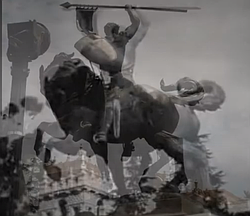
Los Angeles, of course, has an entire documentary devoted to its depiction onscreen: the very fine Los Angeles Plays Itself. San Diego, not so much.
Video:
Trailer: LOS ANGELES PLAYS ITSELF
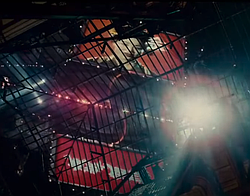
So I absolutely understood — and shared in — the excitement felt by Annie Fitzgerald, VP of Operations and General Manager at The Westgate Hotel upon seeing her workplace in one of the promotional videos for Paul Thomas Anderson's One Battle After Another, which opens today and stars Leonardo DiCaprio, Benicio Del Toro, and Sean Penn alongside relative newcomer Chase Infiniti. As Fitzgerald puts it: "Even just seeing the preview was surreal. We walk past these spaces every day, but on the big screen, they feel larger than life."
Video:
One Battle After Another: "Baby"
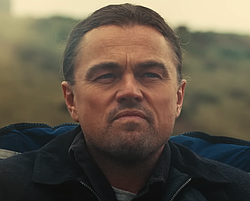
Fitzgerald says that "Warner Bros. worked with our sales team and did a few site visits before making the decision. What stood out was the Westgate’s European-inspired charm and elegance. The hotel has a cinematic quality that made it a great backdrop for the film." I agree. I have long loved the Westgate, and consider it a classically San Diegan spot, in part for its refusal to nailed down by any aesthetic convention other than what it sets for itself. I mean, look at this place:
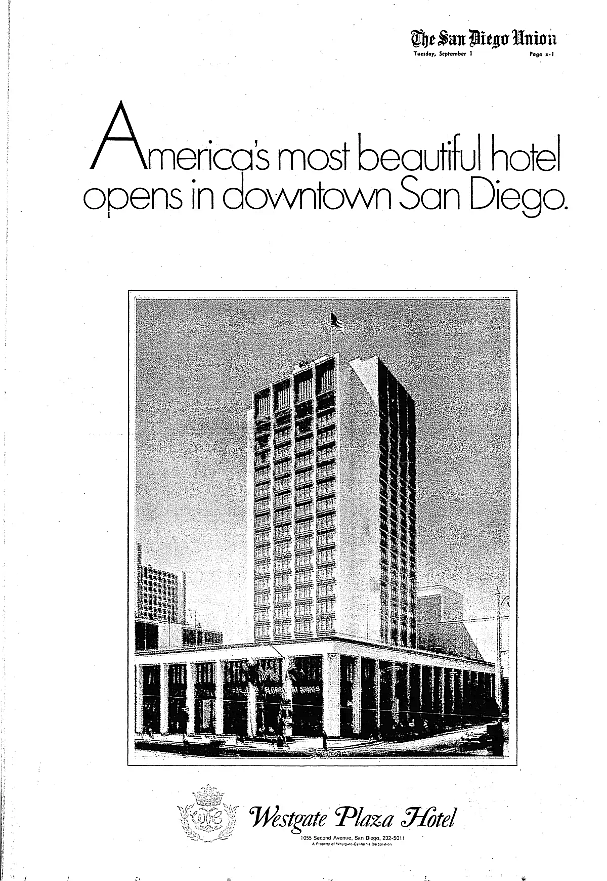
Would you ever in a million years expect a hotel that looks like that on the outside — all mid-century modern clean lines and sharp corners — to bill itself as "inspired by the palace of Versailles" and look like this on the inside?
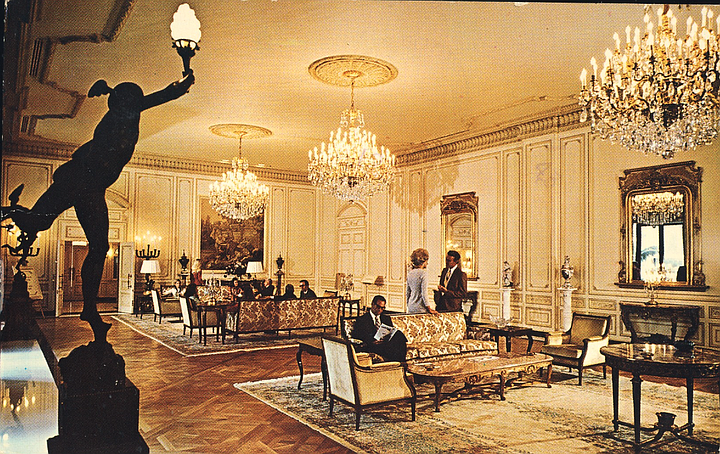
Postcard from 1974
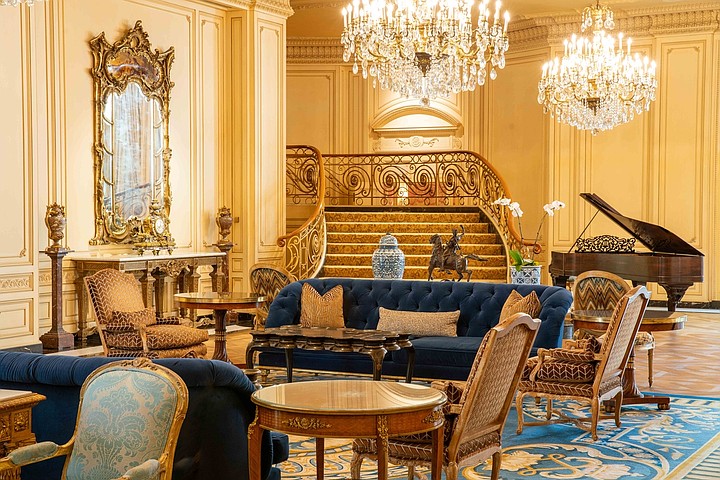
That molding! That statuary! Those chandeliers! And as it happened, those chandeliers provided something of a challenge for the hotel as it strove to provide a suitable setting for the cast and crew to make their magic. "LED lights can flicker on camera," says Fitzgerald, "so the crew needed special bulbs. Our engineering team swapped out every bulb in the filming areas, including more than 300 chandeliers. It took weeks of work with ladders and lowering fixtures. Once filming wrapped, everything had to be switched back. It gave us a new appreciation for all the technical details that go into making a film. It felt like the hotel was living two lives at once. Day-to-day operations continued, but on top of that, there were trucks unloading, cameras set up, wardrobe racks in the hallways, and crews everywhere. The energy was amazing."
Fitzgerald & Co. knew that Penn — aka the star on the staircase — was the film's villain. (One of them, anyway.) Small surprise: bad guys tend to have a taste for the finer things. Have you ever seen anyone other than a baddie enjoy opera onscreen?
Video:
Untouchables: Malone's Death
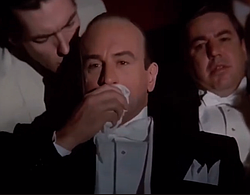
So of course the forces of evil are going to gather and gab amid the baroque splendor at the foot of the grand staircase.
And of course they're going to conduct their nefarious business beneath the countless layers of crown molding that adorn the Governor's Suite.
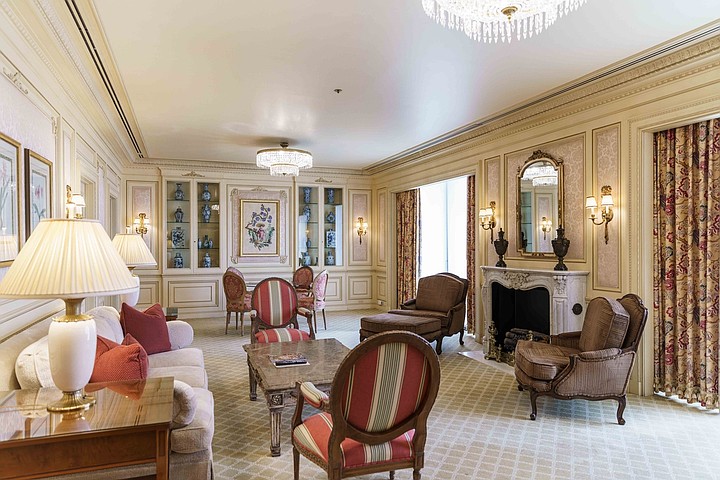
But Fitzgerald was not fazed by the perfidious plots being hatched in her hotel. "The storyline was kept very quiet. Our role was to support the production and let the beauty of the hotel speak for itself."
Here's something you might be interested in.
Certified: The Westgate goes Hollywood in One Battle After Another
Downtown hotel makes its onscreen debut in Paul Thomas Anderson's latest

Certified: The Westgate goes Hollywood in One Battle After Another
Downtown hotel makes its onscreen debut in Paul Thomas Anderson's latest
Colonel Lockjaw (Sean Penn) descends the stairs at the Westgate.
“Nowadays when a person lives somewhere, in a neighborhood, the place is not certified for him. More than likely he will live there sadly and the emptiness which is inside him will expand until it evacuates the entire neighborhood. But if he sees a movie which shows him his very neighborhood, it becomes possible for him to live, for a time at least, as a person who is Somewhere and not Anywhere.” — Walker Percy, The Moviegoer
I do believe Dr. Percy was onto something here; how else to explain the strange thrill one feels upon realizing that Orson Welles used Balboa Park as a stand-in for Xanadu in the newsreel that opens Citizen Kane? (I'm hardly the first person to note this, but I may be the first person to try to recreate his shots, lo these 14 years ago.)
Video:
Kane
Los Angeles, of course, has an entire documentary devoted to its depiction onscreen: the very fine Los Angeles Plays Itself. San Diego, not so much.
Video:
Trailer: LOS ANGELES PLAYS ITSELF
So I absolutely understood — and shared in — the excitement felt by Annie Fitzgerald, VP of Operations and General Manager at The Westgate Hotel upon seeing her workplace in one of the promotional videos for Paul Thomas Anderson's One Battle After Another, which opens today and stars Leonardo DiCaprio, Benicio Del Toro, and Sean Penn alongside relative newcomer Chase Infiniti. As Fitzgerald puts it: "Even just seeing the preview was surreal. We walk past these spaces every day, but on the big screen, they feel larger than life."
Video:
One Battle After Another: "Baby"
Fitzgerald says that "Warner Bros. worked with our sales team and did a few site visits before making the decision. What stood out was the Westgate’s European-inspired charm and elegance. The hotel has a cinematic quality that made it a great backdrop for the film." I agree. I have long loved the Westgate, and consider it a classically San Diegan spot, in part for its refusal to nailed down by any aesthetic convention other than what it sets for itself. I mean, look at this place:
Would you ever in a million years expect a hotel that looks like that on the outside — all mid-century modern clean lines and sharp corners — to bill itself as "inspired by the palace of Versailles" and look like this on the inside?
Postcard from 1974
That molding! That statuary! Those chandeliers! And as it happened, those chandeliers provided something of a challenge for the hotel as it strove to provide a suitable setting for the cast and crew to make their magic. "LED lights can flicker on camera," says Fitzgerald, "so the crew needed special bulbs. Our engineering team swapped out every bulb in the filming areas, including more than 300 chandeliers. It took weeks of work with ladders and lowering fixtures. Once filming wrapped, everything had to be switched back. It gave us a new appreciation for all the technical details that go into making a film. It felt like the hotel was living two lives at once. Day-to-day operations continued, but on top of that, there were trucks unloading, cameras set up, wardrobe racks in the hallways, and crews everywhere. The energy was amazing."
Fitzgerald & Co. knew that Penn — aka the star on the staircase — was the film's villain. (One of them, anyway.) Small surprise: bad guys tend to have a taste for the finer things. Have you ever seen anyone other than a baddie enjoy opera onscreen?
Video:
Untouchables: Malone's Death
So of course the forces of evil are going to gather and gab amid the baroque splendor at the foot of the grand staircase.
And of course they're going to conduct their nefarious business beneath the countless layers of crown molding that adorn the Governor's Suite.
But Fitzgerald was not fazed by the perfidious plots being hatched in her hotel. "The storyline was kept very quiet. Our role was to support the production and let the beauty of the hotel speak for itself."