

Here's something you might be interested in.
Ask a Hipster — Advice you didn't know you needed
Big Screen — Movie commentary
Blurt — Music's inside track
Booze News — San Diego spirits
Classical Music — Immortal beauty
Classifieds — Free and easy
Close to Home — What it’s like on the street where you live
Cover Stories — Front-page features
Drinks All Around — Bartenders' drink recipes
Excerpts — Literary and spiritual excerpts
Feast! — Food & drink reviews
Feature Stories — Local news & stories
Fishing Report — What’s getting hooked from ship and shore
From the Archives — Spotlight on the past
Golden Dreams — Talk of the town
The Gonzo Report — Making the musical scene, or at least reporting from it
Letters — Our inbox
Movies@Home — Local movie buffs share favorites
Movie Reviews — Our critics' picks and pans
Musician Interviews — Up close with local artists
Neighborhood News from Stringers — Hyperlocal news
News Ticker — News & politics
Obermeyer — San Diego politics illustrated
Outdoors — Weekly changes in flora and fauna
Overheard in San Diego — Eavesdropping illustrated
Poetry — The old and the new
Reader Travel — Travel section built by travelers
Reading — The hunt for intellectuals
Roam-O-Rama — SoCal's best hiking/biking trails
San Diego Beer — Inside San Diego suds
SD on the QT — Almost factual news
Sheep and Goats — Places of worship
Special Issues — The best of
Street Style — San Diego streets have style
Surf Diego — Real stories from those braving the waves
Theater — On stage in San Diego this week
Tin Fork — Silver spoon alternative
Under the Radar — Matt Potter's undercover work
Unforgettable — Long-ago San Diego
Unreal Estate — San Diego's priciest pads
Your Week — Daily event picks
Fish Report: Dorado and Yellowfin tuna finally showing
Full Moon fishing: boon, bust or myth?
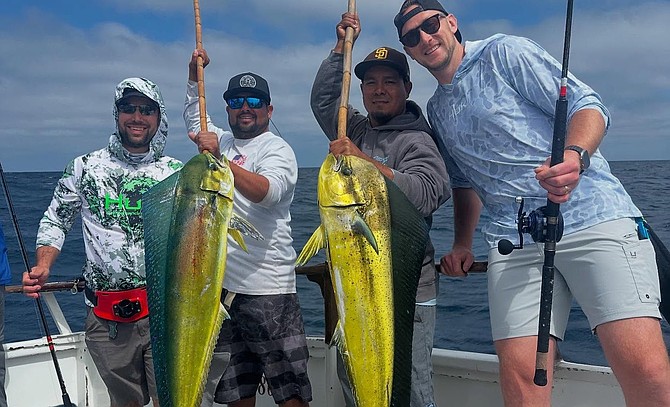
A nice pair of dorado caught aboard the Sea Adventure 80 during their 1.5-day offshore trip.
Dock Totals 8/31 – 9/6: 4285 anglers aboard 210 half-day to 3-day trips out of San Diego landings over the past week caught 28 barracuda, 1 black sea bass (released), 1047 bluefin tuna (to 160 pounds), 189 bonito, 10 cabezon, 813 calico bass, 3 croaker, 23 dorado, 16 halibut, 48 lingcod, 1 mako shark, 7 perch, 3227 rockfish, 6 rock sole, 207 sand bass, 915 sculpin, 221 sheephead, 1 triggerfish, 860 whitefish, 4 white seabass, 443 yellowfin tuna, and 585 yellowtail.
Saltwater: Schools of yellowfin tuna have finally started showing within 1-day range of Point Loma, possibly aided by the northern push of warm water from Hurricane Lorena, the eighth storm to reach hurricane strength during the 2025 season in the Pacific. As is usually the case when yellowfin show up, dorado were also caught, and reached double-digits in the counts for the first time for the short run fleet in 2025. That said, as the Moon phase shifted toward full, the bluefin numbers dropped to a third of the count during the previous week.
Yellowtail continued to bite well in our nearshore waters and down at the Coronado Islands, with half-day boats getting in on the action. The New Seaforth posted 8 yellows on their Wednesday morning run and 15 more during their afternoon outing. Longer trips, both along the Baja Peninsula and out west toward San Clemente Island have also been reporting good yellowtail action and size, with a 48-pounder reported caught among the 27 landed (averaging 35 pounds) aboard the El Capitan 2.5-day run that returned on Monday.
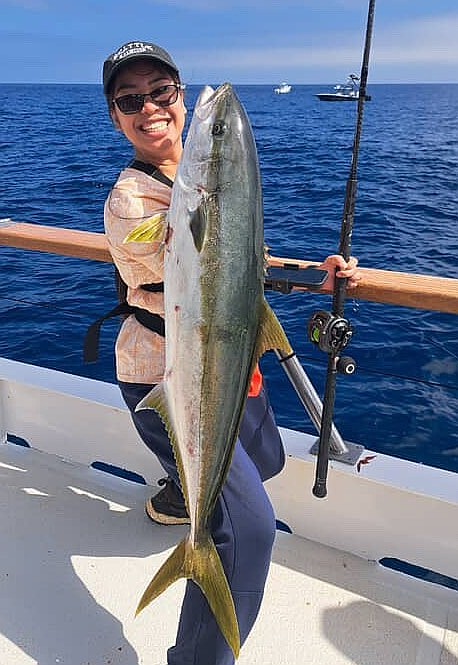
Solid yellowtail caught near the Coronado Islands during a full-day run aboard the Mission Belle.
Other than the jump in yellowfin tuna numbers, most pelagic species were fewer than the week previous, even though there were more trips and anglers on the water this week. So: why does the full Moon seem to slow fishing? Well, for one thing, when the Moon is full, fish become more active during the night, and can be full and lethargic during daylight hours when most of the fishing is going on. Also, tidal currents increase during the full Moon phase, which can stir up inshore waters and slow fish feeding activity. The actual full Moon phase is basically the day before and after the true full moon, but it can seem to affect the bite for a few days before and after. That said, sometimes we run into wide open bites during a full Moon — but those times usually seem to be right around sunrise or sunset, or at night.
Most fishing prediction pages, like tides4fishing.com, use the Moon phase in their calculations to determine prime fishing times. When the Moon is rising or setting, tides will be in a more slack flow into or after the low tide, and usually, that translates to better fishing, as fish will use less energy when foraging. However, this can be species-specific or related to availability of prey, and as fishing goes, there are no set rules covering all species or fisheries concerning the Moon. Still, anglers are happy to place blame somewhere for a slow day on the water, so why not the Moon?
For many months this year, much of the better bluefin fishing has been during the night. Then, about a month ago, bluefin began chewing well during daylight hours. Most of the larger fish have come at night, while the smaller fish bit better during the day. That is, until earlier this week, when the daytime bite slowed, which is why the overall number dropped. I have totaled the catch by the short run fleet for 11 years now, and I have seen this pattern regularly during the full Moon across many species, especially nearshore endemic fish that do not migrate. Calico bass, sand bass, and halibut seem to slow down during the day in full Moon phases, but do tend to bite well around dusk or dawn.
On the other hand, rockfish, lingcod, and whitefish seem to not mind the full Moon as much, as they tend to be caught in deeper water, where the Moon has little effect (outside of the current) —the light reaches only so deep. The ocean zones rated by light are the Sunlight Zone, Twilight Zone, Midnight Zone, Abyssal Zone, and Hadal Zone. The Sunlight Zone is about 650 feet from the surface, and as the Moon, even when full, is much less bright than the sun, its light does not really affect our deep-dwelling gamefish.
As the coming week progresses post-full Moon, I expect to see the numbers of yellowtail, yellowfin, and bluefin to jump, given conditions remain decent offshore, just as their numbers waned for a few days going into the full Moon on September 7. Then again, it is called fishing and not catching for a reason, and for all the predictive models out there, sometimes catching or not catching defies our best efforts in guesstimating what will be a good day. And we can do so only by gearing up and getting out there. So, whether the beach, bay, lake, or offshore, they’re out there so go out and get ‘em!
Here's something you might be interested in.
Fish Report: Dorado and Yellowfin tuna finally showing
Full Moon fishing: boon, bust or myth?

Fish Report: Dorado and Yellowfin tuna finally showing
Full Moon fishing: boon, bust or myth?
A nice pair of dorado caught aboard the Sea Adventure 80 during their 1.5-day offshore trip.
Dock Totals 8/31 – 9/6: 4285 anglers aboard 210 half-day to 3-day trips out of San Diego landings over the past week caught 28 barracuda, 1 black sea bass (released), 1047 bluefin tuna (to 160 pounds), 189 bonito, 10 cabezon, 813 calico bass, 3 croaker, 23 dorado, 16 halibut, 48 lingcod, 1 mako shark, 7 perch, 3227 rockfish, 6 rock sole, 207 sand bass, 915 sculpin, 221 sheephead, 1 triggerfish, 860 whitefish, 4 white seabass, 443 yellowfin tuna, and 585 yellowtail.
Saltwater: Schools of yellowfin tuna have finally started showing within 1-day range of Point Loma, possibly aided by the northern push of warm water from Hurricane Lorena, the eighth storm to reach hurricane strength during the 2025 season in the Pacific. As is usually the case when yellowfin show up, dorado were also caught, and reached double-digits in the counts for the first time for the short run fleet in 2025. That said, as the Moon phase shifted toward full, the bluefin numbers dropped to a third of the count during the previous week.
Yellowtail continued to bite well in our nearshore waters and down at the Coronado Islands, with half-day boats getting in on the action. The New Seaforth posted 8 yellows on their Wednesday morning run and 15 more during their afternoon outing. Longer trips, both along the Baja Peninsula and out west toward San Clemente Island have also been reporting good yellowtail action and size, with a 48-pounder reported caught among the 27 landed (averaging 35 pounds) aboard the El Capitan 2.5-day run that returned on Monday.
Solid yellowtail caught near the Coronado Islands during a full-day run aboard the Mission Belle.
Other than the jump in yellowfin tuna numbers, most pelagic species were fewer than the week previous, even though there were more trips and anglers on the water this week. So: why does the full Moon seem to slow fishing? Well, for one thing, when the Moon is full, fish become more active during the night, and can be full and lethargic during daylight hours when most of the fishing is going on. Also, tidal currents increase during the full Moon phase, which can stir up inshore waters and slow fish feeding activity. The actual full Moon phase is basically the day before and after the true full moon, but it can seem to affect the bite for a few days before and after. That said, sometimes we run into wide open bites during a full Moon — but those times usually seem to be right around sunrise or sunset, or at night.
Most fishing prediction pages, like tides4fishing.com, use the Moon phase in their calculations to determine prime fishing times. When the Moon is rising or setting, tides will be in a more slack flow into or after the low tide, and usually, that translates to better fishing, as fish will use less energy when foraging. However, this can be species-specific or related to availability of prey, and as fishing goes, there are no set rules covering all species or fisheries concerning the Moon. Still, anglers are happy to place blame somewhere for a slow day on the water, so why not the Moon?
For many months this year, much of the better bluefin fishing has been during the night. Then, about a month ago, bluefin began chewing well during daylight hours. Most of the larger fish have come at night, while the smaller fish bit better during the day. That is, until earlier this week, when the daytime bite slowed, which is why the overall number dropped. I have totaled the catch by the short run fleet for 11 years now, and I have seen this pattern regularly during the full Moon across many species, especially nearshore endemic fish that do not migrate. Calico bass, sand bass, and halibut seem to slow down during the day in full Moon phases, but do tend to bite well around dusk or dawn.
On the other hand, rockfish, lingcod, and whitefish seem to not mind the full Moon as much, as they tend to be caught in deeper water, where the Moon has little effect (outside of the current) —the light reaches only so deep. The ocean zones rated by light are the Sunlight Zone, Twilight Zone, Midnight Zone, Abyssal Zone, and Hadal Zone. The Sunlight Zone is about 650 feet from the surface, and as the Moon, even when full, is much less bright than the sun, its light does not really affect our deep-dwelling gamefish.
As the coming week progresses post-full Moon, I expect to see the numbers of yellowtail, yellowfin, and bluefin to jump, given conditions remain decent offshore, just as their numbers waned for a few days going into the full Moon on September 7. Then again, it is called fishing and not catching for a reason, and for all the predictive models out there, sometimes catching or not catching defies our best efforts in guesstimating what will be a good day. And we can do so only by gearing up and getting out there. So, whether the beach, bay, lake, or offshore, they’re out there so go out and get ‘em!
Comments