

Here's something you might be interested in.
Ask a Hipster — Advice you didn't know you needed
Big Screen — Movie commentary
Blurt — Music's inside track
Booze News — San Diego spirits
Classical Music — Immortal beauty
Classifieds — Free and easy
Close to Home — What it’s like on the street where you live
Cover Stories — Front-page features
Drinks All Around — Bartenders' drink recipes
Excerpts — Literary and spiritual excerpts
Feast! — Food & drink reviews
Feature Stories — Local news & stories
Fishing Report — What’s getting hooked from ship and shore
From the Archives — Spotlight on the past
Golden Dreams — Talk of the town
The Gonzo Report — Making the musical scene, or at least reporting from it
Letters — Our inbox
Movies@Home — Local movie buffs share favorites
Movie Reviews — Our critics' picks and pans
Musician Interviews — Up close with local artists
Neighborhood News from Stringers — Hyperlocal news
News Ticker — News & politics
Obermeyer — San Diego politics illustrated
Outdoors — Weekly changes in flora and fauna
Overheard in San Diego — Eavesdropping illustrated
Poetry — The old and the new
Reader Travel — Travel section built by travelers
Reading — The hunt for intellectuals
Roam-O-Rama — SoCal's best hiking/biking trails
San Diego Beer — Inside San Diego suds
SD on the QT — Almost factual news
Sheep and Goats — Places of worship
Special Issues — The best of
Street Style — San Diego streets have style
Surf Diego — Real stories from those braving the waves
Theater — On stage in San Diego this week
Tin Fork — Silver spoon alternative
Under the Radar — Matt Potter's undercover work
Unforgettable — Long-ago San Diego
Unreal Estate — San Diego's priciest pads
Your Week — Daily event picks
Fish Report: A dozen giants in the counts
Another excellent week for the fleet
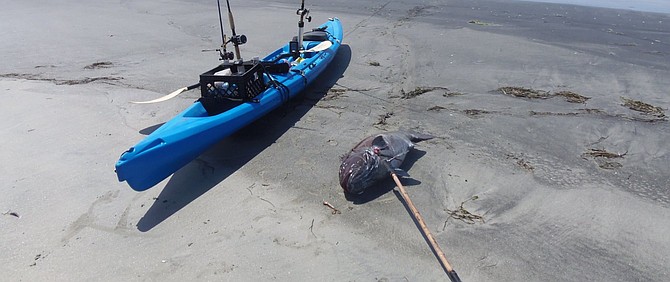
Legal take of black sea bass is one per angler per day in Mexico. This 75-pounder was caught by kayak in Bahia San Quintin, where many are taken every year to several hundred pounds.
Dock Totals 8/24 – 8/30: 3962 anglers aboard 180 half-day to 3-day trips out of San Diego landings over the past week caught 74 barracuda, 12 black sea bass (released), 3010 bluefin tuna (to 240 pounds), 30 bocaccio, 519 bonito, 8 cabezon, 1533 calico bass, 1 dorado, 6 halibut, 21 lingcod, 2491 rockfish, 112 sand bass, 304 sculpin, 150 sheephead, 7 triggerfish, 2164 whitefish, 13 white seabass, 2 yellowfin tuna, and 783 yellowtail.
Saltwater: The week leading into Labor Day weekend didn’t hold too many surprises, as bluefin tuna bit well for most of the boats chasing them, the yellowtail bite off the Coronado Islands was still up and down, and we saw the seemingly weekly shift of calico and sand bass numbers. It always seems like when one bass is on, the other is slow. I reckon it comes down to targeted areas and favorable conditions. A byproduct of that would be the counts of species that dwell in either sand flat or kelp forest biospheres. When sand bass counts are higher, we tend to see a few more halibut and sanddabs caught, and when calico counts are higher, we tend to see more sheephead and white seabass.
I think this is the first week in over 11 years of doing the fishing report that there were so many black (giant) sea bass in the counts. Yeah, that’s just a dozen caught and released, but we usually only see one or two per month in the counts. Also amazing, the Sea Star out of Oceanside reported all of them from two half-day runs this past week — one trip where two were caught on Wednesday, and 10 more on Saturday’s outing. As those trips usually concentrate on coastal fisheries near kelp beds it does make some sense, as black sea bass tend to haunt waters from 35 feet to 140 feet, where the structure and biodiversity of species and prey align with their needs as an apex predator.
Black sea bass are occasional bycatches here along the Southern California coast, as they inhabit our reefs and kelp forests from Humboldt Bay to the tip of Baja California and the Mexican mainland for the length of the Sea of Cortez. Once classed as groupers, black sea bass are now classified as "wreckfish," or species known to inhabit caves and shipwrecks. Once fished to near-extinction here in US waters and thus protected, their numbers have been rebounding from the estimate of fewer than 500 individual fish.
But those early studies only considered about a quarter of the black sea bass range, leaving out Mexico where they have been commercially harvested to the tune of a 55-ton average per year over the past 60 years, per a recent study that combined data from their entire range. That is not to say the older studies and protective status was unwarranted in California waters — they were hammered north of the border by both commercial take and (especially) the early days of large-boat recreational sportfishing. Large black sea bass were often hung on the side of the galleys — a trophy to be seen by all as the boats came back to the dock after the day’s fishing. By the late 1970s, they were a rare catch and were soon declared off-limits by the CDFW.
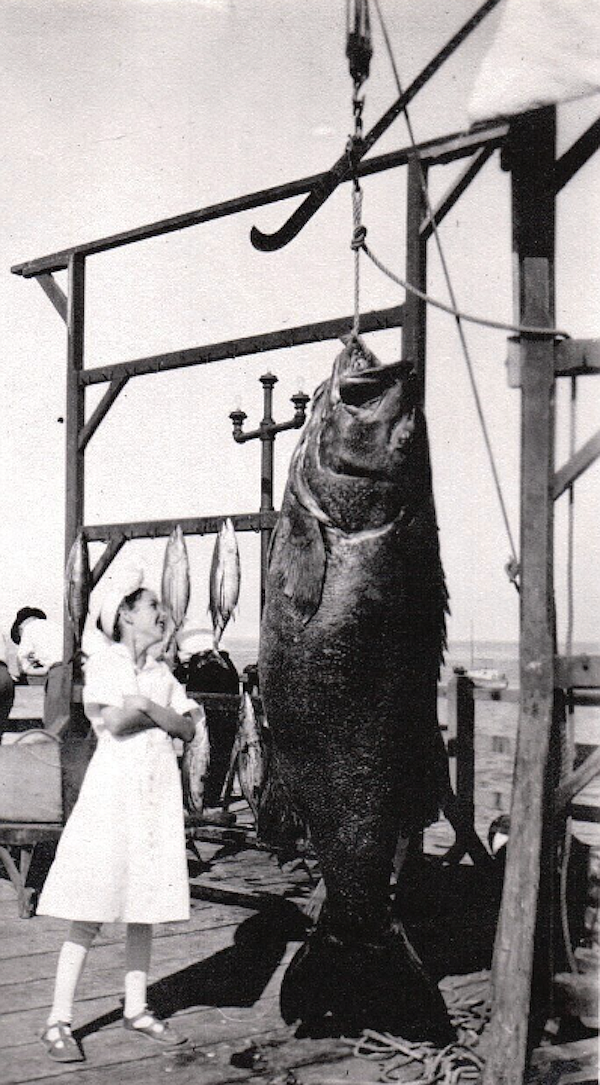
Woman posing with a 320-pound black sea bass caught near Catalina Island in 1913
A couple of weeks ago, an angler kept a black seabass caught in Mexican waters while aboard a full day trip out of San Diego. Though this was legal, the online fishing community blew up a bit over it, with many folks not realizing that not only are black sea bass prolific south of the border, but also, the species has made a huge comeback in California waters in the more than 40 years since the ban on their take in 1981. Again, I am not suggesting lifting the ban on recreational take in U.S. waters, but they are a legal take in Mexican waters at one per angler per day, which has so far proven sustainable.
Even so, most of these fish caught on multi-day trips are released. Commercial operations in U.S. waters are allowed to take an occasional sea bass as bycatch, but that is more due to their low survival rate, especially when caught by commercial gear. Between occasional commercial catches and imported fish from Mexico, black seabass can often be found in local fish markets. As I spend most of my time in Mexico, I have caught a few and will keep one if I feel it cannot be revived…or if I am just wanting to share some really good filets with friends and neighbors.
Though they can grow to 700 pounds and over 8 feet long, black sea bass filets are best, in my opinion, when taken from 30- to 80-pounders. Eighty pounds is also about where I draw the line in wanting to deal with one, as I normally fish from my kayak. The last one I kept was "just" 75 pounds, and it was a struggle to drag the fish back the half mile to the launch. They tend to bloat and roll once near the surface after a prolonged battle, and it can be tough to revive them, which was the case that time. So, I gaffed it around the collar and then found I couldn’t wrestle it into the forward hatch. I was too tired to leash it at that point, so I just held the gaff and paddled one-armed back to the beach.
I reckon the bottom line for me is to fish within my means, respect the rules, and enjoy the fishery and the fruits of doing so…responsibly. To be responsible means that I should stay abreast of the most up-to-date information and rules as they apply. Often, our thinking can be a product of misinformation, so I try to withhold judgement, at least until I fully understand a subject in its proper context. Keeping a black sea bass while fishing in Mexico is not a crime, nor has it been proven harmful to the species as a whole. That California is more on the edge of their range, and given the almost 3000 miles of coastline and islands south of the border, where their population is more centered, the current rules on either side of the border make sense. Whether the beach, bay, lake, or offshore, they’re out there so go out and get ‘em!
Here's something you might be interested in.
Fish Report: A dozen giants in the counts
Another excellent week for the fleet

Fish Report: A dozen giants in the counts
Another excellent week for the fleet
Legal take of black sea bass is one per angler per day in Mexico. This 75-pounder was caught by kayak in Bahia San Quintin, where many are taken every year to several hundred pounds.
Dock Totals 8/24 – 8/30: 3962 anglers aboard 180 half-day to 3-day trips out of San Diego landings over the past week caught 74 barracuda, 12 black sea bass (released), 3010 bluefin tuna (to 240 pounds), 30 bocaccio, 519 bonito, 8 cabezon, 1533 calico bass, 1 dorado, 6 halibut, 21 lingcod, 2491 rockfish, 112 sand bass, 304 sculpin, 150 sheephead, 7 triggerfish, 2164 whitefish, 13 white seabass, 2 yellowfin tuna, and 783 yellowtail.
Saltwater: The week leading into Labor Day weekend didn’t hold too many surprises, as bluefin tuna bit well for most of the boats chasing them, the yellowtail bite off the Coronado Islands was still up and down, and we saw the seemingly weekly shift of calico and sand bass numbers. It always seems like when one bass is on, the other is slow. I reckon it comes down to targeted areas and favorable conditions. A byproduct of that would be the counts of species that dwell in either sand flat or kelp forest biospheres. When sand bass counts are higher, we tend to see a few more halibut and sanddabs caught, and when calico counts are higher, we tend to see more sheephead and white seabass.
I think this is the first week in over 11 years of doing the fishing report that there were so many black (giant) sea bass in the counts. Yeah, that’s just a dozen caught and released, but we usually only see one or two per month in the counts. Also amazing, the Sea Star out of Oceanside reported all of them from two half-day runs this past week — one trip where two were caught on Wednesday, and 10 more on Saturday’s outing. As those trips usually concentrate on coastal fisheries near kelp beds it does make some sense, as black sea bass tend to haunt waters from 35 feet to 140 feet, where the structure and biodiversity of species and prey align with their needs as an apex predator.
Black sea bass are occasional bycatches here along the Southern California coast, as they inhabit our reefs and kelp forests from Humboldt Bay to the tip of Baja California and the Mexican mainland for the length of the Sea of Cortez. Once classed as groupers, black sea bass are now classified as "wreckfish," or species known to inhabit caves and shipwrecks. Once fished to near-extinction here in US waters and thus protected, their numbers have been rebounding from the estimate of fewer than 500 individual fish.
But those early studies only considered about a quarter of the black sea bass range, leaving out Mexico where they have been commercially harvested to the tune of a 55-ton average per year over the past 60 years, per a recent study that combined data from their entire range. That is not to say the older studies and protective status was unwarranted in California waters — they were hammered north of the border by both commercial take and (especially) the early days of large-boat recreational sportfishing. Large black sea bass were often hung on the side of the galleys — a trophy to be seen by all as the boats came back to the dock after the day’s fishing. By the late 1970s, they were a rare catch and were soon declared off-limits by the CDFW.
Woman posing with a 320-pound black sea bass caught near Catalina Island in 1913
A couple of weeks ago, an angler kept a black seabass caught in Mexican waters while aboard a full day trip out of San Diego. Though this was legal, the online fishing community blew up a bit over it, with many folks not realizing that not only are black sea bass prolific south of the border, but also, the species has made a huge comeback in California waters in the more than 40 years since the ban on their take in 1981. Again, I am not suggesting lifting the ban on recreational take in U.S. waters, but they are a legal take in Mexican waters at one per angler per day, which has so far proven sustainable.
Even so, most of these fish caught on multi-day trips are released. Commercial operations in U.S. waters are allowed to take an occasional sea bass as bycatch, but that is more due to their low survival rate, especially when caught by commercial gear. Between occasional commercial catches and imported fish from Mexico, black seabass can often be found in local fish markets. As I spend most of my time in Mexico, I have caught a few and will keep one if I feel it cannot be revived…or if I am just wanting to share some really good filets with friends and neighbors.
Though they can grow to 700 pounds and over 8 feet long, black sea bass filets are best, in my opinion, when taken from 30- to 80-pounders. Eighty pounds is also about where I draw the line in wanting to deal with one, as I normally fish from my kayak. The last one I kept was "just" 75 pounds, and it was a struggle to drag the fish back the half mile to the launch. They tend to bloat and roll once near the surface after a prolonged battle, and it can be tough to revive them, which was the case that time. So, I gaffed it around the collar and then found I couldn’t wrestle it into the forward hatch. I was too tired to leash it at that point, so I just held the gaff and paddled one-armed back to the beach.
I reckon the bottom line for me is to fish within my means, respect the rules, and enjoy the fishery and the fruits of doing so…responsibly. To be responsible means that I should stay abreast of the most up-to-date information and rules as they apply. Often, our thinking can be a product of misinformation, so I try to withhold judgement, at least until I fully understand a subject in its proper context. Keeping a black sea bass while fishing in Mexico is not a crime, nor has it been proven harmful to the species as a whole. That California is more on the edge of their range, and given the almost 3000 miles of coastline and islands south of the border, where their population is more centered, the current rules on either side of the border make sense. Whether the beach, bay, lake, or offshore, they’re out there so go out and get ‘em!