

Here's something you might be interested in.
Ask a Hipster — Advice you didn't know you needed
Big Screen — Movie commentary
Blurt — Music's inside track
Booze News — San Diego spirits
Classical Music — Immortal beauty
Classifieds — Free and easy
Close to Home — What it’s like on the street where you live
Cover Stories — Front-page features
Drinks All Around — Bartenders' drink recipes
Excerpts — Literary and spiritual excerpts
Feast! — Food & drink reviews
Feature Stories — Local news & stories
Fishing Report — What’s getting hooked from ship and shore
From the Archives — Spotlight on the past
Golden Dreams — Talk of the town
The Gonzo Report — Making the musical scene, or at least reporting from it
Letters — Our inbox
Movies@Home — Local movie buffs share favorites
Movie Reviews — Our critics' picks and pans
Musician Interviews — Up close with local artists
Neighborhood News from Stringers — Hyperlocal news
News Ticker — News & politics
Obermeyer — San Diego politics illustrated
Outdoors — Weekly changes in flora and fauna
Overheard in San Diego — Eavesdropping illustrated
Poetry — The old and the new
Reader Travel — Travel section built by travelers
Reading — The hunt for intellectuals
Roam-O-Rama — SoCal's best hiking/biking trails
San Diego Beer — Inside San Diego suds
SD on the QT — Almost factual news
Sheep and Goats — Places of worship
Special Issues — The best of
Street Style — San Diego streets have style
Surf Diego — Real stories from those braving the waves
Theater — On stage in San Diego this week
Tin Fork — Silver spoon alternative
Under the Radar — Matt Potter's undercover work
Unforgettable — Long-ago San Diego
Unreal Estate — San Diego's priciest pads
Your Week — Daily event picks
Opening night for the San Diego Symphony Orchestra
A triumph that opens the door for further theatrical excursions
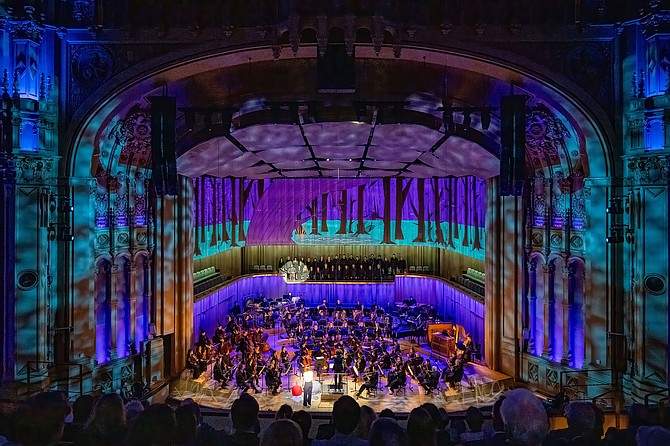
The San Diego Symphony’s 2025-2026 Jacobs Masterworks Series started with a triumph on Friday, October 3 at The Jacobs Music Center. San Diego Symphony Music Director Rafael Payare conducted an all-French concert that set a new standard for what the orchestra and organization are capable of.
We had a similar experience last year when a new standard in chorale quality was set with Gustav Mahler’s Symphony No. 2. This year, the standard was set in the realm of production values. The Jacobs Music Center was transformed, first into a house and into then a garden in the French countryside. I wouldn’t imagine that this type of production will become a staple at the symphony, but as a moonshot type of concert, it was impressive. The eagle has landed.
The concert started with Claude Debussy’s The Joyful Isle, an energetic and enjoyable piece of music. One might even be tempted to consider it joyful. I’d not heard it before, but found it to be indicative of many of the things I love about Debussy’s work.
Video:
Claude Debussy - L'Isle Joyeuse
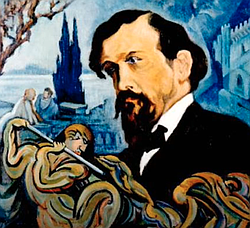
Debussy’s The Toybox followed. This was a study in tedium. A pair of children read a synopsis of the story before the piece started, and projections helped to guide us along as the traditional love story played out amongst the toys in the box. Maybe the piece would have worked as a ballet, but as straight concert music, the entire thing was mezzo-tedious.
The second half of the concert was Maurice Ravel’s L'enfant et les sortilèges. As maestro Payare came out after intermission, mezzo-soprano Isabel Leonard bounded onto the stage with a boyish energy indicative of the role she was portraying. I was skeptical. I muttered to my concert companion, “Well, we’re off to a good start, but can she sing?”
Uh, ya. She can sing.
Leonard has a formidable vocal technique, technique that shapes a naturally beautiful voice into a powerhouse. Yes, Isabel Leonard is talented, but she has clearly taken the time and care to develop that talent into a sound that is consistent from top to bottom. She can come off the voice when the story requires it, and she can rattle the rafters if that is needed. She will be performing the title role in George Bizet’s Carmen at The Met in November. If you have the means, I would suggest you do a bit of opera tourism and enjoy some fall colors in Central Park.
Video:
ISABEL LEONARD - "Una voce poco fa"
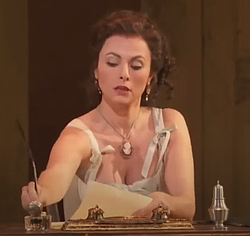
Also impressive, in the roles of The Mother, The Tea Cup, and Sheppard, was Lindsay Ammann. Her first phrase as The Mother kind of blew me away. Again, her technique was legitimate.
I should try to explain what was so engaging about the techniques of these two singers. There is a temptation to create what is referred to as a manufactured sound in opera singing. That means the singer is trying to sound like a voice that they don’t actually have. By way of contrast, a good technique stays true to the natural sound of the voice and maximizes it. This allows the singer to sound consistent throughout the range of their voice and to sing as loud or as softly as the role requires. It also creates a sound that pushes through the orchestra and carries to the back row of any theater. In a nutshell, that’s what makes a good opera singer.
Isabel Leonard and Lindsay Ammann are great opera singers.
The production was phenomenal and opens the door for further theatrical excursions by The San Diego Symphony.
Here's something you might be interested in.
Opening night for the San Diego Symphony Orchestra
A triumph that opens the door for further theatrical excursions

Opening night for the San Diego Symphony Orchestra
A triumph that opens the door for further theatrical excursions
The San Diego Symphony’s 2025-2026 Jacobs Masterworks Series started with a triumph on Friday, October 3 at The Jacobs Music Center. San Diego Symphony Music Director Rafael Payare conducted an all-French concert that set a new standard for what the orchestra and organization are capable of.
We had a similar experience last year when a new standard in chorale quality was set with Gustav Mahler’s Symphony No. 2. This year, the standard was set in the realm of production values. The Jacobs Music Center was transformed, first into a house and into then a garden in the French countryside. I wouldn’t imagine that this type of production will become a staple at the symphony, but as a moonshot type of concert, it was impressive. The eagle has landed.
The concert started with Claude Debussy’s The Joyful Isle, an energetic and enjoyable piece of music. One might even be tempted to consider it joyful. I’d not heard it before, but found it to be indicative of many of the things I love about Debussy’s work.
Video:
Claude Debussy - L'Isle Joyeuse
Debussy’s The Toybox followed. This was a study in tedium. A pair of children read a synopsis of the story before the piece started, and projections helped to guide us along as the traditional love story played out amongst the toys in the box. Maybe the piece would have worked as a ballet, but as straight concert music, the entire thing was mezzo-tedious.
The second half of the concert was Maurice Ravel’s L'enfant et les sortilèges. As maestro Payare came out after intermission, mezzo-soprano Isabel Leonard bounded onto the stage with a boyish energy indicative of the role she was portraying. I was skeptical. I muttered to my concert companion, “Well, we’re off to a good start, but can she sing?”
Uh, ya. She can sing.
Leonard has a formidable vocal technique, technique that shapes a naturally beautiful voice into a powerhouse. Yes, Isabel Leonard is talented, but she has clearly taken the time and care to develop that talent into a sound that is consistent from top to bottom. She can come off the voice when the story requires it, and she can rattle the rafters if that is needed. She will be performing the title role in George Bizet’s Carmen at The Met in November. If you have the means, I would suggest you do a bit of opera tourism and enjoy some fall colors in Central Park.
Video:
ISABEL LEONARD - "Una voce poco fa"
Also impressive, in the roles of The Mother, The Tea Cup, and Sheppard, was Lindsay Ammann. Her first phrase as The Mother kind of blew me away. Again, her technique was legitimate.
I should try to explain what was so engaging about the techniques of these two singers. There is a temptation to create what is referred to as a manufactured sound in opera singing. That means the singer is trying to sound like a voice that they don’t actually have. By way of contrast, a good technique stays true to the natural sound of the voice and maximizes it. This allows the singer to sound consistent throughout the range of their voice and to sing as loud or as softly as the role requires. It also creates a sound that pushes through the orchestra and carries to the back row of any theater. In a nutshell, that’s what makes a good opera singer.
Isabel Leonard and Lindsay Ammann are great opera singers.
The production was phenomenal and opens the door for further theatrical excursions by The San Diego Symphony.
Comments