

Here's something you might be interested in.
Ask a Hipster — Advice you didn't know you needed
Big Screen — Movie commentary
Blurt — Music's inside track
Booze News — San Diego spirits
Classical Music — Immortal beauty
Classifieds — Free and easy
Close to Home — What it’s like on the street where you live
Cover Stories — Front-page features
Drinks All Around — Bartenders' drink recipes
Excerpts — Literary and spiritual excerpts
Feast! — Food & drink reviews
Feature Stories — Local news & stories
Fishing Report — What’s getting hooked from ship and shore
From the Archives — Spotlight on the past
Golden Dreams — Talk of the town
The Gonzo Report — Making the musical scene, or at least reporting from it
Letters — Our inbox
Movies@Home — Local movie buffs share favorites
Movie Reviews — Our critics' picks and pans
Musician Interviews — Up close with local artists
Neighborhood News from Stringers — Hyperlocal news
News Ticker — News & politics
Obermeyer — San Diego politics illustrated
Outdoors — Weekly changes in flora and fauna
Overheard in San Diego — Eavesdropping illustrated
Poetry — The old and the new
Reader Travel — Travel section built by travelers
Reading — The hunt for intellectuals
Roam-O-Rama — SoCal's best hiking/biking trails
San Diego Beer — Inside San Diego suds
SD on the QT — Almost factual news
Sheep and Goats — Places of worship
Special Issues — The best of
Street Style — San Diego streets have style
Surf Diego — Real stories from those braving the waves
Theater — On stage in San Diego this week
Tin Fork — Silver spoon alternative
Under the Radar — Matt Potter's undercover work
Unforgettable — Long-ago San Diego
Unreal Estate — San Diego's priciest pads
Your Week — Daily event picks
Save the San Diego Reader, Day Nine
Getting the story, getting the shot
Dear San Diego,
As we near the end of our campaign to save the Reader and find our way back into print, here's a look back at the making of one of my favorite cover stories from 2024. I think it's a fine example of the sort of thing a publication like the Reader can provide.
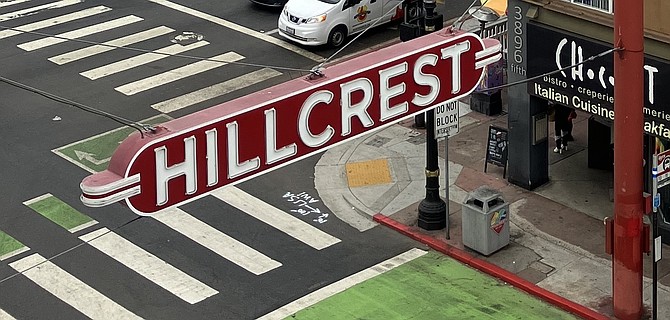
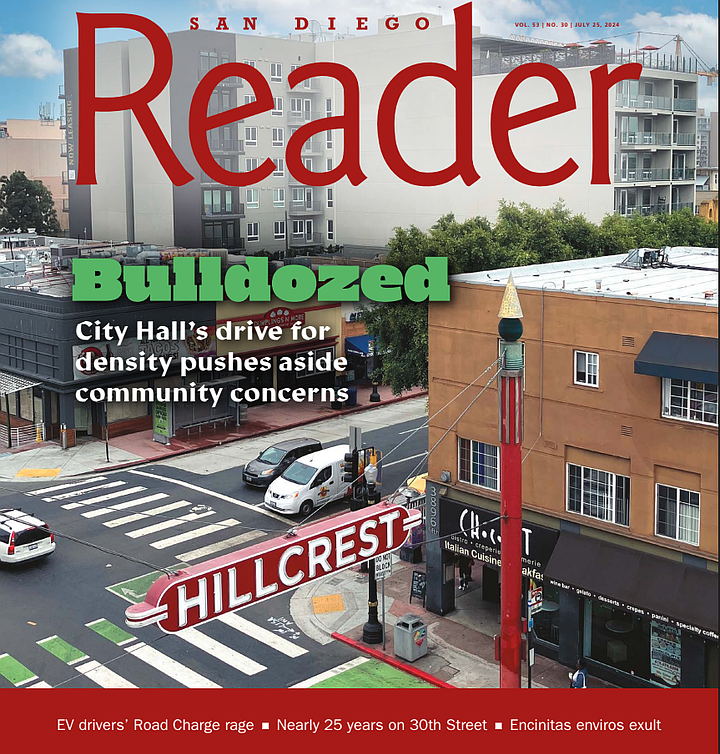
So there I was, locked in a stairwell in a Hillcrest office building, hoping someone would come along and open a door, someone who wasn't building security. But whatever kerfuffle might arise would be worth it: I had my shot. The famous bright red Hillcrest sign in all its cheery, olde-timey neighborhood charm, surrounded by two- and three-story mixed-use buildings — and looming in the background, a blank, gray, eight-story behemoth of an apartment building that had not been there the year before.
My first story for the Reader was a 20th-anniversary look back at the first Orchids & Onions architecture awards; one of the 1976 Onions had been given to Hillcrest's Pacific Bell building, a four-story brown concrete box that occupied a full city block. It was still there in 1995, in step with the city's need for technological infrastructure but hopelessly out of step with its immediate surroundings — and it's still there today. But now it has company.
Getting both the sign and the building in the shot meant getting on a roof, and that meant finding an unlocked access panel in a stairwell, a stairwell with doors that — surprise! — locked from the outside. It took me a while to make my getaway, but as I say — worth it. A proper illustration for Adam Behar's cover story on urban development.
For this fundraising campaign, I asked Behar to provide a little background on this piece of community/grassroots journalism. Here's what he sent me.
Todd Gloria and developers to Hillcrest and University City: Sucks to be you. The 163 will be more congested, but people will adjust.
Coming up with the story: Community plan updates don’t tend to attract a lot of attention. But sources told me the University City and Hillcrest updates had provoked a nasty battle between the city and planning groups – and within the planning groups, between the NIMBYs and YIMBYs.
What was I after? Politics has become so nationalized these days that we may forget that the decision making that really influences our lives, in a meaningful way, occurs at the community level. The 30-year community plan updates are essentially roadmaps for developers, and are supposed to be created by the city in partnership with the community groups. Some community members who took this process seriously felt the city’s outreach consisted of a performative listening campaign – rather than a partnership, it felt like the city was imposing its agenda onto the community groups. That’s what got me asking questions. The story was told against the backdrop of the housing and affordability crisis and a rapidly changing San Diego. The animosity between the NIMBYs and YIMBYs that I witnessed is a microcosm of a larger battle being played out across the city and state. On the heels of SB 79, this conflict is only going to heat up more.
What was involved in the writing: I interviewed 12 people for the story: members of both planning groups, realtors, community activists, elected officials, economists, YIMBYs, NIMBYs. The Reader gave me the luxury of 4500 words, enabling me to explore different aspects of the story and weave multiple perspectives into the narrative.
*****
Please consider donating today so that we can keep giving writers like Behar the luxury of 4500 words in the future.
Yours in hope,
Matthew Lickona
Owner/Editor
San Diego Reader
Here's something you might be interested in.
Save the San Diego Reader, Day Nine
Getting the story, getting the shot

Save the San Diego Reader, Day Nine
Getting the story, getting the shot
Dear San Diego,
As we near the end of our campaign to save the Reader and find our way back into print, here's a look back at the making of one of my favorite cover stories from 2024. I think it's a fine example of the sort of thing a publication like the Reader can provide.
So there I was, locked in a stairwell in a Hillcrest office building, hoping someone would come along and open a door, someone who wasn't building security. But whatever kerfuffle might arise would be worth it: I had my shot. The famous bright red Hillcrest sign in all its cheery, olde-timey neighborhood charm, surrounded by two- and three-story mixed-use buildings — and looming in the background, a blank, gray, eight-story behemoth of an apartment building that had not been there the year before.
My first story for the Reader was a 20th-anniversary look back at the first Orchids & Onions architecture awards; one of the 1976 Onions had been given to Hillcrest's Pacific Bell building, a four-story brown concrete box that occupied a full city block. It was still there in 1995, in step with the city's need for technological infrastructure but hopelessly out of step with its immediate surroundings — and it's still there today. But now it has company.
Getting both the sign and the building in the shot meant getting on a roof, and that meant finding an unlocked access panel in a stairwell, a stairwell with doors that — surprise! — locked from the outside. It took me a while to make my getaway, but as I say — worth it. A proper illustration for Adam Behar's cover story on urban development.
For this fundraising campaign, I asked Behar to provide a little background on this piece of community/grassroots journalism. Here's what he sent me.
Todd Gloria and developers to Hillcrest and University City: Sucks to be you. The 163 will be more congested, but people will adjust.
Coming up with the story: Community plan updates don’t tend to attract a lot of attention. But sources told me the University City and Hillcrest updates had provoked a nasty battle between the city and planning groups – and within the planning groups, between the NIMBYs and YIMBYs.
What was I after? Politics has become so nationalized these days that we may forget that the decision making that really influences our lives, in a meaningful way, occurs at the community level. The 30-year community plan updates are essentially roadmaps for developers, and are supposed to be created by the city in partnership with the community groups. Some community members who took this process seriously felt the city’s outreach consisted of a performative listening campaign – rather than a partnership, it felt like the city was imposing its agenda onto the community groups. That’s what got me asking questions. The story was told against the backdrop of the housing and affordability crisis and a rapidly changing San Diego. The animosity between the NIMBYs and YIMBYs that I witnessed is a microcosm of a larger battle being played out across the city and state. On the heels of SB 79, this conflict is only going to heat up more.
What was involved in the writing: I interviewed 12 people for the story: members of both planning groups, realtors, community activists, elected officials, economists, YIMBYs, NIMBYs. The Reader gave me the luxury of 4500 words, enabling me to explore different aspects of the story and weave multiple perspectives into the narrative.
*****
Please consider donating today so that we can keep giving writers like Behar the luxury of 4500 words in the future.
Yours in hope,
Matthew Lickona
Owner/Editor
San Diego Reader
Comments