

Here's something you might be interested in.
Ask a Hipster — Advice you didn't know you needed
Big Screen — Movie commentary
Blurt — Music's inside track
Booze News — San Diego spirits
Classical Music — Immortal beauty
Classifieds — Free and easy
Close to Home — What it’s like on the street where you live
Cover Stories — Front-page features
Drinks All Around — Bartenders' drink recipes
Excerpts — Literary and spiritual excerpts
Feast! — Food & drink reviews
Feature Stories — Local news & stories
Fishing Report — What’s getting hooked from ship and shore
From the Archives — Spotlight on the past
Golden Dreams — Talk of the town
The Gonzo Report — Making the musical scene, or at least reporting from it
Letters — Our inbox
Movies@Home — Local movie buffs share favorites
Movie Reviews — Our critics' picks and pans
Musician Interviews — Up close with local artists
Neighborhood News from Stringers — Hyperlocal news
News Ticker — News & politics
Obermeyer — San Diego politics illustrated
Outdoors — Weekly changes in flora and fauna
Overheard in San Diego — Eavesdropping illustrated
Poetry — The old and the new
Reader Travel — Travel section built by travelers
Reading — The hunt for intellectuals
Roam-O-Rama — SoCal's best hiking/biking trails
San Diego Beer — Inside San Diego suds
SD on the QT — Almost factual news
Sheep and Goats — Places of worship
Special Issues — The best of
Street Style — San Diego streets have style
Surf Diego — Real stories from those braving the waves
Theater — On stage in San Diego this week
Tin Fork — Silver spoon alternative
Under the Radar — Matt Potter's undercover work
Unforgettable — Long-ago San Diego
Unreal Estate — San Diego's priciest pads
Your Week — Daily event picks
Fish Report: Big ‘Hoo for Halloween
Yellowfin and yellowtail turn on again within 3-day range
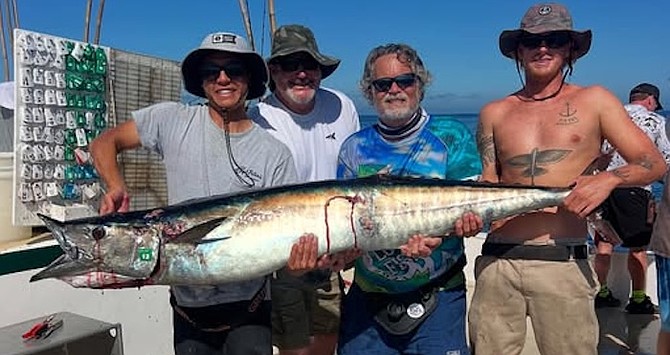
Solid 94.6-pound Wahoo, caught aboard the Royal Polaris while fishing off Baja California Sur
Dock Totals 10/26 – 11/1: 1875 anglers aboard 95 half-day to 3-day trips out of San Diego landings over the past week caught 2668 bluefin tuna (to 100 pounds), 49 bonito, 117 calico bass, 1 dorado, 2 halibut, 39 lingcod, 3 perch, 192 rock crab, 5174 rockfish, 27 sand bass, 467 sculpin, 68 sheephead, 2 skipjack tuna, 129 spiny lobster (243 released), 702 whitefish, 197 yellowfin tuna, and 1231 yellowtail.
Saltwater: Fall seems to be settling in, with cooler nighttime temperatures and calmer days leading to excellent fishing as pelagic species are still thick and within reach of the short run fleet. The number of anglers on half- to three-day trips dropped below 2000 for the first time since late spring. Even so, bluefin tuna were on fire, and though fewer were caught in total, the tuna-per-angler count went up.
Yellowfin tuna are still showing as well, with flurries of action on mixed species and grades foaming the surface in daylight hours and holding deeper but still biting at night. Yellowtail and yellowfin numbers both more than doubled over the week previous, even though there were far fewer anglers and trips targeting them. And though the average tuna caught have been smaller, they are more willing to bite day or night when found.

Yellowfin tuna caught aboard the Tribute. They slowed a bit the week previous, but turned on again this past week within 3-day range
Most of the daylight catch has been on fly-lined bait, while nighttime fish are holding deeper and biting jigs. One rule of thumb when jigging is that, if the fish aren’t on the surface, when the captain calls out the depth where the main concentration is holding, match the jig to the depth at grams per feet. That is, if the fish are holding at 200 feet, then drop a 200-gram jig 250 feet or so, then begin winding up through the school.
Yellowtail have been holding around islands, offshore reefs, and offshore kelp paddies. There have been good numbers of fish caught in the over 20-pound class, especially out around San Clemente Island and along the Baja coast. Long-range boats fishing further south reported excellent fishing along the beach from the Vizcaino Peninsula and to the south, where those fish usually remain active until March or so, as that stretch has a high season that begins in August and is usually two to three months behind our "normal" SoCal seasons.
Deep water rockfish so far since the beginning of the 300-feet or deeper rule began in September has been very good, with quality reds coming over the rail steadily. With tuna hot, many boats are getting limits early enough to also get limits or near-limits on the bottom dwellers, and while lingcod are usually found more often in less than 300 feet, there have been some impressive lings caught in deeper water to over 20 pounds. (But really, if you're targeting lingcod specifically, it is better to catch a ride heading out to fish in Mexican waters, where there is no depth limitation. There, you can target them in prime depths between 90 and 200 feet.) As always, it is always good to check what areas boats are planning to fish if you have specific species in mind to target.
Long-range boats fishing down toward the Ridge, Alijos Rocks and the Hurricane Bank have been reporting solid wahoo fishing, with many caught in the 50- to 90-pound range. The Royal Polaris reported one whopper wahoo caught that was over 94 pounds. Wahoo are amazing fish that can reach speeds of over 60 miles-per-hour, have razor-sharp teeth, and are not only one of the most exciting species to catch, but also excellent table fare, with firm white meat that cooks up well, whether on the grill, oven, or frying pan. That said, as they often bite off, they can be a tricky treat to catch.
And of course, you don't have to book a $400 per day trip to put fresh wahoo on the table. The Tuna Harbor Dockside Market usually has some for sale during their Saturday open-air offering on the Embarcadero. Along with wahoo, opah, albacore, and lobster are also usually available. There is plenty of lobster this year, as China is so far refusing to buy from U.S. lobster operations due to trade issues. Though they are selling at a little over $20 per pound whole at most places, they were $17 at the Market on Saturday, November 1. They’re biting, so, whether the beach, bay, lake, or offshore, they’re out there so go out and get ‘em!
Here's something you might be interested in.
Fish Report: Big ‘Hoo for Halloween
Yellowfin and yellowtail turn on again within 3-day range

Fish Report: Big ‘Hoo for Halloween
Yellowfin and yellowtail turn on again within 3-day range
Solid 94.6-pound Wahoo, caught aboard the Royal Polaris while fishing off Baja California Sur
Dock Totals 10/26 – 11/1: 1875 anglers aboard 95 half-day to 3-day trips out of San Diego landings over the past week caught 2668 bluefin tuna (to 100 pounds), 49 bonito, 117 calico bass, 1 dorado, 2 halibut, 39 lingcod, 3 perch, 192 rock crab, 5174 rockfish, 27 sand bass, 467 sculpin, 68 sheephead, 2 skipjack tuna, 129 spiny lobster (243 released), 702 whitefish, 197 yellowfin tuna, and 1231 yellowtail.
Saltwater: Fall seems to be settling in, with cooler nighttime temperatures and calmer days leading to excellent fishing as pelagic species are still thick and within reach of the short run fleet. The number of anglers on half- to three-day trips dropped below 2000 for the first time since late spring. Even so, bluefin tuna were on fire, and though fewer were caught in total, the tuna-per-angler count went up.
Yellowfin tuna are still showing as well, with flurries of action on mixed species and grades foaming the surface in daylight hours and holding deeper but still biting at night. Yellowtail and yellowfin numbers both more than doubled over the week previous, even though there were far fewer anglers and trips targeting them. And though the average tuna caught have been smaller, they are more willing to bite day or night when found.
Yellowfin tuna caught aboard the Tribute. They slowed a bit the week previous, but turned on again this past week within 3-day range
Most of the daylight catch has been on fly-lined bait, while nighttime fish are holding deeper and biting jigs. One rule of thumb when jigging is that, if the fish aren’t on the surface, when the captain calls out the depth where the main concentration is holding, match the jig to the depth at grams per feet. That is, if the fish are holding at 200 feet, then drop a 200-gram jig 250 feet or so, then begin winding up through the school.
Yellowtail have been holding around islands, offshore reefs, and offshore kelp paddies. There have been good numbers of fish caught in the over 20-pound class, especially out around San Clemente Island and along the Baja coast. Long-range boats fishing further south reported excellent fishing along the beach from the Vizcaino Peninsula and to the south, where those fish usually remain active until March or so, as that stretch has a high season that begins in August and is usually two to three months behind our "normal" SoCal seasons.
Deep water rockfish so far since the beginning of the 300-feet or deeper rule began in September has been very good, with quality reds coming over the rail steadily. With tuna hot, many boats are getting limits early enough to also get limits or near-limits on the bottom dwellers, and while lingcod are usually found more often in less than 300 feet, there have been some impressive lings caught in deeper water to over 20 pounds. (But really, if you're targeting lingcod specifically, it is better to catch a ride heading out to fish in Mexican waters, where there is no depth limitation. There, you can target them in prime depths between 90 and 200 feet.) As always, it is always good to check what areas boats are planning to fish if you have specific species in mind to target.
Long-range boats fishing down toward the Ridge, Alijos Rocks and the Hurricane Bank have been reporting solid wahoo fishing, with many caught in the 50- to 90-pound range. The Royal Polaris reported one whopper wahoo caught that was over 94 pounds. Wahoo are amazing fish that can reach speeds of over 60 miles-per-hour, have razor-sharp teeth, and are not only one of the most exciting species to catch, but also excellent table fare, with firm white meat that cooks up well, whether on the grill, oven, or frying pan. That said, as they often bite off, they can be a tricky treat to catch.
And of course, you don't have to book a $400 per day trip to put fresh wahoo on the table. The Tuna Harbor Dockside Market usually has some for sale during their Saturday open-air offering on the Embarcadero. Along with wahoo, opah, albacore, and lobster are also usually available. There is plenty of lobster this year, as China is so far refusing to buy from U.S. lobster operations due to trade issues. Though they are selling at a little over $20 per pound whole at most places, they were $17 at the Market on Saturday, November 1. They’re biting, so, whether the beach, bay, lake, or offshore, they’re out there so go out and get ‘em!
Comments